If you typed "grow startup" into a search bar, you're probably not looking for a definition. You're standing at a fork: do you buy your way to growth with paid ads and a shelf of new SaaS subscriptions, or do you build a repeatable system that compounds without burning your runway? This is a buyer's guide for that decision. We'll compare the main growth approaches founders actually choose between, lay out the lean stack a small team genuinely needs, and ground each recommendation in current 2026 data and a Y Combinator playbook on finding your first users. The short version, which the rest of this guide unpacks: in 2026 the bottleneck isn't producing output — AI has made landing pages, ad creative, and prototypes cheap — it's distribution and keeping the users you win. Growth is a system, not a pile of tactics. By the end, you'll be able to pick an approach and a stack that match your stage instead of copying someone else's.
What "growing a startup" actually means in 2026 (and why most founders get it wrong)
The phrase "grow startup" hides a buying decision. Founders searching it are usually choosing between approaches (paid versus founder-led, activation-first versus acquisition-first) and a set of tools — not hunting for a textbook definition. So this guide treats it as a comparison: which growth approach, and which lean stack, fits where you are right now.
Here's what changed. In 2026, execution has been commoditized. A founder can stand up a landing page, generate ad creative, and ship a working prototype in an afternoon. When everyone can produce output cheaply, output volume stops being a moat. What's scarce — and what now decides who grows — is distribution and positioning: getting in front of the right people and being clearly worth their attention. Independent 2026 growth analyses make the same point, arguing that AI has commoditized building while distribution has gotten harder, and that one repeatable acquisition loop beats five weak experiments (startupik.com, 2026).
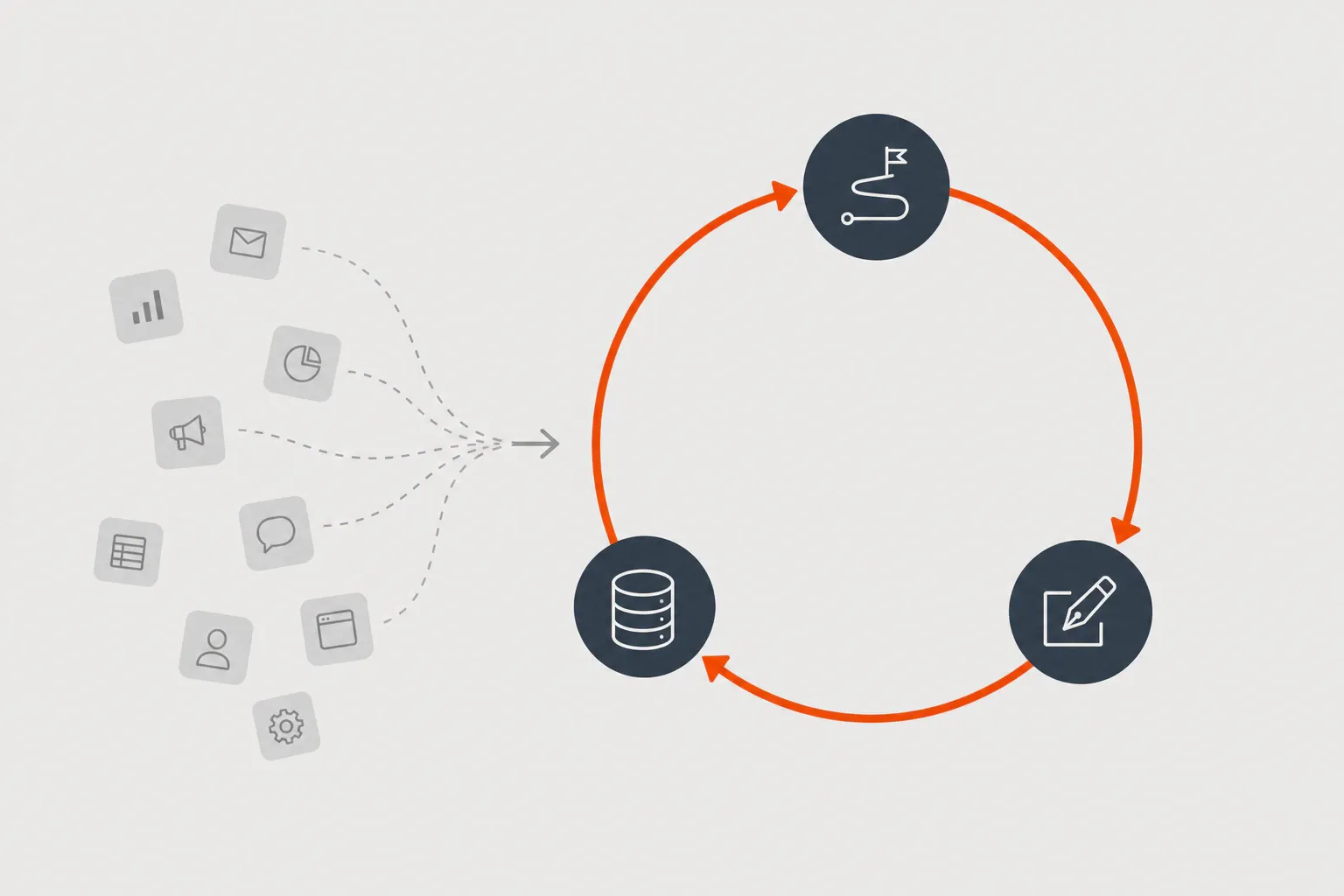
That reframes the whole problem. Growing a startup isn't a to-do list of viral tricks; it's a tight system with three moving parts that reinforce each other: one repeatable acquisition loop (a single way you reliably bring in the right users), fast time-to-value (new users hit the "aha" moment quickly), and early retention (they come back). Get those three turning together and growth compounds. Bolt tactics onto a leaky middle and you just pay to fill a bucket with a hole in it.
As an operator who has shipped and marketed early products, the most expensive mistake I see is sequencing: founders open the acquisition tap before the product can hold the water. The rest of this guide is built to help you avoid that — first the numbers that should shape your decisions, then a comparison of approaches, then the stack.
The numbers that should shape your growth decisions
Before choosing tactics, look at the constraints the market is putting on you in 2026. A few figures, attributed to their sources, do most of the work here — and none of them are FounderHQ's own data.
Validate before you scale spend
The most-cited reason startups fail is building something nobody needs. A 2026 product-market-fit guide reports that roughly 42% of startups fail because of "no market need" (pmtoolkit.ai, 2026, citing the widely referenced CB Insights post-mortem analysis). The practical implication is blunt: spending on growth before you've validated real demand mostly accelerates the failure. Validation comes first.
Rising acquisition costs make retention mandatory
Buying customers keeps getting more expensive. 2026 benchmark reporting puts the average B2B SaaS customer acquisition cost (CAC) at roughly $702 and up to ~$1,200, with analyses noting CAC has climbed on the order of 40–60% in recent years as ad costs rose across most channels (foundrycro.com and gtm8020.com, 2026). One important nuance those same sources stress: a single "average CAC" is misleading — small-business SaaS CAC often lands in the $200–$700 range while enterprise runs far higher. The takeaway for a lean team isn't the exact dollar figure; it's the direction. When acquisition gets more expensive every year, keeping the users you already win is no longer optional.
Retention is the real product-market-fit signal
If you want one honest indicator of whether you're ready to grow, watch whether users come back. 2026 PMF guides point to two complementary signals: a cohort retention curve that flattens rather than declining to zero, and the Sean Ellis 40% test — if at least 40% of active users would be "very disappointed" without your product, that has historically predicted sustainable growth (pmtoolkit.ai and pitchgrade.com, 2026; the test traces back to Sean Ellis, who introduced it in 2010). Below ~25% "very disappointed," the same sources say plainly: don't scale yet.
Read together, these numbers argue for one sequence: validate demand, prove retention, then — and only then — pour fuel on acquisition. The funnel section that follows shows where that fuel actually leaks.
The AARRR funnel: where lean teams should actually focus first
A useful structural lens for the whole guide is the AARRR funnel — Awareness, Acquisition, Activation, Retention, Revenue, and Referral — a full-funnel framing emphasized in 2026 growth writing as a way to see growth as a system rather than a single number (techvorta.com, 2026). Each stage hands users to the next, which means a weak stage caps everything downstream.
The common early-stage mistake is over-investing in Acquisition while Activation and Retention quietly leak. You can buy a thousand signups, but if new users never reach value and don't return, you've simply paid to discover your funnel is broken. The recurring 2026 advice is to fix activation and get crisp on your ideal customer profile (ICP) before scaling acquisition (startupik.com, 2026). In other words, the cheapest growth available to most early teams is plugging the leak, not widening the top.
Activation is largely an onboarding problem: does a new user understand what to do, and reach the moment your product clicks, fast? This is exactly where building deliberate product journeys — guided onboarding and activation flows — earns its place. To be clear, a good onboarding flow is not a magic growth lever; it's the thing that lets acquisition spending actually pay off instead of draining into a leaky middle. Tools like FounderHQ frame this as part of the work, pairing a builder for activation journeys with the content and context that keep messaging consistent — but the principle stands regardless of what you use to build it: close the activation gap before you open the acquisition tap.
Comparison: 4 ways founders try to grow — and when each fits
There's no single right way to grow — there's the way that fits your stage, your ICP, and your runway. Here are the four approaches most early founders weigh, with the trade-off each one carries.
Paid acquisition buys speed: turn on spend, get traffic today. But with CAC rising 40–60% in recent years (foundrycro.com, 2026), it's unforgiving for pre-PMF teams — you're effectively renting attention before you've proven you can keep it. Paid tends to fit best after retention is solid and you know your numbers.
Founder-led / organic distribution — showing up on LinkedIn, X, in communities, and on customer calls — still works for early-stage B2B and is one of the few channels a no-budget founder fully controls (startupik.com, 2026). It's slower to start and depends on your consistency, but it compounds and doesn't get repriced by an ad auction.
Product-led growth (PLG) lets the product do the selling through fast onboarding and visible early value. It's powerful when activation is genuinely quick — and actively harmful when activation is broken, because you're inviting users to self-serve into a confusing experience.
Community-led growth compounds beautifully but slowly, and it demands a consistent, authentic presence. It rarely delivers on a deadline, so treat it as a long game rather than a launch tactic.
The meta-lesson across 2026 sources is consistency over variety: one repeatable acquisition loop beats five half-run experiments (startupik.com, 2026). Use the table below to self-select a starting point.
Approach | Best stage / ICP | Main risk |
|---|---|---|
Paid acquisition | Post-PMF, retention proven, known LTV | Rising CAC burns runway pre-PMF |
Founder-led / organic | Pre- to early-PMF B2B; founder is credible | Slow to start; dies without consistency |
Product-led growth (PLG) | Fast time-to-value, self-serve product | Breaks if activation/onboarding leaks |
Community-led | Strong niche, long time horizon | Slowest; needs sustained presence |
For most lean teams pre- or early-PMF, the honest answer is to start with founder-led distribution and one PLG-friendly onboarding flow — then earn the right to add paid later.
Your first users come from search, not persuasion (the activation foundation)
Before any loop can repeat, you need first users — and the way you get them is counterintuitive. In Y Combinator's "How To Get Your First Users," GP Ankit Gupta argues your earliest version shouldn't just be a minimum viable product but a minimum evolvable product: something simple that can survive contact with a few real users and adapt fast. Crucially, he frames finding those users as a search problem, not a persuasion problem — you're hunting for the rare people who love trying new things or have a burning need you can solve, not convincing the average skeptic.
That reframing produces several practical moves worth copying directly from the talk: charge real money early, because paying customers give sharper feedback than free ones; use targeted, personal outreach (a cold email or a direct ask, not a billboard); launch early to widen the surface area where the right people can find you; study your early users like an anthropologist to understand how they decide and why they'd trust you; and experiment fast without fearing churn, since losing an early user is rarely fatal and the relationship is personal enough to repair.
It's a credible, non-promotional resource for this exact problem, so it's worth watching in full.
There's a growth implication hiding in here. As YC's piece notes, early users don't just give feedback — they steer how your product (and its onboarding journeys) evolve. Which means the decisions you make with those first users are growth assets. Capturing them — why you chose this ICP, what wording made the product click, which objection kept recurring — in a shared workspace keeps your later messaging and journeys consistent instead of getting re-litigated every week. That persistent company context is the connective tissue between activation and distribution.
The lean growth stack: consolidate jobs, don't collect tools
The most common 2026 spend mistake for early teams isn't buying the wrong tool — it's buying the right tool's expensive tier a year too early. Stack guides describe subscription fatigue and paying for, say, marketing automation twelve months before you have the volume to use it (bitsfrombytes.com and waveup.com, 2026, used here for category and criteria thinking, not as endorsements). Lean teams win on focus, not on software count.
The jobs a lean team actually needs
Think in jobs-to-be-done, not logos. A small product team genuinely needs a handful of capabilities: lightweight analytics/retention measurement, a simple way to track customers and conversations (a lightweight CRM), project/work tracking, an AI co-pilot for drafting and synthesis, and a place to build activation experiences and founder-led content. You can assemble those from many vendors — the listed names in those guides (and there are many) are mostly unrelated to any one product and shouldn't be read as competitors or endorsements.
Six gates for choosing any tool
When you do add something, run it through the kind of selection "gates" the stack guides recommend (waveup.com, 2026): does it have a clear single scope, or is it sprawling? What's the free-tier ceiling before you must pay? How fast is onboarding for your team? Is there a clean data export path so you're not trapped? Do you know the specific trigger that would make you upgrade? And does it cover security basics? If a tool can't pass those gates, it's a future headache, not leverage.
Where consolidation actually helps
Several of these jobs cluster naturally: building activation journeys (the activation fix from the funnel section), producing founder-led content (your distribution engine), and preserving company context (what keeps both consistent). Consolidating that cluster reduces tool sprawl and the weekly tax of copying context between apps. This is the angle FounderHQ takes — a unified builder, writer, and workspace in one focused operating system. In the interest of honesty: there's no published price tier or specific integration list we can responsibly quote here, so evaluate it on the capability — does combining journeys, content, and shared context in one place remove real friction for your team — rather than on a number we can't verify.
How FounderHQ fits a 2026 growth system (without replacing the founder)
If the system is one acquisition loop plus fast activation plus early retention, FounderHQ is built to support three of its load-bearing jobs in one place. Take them in the order the funnel exposed.
The builder addresses activation. It's a structured editor for designing onboarding, activation flows, and mobile-first product journeys — the work that closes the activation leak so the users you win actually reach value. That directly attacks the pain of a leaky middle that quietly caps everything downstream.
The writer powers distribution. It turns your founder context into founder-led content and market narratives — for example, drafting LinkedIn posts — so the organic channel that still works for early-stage B2B doesn't stall out on busy build weeks. The benefit is less drafting fatigue and a more consistent presence.
The workspace keeps it all coherent. It captures decisions and reusable company context so positioning and messaging stay consistent as you scale, instead of being re-argued in every new doc. That's the antidote to inconsistent messaging and repetitive weekly loops.
One deliberate contrast: FounderHQ is designed to augment the founder and give you leverage — not to autonomously run your company while you sleep. That fully-autonomous "AI runs the business" pitch is a different category with a different bet. Here the founder stays in the driver's seat; the system just removes the friction between your knowledge and your shipped assets. Every capability ties back to a founder pain: tool sprawl, drafting fatigue, and messaging that drifts.
A 90-day starter system you can run this quarter
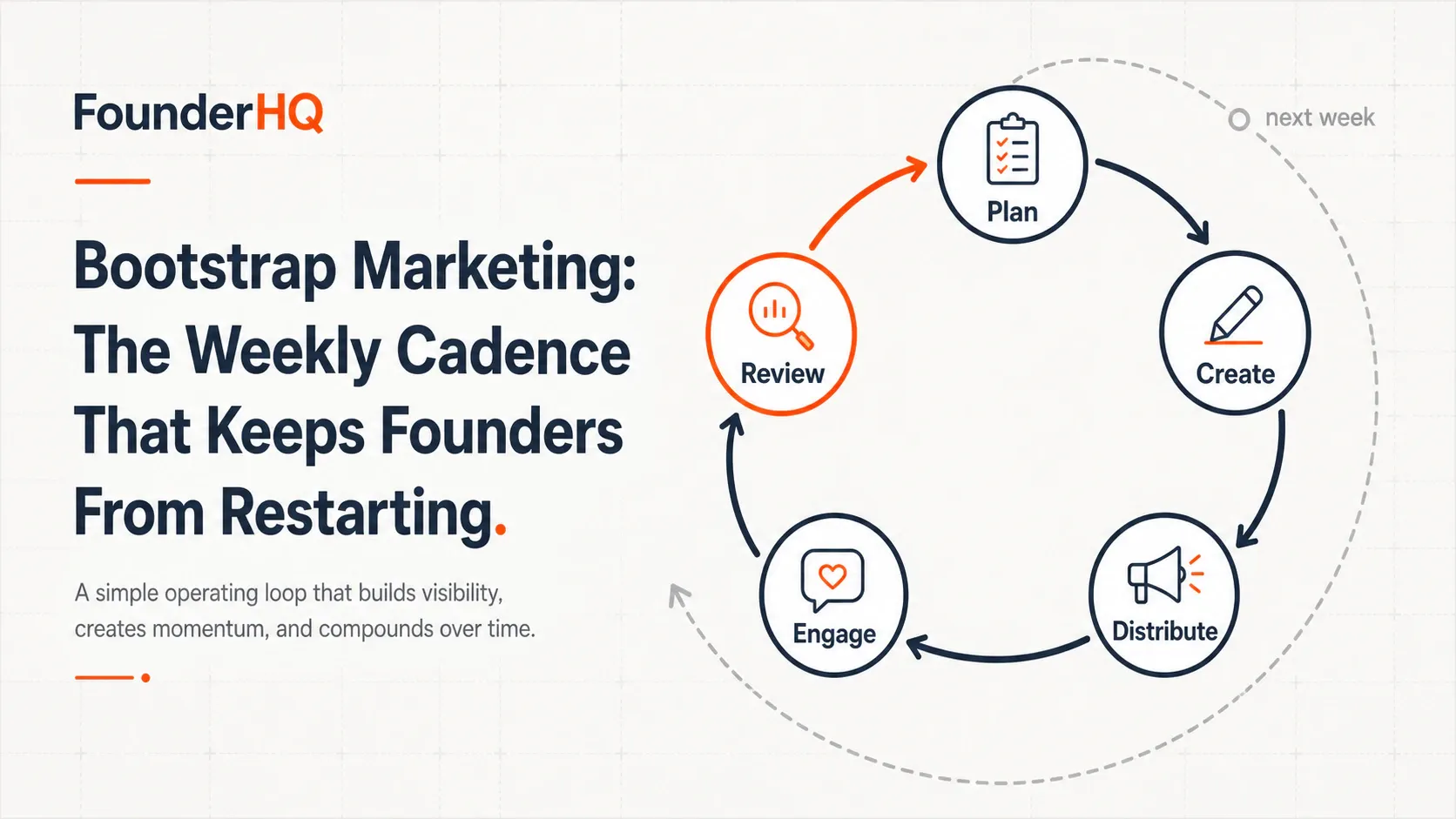
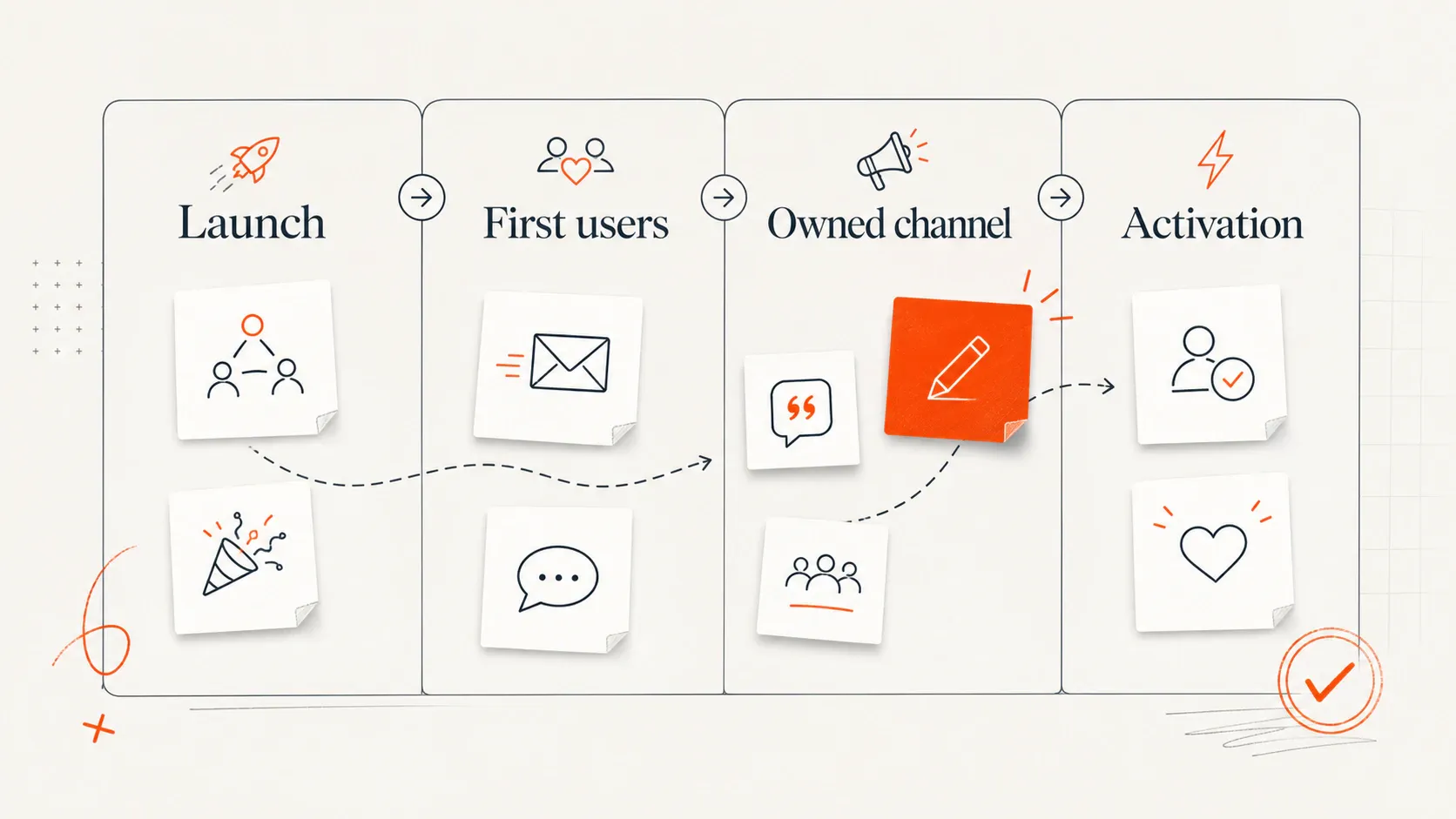
Theory is cheap; here's a sequence you can actually run in one quarter. It maps the AARRR funnel onto a 90-day cadence so you fix the right thing in the right order, as the infographic below summarizes.
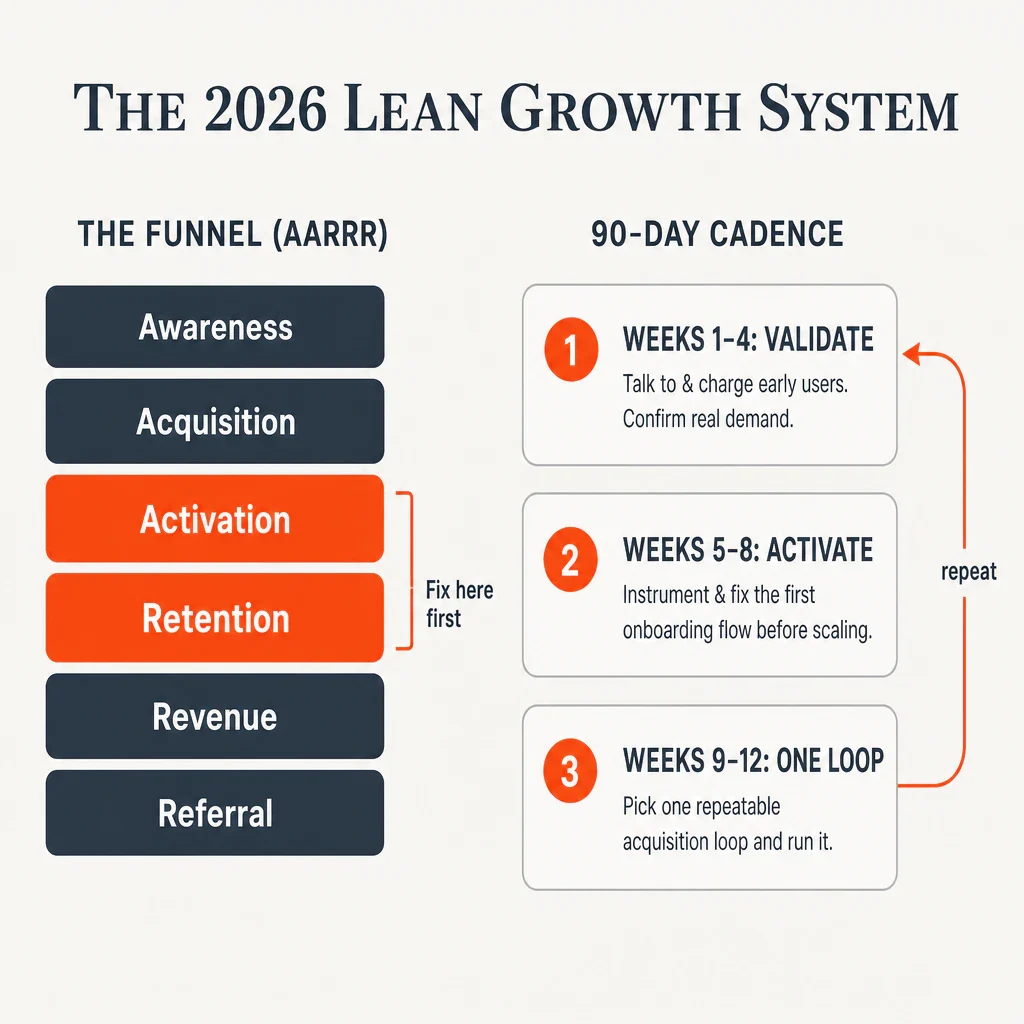
Weeks 1–4 — Validate. Talk to and charge early users before spending on growth. Use targeted outreach to find people with a burning need (YC's "search, not persuasion"), get crisp on your ICP, and confirm real demand rather than polite interest. Charging early sharpens the feedback (YC, 2026; pmtoolkit.ai, 2026).
Weeks 5–8 — Activate and measure retention. Instrument activation and retention, then fix your first onboarding/activation flow before opening the acquisition tap. Watch whether your cohort retention curve flattens and, once you have enough active users, run the Sean Ellis 40% test as a gut-check on readiness (pmtoolkit.ai, 2026).
Weeks 9–12 — Run one loop. Pick a single acquisition loop — most likely founder-led distribution at this stage — and run it consistently rather than scattering effort across five channels (startupik.com, 2026). Keep your decisions, messaging, and ICP in one place so each week's output compounds on the last instead of starting from a blank page.
The point of the cadence isn't to finish in 90 days — it's to build a loop you repeat. Validate, activate, run one loop, learn, and go again with sharper inputs each cycle.
FAQ
What's the fastest way to grow an early-stage startup in 2026? Fix activation first, then run one repeatable acquisition loop. Buying traffic into a product that doesn't retain is the slow, expensive path; getting new users to value quickly and then concentrating on a single channel (usually founder-led distribution at this stage) is faster and cheaper because it compounds (startupik.com, techvorta.com, 2026).
How many tools does a startup actually need? Fewer than you think — think in jobs, not logos. A lean team needs analytics/retention, a lightweight CRM, work tracking, an AI co-pilot, and somewhere to build activation experiences and founder-led content. Run any new tool through six gates: clear scope, free-tier ceiling, onboarding speed, data export, a known upgrade trigger, and security basics, and resist buying expensive tiers early (waveup.com, bitsfrombytes.com, 2026).
Should I do paid ads or founder-led content first? For most pre- or early-PMF teams, founder-led content first. Paid acquisition buys speed but CAC has risen ~40–60% in recent years and punishes teams that scale before proving retention (foundrycro.com, 2026). Earn the right to add paid once retention is solid and you know your LTV.
How do I know if I've found product-market fit? Two signals: a cohort retention curve that flattens rather than trending to zero, and the Sean Ellis test — 40%+ of active users saying they'd be "very disappointed" without your product is a strong indicator, while under ~25% means don't scale yet (pmtoolkit.ai, pitchgrade.com, 2026).
Conclusion
Growing a startup in 2026 is less about discovering a secret tactic and more about making two good decisions and committing to them: which growth approach fits your stage, and which lean stack supports it without bleeding your runway. The evidence points one way — validate demand, prove retention, fix activation, then run one repeatable acquisition loop, all on a consolidated set of tools chosen by job rather than by logo. Do that and growth becomes a system that compounds. Whatever you build it on, resist the two reflexes that quietly kill early teams: scaling acquisition before the product can hold users, and buying more software than you can actually use. Pick your loop, close your activation gap, keep your context in one place, and run the quarter.
Recommended Videos
Verified via transcript: Y Combinator GP Ankit Gupta on the 'minimum evolvable product,' finding first users as a search (not persuasion) problem, charging early, targeted outreach, and not fearing churn — directly supports the activation-foundation section. High-authority, non-competitor source.