Bootstrap marketing is not a personality test for founders who enjoy doing everything manually. It is a constraint-driven way to earn distribution before you can buy it. When you have no ad budget, your leverage comes from focus, specificity, founder credibility, and fast learning. The real failure mode is not usually “we did not spend enough.” It is spreading effort across LinkedIn, SEO, communities, Product Hunt, cold email, newsletters, and partnerships before any one path has a chance to work.
Why bootstrap marketing fails (and what it actually is)
Bootstrap marketing means using time, customer insight, and founder-led distribution instead of paid media to find your first repeatable path to users. A recent Startupik guide defines no-budget startup marketing as a distribution system rather than a brand exercise, with the key constraint being focus, speed, and message clarity rather than cash (Startupik). That is the right frame for an early-stage product team: you are not trying to look big; you are trying to learn where real demand lives.
Most founders make the sprint harder by turning “free channels” into a buffet. They post for a week, try a directory launch, answer three community threads, rewrite the landing page, then declare organic marketing too slow. The problem is not the tactic. The problem is that no tactic got enough repetitions to produce a signal.
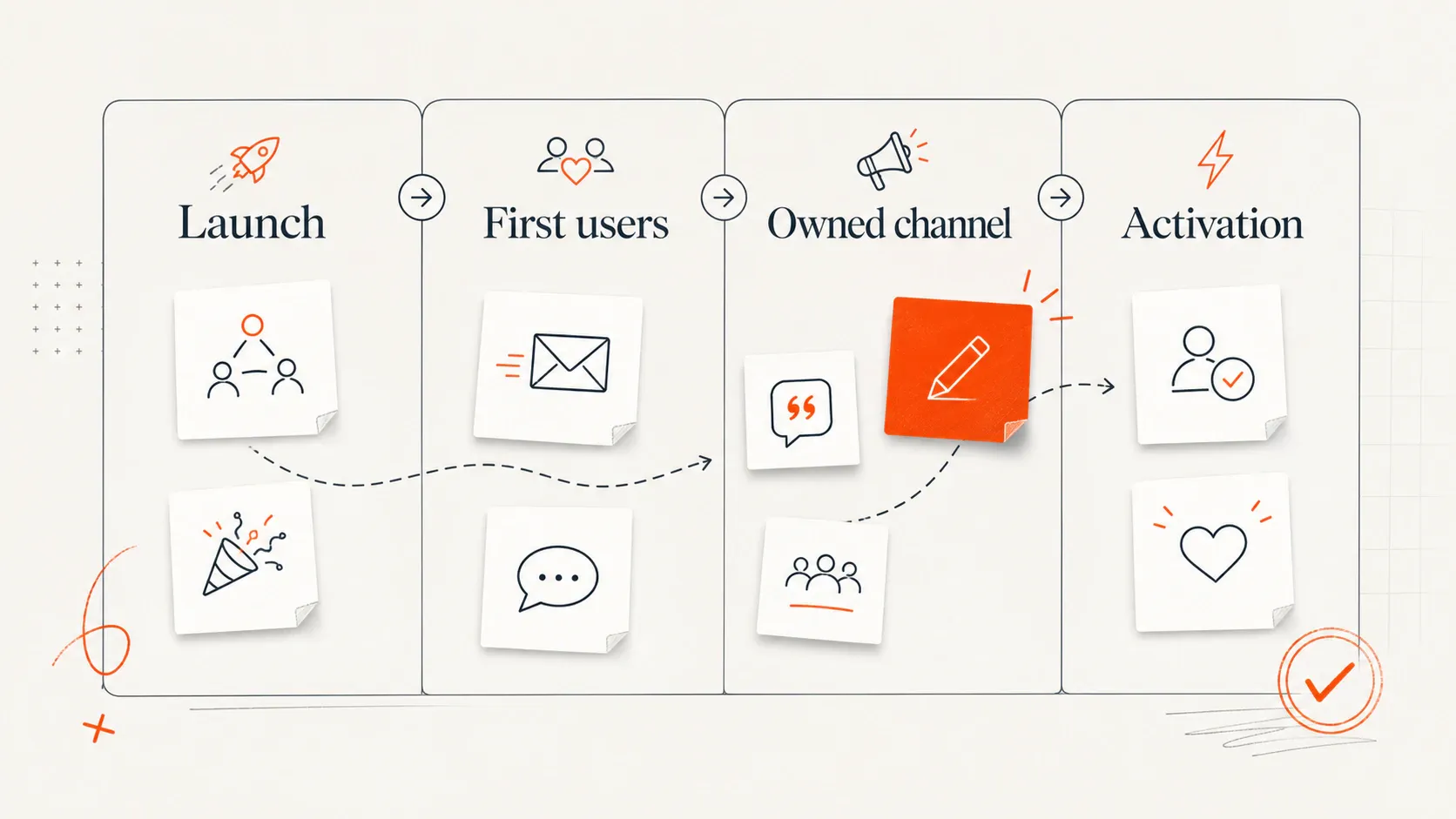
This guide keeps the scope narrow: launch to your first roughly 100 users using free, founder-led levers. It is not a full channel theory article, a paid acquisition model, or a deep measurement framework. It is the operating sprint: pick one channel, talk to people, turn conversations into reusable messaging, and build one owned channel before launch energy fades.
The economics that justify going organic-first in 2026
Organic-first does not mean paid channels are bad. It means early founders usually need proof before they need scale. Recent startup CAC benchmark roundups continue to show the same pattern: organic and referral-led channels tend to be cheaper but slower, while paid channels are faster to test but more expensive and easier to waste before positioning is clear. Culta’s 2026 startup CAC benchmarks list organic search/content at $100–$500 CAC, referrals at $50–$300, paid search at $500–$3,000, and outbound sales at $2,000–$8,000, with the caveat that ranges vary by stage and market (Culta).
The content side of the argument is similar. Content Marketing Institute has long cited the benchmark that content marketing costs 62% less than outbound marketing and generates more than three times as many leads (Content Marketing Institute). HubSpot’s inbound research reported a similar cost-per-lead advantage for inbound-dominated organizations (HubSpot). More recent 2026 content-stat roundups still repeat the same directional point: owned content can compound, but it takes consistency and time (Digital Applied).
The honest tradeoff: organic bootstrap marketing is not a magic shortcut to volume. It is a way to buy learning with founder effort before you buy attention with cash. In the first 100-user sprint, your goal is not “make organic scale.” Your goal is to discover which message, buyer, and channel create qualified conversations and activated users.
Week 0: Pick one channel and write down your message
Before you send a single message or publish a post, choose one primary channel for the next 60–90 days. Startupik’s no-budget marketing guidance recommends picking one primary acquisition channel for the first 60–90 days, and its early-stage marketing guide makes the same point: do not try to win SEO, paid acquisition, partnerships, affiliates, events, outbound, community, and PR at the same time (Startupik). The sprint map below shows the whole sequence so you can see how the pieces connect before you start.
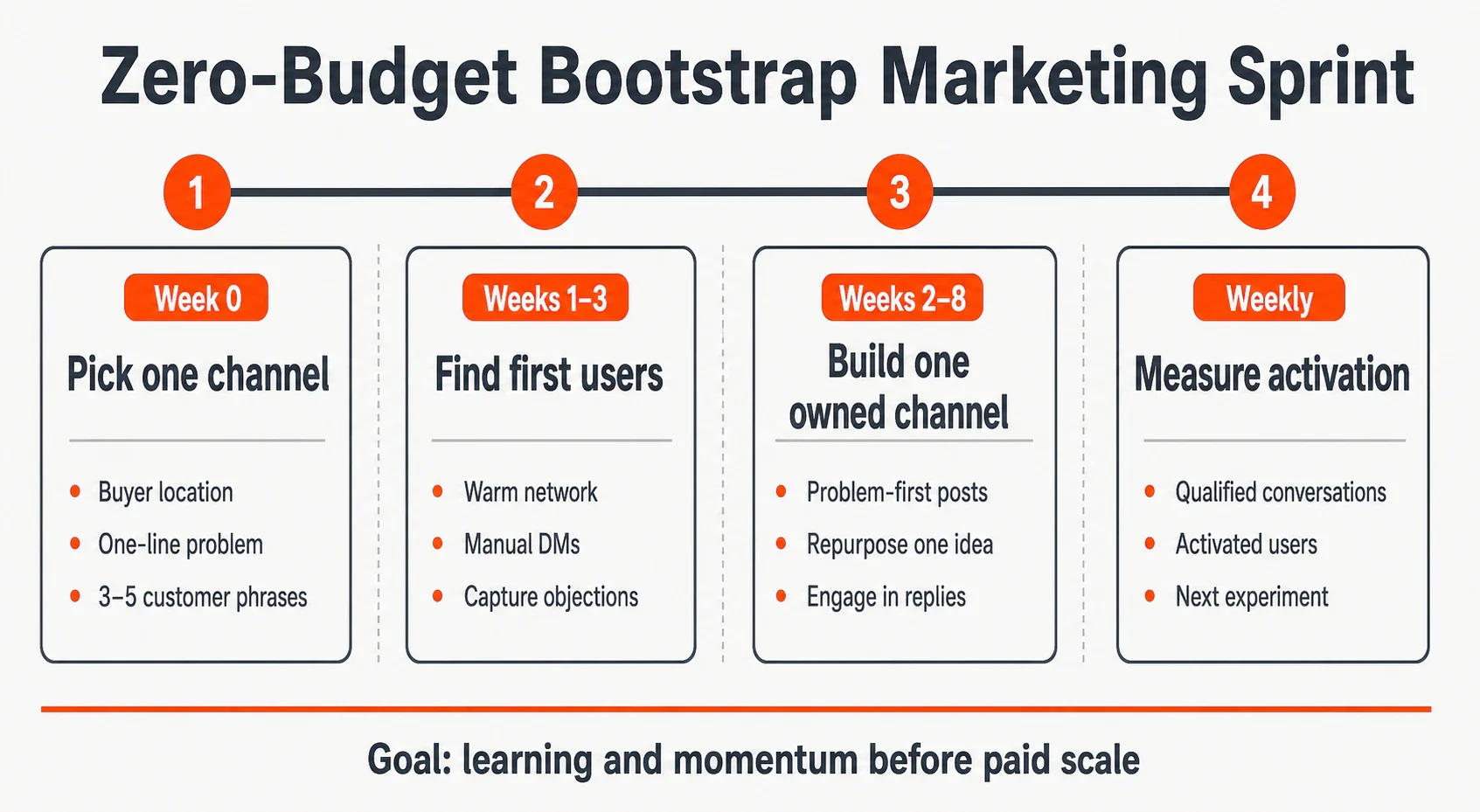
Pick the channel based on buyer access, not founder preference. If your buyers are B2B operators who already discuss the problem on LinkedIn, start there. If they search urgently for the problem, start with pain-specific SEO. If they gather in a small Slack, Discord, Reddit, or niche forum, start with community participation. The best channel is the one where a specific buyer already has the problem in public.
Then write a tiny message source of truth:
- ICP: the narrow buyer you can identify and reach.
- Problem: the painful situation they already recognize.
- Trigger: the event that makes the problem urgent now.
- Promise: the outcome your product helps them move toward, without guaranteeing results.
- Customer phrases: 3–5 exact words buyers use when describing the pain.
For a founder-led sprint, this document matters more than a polished campaign brief. Every outreach note, founder post, landing-page edit, and community answer should pull from the same message. That is where a shared company context becomes useful: FounderHQ is positioned as a focused operating system for early-stage product teams to compose founder-led content and keep company context in one place, so the founder is not starting from a blank page every week (FounderHQ).
Weeks 1–3: Get the first handful of users through warm network and manual outreach
Your first users rarely come from a polished funnel. They come from direct contact with people who already trust you, already feel the pain, or already gather where the pain is discussed. This stage is intentionally manual because manual work gives you signal automated campaigns hide.
Start with the warmest credible path
Make a list of 30–50 people who might be close to the problem: former colleagues, peers, advisors, friendly operators, community acquaintances, and people who can refer you to the right buyer. Do not blast them. Send short, specific notes that make it easy to help:
“Hey [Name] — I’m working on [problem] for [specific buyer]. You came to mind because [real reason]. Do you know one person who struggles with [specific situation] and would be open to a 15-minute feedback call?”
The goal is not to pressure friends into becoming customers. The goal is to reach people with enough trust to tell you the truth. If a warm contact becomes an early user, great. If they introduce you to someone better, that may be even more valuable.
Move into manual, pain-specific outreach
Once you have exhausted the warmest path, build a small list of people who match the ICP and show signs of the pain. That might be a founder asking about onboarding in a community, a product marketer posting about launch messaging, or an operator complaining about repetitive manual workflows. Your outreach should reference the real context that made the person relevant.
A useful manual DM has four parts:
- Context: why you are reaching out to this person, not a list.
- Pain: the specific problem you noticed.
- Low-friction ask: a question, not a pitch deck.
- Permission: an easy way to say no.
Example: “Saw your post about trying to keep onboarding emails, demo copy, and launch posts consistent while the product is still changing. I’m exploring that exact problem for early-stage product teams. Is this something you’re actively dealing with, or was it more of a one-off launch scramble?”
Capture the signal immediately
Every conversation should produce more than a yes/no outcome. Capture the buyer’s exact words, objections, alternatives, trigger events, and the moment when they understood the product. Your first 10–20 conversations are a messaging lab. If you only track signups, you miss the language that will make the next 80 users easier to reach.
Weeks 2–8: Build one founder-led owned channel that compounds
Manual outreach gets the first conversations moving. An owned channel keeps the sprint from depending entirely on one-to-one effort. The mistake is trying to launch five content programs at once. Pick one: LinkedIn founder posts, a practical newsletter, pain-specific SEO articles, a public build log, or a focused community presence.
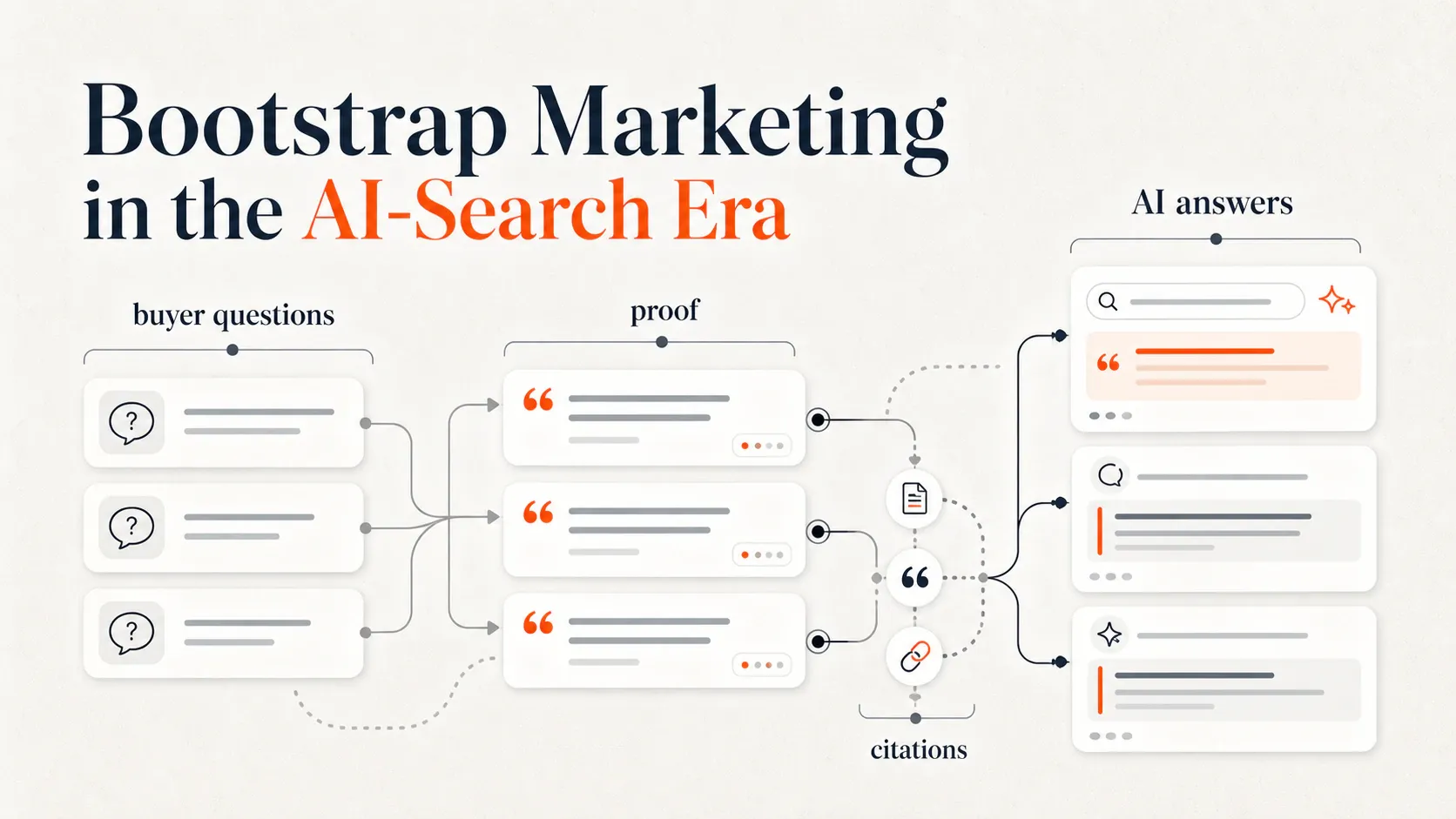
Start with the question your buyer is already asking. For example:
- “How do I get my first users without paid ads?”
- “How do I know if this channel is working before revenue?”
- “How do I explain this product when the category is still new?”
- “How do I turn customer calls into better landing-page copy?”
Then write the thing you wish you had found when you hit the same problem. That is the center of founder-led marketing: specific, useful, lived-in content that shows the work behind the product. It does not need to be loud. It needs to make the right buyer think, “This person understands the problem.”
Repurpose one core idea instead of creating from scratch every day. A single customer objection can become:
- a short founder post,
- a reply in a relevant thread,
- a landing-page FAQ,
- a short email to prospects,
- and a future SEO section.
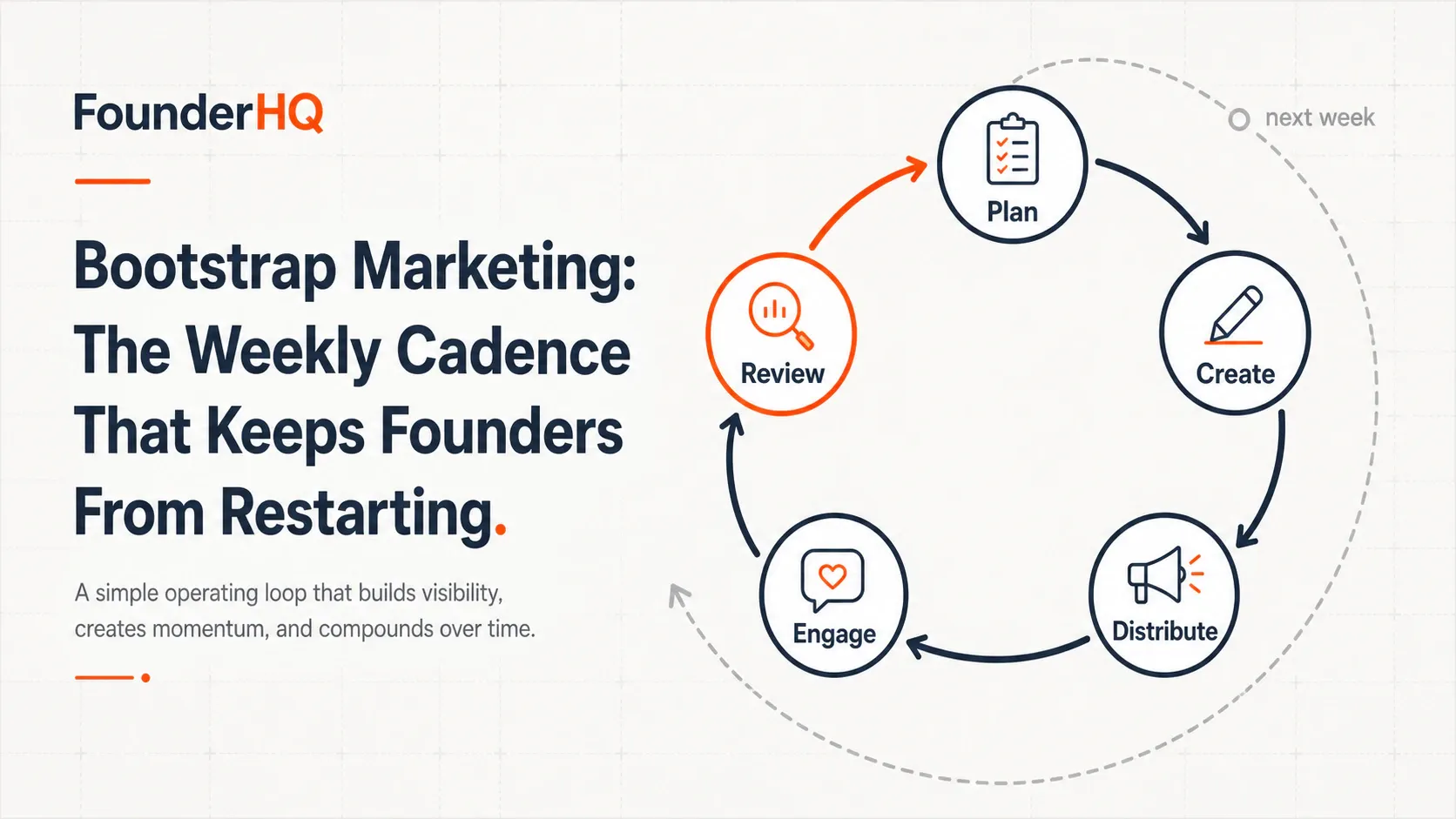
This is where bootstrap marketing becomes an operating cadence, not a motivation game. If your content depends on inspiration, it will disappear the moment product work spikes. If it depends on captured customer language, saved decisions, and a light weekly loop, it has a chance to compound.
Measure activation, not vanity metrics
In the first 100-user sprint, impressions can be useful context, but they are not the scoreboard. Startupik’s first-users-without-ads guide argues that teams should measure activation rather than signups because weak users are less valuable than fewer active ones (Startupik). For an early-stage product team, that is the right bias: attention only matters if it creates learning or product usage.
Use a simple weekly log. You do not need a complex dashboard yet. Track:
- Outbound sent: how many specific, relevant messages you sent.
- Replies: how many real conversations started.
- Qualified conversations: how many matched your ICP and pain.
- Signups or trials: how many entered the product or offer.
- Activated users: how many reached the first meaningful value moment.
- Language captured: objections, phrases, alternatives, and triggers worth reusing.
This scoreboard keeps you honest. A post with low reach but three high-fit DMs may be more valuable than a viral post from the wrong audience. A community answer that creates one activated user is stronger evidence than 50 anonymous likes. A cold message with a clear objection is still useful if it tells you why the positioning is not landing.
Keeping it sustainable: context over willpower
The sprint is simple, but not easy: choose one channel, start with warm network and manual outreach, build one owned channel, and measure activation. The founder’s job is to keep the loop specific enough that every week teaches the next week what to say.
The sustainability problem is that early-stage teams are always context-switching. Product decisions change. The ICP sharpens. A customer phrase from Tuesday should improve Friday’s post, but it often gets lost in notes, DMs, call transcripts, and memory. That is why the underlying system matters. FounderHQ’s angle is not “AI runs the company.” It is founder augmentation: a workspace where early-stage product teams can keep company context and compose founder-led content against that context.
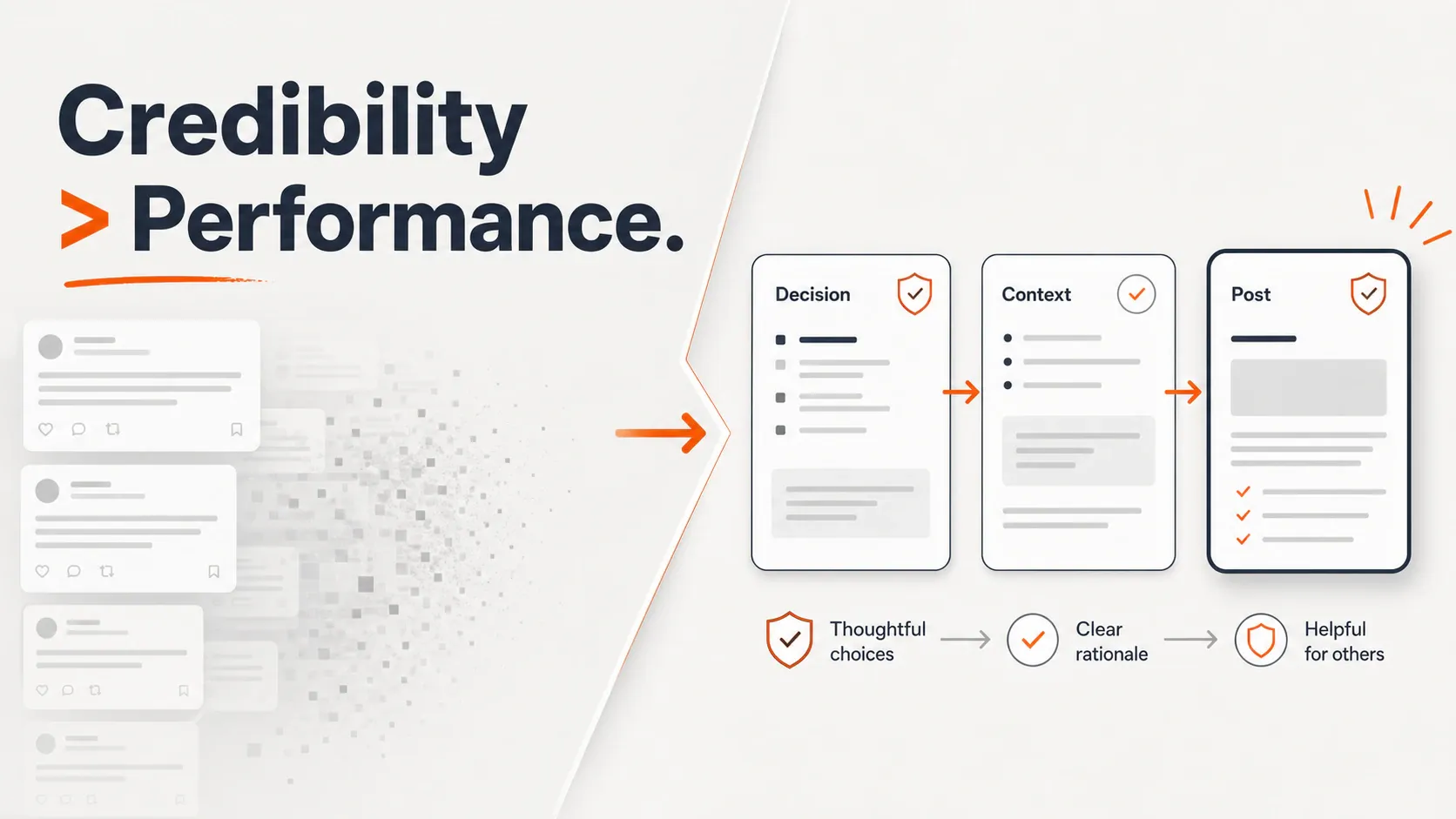
For bootstrap marketing, that means your outreach, posts, launch messages, and product journey ideas should not live as disconnected drafts. They should share the same source of truth: who you serve, what pain you solve, what buyers actually said, and what proof you can honestly claim.
The compounding payoff is not only cheaper acquisition. It is sharper judgment. By the time you reach your first 100 users, you should know which buyer responds, which words create recognition, which channel produces real conversations, and which activation moment is worth protecting.
Conclusion
Bootstrap marketing is not about pretending money does not matter. It is about refusing to spend money before you know what deserves scale. For the first 100 users, run the sprint with discipline: one channel, direct conversations, one owned content path, and activation as the scoreboard. If you keep the customer language and founder context in one place, each week starts a little less from scratch — and that is how no-budget marketing begins to compound.