Bootstrap marketing used to mean finding cheap channels before you could afford expensive ones. In 2026, that definition is too small. If you are an early-stage founder, you are not only competing with funded teams that can rent attention through ads; you are competing with answer engines that summarize the web before anyone clicks. The new bootstrap marketing strategy is not louder posting or generic SEO volume. It is building specific, proof-backed, founder-led content that can be cited when buyers ask AI tools for help.
The bootstrapped founder's real 2026 problem: you can't buy attention, and the click is disappearing
The uncomfortable part of bootstrap marketing is not that you have no budget. It is that the channels that once rewarded patience now have more friction. Paid acquisition is harder to justify when your price point is still moving, your funnel is still leaky, and every dollar spent on traffic competes with product, support, and runway.
The external data points all point in the same direction: paid attention is expensive, and organic clicks are less guaranteed than they used to be. Culta's 2026 startup CAC benchmark roundup reports that customer acquisition costs have surged 222% over eight years and 40–60% from 2023 to 2025, citing SimplicityDX and Phoenix Strategy Group. First Page Sage's 2026 cost-per-lead report lists B2B SaaS paid CPL around $310 and organic CPL around $164. Treat those as directional benchmarks, not rules for your exact product, but the implication is clear: paid channels can be punishing before your conversion math is proven.
At the same time, search behavior is shifting. Bain & Company reported that about 60% of traditional searches now end without the user clicking through to another destination, and that AI summaries can reduce organic web traffic by an estimated 15% to 25%. Ahrefs, in a December 2025 re-run of its AI Overview study, found that the presence of an AI Overview correlated with a 58% lower click-through rate for the top-ranking page.
That does not mean SEO is dead. It means the old goal—"rank and wait for the click"—is no longer enough. For a founder doing marketing with no budget, the new goal is to earn a place inside the answer: the cited source, the named example, the specific explanation an AI result can safely use.
What bootstrap marketing actually means now
Bootstrap marketing is the practice of converting founder time, customer insight, and product knowledge into durable distribution assets. It is not "free marketing" in the literal sense. You pay with focus, consistency, and the willingness to make your thinking public before it feels polished.
In the AI-search era, the strongest no-budget asset is specificity. A generic article on "how to grow a startup" is easy to ignore and hard to cite. A focused answer to "how should a solo B2B SaaS founder explain activation before product-market fit?" is much more useful to a buyer, a search engine, and an AI answer system.
This guide is intentionally narrow. It is not a list of every bootstrap marketing channel—community, outbound, referral loops, partnerships, and product-led loops all matter. The specific opportunity here is citable founder-led content: pages, posts, and explainers that answer real buyer questions with enough proof, structure, and context to be reused by humans and answer engines.
Why bootstrapped founders have an advantage in AI search
AI search has created a strange opening for small teams. Generic AI-written content is everywhere, but answer engines still need grounded material: clear definitions, named entities, original examples, useful comparisons, and sourced claims. Bootstrapped founders often have the raw material that content mills lack.
Your real experience is harder to copy
A founder can explain the messy middle: why a buyer hesitated, which onboarding step confused users, what language finally made the product click, or how a small launch actually unfolded. That kind of detail is difficult for generic content to fabricate convincingly. It also gives readers a reason to trust the page even if they arrived through an AI summary.
For example, a FounderHQ-style workflow could start with a sharper question than "What should we post this week?" A more useful prompt might be: "Which objection keeps appearing when a founder explains the product journey—too many tools, a new learning curve, or uncertainty about whether another workspace will stay current?" Framing the content around that kind of buyer concern can turn a vague idea into a citable answer: here is the concern, here is the product context it affects, and here is the way the team is thinking about it. That is the kind of operator detail a generic listicle cannot supply.
Citability rewards concrete claims
The original Generative Engine Optimization research paper on arXiv found that adding citations, quotations, and statistics could significantly improve visibility in generative engine responses, with gains of more than 40% across some query sets. A 2026 Geology study of B2B SaaS citations across ChatGPT, Google AI Overviews, and Perplexity found that outbound links were the second-strongest on-page signal in its sample, with pages containing 30+ external links cited 60% more often. These are not universal laws, but they reinforce a practical principle: answer engines need attributable material.
AI visibility is still uneven
Do not build your entire bootstrap marketing plan on one AI-search hack. The tools are changing quickly, citation behavior varies by platform, and tracking is still immature. Ahrefs notes that Google does not separate AI Overview impressions, citations, or clicks cleanly in Search Console or GA4. That makes AI visibility harder to measure than classic rankings. The founder-friendly takeaway is not "chase every AI engine." It is: publish the kind of specific, well-sourced, answer-shaped content that works for buyers whether the traffic comes from Google, ChatGPT, Perplexity, a newsletter, or a sales conversation.
The citable-content checklist: how to write so AI answer engines and humans pick you
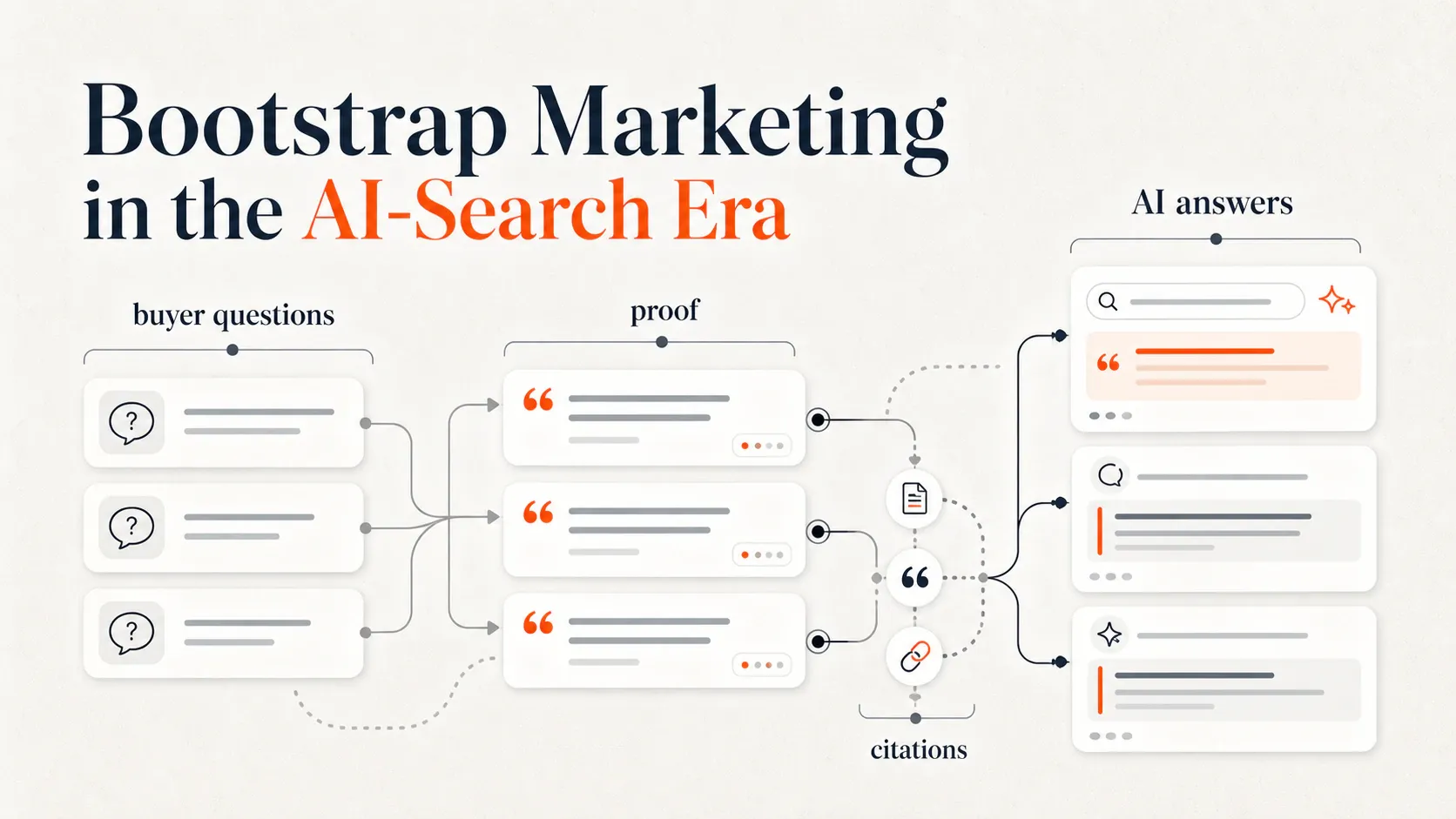
A citable page does five jobs in sequence: it names the buyer's question, answers it directly, adds proof, attributes outside claims, and makes the entity relationships obvious. The loop below is the simplest way to check whether a piece is useful enough to earn attention beyond the first publish date.
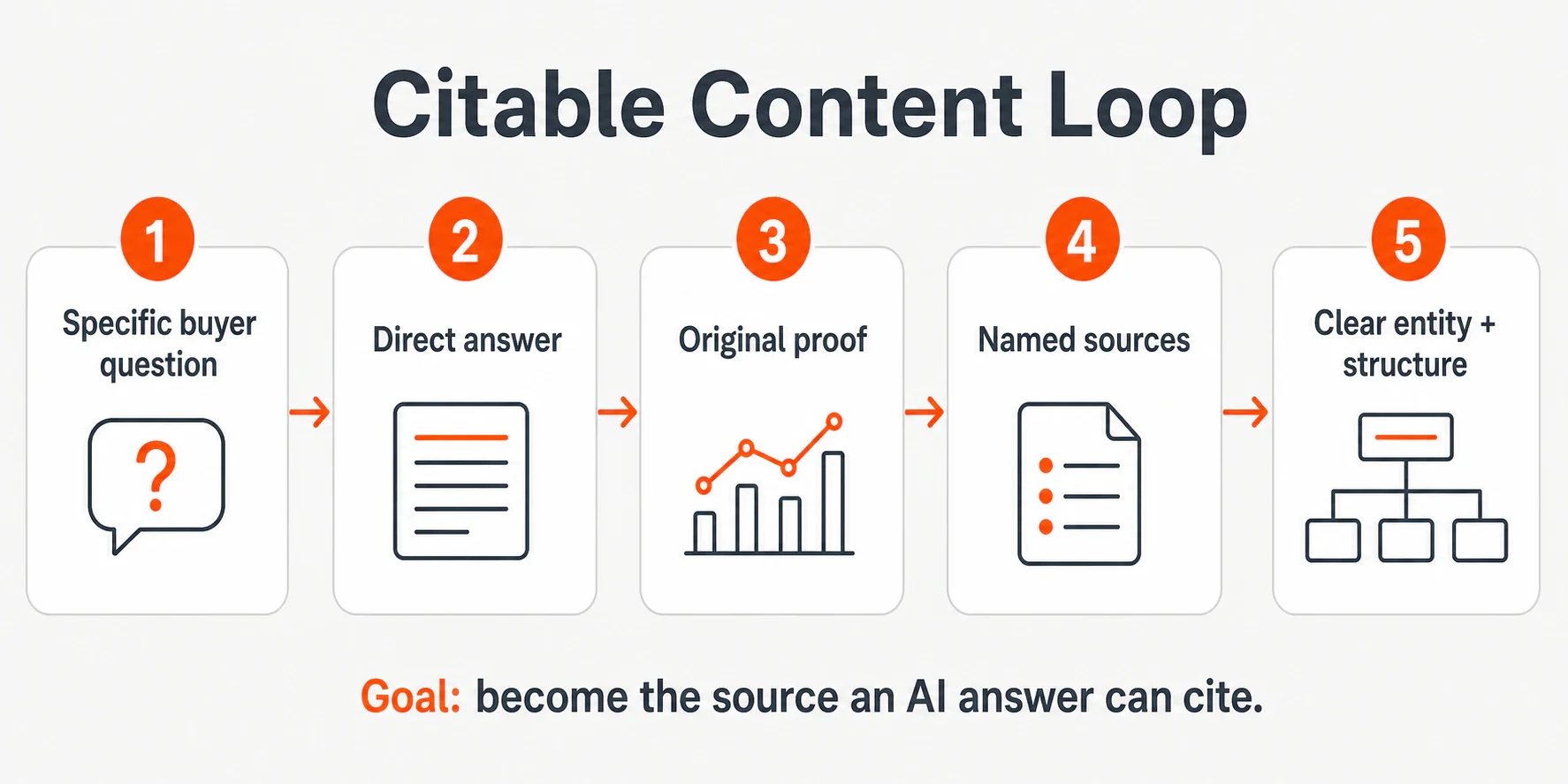
Use the framework as a pre-publish pass, not as a rigid template. If one step is weak, the page will usually read like opinion, filler, or a thin SEO asset.
1. Answer one specific buyer question
Do not start with a keyword; start with a question a real buyer would ask in their own words. For example: "How do I market a SaaS product with no ad budget?" is better than "startup marketing tips." Even better: "How do I create demand for a developer tool before I have a sales team?" Specificity helps the page become extractable.
2. Put the direct answer early
AI answer engines and busy founders both reward clarity. In the first few paragraphs, state the answer plainly. Then use the rest of the page to explain nuance, trade-offs, proof, examples, and implementation. If the reader has to dig through 900 words before they know your position, the page is not answer-shaped.
3. Add original proof where you can
Original proof does not have to mean a statistically significant industry report. It can be a small teardown, a before-and-after messaging example, anonymized sales objections, a founder decision log, a support-ticket pattern, or a product workflow screenshot. The point is to add something only your team could know.
4. Cite named sources for external claims
When you use external data—CAC benchmarks, AI Overview click-through studies, search behavior trends—attribute it clearly. Do not launder someone else's number into your own claim. For a founder-led brand, honest attribution builds more trust than inflated certainty.
5. Make the entity clear
Answer engines need to understand who is speaking, what company is being discussed, what category the company belongs to, and how the page relates to adjacent topics. Use clear author information, a consistent company description, descriptive headings, and internal links where they are genuinely relevant. For FounderHQ, that means consistently describing the product as a focused operating system for early-stage product teams that brings product journeys, founder-led content, and company context into one place.
A lean weekly operating system so this does not become a second job
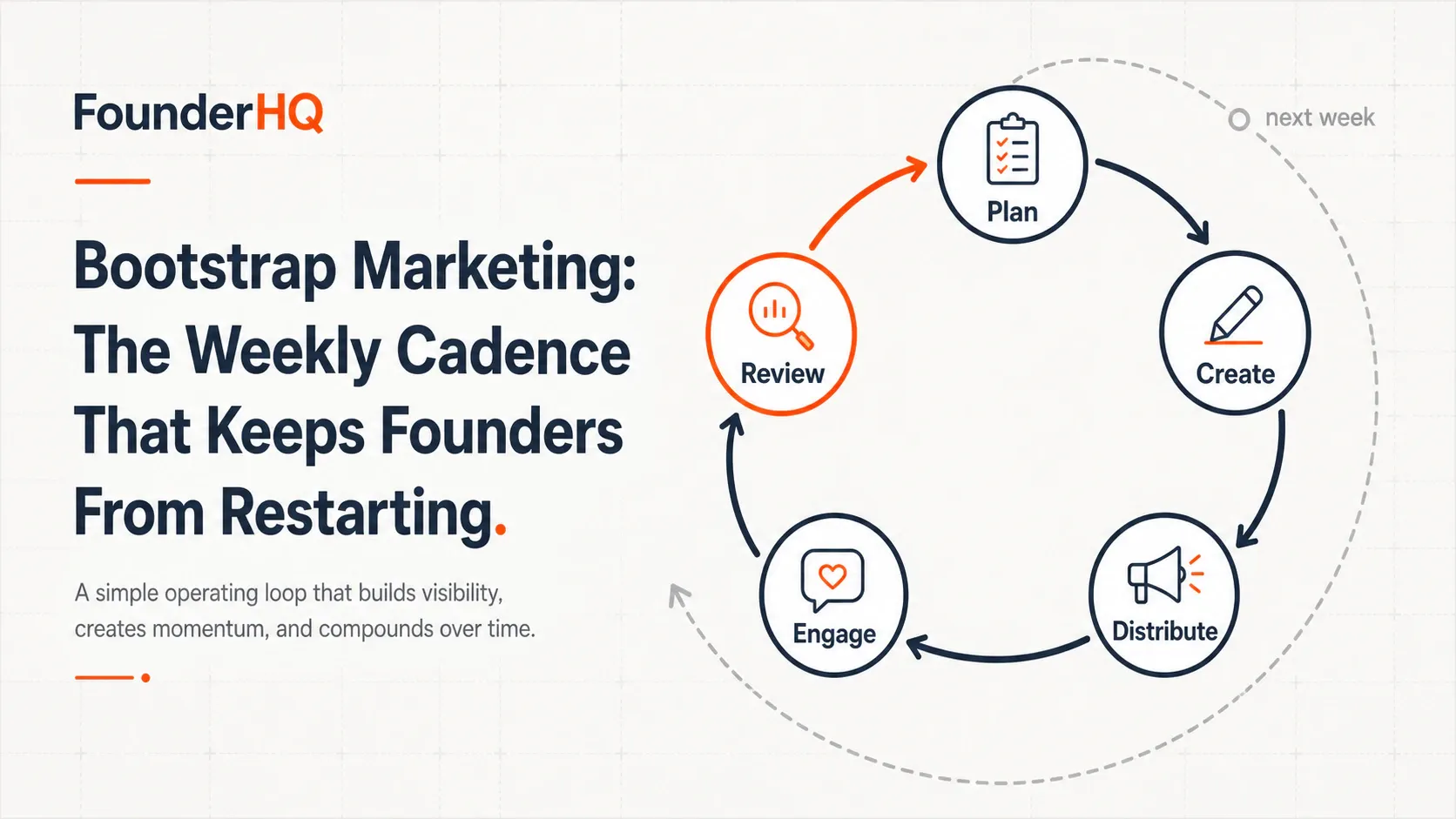
The common failure mode in bootstrap marketing is not lack of ideas. It is that marketing becomes a parallel job beside building the product. To keep this article distinct from a general weekly marketing cadence, use the loop here for one purpose only: producing answer assets that are specific, sourced, and citable enough for AI-search surfaces and human buyers.
Step 1: Mine one answer-worthy buyer question
Start with the question an answer engine would plausibly receive from your buyer. Pull it from sales calls, support notes, onboarding friction, founder DMs, search queries, community threads, or product demos. The best question usually combines a problem, a persona, and a moment: "How should a solo founder explain activation before product-market fit?" is stronger than "activation tips."
Step 2: Build a source packet before drafting
Before you write, collect the evidence the page will stand on: one or two external sources for market claims, one internal proof point from your own workflow, and the exact buyer language you are answering. This prevents the common founder-content drift where the post starts specific and ends as a broad opinion piece.
Step 3: Publish one answer asset, not a content bundle
Write one controlled asset: a page, article, teardown, comparison, or founder note that gives the direct answer early. Include your point of view, the buyer context, the proof, and the named sources. Keep distribution fragments secondary. The asset is the citation target; the social post or email is just a path back to it.
Step 4: Make the asset easy to extract
Add descriptive headings, a concise definition, source attribution, and a clear relationship between the entities involved: the problem, the buyer, the workflow, the product category, and your company. If an AI answer engine or a busy buyer cannot tell what the page is about in seconds, the asset is not yet citable.
Step 5: Review citation signals separately from classic engagement
Track normal signals—qualified replies, saves, demos booked, sales-call mentions, referral paths—but keep a separate note for AI-search signals: branded queries, manual checks in answer engines, mentions in AI-generated summaries, and whether your exact framing starts appearing in buyer conversations. Be patient; AI-citation tracking is still early and uneven. The immediate win is learning which questions deserve durable answer assets.
A practical example: distribute where the product's problem already lives
The Tweet Hunter story is a useful illustration, even if every founder should be careful about copying another company's exact channel. A public founder breakdown of the company describes the early distribution logic clearly: a tool for growing on Twitter was distributed to people already trying to grow on Twitter.
The lesson is not "go all in on X" or "DM 1,000 people." The lesson is that bootstrap marketing works best when the content, audience, product, and proof all sit in the same context. If your product helps onboarding, your best early answers should live where founders discuss activation friction. If your product helps founder-led content, your best early answers should help founders turn real company context into sharper public thinking.
That context match matters even more for AI-search visibility. A page that clearly connects a problem, audience, workflow, and proof is easier for a human to trust and easier for an answer engine to place.
Where FounderHQ fits
The hard part of citable founder-led content is not producing more words. It is staying specific and consistent every week while the company keeps changing. Your positioning shifts, your onboarding changes, customer objections evolve, and yesterday's best explanation becomes stale.
That is why this is a context problem as much as a writing problem. FounderHQ helps early-stage product teams build product journeys, compose founder-led content, and keep company context in one focused operating system. That public positioning is the relevant fit here: citable founder-led content works best when product context and content work stay connected.
That positioning matters because bootstrap marketing should augment the founder, not replace the founder. The goal is not an autonomous system that runs marketing while you disappear. The goal is leverage: preserving the context that makes your content specific, so each answer, post, and narrative starts closer to the truth.
A simple starting move for this week
If you want to start without turning this into a large project, pick one real buyer question you heard in the last 30 days. Write a direct answer. Add one concrete example from your product or customer conversations. Cite any external claims you use. Publish it somewhere you control, then repurpose the strongest parts into the channel where that buyer already spends time.
Do that for four weeks and you will have more than content. You will have the beginning of a citable knowledge base: specific buyer questions, founder-level answers, proof from the field, and a clearer story about what your company actually helps people do.
Conclusion
Bootstrap marketing in 2026 is not about being louder than funded competitors. It is about becoming more useful, more specific, and more citable than generic content can be. The founder's edge is still real: you are closest to the product, the customer language, the objections, and the proof. Turn that context into a repeatable AI-citation workflow—buyer question, source packet, original proof, answer asset, and signal review—and your no-budget marketing starts to compound in the places buyers now ask for help. Just keep the measurement honest: AI-citation signals are directional, so review them alongside buyer conversations and the real language customers bring back to you.