FounderHQJun 22, 202610 min read
Bootstrap Marketing: The Weekly Cadence That Keeps Founders From Restarting
Bootstrap marketing usually fails because the founder stops showing up, not because the channel was wrong. This guide gives early-stage teams a repeatable weekly loop for planni...

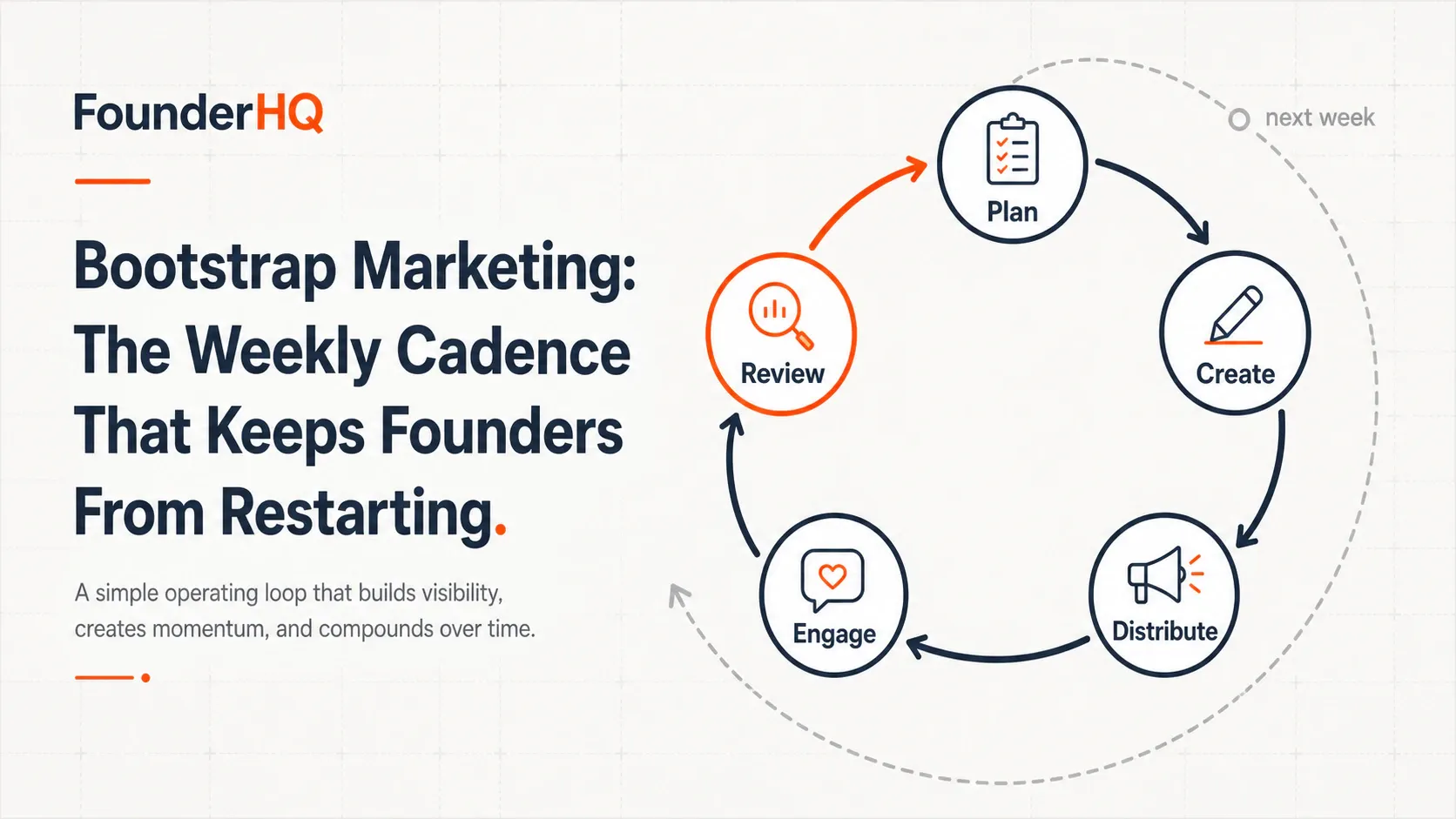
Most bootstrap marketing does not fail in a dramatic way. It fades. A founder picks LinkedIn, X, SEO, community, or outreach, shows up for two focused weeks, gets pulled back into product work, then quietly stops. A month later, the channel gets blamed. The real issue is usually simpler: the marketing system depended on available energy instead of a repeatable weekly cadence. This guide assumes you have already chosen a channel; it is not another list of cheap channels. It is the operating rhythm that lets the channel you already chose survive busy build weeks.
Why bootstrap marketing fails: consistency, not channel choice
Bootstrap marketing means growing with little or no paid budget, so the founder pays with judgment, speed, and time instead. That trade can work, but only if the work repeats. Organic channels need visible reps: posts, conversations, search assets, replies, follow-ups, and small product-facing proof. If those reps stop every time product work gets intense, the channel never gets enough continuity to teach you anything.
The pattern is familiar: one week of strategy, one burst of content, a few comments or outreach messages, then a gap. When the next free slot appears, the founder starts over by asking, "What should we post?" or "Which channel should we try now?" That reset is the hidden tax. It makes bootstrap marketing feel heavier than it is because every session begins with rediscovery.
The better question is not "Which free channel is best?" It is "What is the smallest marketing loop we can run every week without negotiating with ourselves?" For an early-stage founder, that loop needs to be narrow enough to fit around product work and structured enough that every block has one job.
The 2026 math: why organic deserves a fixed weekly slot
The reason to protect a weekly slot is not ideology. It is economics. Current SaaS benchmark writeups continue to show organic acquisition as materially cheaper than paid acquisition. Position Digital’s 2026 SaaS marketing benchmark reports average organic CAC around $205 versus roughly $341 for paid channels, framing organic as about 40% cheaper in that dataset (Position Digital). Digital Applied’s 2026 SaaS marketing statistics similarly reports lower median CAC for organic/SEO and content-marketing sources than paid channels in its benchmark set (Digital Applied). These are third-party benchmark writeup figures, not FounderHQ data or a guarantee for every startup, but they support the larger point: organic lowers media spend only when the cadence is sustained.
That does not mean organic is free. It means the cost shifts from media spend to sustained founder attention. Content, SEO, community participation, and founder-led social all tend to compound slowly. One content-services benchmark summary from Genesys Growth says B2B content returns typically take 3–6 months to materialize, especially when SEO is part of the motion (Genesys Growth). Treat that as directional source-summary evidence, not a universal rule. The useful takeaway is simpler: sporadic effort underperforms because it resets before the channel has time to mature.
The founder-time constraint is real, so the answer cannot be "market more." Solo-founder marketing guides increasingly converge on small, timeboxed operating loops rather than open-ended content calendars. Recent founder playbooks suggest focusing on one narrow audience and one distribution loop long enough to get signal, not spreading scarce hours across many disconnected tactics (Lishchuk). Bootstrap marketing works when it is treated as a repeatable system, not a motivation-dependent side project.
The weekly marketing loop: five hours, five jobs, same every week
A useful starting point is a five-block weekly loop: Plan, Create, Distribute, Engage, Review. The total is roughly five hours, but the more important rule is that each block keeps its own job. Planning is not drafting. Drafting is not distribution. Distribution is not analytics. When those jobs blur, a founder opens a blank doc, loses 90 minutes, and calls it marketing. The loop below is the whole operating system in one view: five jobs, fixed timeboxes, repeated weekly.
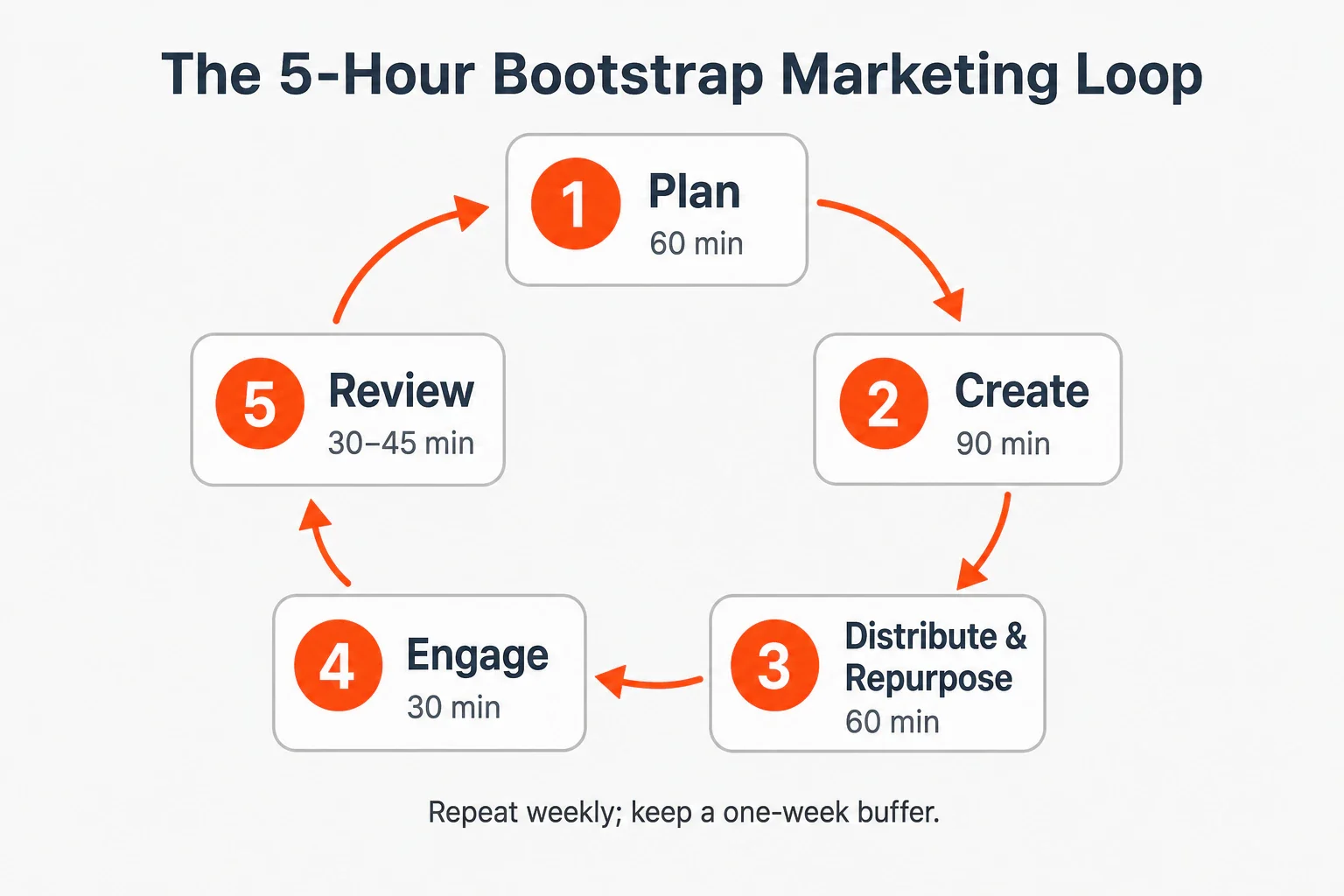
1. Plan: 60 minutes
Set the week’s marketing intention before you write anything. Choose one audience segment, one message, one asset or post theme, and one primary channel. Pull from customer language, product decisions, objections, sales calls, support notes, or founder observations. The output of this block is a short brief: who this is for, what problem it addresses, what proof or example you can use, and what action or conversation you want it to create.
A practical operator rule: keep the planning brief small enough that it can survive a messy week. Six lines are enough — audience, pain, message, proof, channel, next action. If a signal belongs in the review log, capture the exact phrase or objection, not a polished interpretation. That preserves useful market language for next week instead of forcing you to reconstruct it from memory.
Do not cut the Plan block when the week gets crowded. Cutting planning feels efficient for one day and expensive for the rest of the week. Without it, every other block starts with a blank page.
2. Create: 90 minutes
Produce one strong piece of founder-led content or one compact campaign asset. This could be a LinkedIn post, a short thread, a customer-problem article, a landing-page section, a community post, or an outreach note sequence. One useful asset beats five rushed outputs because it gives the rest of the loop something solid to distribute and learn from.
Keep creation constrained. Use the brief from the Plan block, draft the asset, and stop when it is clear enough to publish or send. Bootstrap marketing rewards usable consistency more than perfect polish.
3. Distribute and repurpose: 60 minutes
Most founders create and then under-distribute. This block exists to prevent that. Publish the asset, adapt it for one secondary surface, send it to relevant people, or turn it into a short follow-up post. If the original piece is a pillar article, pull out a few platform-native snippets. If it is a founder post, turn the strongest comment or objection into tomorrow’s reply or outreach angle.
The rule is simple: every created asset needs a distribution job. Otherwise you are building inventory, not reach.
4. Engage: 30 minutes
Reply, comment, DM, ask follow-up questions, or start a small number of direct conversations with people who match the audience. For pre-product-market-fit teams, this block may deserve more time than creation because conversations teach you what the market actually understands, ignores, or repeats back.
Engagement is not vanity maintenance. It is where bootstrap marketing turns from broadcasting into learning. A good reply can become a sales conversation, a product insight, or next week’s message.
5. Review: 30 to 45 minutes
Review leading signals, not just impressions. Track replies from qualified people, profile visits from the right accounts, saves, meaningful comments, direct conversations, demo requests, early signups, and repeated objections. A tiny team does not need a complex dashboard for this. It needs enough consistency to compare this week to the last few weeks.
The review output is one decision: keep, adjust, or pause. Do not re-strategize the entire marketing motion every Friday. The goal is to learn from repetition, not to reward novelty.
Make the cadence survive a bad week
A cadence that only works during calm weeks is not a system. Founders need recovery rules because product fires, customer calls, investor work, hiring, bugs, and life will interrupt the calendar. The point is not to avoid missed weeks forever. The point is to stop one missed week from turning into a full restart.
Keep a one-week buffer
Create this week for next week whenever possible. A one-week buffer gives you margin when something breaks. It also changes the emotional texture of marketing. Instead of publishing under pressure, you are maintaining a queue. That makes the cadence less dependent on mood and more like a normal operating rhythm.
The buffer can be small: one post, one email, one article outline, one outreach batch, or one repurposed asset ready to go. It does not need to be a month-long content calendar.
Use recovery rules, not guilt
If you miss one week, resume the next scheduled block. Do not double the workload to "catch up." Doubling usually creates a second failure: the founder tries to repay the missed week, burns the next available block, and then avoids marketing again.
If you miss two weeks, spend the next session on planning only. Rebuild the queue, restate the audience and message, choose one asset, and restart the loop cleanly. This is less satisfying than a heroic catch-up sprint, but it protects the habit.
Protect the ceiling
The five-hour loop is a ceiling before it is a target. Some weeks may only allow two focused hours. That is fine if the structure stays intact. What usually breaks founders is the opposite: a 10-hour marketing sprint that feels productive for a few weeks, then collapses to zero when product work spikes. Bootstrap marketing compounds from sustainable reps, not occasional heroics.
Fit the loop to your channel and stage
The same loop works across channels because it separates operating rhythm from channel tactics. If your primary channel is founder-led LinkedIn or X, Create becomes the core post and Distribute becomes comments, reposts, replies, and one repurposed variant. If your channel is SEO, Create becomes a focused article or landing-page asset and Distribute becomes internal linking, newsletter sharing, community answers, and follow-up posts. If your motion is direct outreach, Create becomes a tight message set and Distribute becomes a small batch of researched sends.
Pre-product-market-fit teams should weight the loop toward Engage. At that stage, reach is useful, but learning is more valuable. A small number of real conversations can improve your positioning faster than another week of broadcasting. Early traction teams can shift more time into Create and Distribute once the message is clearer.
Do not add a second primary channel until you have held the loop for several consecutive weeks. Adding channels before the cadence is stable creates the same restart problem in more places. The founder’s job is to make one loop reliable first, then expand the surface area.
Run the cadence against persistent context
The loop gets easier when every block draws from the same company context: audience notes, product decisions, objections, positioning, journey ideas, previous drafts, and what the team has already learned. Without that context, each marketing session starts from founder memory. That is fragile. It also creates message drift, where the homepage says one thing, the founder post says another, and the onboarding flow teaches a third story.
FounderHQ is designed around that consolidation problem for early-stage product teams. It helps teams build product journeys, compose founder-led content, and keep company context in one focused operating system. In this cadence, that means the founder can draft content against reusable context, preserve decisions and messaging, and connect marketing work back to product journeys instead of treating every asset as a blank page.
That distinction matters. FounderHQ should not be framed as an autonomous system that runs the company in place of the founder. The stronger, more defensible position is that it gives the founder leverage: a shared place to keep the context that makes weekly marketing faster, more consistent, and closer to the product work already happening.
Your first month: install the loop, then leave it alone
Week 1 is for setup. Put the five blocks on the calendar like customer calls. Choose one primary channel, one audience segment, and one simple leading-signal scoreboard. Build the smallest possible one-week buffer: one ready-to-publish asset or one ready-to-send outreach batch.
Weeks 2 through 4 are for repetition. Run the same loop even if the first results are quiet. Resist the founder instinct to re-architect the whole motion after one slow post or one unanswered batch. Early bootstrap marketing is a signal-gathering exercise. You need enough reps to separate a weak channel from a weak message, a weak asset, or a weak distribution habit.
At the end of the month, review the pattern. Keep the channel if qualified conversations, replies, saves, profile visits, referrals, or signups are moving in the right direction. Adjust the message if people engage but misunderstand the product. Change the channel only if the audience is clearly not there or the work cannot be sustained. The win is not doing more marketing. It is doing the same essential marketing work every week without restarting.
Conclusion
Bootstrap marketing is not a challenge to become louder than better-funded competitors. It is a discipline of showing up with enough focus that your chosen channel can compound. A five-hour weekly cadence gives founders a realistic way to do that: plan the message, create one useful asset, distribute it, engage with the market, review the signal, and recover cleanly when a week goes wrong. For a time-poor founder, less marketing done the same way every week usually beats a bigger plan that keeps collapsing back to zero. That cadence-only focus is the point: solve the weekly operating rhythm first, then let other channel, message, and distribution decisions plug into it.
Related articles
Application Onboarding Process: Definition, Steps, and When to Use It
A practical seven-step application onboarding process for moving new users from signup to first meaningful value without unnecessary setup or generic tours.
In-App Analytics for Onboarding: Definition, Metrics, and When to Use It
In-app analytics for onboarding turns events, funnels, segments, and user feedback into decisions about the path from signup to first value.
In-App Guidance for Onboarding: Definition, Examples, and When to Use It
In-app guidance helps users complete meaningful tasks inside a product. This guide explains the main patterns and how to match each one to an onboarding blocker.