Most advice on how to grow a startup assumes every founder is at the same stage. Pick a channel. Run more experiments. Post more. Buy more tools. The problem is that a pre-product-market-fit team, an early activation team, and a team with repeatable demand do not need the same next move. For a solo founder or 2–3 person product team, the expensive mistake is not choosing the wrong tactic; it is acting as if you have earned the next stage when the current one is still unproven. Use this guide as a stage-skipping audit before your next tool purchase, channel sprint, or weekly planning session.
The real reason growth advice fails: you are solving the wrong stage
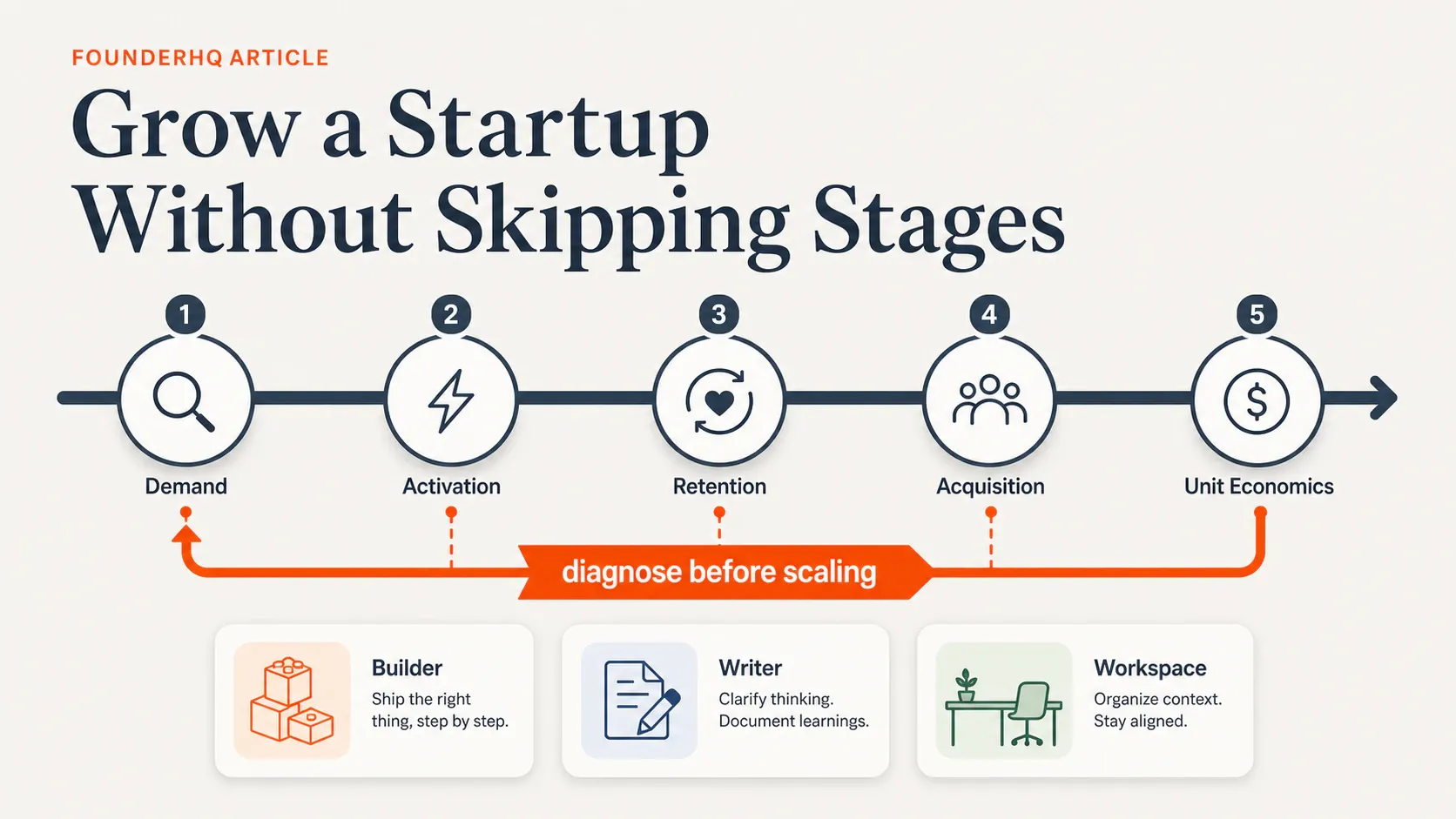
Growth is sequential before it is scalable. In a simple early-stage product business, the path usually looks like this: validate demand, help new users reach first value, prove they come back, find one repeatable acquisition loop, then improve unit economics. You can move through those stages quickly, but you rarely get to skip them.
That is why “more traffic” can make a weak product look worse, not better. Startupik’s 2026 growth-system guidance argues that growth systems fail when teams scale channels before fixing activation, retention, or the sales handoff. Capstacker makes the same point in PLG language: if users sign up but do not complete the core action quickly, you do not have product-led growth; you have expensive top-of-funnel activity with poor downstream economics.
The practical question is not “which growth lever should we optimize?” in the abstract. It is: which stage are we trying to skip right now? A founder who treats curiosity as demand will overbuild. A founder who treats signups as activation will buy traffic too early. A founder who treats one good post as a repeatable loop will turn a lucky spike into a process that cannot repeat.
Operator note: when we evaluate whether a tiny team is ready to move from manual notes into a shared operating cadence, we look at the actual artifacts from the week: the planning doc, customer-call log, launch recap, or activation map. Can the team point to one stage, one proof signal, and one decision rule written down in that artifact? If the weekly plan says “get more users” but the call log shows users still do not understand first value, the team is not ready for a bigger stack; it is ready for a clearer activation decision.
This guide is not a channel list. It is a stage-skipping buyer’s guide. First, identify the stage you are actually in. Then test the proof against false positives. Only after that should you decide how to run the loop: with founder memory and spreadsheets, a set of point tools, or a consolidated operating system like FounderHQ that is publicly positioned around product journeys, founder-led content, and company context in one focused operating system.
A 5-minute stage self-diagnosis: which stage are you actually in?
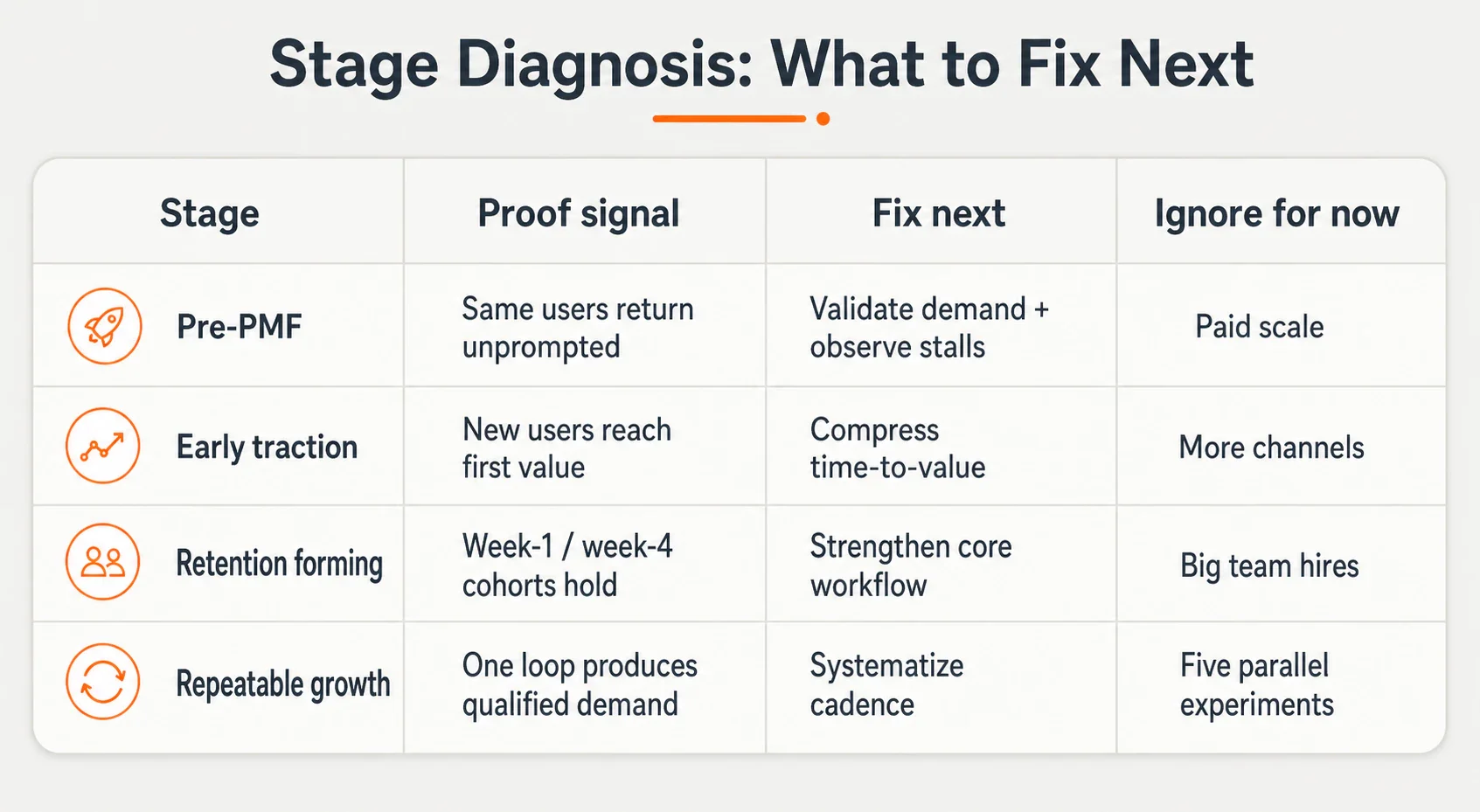
Use this as a forcing function, not a perfect scientific model. Pick the row that describes the proof you already have, then check the false-positive column before you let the team advance.
The table below is intentionally stricter than a normal scorecard. Its job is to stop stage skipping. If you are unsure between two rows, choose the earlier stage. Tiny teams usually lose more time by pretending they are ready to scale than by spending one extra cycle strengthening the foundation.
Stage | The proof signal | What skipping this stage looks like | False positive to reject | Your next lever |
|---|---|---|---|---|
Pre-PMF | The same users return unprompted or ask for the product again | You buy tools and campaigns before the problem is proven | False demand: people say “interesting” but do not return, pay, ask for access, or change behavior | Demand validation and direct user observation |
Early traction | New users reliably reach first value | You scale acquisition because signups are rising | False activation: signups are up, but core action completion and time-to-value are flat | Activation and time-to-value |
Retention forming | Week-1 and week-4 cohorts show real repeat use | You call revenue “PMF” before users come back | False retention: a few payments arrive, but usage drops immediately after first value | Core workflow quality and retention |
Repeatable growth | One loop produces qualified demand you can serve | You systematize a channel that only worked once | False repeatability: one viral post, launch spike, or referral burst cannot be repeated on a cadence | Cadence, learning loop, and unit economics |
If you want a visual shortcut, keep this stage map nearby during weekly planning. It is designed to stop the most common founder reflex: jumping to a louder growth tactic before the previous stage has earned it.
A quick decision sequence helps: 1) What stage are we claiming? 2) What behavior proves it? 3) What would make that proof fake? 4) What will we ignore until the proof holds? If you cannot answer all four, do not advance the stage yet.
Do not advance if... your proof depends on a one-off event, your strongest evidence is a compliment instead of behavior, your activation map still has obvious drop-offs, or the team cannot name what it will stop doing if the signal fails. This is the stage-skipping audit in one sentence: if the proof would disappear without founder push, launch novelty, or manual rescue, the next stage has not been earned yet.
For an even faster audit, name the failure mode out loud before the weekly plan becomes a tool or channel decision: false demand, false activation, false retention, or false repeatability. That label keeps the discussion grounded in the stage you are trying not to skip, rather than drifting into a generic growth-system debate.
Practical example: a founder sees 300 signups after a launch and calls it traction. But if only a small fraction completes the core action, if new users do not return the next week, and if the team cannot explain who activated and why, the stage is not repeatable growth. It is an acquisition spike sitting on an activation question.
The one fix per stage (and what to ignore for now)
If you are pre-PMF, do the unscalable work
At this stage, growth is not a distribution problem yet. It is a learning problem. Your job is to talk to users, watch where they stall, and understand whether the problem is painful enough for them to change behavior. Resist the temptation to build a polished growth stack around an offer that is still moving every week.
A practical rule: if your best evidence is “people said this is interesting,” stay close to conversations. If your evidence is “the same people keep coming back or asking for access,” you may be ready to improve activation.
Operator note: one of the easiest ways to fool yourself here is to document compliments but not behavior. In early-stage work, a note that says “loved the idea” is weaker than a note that says “came back three days later and asked if the workflow could handle their real use case.” The second one changes what you build next.
If you have early traction, compress time-to-value
Early traction is where many teams misread the scoreboard. Signups feel like growth, but the more important question is whether new users reach the first meaningful outcome. Startupik’s 2026 growth playbook highlights time-to-value, signup-to-activation rate, activation by source, and onboarding drop-off as key signals before scaling acquisition.
The fix is usually not another blog post or ad campaign. It is a guided first-value journey: reduce cognitive load, remove confusing steps, clarify what the user should do next, and make the product’s core value visible faster.
If retention is forming, protect the core workflow
Retention is the first evidence that the product is becoming part of a real operating rhythm. Harvard Business Review summarizes the economics clearly: acquiring a new customer can cost anywhere from five to 25 times more than retaining an existing one, and research attributed to Frederick Reichheld of Bain & Company found that increasing customer retention by 5% can increase profits by 25% to 95%. Those are broad business findings, not startup-specific guarantees, but the principle matters: retention compounds.
For a tiny team, the move is to strengthen the workflow users already rely on. Do fewer feature experiments. Study the retained users. What did they understand earlier? Which promise did the product actually keep for them?
If growth is repeatable, systematize one loop
Once one loop produces qualified demand, your risk changes. The danger is no longer doing too little; it is spreading the team across five half-owned loops. Startupik’s 2026 playbook argues that one primary growth loop usually outperforms five weak acquisition experiments. For a tiny team, that is less a slogan and more an operating constraint.
Choose the loop you can run consistently: founder-led content, product-led referrals, targeted outbound, partnerships, or another channel that fits your market. Then build the weekly cadence, measurement, and context needed to improve it.
Now the buying decision: 3 ways a tiny team can run the loop
Once you know the stage you are not allowed to skip, the buying decision becomes much simpler. You are not buying “growth.” You are choosing the lightest system that helps you run the next proof loop without losing context.
Option A: Spreadsheets + founder memory
This is the cheapest and often the right starting point. A spreadsheet, notes doc, and founder judgment can be enough when the model is still changing weekly. Choose this if you are pre-PMF, still validating the audience, and learning more from conversations than dashboards.
The trade-off is fragility. Founder memory works until build weeks get busy, customer language gets scattered, and the reason behind last week’s decision disappears. It avoids tool overhead, but it creates a context bottleneck.
Option B: A point-tool stack
A point-tool stack gives you specialized tools for analytics, onboarding, content, lifecycle messaging, documentation, and customer feedback. Choose this if one lever is clearly the bottleneck and you are ready to go deep on it. For example, if activation is the only thing blocking progress, a specialized onboarding or product analytics workflow may be worth the overhead.
The risk is tool sprawl. Enterprise-scale SaaS reports are not a direct proxy for tiny startups, but they show the direction of travel: Zylo’s 2026 SaaS Management Index reports large organizations managing hundreds of applications, while consolidation guidance focuses on reducing overlap and restoring control. A 2-person team will not have that enterprise app-count problem. For tiny teams, the issue is not the number of apps; it is context switching, fragmented decisions, and every growth question creating another disconnected place to look.
Option C: A consolidated operating system
A consolidated operating system is for teams whose bottleneck is not one isolated feature but continuity across the loop: the product journey, the founder-led narrative, and the company context behind both. Choose this if you need one place to design activation journeys, turn founder knowledge into content, and preserve decisions so the next asset is sharper than the last.
FounderHQ’s public positioning fits this category at the capability level: it helps early-stage product teams build product journeys, compose founder-led content, and keep company context in a focused operating system. That makes it best framed as founder leverage: a way to make your product journeys, market narrative, and reusable memory work from shared context. It is not a full analytics suite, not a CRM, and not an autonomous AI product that runs the company for you.
Decision table: choose the lightest system your stage can support
The right choice is the one that matches your current proof, not the one that feels most advanced.
System | Best fit | What it helps you avoid | What it can create |
|---|---|---|---|
Spreadsheets + founder memory | Pre-PMF, fast-changing model, direct user learning | Premature tooling and process drag | Lost context, inconsistent follow-through |
Point-tool stack | One clear bottleneck that needs depth | Generic workflows and shallow instrumentation | Integration overhead, scattered decisions |
Consolidated operating system | Tiny team running journeys, founder-led content, and context together | Rewriting from scratch and disconnected growth assets | A learning curve if the team is not ready for a shared cadence |
The most practical rule is this: stay manual when the market is still teaching you what the product should be; buy depth when one bottleneck is obvious; buy consolidation when the bottleneck is handoff, memory, and consistency across the loop.
For FounderHQ specifically, the defensible fit is the consolidated path. FounderHQ is positioned around three connected jobs: product journeys, founder-led content, and company context. The value is not a claimed lift or guaranteed outcome. It is a cleaner operating loop for founders who are tired of rebuilding the same context across every draft, journey, and decision.
The stage-skipping test still applies after you buy. If a system helps you preserve learning, clarify journeys, and keep decisions reusable, it supports the next stage. If it mainly makes an unproven stage look more sophisticated, it is probably process decoration.
Conclusion
To grow a startup in 2026, start by refusing the wrong question. “Which tactic should we try?” comes after “Which stage are we trying to skip?” If demand is unproven, talk to users and reject false demand. If activation is weak, shorten the path to first value and reject false activation. If retention is fragile, protect the core workflow and reject false retention. If one loop is working, systematize it only after you reject false repeatability. In your next weekly planning session, open the customer-call log, activation map, or launch recap and name the exact stage-skipping failure mode you are auditing this week. Then choose the lightest system that helps you run that stage with less context loss and more consistency.