
Type "grow startup" into a search bar and the advice piles up fast: run paid ads, post on LinkedIn, build a referral loop, launch a waitlist, start a podcast. For a solo founder or a team of two or three, that pile isn't a plan — it's a trap. The binding constraint on a lean team in 2026 isn't a shortage of ideas; it's a shortage of hours, and the steep cost of splitting those hours across ten bets at once. So the question worth asking isn't "what should I do to grow?" It's: which single growth lever — activation, retention, or acquisition — earns your scarce attention right now, given your stage, and which one or two metrics will honestly confirm it's working? This guide stays deliberately narrow. It won't sequence your channels or audit your toolchain (those are separate decisions). Instead, it hands you a 60-second way to classify your stage, a head-to-head comparison of the three levers with "choose this if" rules, and a lightweight measurement layer you can run without a growth pod. By the end you'll walk away with one lever, not three — and a metric to verify it.
Why "grow a startup" is the wrong question
"How do I grow?" invites a list. Every list is plausible, and that's exactly the problem — a time-poor founder can't tell which item on it actually moves the business this quarter. When everything is a priority, nothing gets enough reps to work, and you end up with five half-built efforts instead of one that compounds.
The sharper question is a diagnosis, not a menu: of the three classic growth levers — activation (do new users reach value?), retention (do they keep coming back?), and acquisition (can you bring more of them in?) — which one is your binding constraint right now? Optimizing the wrong lever is worse than doing nothing, because it burns the hours you'll wish you'd had. Pouring acquisition spend into a product nobody sticks with just fills a leaky bucket faster.
This is also why a single metric matters more than a dashboard. The lever you choose comes with one or two numbers that honestly signal progress — and a longer list of numbers you should deliberately ignore for now. Treat the rest of this guide as a way to pick that lever and that number, then protect both from the next shiny tactic that crosses your feed.
First, classify your stage (the 60-second diagnosis)
Your stage decides your lever, so start there. A practical, revenue-anchored frame that recurs across 2026 SaaS benchmark write-ups breaks early-stage growth into three bands: pre-product-market-fit (roughly $0–$10K MRR), early traction (roughly $10K–$50K MRR), and growth (roughly $50K–$200K MRR). Treat the dollar figures as rough signposts, not gates — they exist to anchor the conversation, not to grade you.
Revenue alone is a blunt instrument, so read it alongside three other signals: your active customer count, where demand is coming from (founder hustle and warm intros versus repeatable inbound), and the strength of your product-market-fit signal (do users come back on their own, or only when you nudge them?). A company at $8K MRR entirely from the founder's network is in a very different spot than one at $8K MRR with users returning weekly without prompting.
Why stage dictates the lever
Before product-market fit, acquisition and revenue are misleading — you can manufacture both with enough manual effort. The only honest signal at this stage is whether the users you already have keep using the product, which makes retention the lever and cohort retention the metric. Once people clearly stick but too few of your signups ever reach the "aha" moment, the leak is activation. And only once both hold — users reach value and come back — does scaling acquisition and watching unit economics become the right use of your hours.
A one-minute self-check
Answer these quickly and honestly: Do the users who signed up last month still use the product this month without you reminding them? If no, you're pre-PMF — work retention. If yes, what share of new signups actually reach first value in their first session or two? If that share is low, you're in early-traction territory — work activation. If users reach value and stick, and your real bottleneck is simply not enough people finding you, you've earned the right to work acquisition. Pick the first "no" you hit; that's your lever.
Lever 1 — Activation: make the first run deliver value fast
Activation is the moment a new user first experiences your product's core value — the "aha" — and time-to-value (TTV) is how long it takes them to get there. The activation event should be a specific action that correlates with users coming back, not a vanity step like "completed signup." Get this lever right and every downstream metric improves; get it wrong and acquisition just feeds the leak.
The 2026 benchmarks make the stakes concrete. Userpilot's analysis of 547 SaaS companies puts the average activation rate at 37.5% (median ~37%), meaning nearly two-thirds of signups never reach core value; Perspective AI's 2026 onboarding report similarly pegs the B2B SaaS median at 38%, with the top quartile around 61%. Several 2026 onboarding write-ups treat clearing roughly 40% as above the median bar. On speed, Userpilot reports a median time-to-value of about 1 day, 12 hours, and ProductQuant's 2026 benchmark argues that for pure product-led self-serve, value needs to land in under ~15 minutes, with every additional 10-minute delay costing trial conversion (citing OpenView). Translation: most products lose the majority of their users before those users ever see why they signed up.
Choose this lever if: you already have signups or traffic, but a small fraction reach value, your first-week (Day-7) return rate is weak, or users complete onboarding steps yet still churn. That gap between "signed up" and "got value" is your highest-ROI fix — Perspective AI's data shows onboarding completion and true activation are not the same thing, so chasing checklist completion can fool you.
Where FounderHQ fits here is its builder: it lets early teams design product journeys, onboarding, and activation flows — including mobile-first guided experiences — so new users hit first value faster. That's a capability for shortening time-to-value, not a promise of a specific lift; instrument your own activation rate and TTV to judge whether a given flow helped.
Lever 2 — Retention: the only honest measure of product-market fit
If you're pre-PMF, retention isn't one option among three — it's the one signal you can't fake. Y Combinator's framing is blunt: the purest job of a startup is to make something people want, and the most quantitative way to know if you have is cohort retention — tracking what fraction of each group of new users keeps coming back over time. Acquisition and even revenue can be willed into existence with founder effort; a retention curve cannot.
Measuring it well takes three decisions, straight from YC's playbook. First, define your cohorts — usually by the week or month users first signed up. Second, define the active-user action — a specific behavior tied to real value (viewing a photo full-screen, completing a ride, running a core workflow), not just "opened the app." Third, pick a time period that matches how often the product is meant to be used: daily for a social app, weekly or monthly for a utility. Then watch whether each cohort's curve flattens (a sign of a sticky core) or decays to zero (a sign you haven't made something people want yet).
The 2026 benchmarks give you reference points, though they vary by segment, so treat each as that source's own claim. For revenue-side stickiness, the SaaS benchmark reporting converges on net revenue retention (NRR) around 101–102% at the median, with ≥110% widely called the single strongest long-term predictor of value (per the 2026 SaaS Benchmarks Report and others). knowledgelib's 2026 retention-curve data shows SMB SaaS NRR near 97% versus enterprise around 112%+, and gross revenue retention of ~90% as a healthy floor. The practical takeaway for a lean team: don't chase a universal number — watch whether your own cohort curve stops dropping.
Choose this lever if: you're pre-PMF, or your funnel visibly leaks after week one. Fixing acquisition before the bucket holds is the classic early-stage mistake. The video below — Y Combinator's "How To Keep Your Users" Startup School session — is the clearest plain-English explainer of cohort retention we've found, and it's worth the half hour before you touch any other lever.
Where FounderHQ fits: as you iterate on what makes users stick, its workspace keeps your company context and decisions in one place, so the activation flows and messaging you test stay consistent rather than drifting every time you change your mind.
Lever 3 — Acquisition: only after the bucket holds
Acquisition feels like "growth," which is exactly why founders reach for it too early. Pre-PMF, more traffic mostly accelerates churn and obscures the retention signal you actually need. The discipline is to gate acquisition behind your unit economics — and 2026 benchmarks give you clear thresholds. Across roughly 939 B2B SaaS companies, the median LTV:CAC ratio is about 3.2:1, with 3:1 treated as the minimum healthy bar and 5:1+ as efficient (Optifai). The more cash-sensitive metric for a lean team is CAC payback: the median B2B SaaS figure sits around 8.6 months, with under 12 months widely cited as the SMB target and over 18 as a red flag (Peppereffect, Mowsix). If you can't recover acquisition cost in a reasonable window, scaling spend just shortens your runway.
For early teams, the lean default isn't paid media — it's founder-led, organic distribution: the founder's own voice, network, and content feeding top-of-funnel without a marketing team or budget. (The mechanics of choosing and sequencing specific channels are their own topic; here the point is simply when acquisition earns priority, not which channel to run.)
Choose this lever if: activation and retention are genuinely healthy — users reach value and your cohort curves flatten — and your honest constraint is simply that not enough of the right people know you exist. If you can't say that with a straight face, you're not ready for this lever yet.
Where FounderHQ fits: its writer turns your company context into founder-led content and market narratives — drafting posts and launch messaging from what you already know — so a founder can feed acquisition without standing up a content team. As with the other levers, treat it as a capability to produce on-message content faster, and let your own funnel numbers judge the result.
The decision: a lever-by-stage comparison
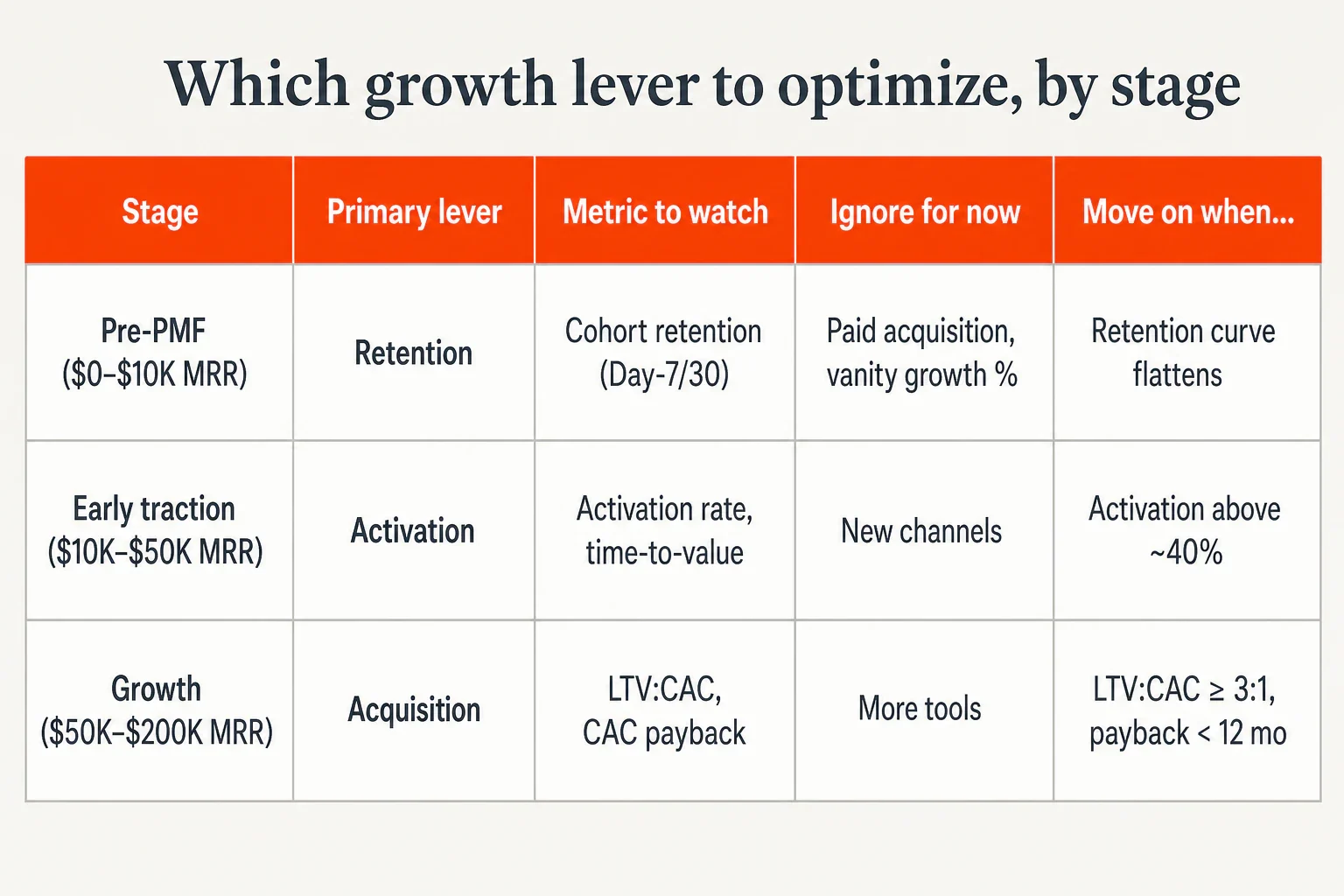
Here's the whole guide in one view. Match your stage to a single primary lever, the one or two metrics to obsess over, what to deliberately ignore for now, and the threshold that tells you it's time to move on. The infographic below captures the same logic at a glance.
Stage | Primary lever | Metric(s) to watch | Ignore for now | Move on when… |
|---|---|---|---|---|
Pre-PMF (~$0–$10K MRR) | Retention | Cohort retention (Day-7 / Day-30 curve) | Paid acquisition, vanity growth % | Your cohort retention curve flattens instead of decaying to zero |
Early traction (~$10K–$50K MRR) | Activation | Activation rate, time-to-value | New channels, brand polish | Activation clears roughly the ~40% above-median bar and first-week churn drops |
Growth (~$50K–$200K MRR) | Acquisition | LTV:CAC, CAC payback | More point tools, more metrics | LTV:CAC ≥ ~3:1 and CAC payback is under ~12 months |
Two rules keep this honest. First, cap yourself at five to seven metrics per stage — knowledgelib and other 2026 KPI frameworks make the case that more metrics slow decisions rather than sharpen them. Second, name the traps out loud. Vanity growth percentages ("up 300% week over week" off a tiny base) flatter you; aggregate retention blends your loyal core with churned users and hides the truth that only cohort retention reveals. When a number feels good but you can't act on it, it's probably one of these.
Build the measurement and execution loop on a lean stack
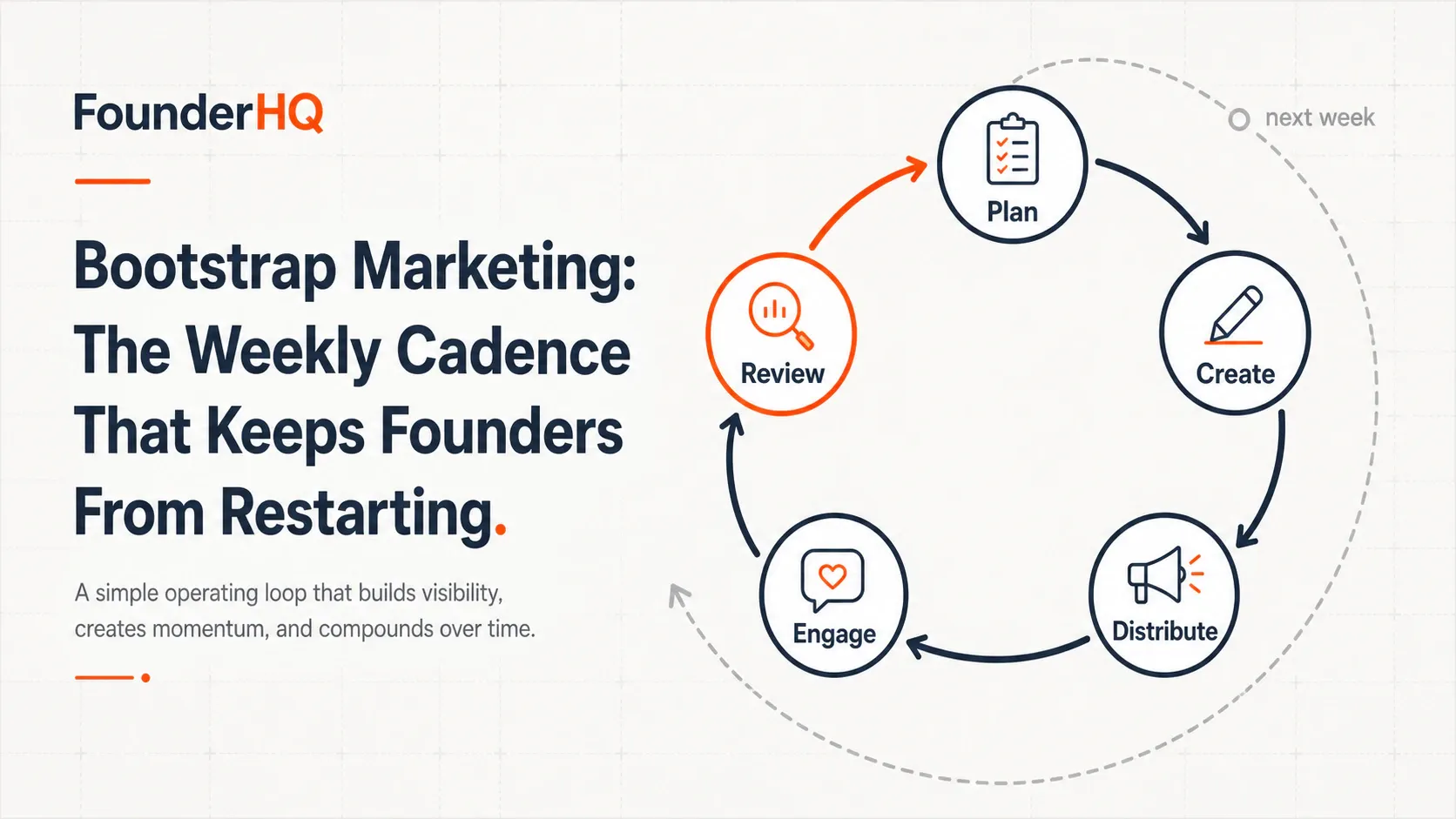
A chosen lever only works if you actually look at its metric on a schedule. Set a 15-minute weekly review: check the one or two numbers for your current lever (the cohort curve, activation rate, or LTV:CAC and payback), note what changed, and decide on exactly one experiment for the week ahead. That's the entire operating loop — small, repeatable, and resistant to the urge to chase everything at once.
The hard part isn't the loop; it's where it lives. The 2026 tooling reality is that stacks keep sprawling: Vertice reports the average business managed about 138 SaaS apps as of March 2026 (up from 128 in late 2024), and Zylo's 2026 index puts the average organization at around 305 applications. Those figures are enterprise-skewed — no solo founder runs 138 apps — but the direction is the warning: tools accumulate faster than they're retired, and context scatters across them. For a lean team, every extra disconnected tool is another place your numbers and decisions go to get lost.
That's the argument for consolidation and one source of truth over point-tool sprawl. FounderHQ is built around exactly that: a unified builder + writer + workspace with persistent company context, so the lever you choose — activation via product journeys, acquisition via founder-led content, consistency via shared memory — is something you act on in one focused operating system instead of stitching together five. The benefit isn't "more software"; it's fewer places for your context to fragment as you iterate week to week.
Conclusion
Growing a startup in 2026 is less about discovering a tactic and more about refusing to run all of them. Diagnose your stage, choose the single lever that's actually your constraint — retention if you're pre-PMF, activation if users don't reach value, acquisition only once the bucket holds — and instrument the one or two metrics that honestly prove it's working. Then do the boring, compounding thing: pick that one lever this week, instrument that one metric, and review it every week. Focus, not volume, is the founder's real leverage.
Recommended Videos
Y Combinator's Startup School explainer on cohort retention — transcript confirms it walks through defining cohorts, an active-user action, and the right time period, exactly the framework in the Retention section. High-authority, non-competitor channel (~54.1K views).