Most founders asking how to grow a startup are not really asking for another list of channels. They are asking a harder operating question: where should we put scarce time, cash, and attention so growth becomes repeatable instead of noisy? In 2026, the useful answer is less about doing more and more about choosing the right system. Use the five-signal scorecard in this guide first: diagnose the constraint, choose the matching growth system, and then decide what stack is light enough to run every week.
The real question behind how to grow a startup
The commercial decision is not "Should we try SEO, LinkedIn, outbound, partnerships, paid ads, or product-led growth?" It is "Which growth system fits our stage right now, and what stack will help us run it without adding operational drag?"
That distinction matters because startup growth is sequential. Unit economics research consistently points founders back to the same basic equation: acquisition only compounds when customer value, retention, and acquisition cost make sense together. A 2026 SaaS unit economics guide from G-Squared CFO frames unit economics around customer lifetime value, customer acquisition cost, CAC payback, gross margin, and the LTV:CAC relationship.
For a lean team, this makes growth a buying decision as much as a marketing decision. You are choosing a stage-appropriate operating path, not just a tactic: prove first value, create specific demand, and keep the team from scattering its context across too many disconnected tools. The wrong choice can make a hardworking team look unfocused; the right one gives the team a weekly loop it can actually sustain.
What growth means before you scale
A defensible startup growth system has four ingredients: validated demand, repeatable acquisition, strong enough activation and retention, and unit economics that do not get worse as volume increases. If one of those is missing, adding channels usually increases noise faster than learning.
Validated demand comes before scale
Before you pour traffic into the product, prove that a narrow group has a real problem, understands your promise, and is willing to act. Y Combinator's guidance on first users argues that early growth is often a search problem rather than a persuasion problem: the job is to find early adopters with a strong enough need to tolerate an imperfect first product.
Repeatability beats isolated wins
A good week is not a growth system. A repeatable growth system has a clear input, a visible output, and a review loop. For example: publish founder-led insight, start ten relevant conversations, route interested users into a guided onboarding journey, then capture what converted or confused them.
FounderHQ's role in this layer
FounderHQ is described on its verified homepage as a focused operating system for early-stage product teams that helps teams build product journeys, compose founder-led content, and keep company context in one place. Because no approved customer metrics or case-study proof were available for this run, the useful claim is capability-based: FounderHQ helps founders keep product journeys, market narratives, and reusable company context closer together.
Trade-off 1: Activation-first vs. acquisition-first
If users sign up and disappear, acquisition is not your bottleneck. The bottleneck is the handoff from interest to first value. In that case, growth work should start with activation: onboarding, first-use clarity, the moment of value, and the messages that help a new user understand why the product is worth adopting.
Choose activation-first if users arrive but do not complete setup, do not reach the core action, ask the same basic questions repeatedly, or churn before they have enough context to judge the product fairly. This is where guided product journeys, onboarding flows, and activation paths do real work.
Choose acquisition-first only when the product already converts a meaningful share of the right users and the team can explain who it is for, why they buy, what first value looks like, and which acquisition loop is most likely to repeat. Otherwise, paid spend and extra channels mostly expose the same leak to a larger audience.
The YC first-users playbook is useful here because it pushes founders toward small groups, targeted outreach, early charging, and close observation. That is the opposite of premature scale. It is growth through a tighter learning loop.
Trade-off 2: Founder-led distribution vs. paid acquisition
Founder-led distribution still has a practical advantage for early-stage teams: it carries context that paid campaigns rarely have at the beginning. A founder can explain the problem, narrate the product's point of view, share decisions, respond to objections, and learn directly from the market.
Paid acquisition is not wrong. It becomes useful when the team has a clear ICP, a working activation path, a conversion baseline, and enough unit economics clarity to know what a customer can cost. Without that, paid traffic can create a false sense of motion while the real learning remains stuck.
The 2026 distribution challenge is that content and outreach are easier to produce than they used to be. HubSpot's 2026 product updates describe AI systems that can help teams create campaign briefs, generate rich content, and support prospecting with more context. That makes specificity more valuable: named pain, concrete use cases, clear product journeys, and founder insight that does not sound interchangeable.
FounderHQ's writer is relevant to this choice because founder-led content depends on reusable context. The goal is not to replace the founder's judgment. It is to turn founder knowledge, customer signals, launch narratives, and decisions into posts and market narratives that stay consistent over time.
Trade-off 3: Consolidated operating system vs. point-tool sprawl
Point tools are tempting because each one promises to solve a narrow problem well. A journey builder here, a content tool there, a notes system somewhere else, a spreadsheet for experiments, and a doc for positioning. The cost appears later: context fragmentation.
Current GTM stack research points in the same direction. Zylo's GTM tech stack guide notes that teams struggle with duplicated features, inconsistent data, and rising costs when stacks grow without oversight. Salesforce's 2026 sales statistics report that 42% of sales reps feel overwhelmed by too many tools. These sources skew toward revenue teams larger than a tiny startup, so treat them as directional context rather than a 1:1 benchmark for a two-person product team. The operating lesson still applies early: tool sprawl compounds if you do not design against it.
The best-of-breed approach can be right when a team has clear ownership, enough volume to justify specialized workflows, and the discipline to keep systems integrated. But for a founder-led product team, separate tools often mean the product journey, the market narrative, and the decision history drift apart.
A consolidated operating system is the better fit when the same small team is responsible for product activation, founder-led content, and weekly growth review. FounderHQ's builder + writer + workspace model is designed for that reality: build product journeys, compose founder-led content, and keep company context in one place rather than recreating context for every asset.
The decision matrix: choose your growth system and lean stack
This scorecard is the article's central tool. Use it before buying another product, adding another channel, or asking the team to execute another growth plan. The point is not to make a perfect strategic choice. It is to make the next choice explicit enough to review.
Step 1: Score the stage signal
Give each row a score from 0 to 2. Use 0 when the signal is mostly absent, 1 when it is partially true, and 2 when it is consistently true.
Diagnostic question | 0 | 1 | 2 |
|---|---|---|---|
Do the right users reach first value without founder hand-holding? | Rarely | Sometimes | Consistently |
Can we describe one narrow ICP and the pain that makes them act now? | Not yet | Partly | Clearly |
Do founder-led posts, calls, or outreach create qualified conversations? | Rarely | Occasionally | Predictably |
Do activation and retention look strong enough to justify more acquisition? | No | Mixed | Yes |
Is tool/context fragmentation slowing weekly execution? | No | Somewhat | Yes |
Step 2: Choose the path with the strongest constraint
Do not average the scores into a vanity number. Read them as constraints. If first value is weak, activation wins. If the ICP and message are still forming, founder-led distribution wins. If activation and retention are already working, acquisition can move up the priority list. If the team is losing time recreating context, the stack decision becomes part of the growth decision. If two constraints tie, choose the one that blocks the other: activation before acquisition, ICP clarity before paid spend, and context consolidation before adding more weekly work.
The visual below summarizes the scorecard's decision layer. Use it as the fast version, then use the table that follows to turn the diagnosis into a concrete next action.
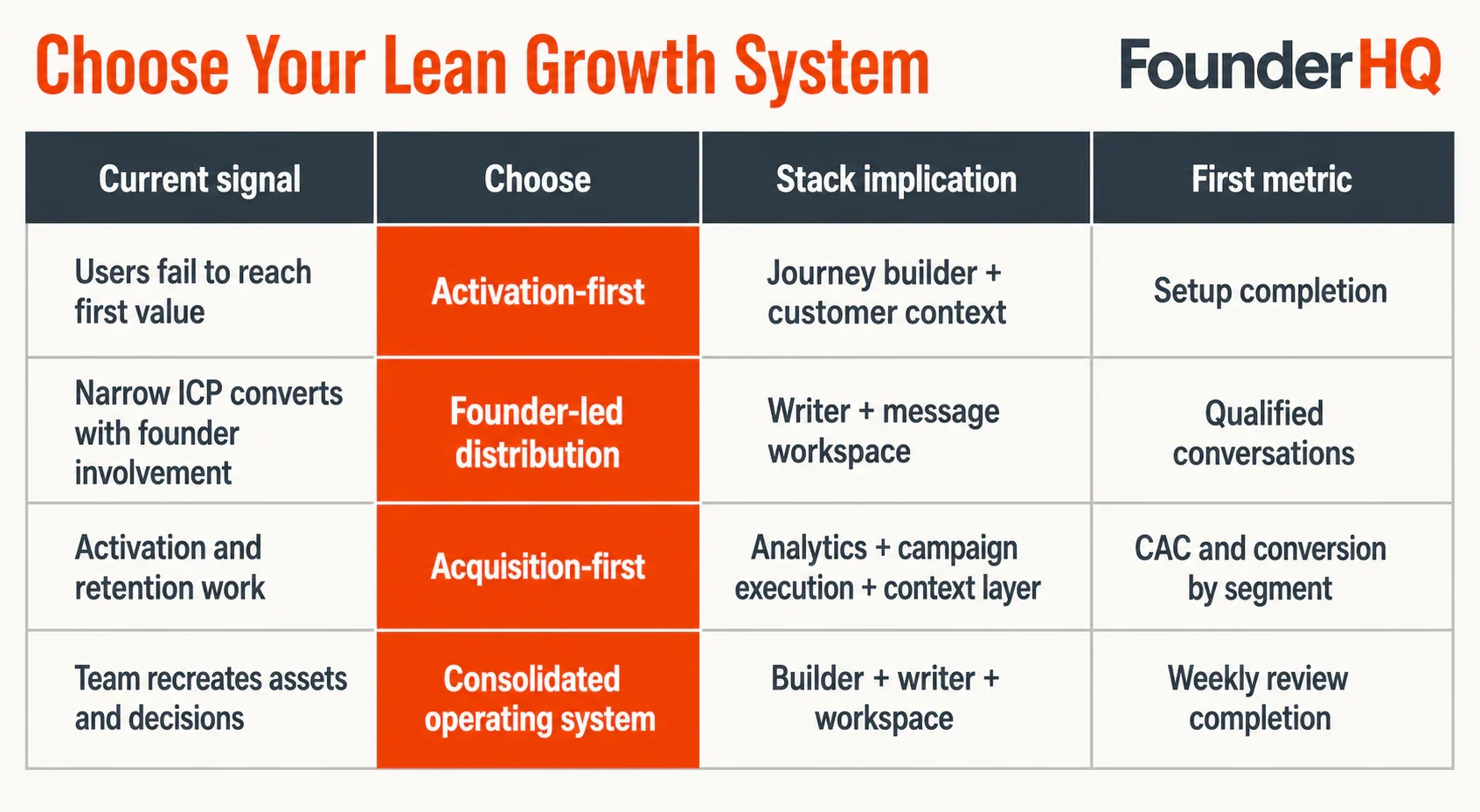
Current signal | Choose | Stack implication | First metric | Recommended next action |
|---|---|---|---|---|
Users fail to reach first value | Activation-first | Journey builder + customer context | Setup completion | Rewrite the first-value path and review every drop-off this week |
Narrow ICP converts with founder involvement | Founder-led distribution | Writer + message workspace | Qualified conversations | Turn one real objection into a founder-led post and a targeted outreach batch |
Activation and retention work for a defined segment | Acquisition-first | Analytics + campaign execution + context layer | CAC and conversion by segment | Run one paid or partner channel test against the proven segment |
Team recreates assets and decisions every week | Consolidated operating system | Builder + writer + workspace | Reused assets and weekly review completion | Move decisions, message notes, journey drafts, and content drafts into one reviewable workspace |
Step 3: Interpret the result
Pick the row that exposes the most expensive constraint, not the row that sounds most ambitious. A low activation score blocks acquisition. A vague ICP blocks paid spend. Weak founder-led response means the message needs sharper context before a bigger campaign. High fragmentation means the stack itself is now part of the growth problem.
Score patterns matter more than the total. Mostly 0s means the team needs a learning system, not a growth budget. Mixed 1s means the team should choose the one constraint that blocks the others and run a one-week loop around it. Several 2s with one obvious 0 means the 0 is the bottleneck. High fragmentation with otherwise healthy signals means the team may already know what to do, but the stack is slowing execution.
Step 4: Apply the default rule
The safest default for most early-stage product teams is activation-first plus founder-led distribution, run on the leanest stack that preserves context. That gives you learning density before you add spend or complexity. The exception is a team that can already prove a defined segment activates, retains, and can be acquired at an acceptable cost.
Example: the Friday constraint review
Here is a hypothetical decision scenario, not a customer result or operator anecdote. Imagine a two-person product team reviewing the week. Five qualified prospects clicked through from founder-led posts, three started onboarding, and none completed the setup step that reveals first value. The tempting move is to publish more or test ads because demand exists. The better move is activation-first: rewrite the setup journey, capture the objection language in the shared context, and use next week's founder-led content to set expectations before users enter the product. No performance claim is needed; the example shows the operating choice.
A weekly operating cadence that keeps the system alive
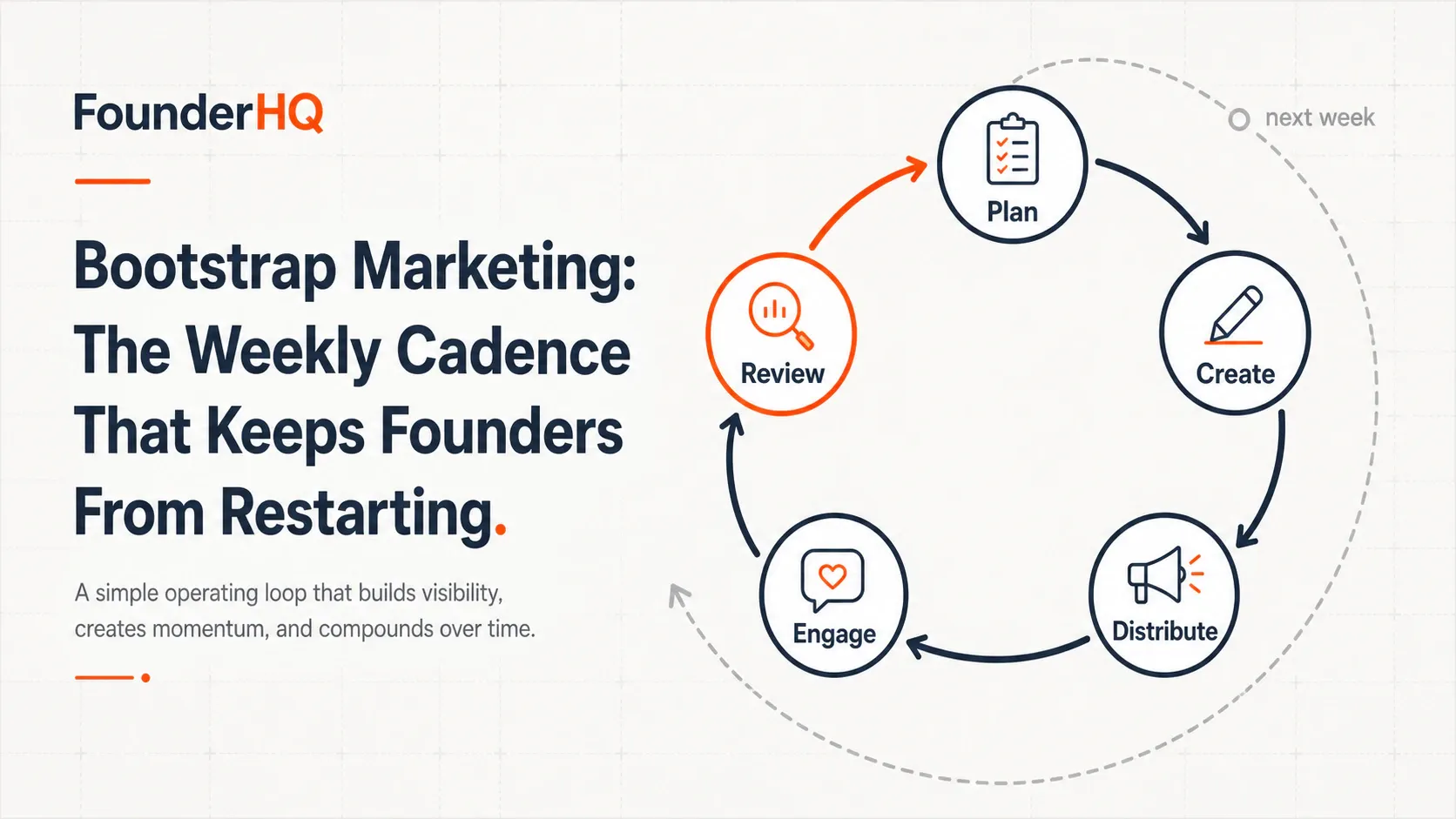
A growth system fails when it lives in strategy docs but not in the calendar. For a small product team, the cadence can be simple.
Monday: choose the constraint
Pick one constraint for the week: unclear ICP, leaky activation, weak message, low-quality conversations, or tool/context fragmentation. Do not let the week become a grab bag.
Tuesday to Thursday: run the loop
Ship one concrete improvement. That might be a tighter onboarding step, a founder-led post based on a real customer objection, a revised activation message, or a small outreach batch to a defined segment.
Friday: capture the learning
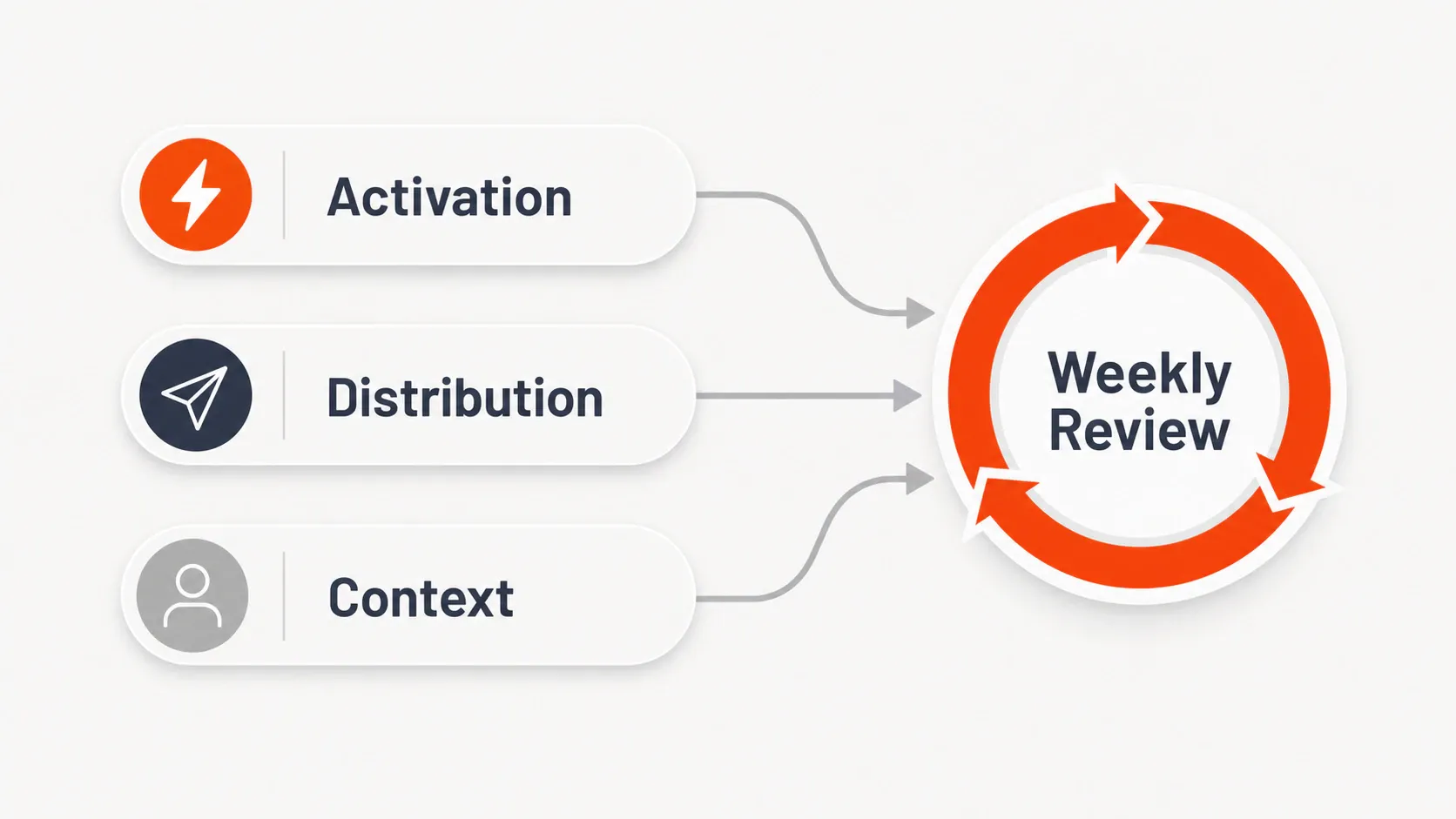
Write down what changed, what users did, what language worked, and what decision should carry forward. This is where company memory matters. If the learning stays in a call transcript, a Slack thread, or the founder's head, next week starts from a weaker place.
FounderHQ's focused operating system angle is strongest here: not another blank page, but a place where product journeys, founder-led content, and reusable context reinforce one another.
Quick FAQ for founders deciding how to grow
Should we focus on activation or acquisition first? If users are not reaching first value, focus on activation first. If the right users consistently activate and retain, acquisition becomes a more rational bet.
Is founder-led growth better than paid acquisition in 2026? For early-stage teams, founder-led growth is often the better learning channel because it produces market feedback and distribution at the same time. Paid acquisition becomes stronger once positioning, activation, and unit economics are clearer.
Do we need a consolidated platform or best-of-breed tools? Choose best-of-breed when you have specialized owners and enough process maturity to manage integrations. Choose a consolidated operating system when the same small team needs product journeys, content, and company context to stay aligned.
What is the simplest way to grow a startup without burning out? Pick one repeatable loop, instrument it, and review it weekly. Start with the scorecard above, choose the strongest constraint, and keep the next action small enough to complete this week.
Conclusion
To grow a startup in 2026, do not start by adding five channels or buying five tools. Start with the scorecard: choose the constraint, then choose the system. Activation comes first when the product leaks, founder-led distribution when learning is still scarce, acquisition when activation and unit economics are ready, and consolidation when context fragmentation is slowing the team down. Before buying another tool, score the five signals, pick the strongest constraint, and run one weekly loop that makes every journey, post, decision, and review sharper.
Recommended Videos
This YC video is a useful companion to the activation-first section because it explains how early users shape the product and why founders should learn from a small group before trying to scale.