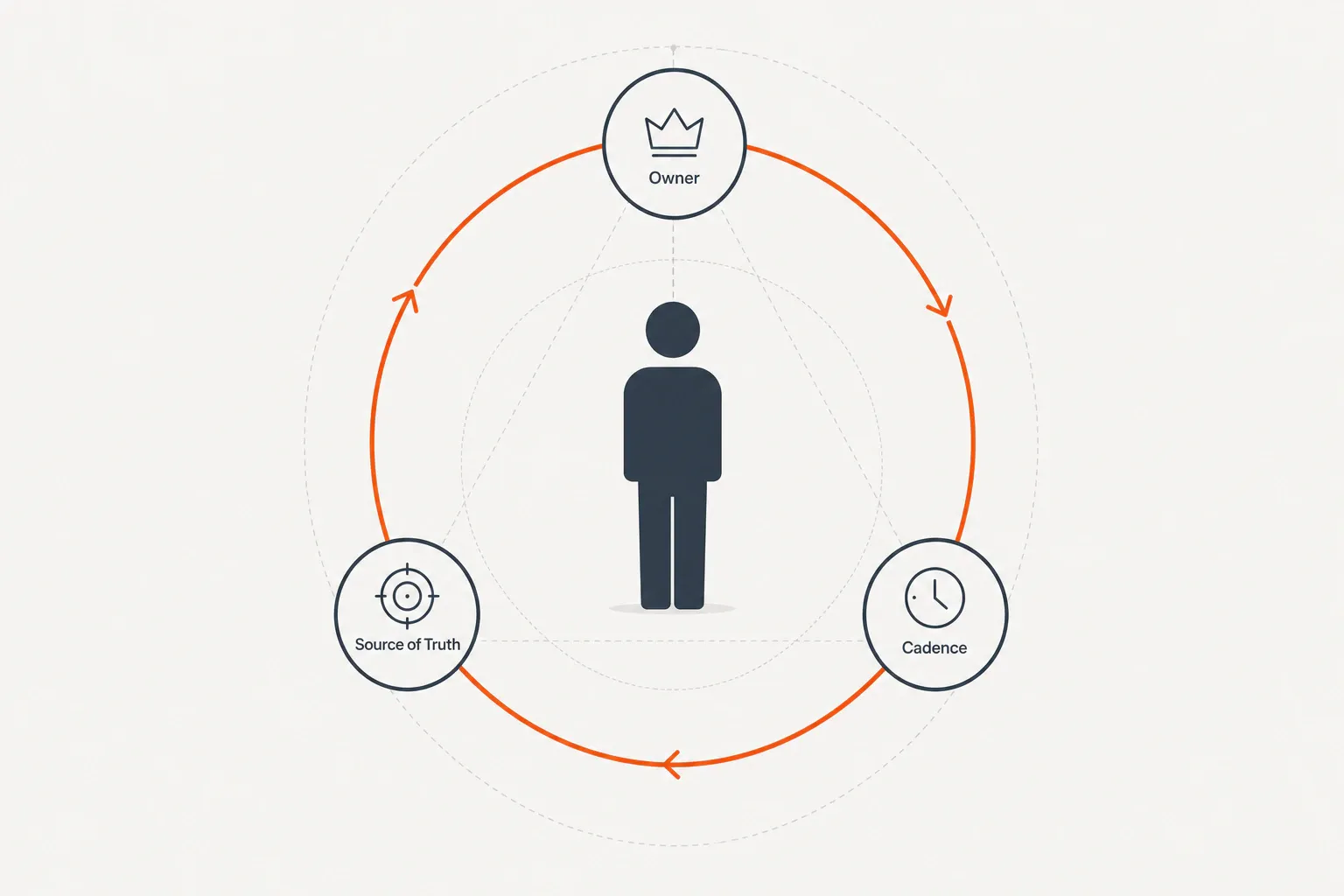
Search "grow startup" and you expect a tactics dump: pick a channel, run some ads, post on LinkedIn, repeat. But the credible 2026 advice has converged somewhere less convenient. Growth consultancy MAVAN puts it plainly: the best growth strategy now is to stop treating growth as a channel question and start treating it as an operating model — and a growth operating model only compounds when three pieces lock together, namely one accountable owner of the full funnel, one source of truth for data, and one cadence that turns weekly experiments into outcomes. Miss one and, as MAVAN notes, your wins leak back out the next quarter. Here's the problem that advice quietly assumes: a cross-functional growth pod, a quarterly cadence, and a team big enough to staff all three pieces. If you're a solo founder or a 2–3 person team, you have none of that. You don't have a pod — you ARE the pod. You're marketing, product, and analytics in one chair, and "name the accountable owner for the full funnel" just means "it's you, again." So the real buying decision isn't which channel to chase. It's how you run the growth operating model with the team you actually have: glue it together by hand, assemble a stack of point tools, or consolidate into one operating system. This guide gives you a decision framework — a comparison table, a five-question scorecard, and clear "choose this if" rules — built for the no-pod reality the rest of the genre skips.
The real "grow a startup" problem isn't channels — it's running a model with no pod
The reason most growth advice doesn't translate for tiny teams isn't that it's wrong — it's that it's scaled for someone else. The 2026 playbooks describe a system designed for a company that already has marketers, a product lead, a data person, and a lifecycle owner who can all sit in the same room every week. MAVAN's prescription for a stalled startup is explicit about this: establish one source of truth for revenue, name a single accountable owner for the full funnel ("not a committee, not a steering group"), and build a cross-functional cadence that includes product. That's excellent advice. It's also a staffing plan you can't run when the org chart is one person.
What survives the translation is the shape of the model, not the headcount. You still need an accountable owner — except that owner is you, and the scarce resource isn't a hire, it's a protected slot in your week. You still need a single source of truth — except it's not a data-warehouse arbitration ritual between finance and product; it's one place where your decisions, messaging, and numbers actually live instead of scattering across your head, your notes app, and six tabs. And you still need a cadence — except a 90-day quarterly rhythm is too coarse for a team that changes direction weekly, so yours has to be a sustainable weekly loop you can hold even on a heavy build week.
That reframe changes the question. For a no-pod team, "how do I grow?" is really "how do I operationalize owner + source-of-truth + cadence without a team to distribute the work across?" And once you see it that way, the decision stops being about channels and becomes a build-vs-buy decision about the operating model itself. The rest of this guide is that decision: what the model is, why it tends to break for small teams, the three ways to run it, and a scorecard to pick the one that fits your stage right now.
What a growth operating model actually is (and the 3 pieces a tiny team still needs)
Start with the distinction that the whole genre keeps reaching for: a growth system is not a list of channels. It's the loop that connects acquisition → activation → retention → referral → revenue into one repeatable motion — the stages popularized by Dave McClure's "Pirate Metrics" (AARRR) framework back in 2007 and still the default mental model in 2026 write-ups. A tactics dump optimizes one box in isolation. A system asks how a new user moves through the whole loop and where they fall out. That's the difference between "I posted on LinkedIn" and "I know what makes the people who find me actually stick."
Here's how the three pod requirements compress down to a team of one. None of them disappear — they just get smaller and more personal.
The accountable owner: a protected weekly slot, not a hire
On a big team, the owner is a person you appoint. On your team, the owner already exists — it's you — so the real act of ownership is protecting time. Block a recurring, non-negotiable slot for growth work the same way you'd protect a customer call. Without it, growth becomes the thing that always loses to shipping, and the loop never actually runs.
The single source of truth: one place context lives
For a funded company, the source of truth is a warehouse number that finance and product both agree on. For you, it's simpler and broader: one place where your company context — the decisions you've made, the messaging that works, the metrics you watch — is captured once and reused everywhere. The failure mode isn't disagreement between teams; it's that you re-derive the same positioning, the same onboarding copy, the same "what did we decide about pricing" from memory every time, slightly differently each time.
The cadence: a weekly loop, not quarterly OKRs
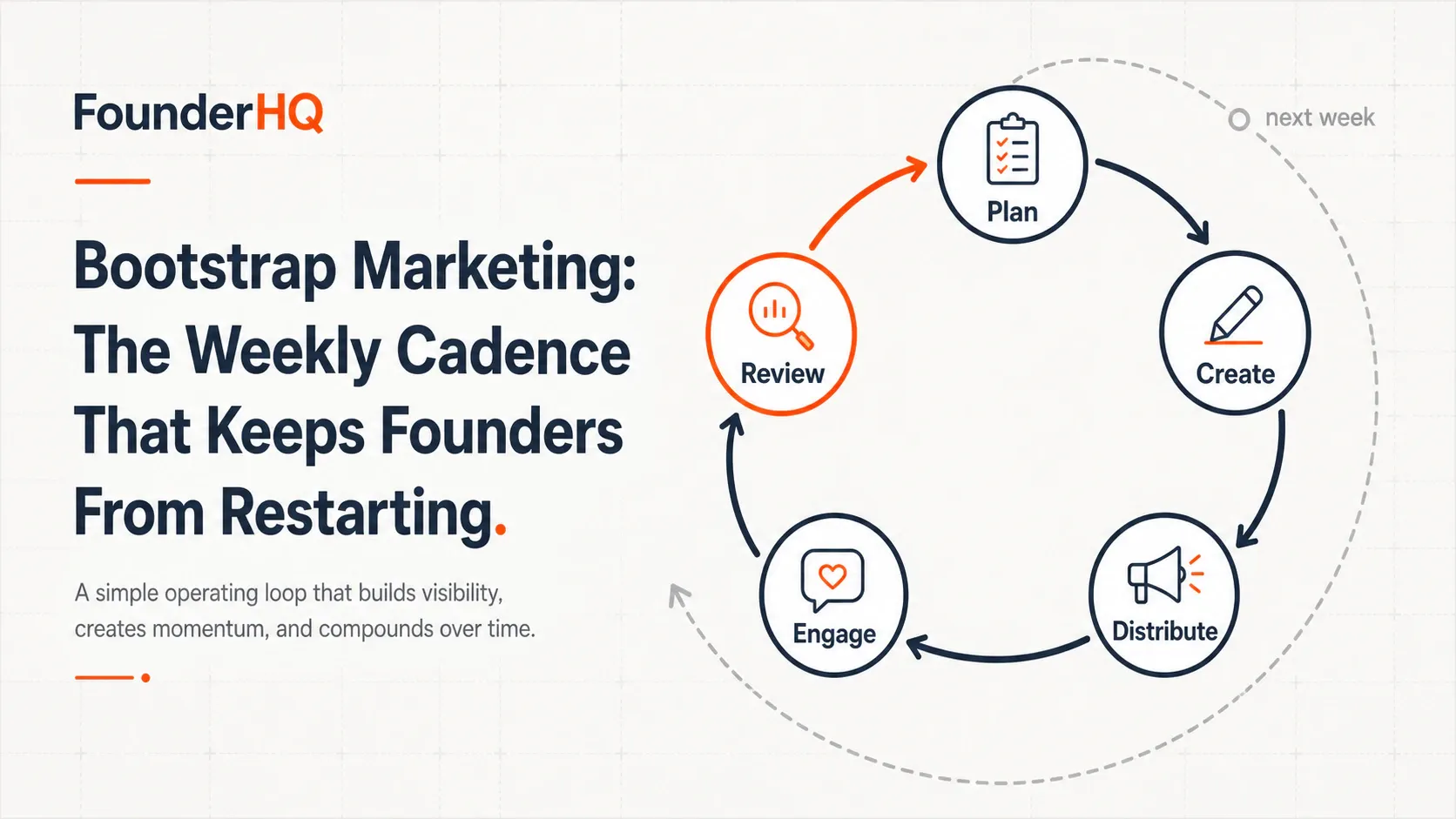
Quarterly planning assumes enough stability and staff to hold a 90-day line. A tiny team's cadence has to be weekly and small enough to survive interruptions: one experiment, one content beat, one context-capture habit. The point isn't velocity for its own sake — it's that a loop you can actually repeat beats an ambitious plan you abandon in week three.
One sequencing rule cuts across all of this, and nearly every credible source agrees on it: fix activation before you scale acquisition. Pouring more traffic into a product that doesn't reliably get people to first value just leaks faster. Pre–product-market-fit, the smarter move is to start with activation — understand what makes early users stay — and build acquisition around that. We'll keep the diagnosis light here, because the weight of this guide is on the operating-model decision, not on re-running the funnel math. But hold onto the rule: whatever model you pick below, instrument activation first.
Why the operating model breaks for small teams: tool sprawl and lost context
The most common way a small team's growth model quietly fails isn't laziness — it's fragmentation. The work gets real, so you add a tool for it. Then another. Onboarding lives in one place, your content drafts in another, your numbers in a third, your decisions in a fourth, and your actual company context nowhere durable at all. Each addition feels reasonable in isolation. Together they dissolve the "single source of truth" you were supposed to be protecting.
The data on stack sprawl is striking, even if you have to read it carefully. StackSwap's State of the GTM Stack 2026 — a model of 100,000 synthetic go-to-market stacks — found that 81.66% of stacks carried at least one redundant tool pair, with a median of two overlap pairs and a median $7,770/month in recoverable spend for teams large enough to have real overlap. Separately, the consolidation appetite is now mainstream: per ADAPT's CIO Edge research (reported via SAP), 68% of technology leaders plan to consolidate their vendor landscape, with a majority targeting roughly a 20% reduction in vendor count, and a survey of 1,000+ IT professionals found 90% rank software consolidation a priority. Sprawl is no longer a fringe complaint; it's the default state buyers are actively reversing.
One honest caveat before you spend on the strength of those numbers: that recoverable-spend figure is an enterprise and mid-market story. In the same StackSwap dataset, teams of 1–5 people showed essentially $0 in recoverable spend — a tiny stack doesn't have much fat to cut. So if you're a two-person team, the case for consolidating is not "you'll save thousands a month." Don't let anyone sell you that.
The tax that does hit you is different, and it's the one the spend numbers miss: context-switching and duplicated context. Every extra tool is one more place your decisions, your messaging, and your product journey live separately — one more login, one more place to keep in sync, one more re-explanation of what your product is and who it's for. For a team of one, attention is the bottleneck, not budget. The hidden cost of sprawl isn't the invoice; it's that your single source of truth is now spread across five surfaces and only fully assembled inside your head.
The buyer's decision: 3 ways to run your growth operating model
With the model defined and the failure mode named, the decision narrows to three operating modes. There's no universally "right" one — the right answer depends on your stage, your bottleneck, and how much context you can hold in your head before it starts dropping. The comparison below lays the three side by side; read your own situation into the rows.
Option A — Manual glue (spreadsheets + docs + memory). The cheapest, most flexible option, and genuinely the correct one for many pre-revenue teams. You run one experiment at a time, track it in a sheet, keep decisions in a doc, and hold the rest in your head. Choose this if you're pre-revenue, running a single experiment, and your whole company context still fits comfortably in your memory. The moment you find yourself re-deriving the same answer twice because you can't remember where you wrote it down, you've outgrown it.
Option B — Point-tool stack (separate onboarding/activation tool + content tool + analytics + notes). Best-of-breed depth: each layer gets a purpose-built tool that does its one job well. Choose this if a single layer is clearly your bottleneck — say activation flows are where you're losing people and you need a specialized builder for it — and you're willing to accept the integration and context-switching overhead that comes with it. Go in clear-eyed about the sprawl risk above: with most stacks carrying redundant pairs and consolidation now a top buyer priority, adding tools faster than you retire them is the exact pattern teams are working to undo.
Option C — Consolidated operating system (builder + writer + workspace in one). Choose this if your real constraint isn't depth in any one layer but focus, speed-to-output, and keeping your message and context consistent across journeys and content. This is the lane FounderHQ is built for: a focused operating system that combines a builder for product journeys, a writer for founder-led content, and a workspace for company context — so the three pieces of your operating model share one home instead of scattering. The trade is that you accept one integrated surface over best-of-breed depth in every layer.
The table below makes the trade-offs concrete. Note that all three are legitimate; the dimensions that should decide it for a tiny team are context consistency and switching cost, not raw feature depth.
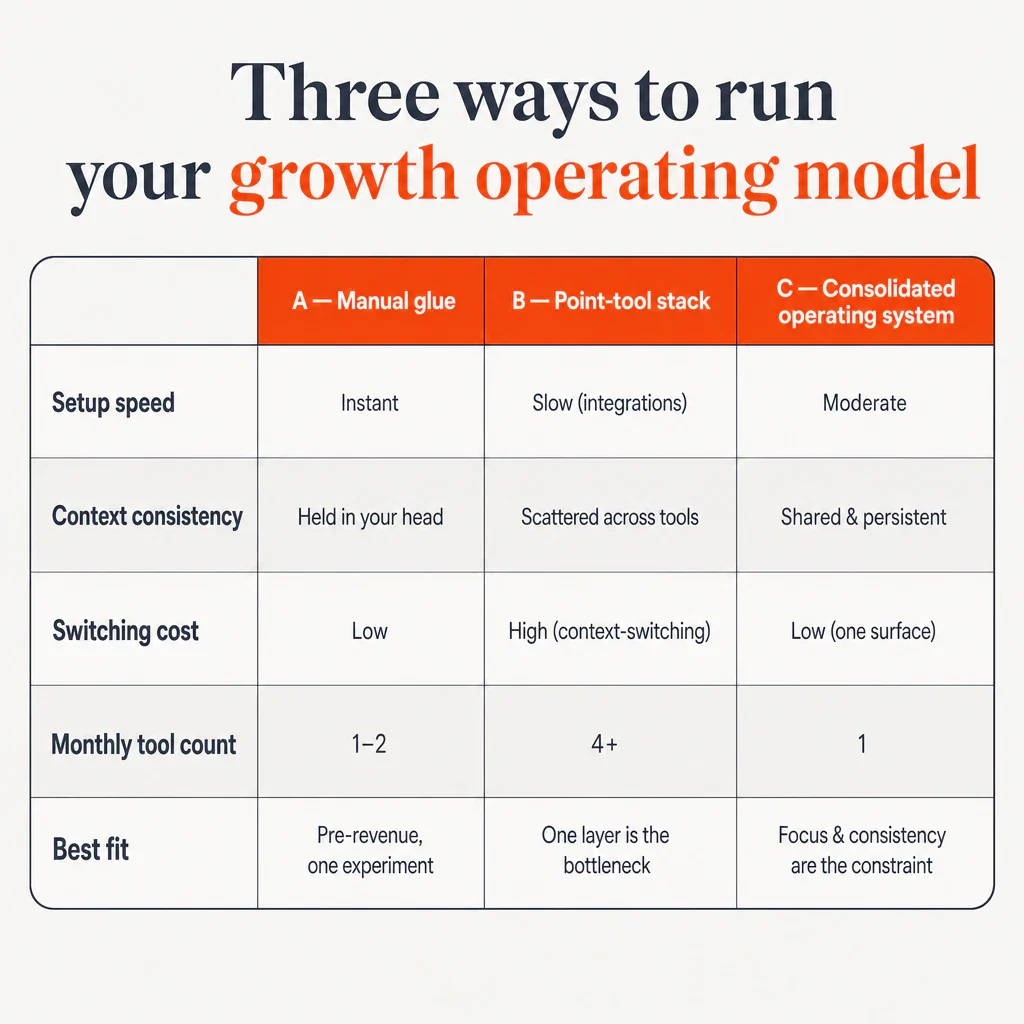
Dimension | A — Manual glue | B — Point-tool stack | C — Consolidated OS |
|---|---|---|---|
Setup speed | Instant | Slow (integrations) | Moderate |
Context consistency | Held in your head | Scattered across tools | Shared & persistent |
Switching cost | Low | High (context-switching) | Low (one surface) |
Monthly tool count | 1–2 | 4+ | 1 |
Best fit | Pre-revenue, one experiment | One layer is the bottleneck | Focus & consistency are the constraint |
Two honesty notes on Option C, because this is a buyer's guide and not a pitch. First, none of the product claims here are outcome metrics — we're describing capabilities (build journeys, compose content, keep context), not promising a conversion lift or hours saved, because those would be unverified. Second, consolidation is a real lever for time-poor teams, but the win for you specifically is context and focus, not the procurement-scale savings enterprises chase.
A decision scorecard: which model fits your stage right now
If the three options still feel close, score yourself. The five questions below are a quick, original self-diagnostic — answer each honestly, tally your points, and map the total to a model. It's deliberately blunt; the goal is a defensible default, not a precise verdict.
The 5 questions
Give yourself the points in brackets for each answer.
- 1. Where are you on activation signal? Pre-activation / no clear "aha" yet [1] · Some signal, refining it [2] · Activation works, scaling it [3].
- 2. How many tools already touch your growth work? One or two [1] · Three [2] · Four or more [3].
- 3. Where do your decisions and messaging live? All in my head / one doc [1] · A couple of places [2] · Scattered across several tools [3].
- 4. Is your bottleneck a single layer or whole-loop consistency? One specific layer [1 → but flag Option B] · A bit of both [2] · Keeping the whole loop and message consistent [3].
- 5. How many hours a week can you protect for growth? A few, ad hoc [1] · A reliable block [2] · A serious recurring commitment [3].
Reading your score
5–7 points → Option A (manual glue). You're early, light on tools, and can still hold context in your head. Don't buy software to feel productive; run one experiment, instrument activation, and revisit when memory starts dropping. Exception: a high score on question 4's "one specific layer" answer is a nudge toward Option B even at a low total.
8–11 points → Option B or C, decided by question 4. If your pain is concentrated in one layer, a specialized point tool (Option B) earns its place — just retire something when you add it. If your pain is whole-loop consistency and context drift, lean Option C. 12–15 points → Option C (consolidated operating system). Your context is scattered, your tool count is climbing, and your constraint is focus and consistency across journeys and content — exactly the conditions where one shared, persistent workspace beats a wider stack.
Tie the external evidence in plainly here, and keep it honest: analyses of unified platforms (Shopify's enterprise consolidation work, for instance) associate consolidation with faster implementation and fewer surprise costs — but that's enterprise data, and you should not transpose those outcomes onto a two-person team. For you, the consolidation payoff isn't procurement leverage; it's that your operating model's three pieces stop living in separate places. And whatever your score points to, the sequencing rule still rules: instrument activation before you scale acquisition, in any model.
Running the loop weekly: turning founder context into journeys and content
Picking a model is the buying decision; running the loop is the part that actually grows the startup. For a solo founder, a sustainable weekly cadence has three moves, and only three: one activation experiment (a change to how new users reach first value), one founder-led content beat (a post or narrative that reaches the right people), and one context-capture habit (logging the decisions and learnings from the week once, so you can reuse them instead of re-deriving them). That's the whole loop. Its power is that it's small enough to survive a bad week.
The reason context-capture is the quiet hero is that it's what makes the other two moves cheaper every week. Founder-led distribution still works early-stage — LinkedIn, X, and plain customer calls remain how a lot of tiny teams get their first users — but the leverage isn't in posting more; it's in turning those conversations and decisions into reusable messaging you don't have to reinvent. The same is true for activation: the copy and flows that explain your product to a new user are sharper when they draw on the positioning you already worked out, rather than being written fresh and slightly off-message each time.
This is where a consolidated operating system does its real work, and it's worth being precise about the mechanism rather than the magic. FounderHQ's pitch — builder, writer, workspace in one — maps directly onto the weekly loop: build the product journeys and onboarding/activation flows (the activation move), compose the founder-led content (the content move), and keep company context and memory in one place (the capture move). Because all three draw on the same persistent context, each output can stay consistent with the others instead of drifting. That's the capability claim, stated at capability level: shared context, not guaranteed results.
One thing to be clear about, because it's the whole brand line and an honest distinction in the market: this is about augmenting the founder, not replacing them. There's a genre of tooling that promises an autonomous "AI that runs your company while you sleep." That's a different bet. The operating-model approach here assumes you're still the owner, still making the calls, still the one accountable for the loop — the system just keeps your context in one place so you make those calls faster and more consistently. For a team that is the pod, leverage means doing your own thinking with less friction, not handing the thinking away.
Pick the model, not more tactics
Conclusion
Growing a startup in 2026 is, first, an operating-model decision and only second a channel decision. The 2026 consensus — one accountable owner, one source of truth, one cadence — is sound, but it was written for teams with a pod. As a solo founder or a 2–3 person team, you're the pod, so your version is a protected weekly slot, one home for your context, and a loop small enough to repeat. The buying decision underneath "how do I grow?" is really how you run that model: glue it manually while you're early and light, assemble point tools when one layer is your clear bottleneck, or consolidate into one operating system when focus and context consistency are what's actually holding you back. Use the scorecard to pick a defensible default, sequence activation before acquisition no matter which way you go, and remember the honest version of the consolidation case: for a tiny team the win isn't saved spend, it's keeping your decisions, your messaging, and your journeys in one place so every output gets sharper instead of drifting. Choose the model that fits the team you have — then go run the loop.