
Here's the trap almost every early-stage team falls into. Growth flattens, so you reach for another channel, another tactic, another tool — a second newsletter, a paid experiment, a fresh landing page. You're adding inputs because the output stalled. But on a tiny team, the leak is rarely the channel. It's that your homepage, your LinkedIn posts, your onboarding copy, your pitch deck, and your last three sales calls have each drifted a few degrees apart, until the same company is quietly describing several slightly different products. That gap has a name — message drift — and in 2026 it's one of the most under-diagnosed reasons a startup's growth refuses to compound. This is a buyer's guide, but not the usual tactics dump. The decision underneath 'how do I grow?' is really 'where does my story and company context actually live, so every surface pulls from the same source?' We'll define the problem, give you a fast self-diagnosis, then compare three ways to hold one consistent narrative — including FounderHQ's own consolidating angle: leverage, not another blank page. Throughout, treat third-party figures as cited claims to weigh, not gospel.
You don't have a growth problem — you have a consistency problem
When effort is high and the line barely moves, founders instinctively blame reach. But for teams past their first users, the more common culprit is that the story has fractured across surfaces. The marketing consultancy Stratridge describes message drift as the hardest failure mode to catch precisely because nothing looks broken in isolation: "The homepage update was fine. The pricing-page refresh was fine. The sales deck revision was fine... The aggregate is seven subtly different products being described by the same company."
Drift doesn't announce itself. Copywriting firm Marketsmiths frames it as "the gradual loss of coherence in how an organization describes its value, capabilities, and market position" — precision quietly giving way to approximation as new pages, posts, and decks get written on different days, in different moods, against no shared reference. Old positioning rarely disappears; it just accumulates in layers until you spend more time clarifying what you mean than communicating what you offer.
The reframe that matters for this guide: growing a startup isn't only a question of which lever to pull. It's a question of where your through-line lives. If the answer is 'in my head, mostly,' then every busy week is a chance for the story to drift another degree — and no channel tactic fixes an unclear message. This is a decision about your single source of truth, and it's the one we'll help you make.
Why message drift quietly throttles early-stage growth in 2026
Narrative strategist Kate M. Hamilton argues that many growth problems are "narrative problems in disguise" — pipeline gaps, weak referrals, and content that never compounds often trace back to a missing through-line everything should pull from. When each surface tells a slightly different story, your assets stop reinforcing one another, so the cumulative effect a consistent narrative is supposed to build never accrues.
Positioning is operational infrastructure, not a creative exercise
Unclear positioning shows up as concrete, expensive symptoms. Consultancy Stainless Communications describes how, when positioning is weak, "deals take longer to close. Buyers want more calls... Discounts become normal," because the buyer can't quickly tell why you're the safer choice and resorts to comparing you. StartupNation's analysis of the 'positioning trap' cites CB Insights' well-known finding that roughly 42–43% of startups fail because there's no market need for the product — frequently a failure of the market to understand why it needs you, not only of the product itself. Treat that figure as the widely-cited CB Insights claim it is; the point here is the cost of being misunderstood, which inconsistency amplifies.
A clear, repeatable story is the cheaper edge
The economics tilted further in 2026. Marketsmiths notes that buyers are now "overwhelmed with a deluge of voices, many of them AI-generated," and that the trust deficit from content fatigue is one of the biggest threats to brands. When everyone can generate more content cheaply, volume stops being a moat. The startup that says one clear, repeatable thing across every surface stands out at lower cost than the one drowning prospects in well-produced but subtly inconsistent noise. Consistency, in other words, has quietly become a growth lever — not a branding nicety.
Reframing 'grow a startup' as a single-source-of-truth decision
Tactics live on the surface: which channel, what sequence, how often. Beneath them sits the layer that decides whether any of it compounds — the named story everything must pull from. Hamilton's core prescription is exactly that: define the through-line once, then make every output pull from that single source. Get that layer right and your channel choices get easier; get it wrong and even great channels carry a muddled message.
This hits the smallest teams hardest, and counterintuitively so. With no growth pod, no PMM, and no brand guardian, the story lives almost entirely in the founder's head. That feels like an advantage — total proximity to the narrative — right up until a busy build week, a fundraising sprint, or a support fire pushes it aside and the next post gets written from memory rather than from a reference. Storytelling firm Go Narrative calls this accumulating gap 'narrative debt': the drift that compounds when there's no shared, written source for the story to anchor to. Proximity stops substituting for clarity the moment you're too busy to remember exactly how you framed it last time.
This is the gap FounderHQ is built to close. Its premise is a unified growth stack for early-stage product teams — a builder, a writer, and a workspace — organized so persistent company context and memory sit underneath everything you produce, keeping journeys, posts, and narratives consistent over time. To be transparent about what that is and isn't: it's founder-augmenting, not a system that autonomously 'runs your company.' It exists to make the founder's own story easier to keep straight, not to replace the founder's judgment about what that story should be.
A 90-second self-diagnosis: is message drift your real bottleneck?
Before you commit to a fix, confirm you have the problem. Drift is field-detectable if you go looking. Adapting the signals Stratridge and others document, scan your own surfaces for these tells:
- Homepage vs. deck mismatch. Your homepage hero, your pitch deck, and your pricing page name the category or core value differently — each written by someone real, each contradicting the others.
- You're absorbing a competitor's language. A rival calls their product a 'revenue intelligence platform,' and six months later that phrase is creeping into your own posts and calls — even though you positioned against it.
- Your ICP is named differently across artifacts. Onboarding speaks to a beginner, the sales deck speaks to a power user, and the blog speaks to someone else entirely.
- Effort is high but the line is flat. Stainless and others flag this as the textbook signal: when activity is high and output is flat, the constraint is usually message clarity, not hustle.
Then run the simplest test there is: ask three people who know your product to describe what you do in one sentence. If you get three meaningfully different answers, the problem is upstream of your channels — no amount of channel optimization will fix a story that hasn't been pinned down. Choose into the comparison below if any of this lands: you're a solo founder or 2–3 person team, past your first users, producing content across more than one surface, and sensing the story has started to scatter. If you're pre-first-users and barely writing yet, the lightest option will do — keep reading to see which.
The buyer's decision: 3 ways to keep one consistent story
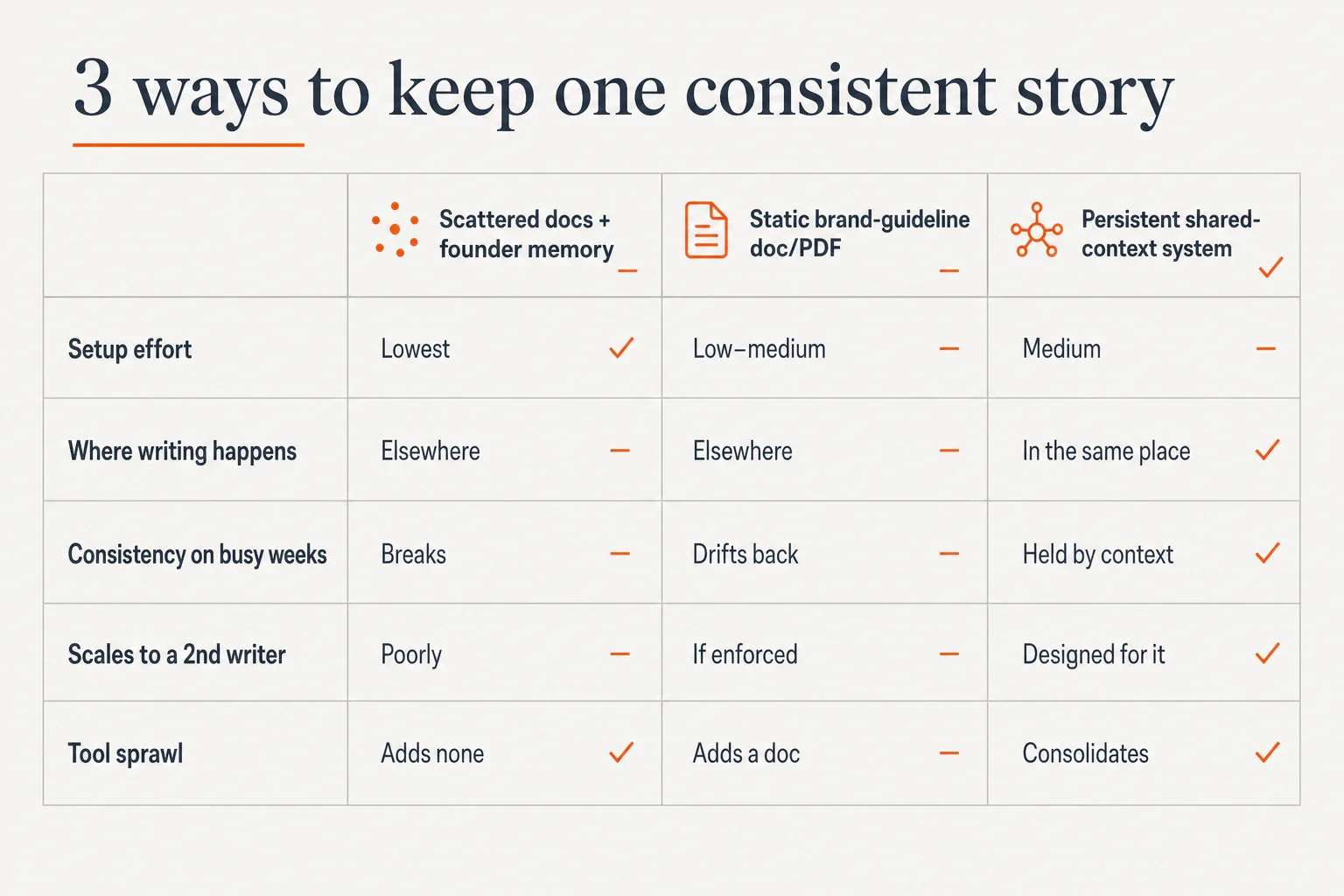
There are really three places your story and context can live, each a legitimate choice at a different stage. The figure below summarizes the trade-offs; the detail follows.
Option A — Scattered docs + founder memory
Your story lives across Notion pages, a few Google Docs, some screenshots, old launch posts, and mostly the founder's head. Pros: zero setup, zero new tools, zero cost. Cons: it's the most fragile arrangement under exactly the conditions that matter — busy weeks, and the moment a second person starts writing. With no canonical reference, every new asset is reconstructed from memory, which is how narrative debt accrues. Choose this if you're pre-first-users, writing rarely, and the entire story still genuinely fits in one head.
Option B — A static brand/messaging-guideline doc
You write the story down once — a positioning doc, a messaging framework, a one-page brand guideline — and treat it as the reference. This is a real improvement: it creates an explicit single source of truth, the thing messaging strategists like The Starr Conspiracy advocate as a cross-functional reference. The catch is that a static doc isn't where the actual writing happens. It lives in a separate tab, gets opened during a rebrand and rarely after, and 'collects dust' while the live surfaces keep evolving on their own cadence — so drift creeps back in. Choose this if you have the discipline (or a person) to actively enforce the doc against every new asset.
Option C — A persistent shared-context operating system
Here the story and the drafting live in the same place: a workspace that holds persistent company context and memory, and a writer that drafts founder-led content against it — so posts, narratives, and onboarding copy are produced on top of the source of truth rather than beside it. This is FounderHQ's lane: builder plus writer plus workspace in one focused operating system, so consistency is a property of where you work, not a doc you have to remember to consult. Choose this if you're producing content regularly across surfaces, tool-fatigued, and want the through-line to hold even on weeks you're heads-down. Keep your expectations capability-level: a shared context makes consistency easier to sustain; it doesn't write your positioning for you or guarantee an outcome.
Scattered docs + memory | Static guideline doc | Persistent shared-context system | |
|---|---|---|---|
Setup effort | Lowest | Low–medium | Medium |
Where writing happens | Elsewhere | Elsewhere | In the same place |
Consistency on busy weeks | Breaks | Drifts back | Held by context |
Scales to a 2nd writer | Poorly | If enforced | Designed for it |
Tool sprawl | Adds none | Adds a doc | Consolidates |
The consolidation case: fewer tools, one story
There's a tempting fourth option lurking here: bolt a dedicated messaging tool onto everything else. Be careful, because the 2026 data on small-team tooling runs the other way. The Mewayz SMB Software Spend Report 2026 — based on its analysis of 138,000+ businesses — reports the average SMB now uses about 8.7 core tools, down from roughly 11.2 in 2023, and that 61% of SMBs prefer 'an integrated platform where tools share data' over a collection of best-in-class point solutions. For micro and solo businesses specifically, the report puts the active tool count even lower, around five. The direction of travel is consolidation, not accumulation.
The waste underneath that shift is real, too. The same report notes that 94% of businesses admit to at least one tool they 'rarely use but still pay for,' and broader 2026 SaaS research (BetterCloud and others) repeatedly flags that a meaningful share of SaaS spend goes to redundant, overlapping, or unused licenses — one consolidation analysis cites consensus that fewer than a third of purchased software features actually get used. Every extra tool also adds switching cost: another login, another place the story could quietly diverge. Present all of these as the cited industry claims they are — but the pattern is consistent enough to plan around.
This is the practical argument for Option C over a sprawl of point tools. If the goal is one consistent story, putting where-you-write and where-your-context-lives in the same focused operating system is how a tiny team holds the narrative without managing a stack to do it. That's the heart of FounderHQ's unified-growth-stack differentiator: not more software, but less — builder, writer, and workspace consolidated around a single persistent context, so consistency is the default rather than a separate job.
A lightweight weekly cadence to hold the story steady
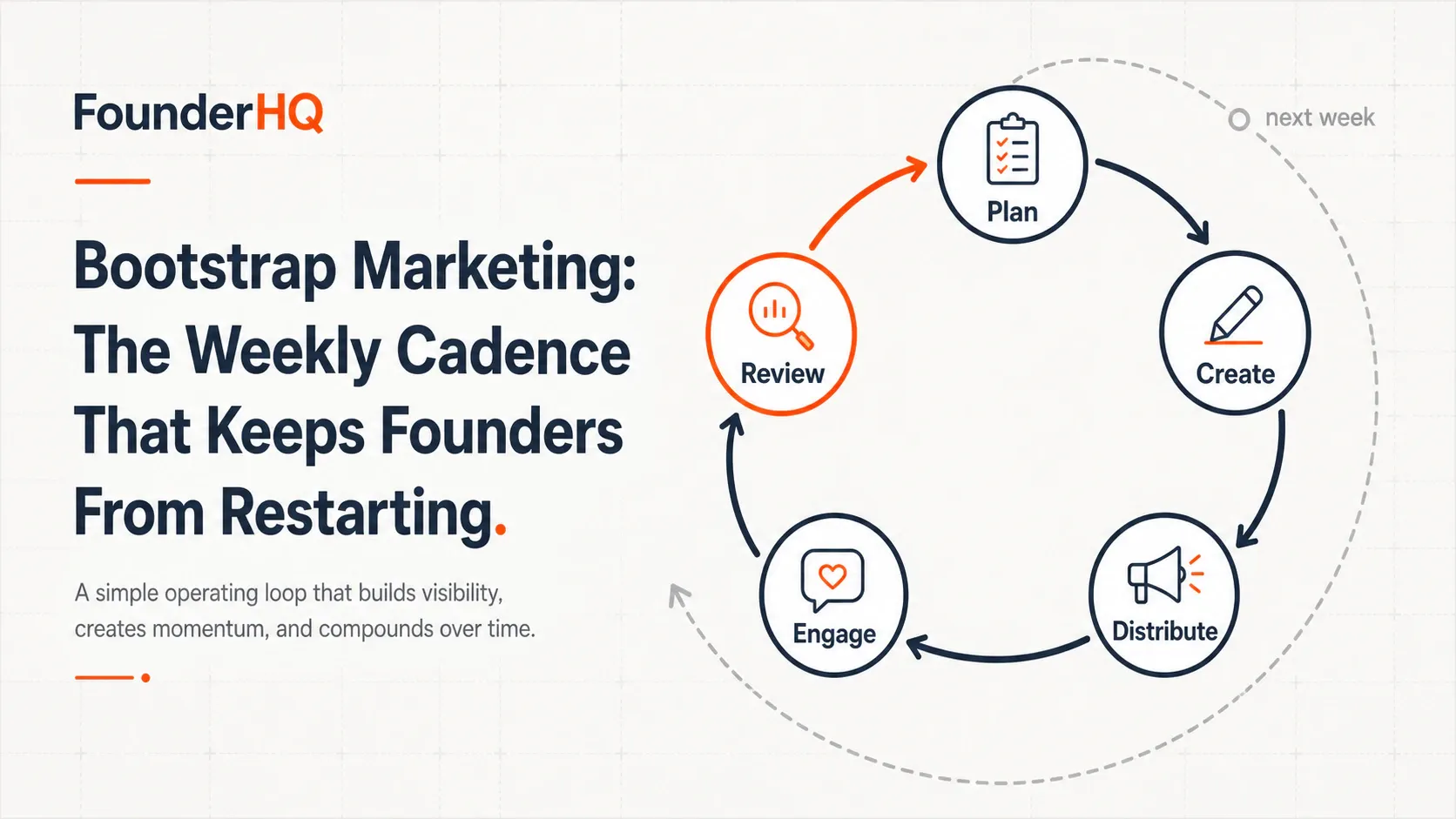
Whichever option you pick, the source of truth only works if you protect it on a rhythm. Growth-advisory firm Mavan frames the modern growth-operating model as 'one source of truth plus one cadence' — a single reference, reviewed on a fixed beat, rather than scattered tactics chased ad hoc. For a time-poor founder, that translates into a loop you can hold in under an hour a week.
The loop
- Name the one through-line. In a single sentence: who it's for, the problem, and why you specifically. This is the reference everything else pulls from.
- Write everything against it. Before a post, page, or deck slide goes out, check it answers to that sentence rather than improvising a new framing.
- Review the surfaces on a fixed cadence. Once a week or every two weeks, skim your live surfaces — homepage, latest posts, onboarding, the deck — for the drift signals from the self-diagnosis, and pull any stragglers back in line.
Why a persistent context makes the loop cheaper
The loop is far lighter when your context is captured rather than reconstructed. Reusable company context and memory turn each piece of writing into raw material for the next — a launch narrative feeds the LinkedIn post, which feeds the onboarding copy — instead of every asset starting from a blank page. That's the FounderHQ workspace premise at capability level: a place where decisions and framing persist, so consistency compounds instead of resetting each week. So here's the decision recap. Diagnose honestly whether message drift is your real bottleneck; if it is, pick the option that fits your stage — scattered docs while you're tiny, a static doc if you'll enforce it, a shared-context system once you're writing regularly and tired of the sprawl — and then protect the story on a weekly beat. Growth compounds when the narrative does.
Conclusion
It's a quietly liberating reframe: you may not need another channel, another hack, or another tool to grow. You may just need every surface to tell the same story. For a solo founder or a 2–3 person team, message drift is the leak that lengthens sales cycles, weakens referrals, and stops content from ever compounding — and it's fixable without a growth pod. Decide where your story and context will live, choose the option that matches your stage, and review your surfaces on a cadence you can actually hold. Do that, and the work you were already doing starts to add up instead of canceling itself out. The narrative is the asset; protect it, and growth follows.