If you have a few genuinely happy users and no ad budget, the advice you keep reading — pick a channel, sequence your stack, run paid once it works — is mostly upstream of the real question. The quieter, higher-leverage move is to stop hoping word-of-mouth happens and start engineering it into a deliberate, repeatable referral loop. Word-of-mouth still does extraordinary work: McKinsey finds it is the primary factor behind 20 to 50 percent of all purchasing decisions, and survey data from Ogilvy/TNS/Google puts the share of consumers citing it as a key purchase influence around 74 percent. Yet most founders treat it as luck — they want it, assume a good product spreads on its own, and never build a system for it. This guide is scoped to one decision the rest of the 'grow startup' canon skips: how a solo founder or 2–3 person team should engineer word-of-mouth into a referral loop, and which mechanic to choose. It deliberately defers to our companion pieces on activation, message consistency, and stage diagnosis — here, we stay on the loop.
The bottleneck most 'grow startup' advice skips: hoping for word-of-mouth instead of engineering it
Channels, levers, and sequencing are real debates, but they all assume you've already decided how you'll turn happy users into more users. For a tiny team with no paid budget, that's the leverage point. Referrals aren't just cheap acquisition — they bring better customers. Drawing on academic and industry research, Extole reports that referred customers convert several times better and retain meaningfully longer than customers acquired through paid channels, with figures often cited around a 37% higher retention rate and roughly 16% higher lifetime value (the LTV number traces back to a Wharton study of bank customers). Trust is the reason: Nielsen-style survey data summarized by Buyapowa puts the share of consumers who trust recommendations from people they know around 88%, and people are far more likely to buy when a friend recommends the product.
The failure mode is consistent across the research we reviewed: founders want word-of-mouth but never design for it. They assume a good product spreads by itself. It rarely does at the volume a startup needs — there's a well-documented gap between the share of satisfied customers willing to refer and the share who actually do without a structured prompt. Word-of-mouth is also one of the few channels relatively untouched by the flood of AI-generated content; a real recommendation from a real person still cuts through where another generic post does not.
So this is not another channel listicle. It's the referral-loop design decision: first confirm you're ready, then choose the mechanic that fits your stage and product. We'll touch the activation gate only as a prerequisite — the deeper work of shipping a guided first-value journey, keeping your message consistent across surfaces, and diagnosing which growth stage you're actually in lives in separate guides on the FounderHQ blog.
First, the gate: don't build a referral loop into a leaky bucket
A referral program amplifies whatever is already true about your product. If users love it, you multiply that love. If they quietly churn, you simply pay to introduce more strangers to a product that won't keep them — and you accelerate the leak instead of plugging it. The signal worth chasing is real: research summarized by Value Add VC notes that companies with an NPS above 50 generate roughly twice the organic referral rate of companies below 30. Treat strong retention and genuine enthusiasm as the entry fee, not the prize.
You don't need a formal NPS survey to run the gate. The most honest self-check is behavioral: are users already referring you without being asked? Look at your inbox, your DMs, the Slack and community threads where your name comes up. Unprompted, organic word-of-mouth — even a trickle of it — is the raw material you can engineer. If it isn't happening at all yet, a referral incentive is unlikely to manufacture advocacy that doesn't exist.
If the gate is failing, the fix isn't a referral tool — it's first value. Make sure new users reliably reach their first 'aha,' then layer the loop on top once value lands. That activation work is a distinct discipline (we cover the guided first-value journey in a companion guide); referral loops are the layer you add after it, not instead of it.
'Ready enough' for a tiny team, in plain and defensible terms: a handful of users who keep coming back, at least some unprompted recommendations in the wild, and a clear sense of the moment in your product where a user first feels the win. You don't need a viral product. You need a real one with at least a few people who'd vouch for it.
How an engineered referral loop actually works (the vocabulary you need to choose)
Before you pick a mechanic, you need three pieces of vocabulary so you can set honest expectations and avoid chasing 'viral.'
K-factor (viral coefficient): what it is and why it's usually under 1
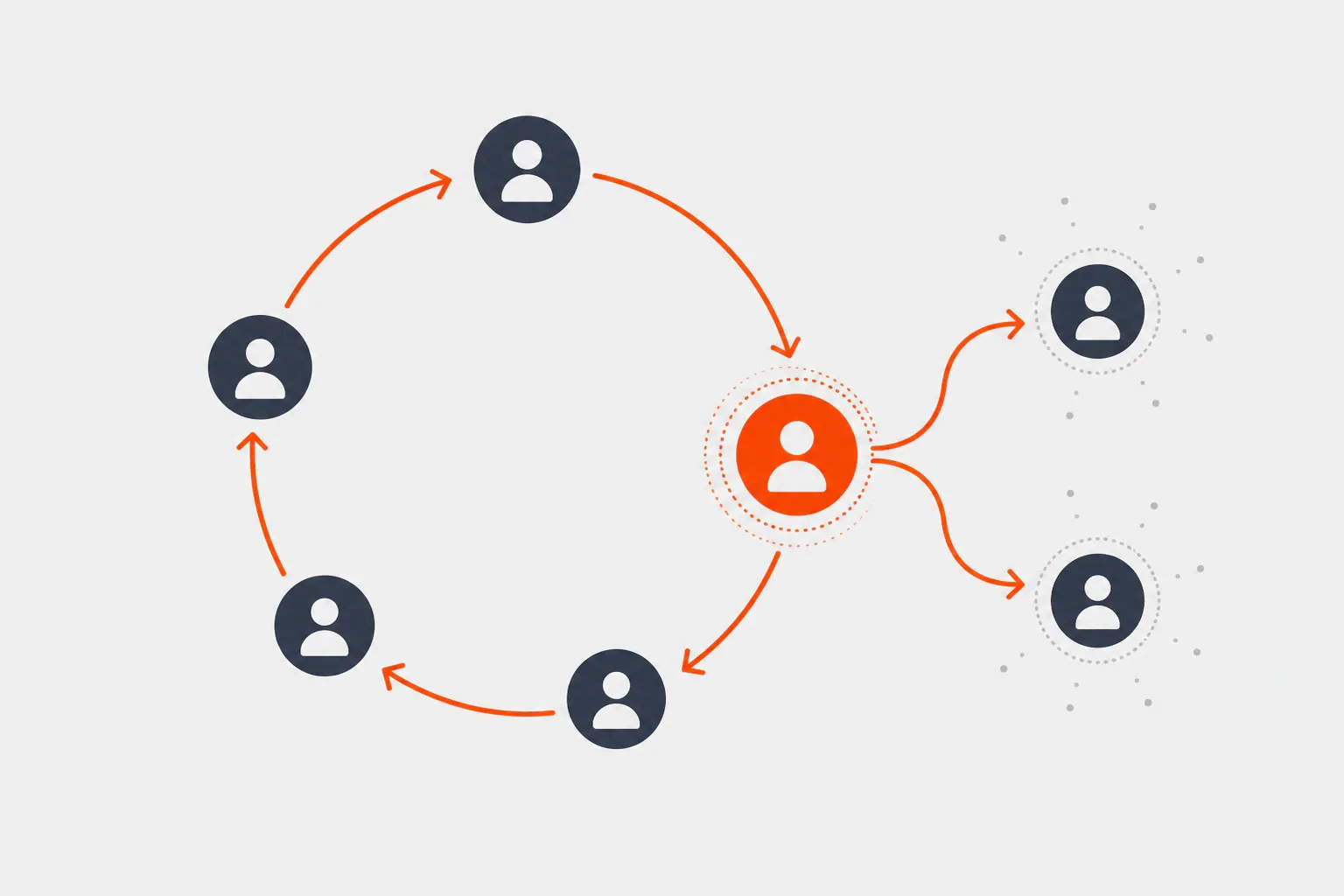
The K-factor is the average number of new users each existing user generates through invites. The standard formula is K = i × c, where i is invites sent per user and c is the conversion rate of those invites. K above 1 means each user brings more than one new user — self-sustaining, exponential growth. K below 1 means referrals amplify but don't replace your other acquisition; you still need another front door. Sustained K above 1 is rare and usually temporary, even for famous examples, as audiences saturate and invite fatigue sets in. For most B2B SaaS, benchmark data (e.g., Monetizely figures cited by Growth Engineer) puts the average K-factor around 0.2, with healthier loops landing roughly in the 0.15–0.7 range. That's not 'viral' — it's a multiplier on the users you already acquire, and it's still worth running.
Cycle time can matter as much as the coefficient
The number founders ignore is viral cycle time — how long it takes a new user to generate their referrals. The same K compounds very differently at different speeds: a lower K with a fast cycle can outpace a higher K with a slow one, because the loop closes more often. The practical implication splits by product type. Consumer products with quick, repeated use can have short cycles; many B2B products have long ones (a user might not hit a shareable milestone for weeks). If your cycle is slow, optimizing speed to the share moment often beats squeezing the incentive.
The trigger principle every source agrees on
Across the program-design research we reviewed (mean.ceo, The Growth Terminal, Value Add VC, Bricqs), the consensus is unusually tight on two rules. First, ask after a real win — not at signup. The brain is in a giving mood right after a meaningful result; the account-settings page and cold emails get materially lower share rates. The Growth Terminal pegs the sweet spot around 48–72 hours after a user's first activation moment, and notes in-product prompts convert far better than email asks. Second, reward only after the referred user reaches value (a verified signup, first use, or purchase), never on a click. Click-based rewards attract fraud; conversion-based rewards, plus basic anti-fraud controls like blocking self-referrals and capping rewards per inviter, keep the loop honest from day one.
The decision: three ways a tiny team can run a word-of-mouth loop
There are three honest ways to run the loop, and the right one depends on your stage, volume, and how naturally your product is shared. The matrix below summarizes the trade-offs; the notes after it give you a 'choose this if' rule for each.
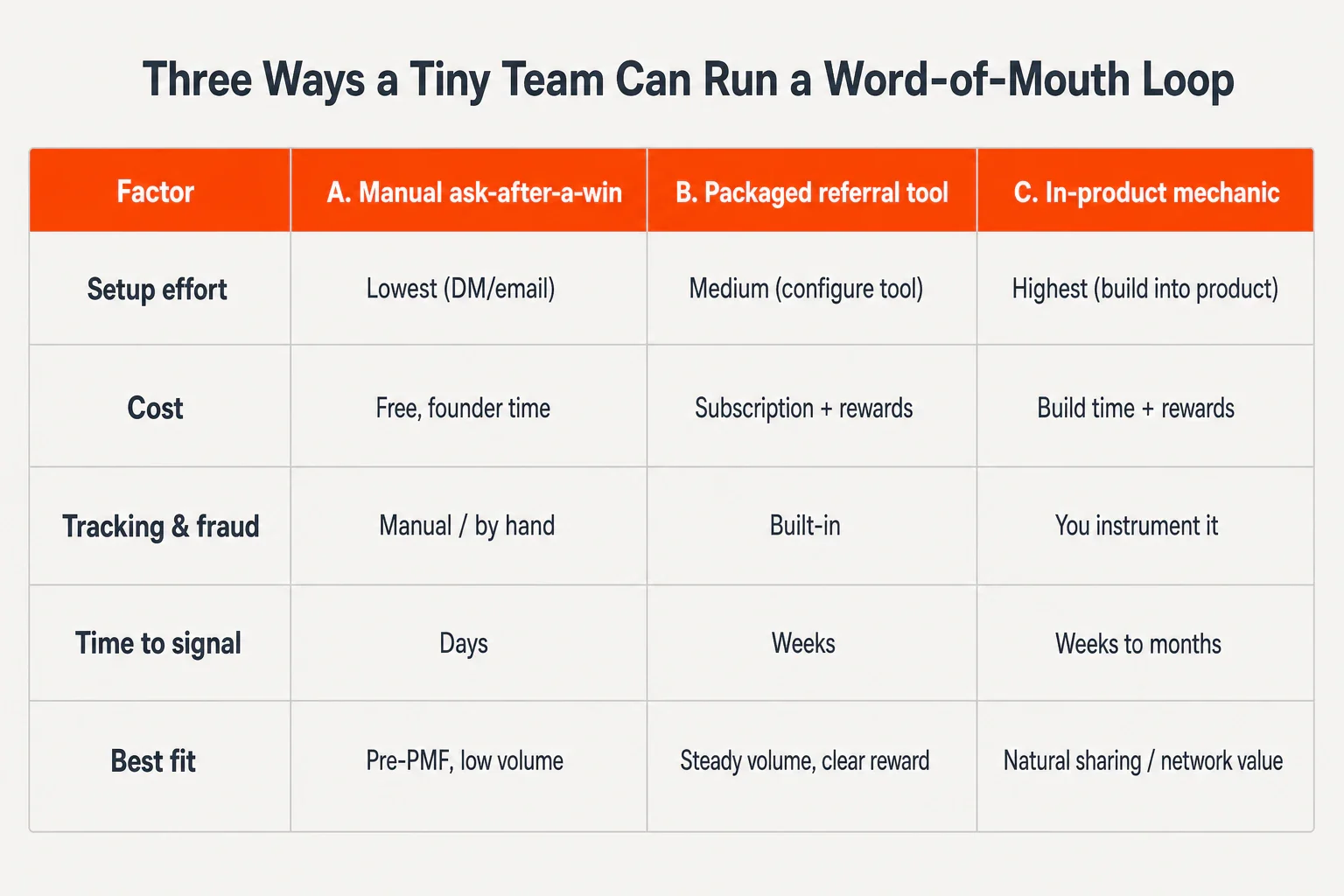
Option A — Manual ask-after-a-win
Founder-led, no tooling. You watch for a high-NPS moment — a user hits a real result, replies with praise, completes a project — and you personally DM or email them with a simple, specific ask and a pre-written share message. Choose this if: you're pre-PMF, your volume is very low, and you want interpretable signal and qualitative learning fast. The manual version teaches you why people refer (or don't) before you automate anything — and that learning is the real asset at this stage.
Option B — Packaged referral / customer-marketing tool
A dedicated tool gives you tracking, reward fulfillment, attribution, and fraud checks out of the box, so you don't build any of it. Choose this if: you have steady, repeatable volume, a clear reward that fits your margins, and you'd rather configure than code. The cost is a subscription plus the rewards themselves, and you'll still need to design the trigger and offer well — the tool runs the plumbing, not the strategy. (We're not naming or endorsing a specific vendor here; evaluate current options against your own margins and attribution needs.)
Option C — In-product referral mechanic
The Dropbox-style move: the share moment is built directly into the product journey — an invite-and-credit loop placed at the activation milestone, often with a two-sided reward. Choose this if: your product has natural sharing or network value (collaboration, shared outputs, multiplayer workflows) and you can place the ask at the moment a user first feels the win. This is the highest-effort option to build and instrument, but it's also where strong B2B loops actually come from — research is clear that real virality is designed in, not bolted on with a 'refer a friend' checkbox.
Use the matrix as a fast self-route: if you can't yet describe the single moment your user feels their first win, you're not ready for Option C — start with A, learn the moment, then graduate.
Designing the loop: trigger, offer, and measurement that don't waste your scarce hours
Whichever mechanic you choose, the loop is the same three parts. Get these right and the mechanic almost doesn't matter; get them wrong and no tool saves you.
Trigger. Pin the ask to a specific value moment in the user journey — first win, project completion, an onboarding milestone — not account creation. This is the single most under-designed part of most programs and the cheapest to fix. Map the one action that defines 'activated' for your product, then fire the ask shortly after it, ideally inside the product rather than over email.
Offer. Match the reward to your model and margins: account credit, a free month, status or a feature unlock, or a two-sided perk so the referrer feels like they're giving a gift, not pocketing a bounty. Don't optimize incentive size before you've optimized timing — the research is consistent that when you ask beats how much you offer. Test one reward and one trigger at a time so you can actually read what changed.
Measurement. Track the handful that matter and ignore vanity volume: invite rate, share-to-click, referred-lead conversion, and — most important — referred-customer retention versus your other channels. That last metric is the whole point: referred customers tend to retain and convert better, so if your referred cohort isn't outperforming, your trigger or your targeting is off. Watch reward cost per approved referral too, so a flood of low-quality signups doesn't quietly drain you.
Finally, the reason this is worth your scarce hours at all: a referral loop is an owned, compounding asset, not rented reach. Paid acquisition stops the moment you stop paying; a loop you've engineered keeps multiplying every user you bring in by other means. For a no-budget team, that compounding is the closest thing to leverage you can build — which is exactly why it's worth setting up properly before you ever consider paid.
Where FounderHQ fits (and where it doesn't)
Designing a referral loop is mostly a sequence of small, reusable decisions — where the share moment lives, what the trigger is, what language your best advocates actually use. That's the kind of work FounderHQ is built to support, by combining a builder, a writer, and a workspace in one focused operating system rather than scattering it across point tools.
Builder. Because the loop should live at the activation milestone, the design starts in the product journey. FounderHQ's builder is for prototyping product journeys, onboarding, and activation flows — so you can design the moment a user first feels the win and place the share prompt there, instead of bolting it on later. The trigger is a product-journey decision before it's a marketing one.
Workspace (company context). A loop only improves if you remember what you tried. Keeping your working trigger, your current reward, and the voice-of-customer language behind your best referrals in one persistent place means the loop stays consistent as you iterate — and your next experiment starts from accumulated context, not a blank page. That's the role of FounderHQ's company context/memory.
Writer. When a real referral win happens, FounderHQ's writer turns founder context into founder-led content and share prompts, so a good moment becomes a post or an ask without re-researching it each time.
Now the honest guardrails. FounderHQ is not a payments processor, a referral-fraud engine, or a dedicated referral analytics platform — if you choose Option B, a packaged tool still handles reward fulfillment, attribution, and fraud checks better than a general-purpose system will. We make no claims here about specific conversion lifts, customer counts, or outcome metrics, because those aren't ours to assert. What FounderHQ augments is the design and consistency of the loop: where it lives, how it reads, and how its lessons accumulate — not the transactional plumbing a dedicated tool exists to run.
Your next move: pick one loop, seed it with your happiest users, review weekly
Route yourself by stage and product. Pre-PMF or very low volume: start with the manual ask-after-a-win — it's free, it's interpretable, and it teaches you why people refer. Steady volume with a clear, margin-friendly reward: a packaged tool buys you clean tracking and fraud checks without building. Natural sharing or network value in the product itself: an in-product mechanic placed at the activation milestone is where durable loops come from.
Then run a deliberately small v1: your happiest customers only, exactly one reward and one trigger, nothing more. Review referral conversion weekly and referred-customer retention monthly, changing one variable at a time so you can actually read the result. Resist the urge to scale before the loop is clearly working — don't pour volume into an unproven mechanic.
And hold the gate. If retention is weak or unprompted referrals simply aren't happening, stop and fix first value before you scale the loop — amplifying a leaky bucket just empties it faster. The loop is the multiplier; the product is the thing being multiplied.
Growing a startup on a tiny team isn't about running more tactics. It's about engineering leverage into a few repeatable systems — and a well-designed referral loop, gated behind real retention, is one of the highest-leverage systems a no-budget team can build.
Conclusion
Most 'grow startup' advice keeps you arguing about channels. The move that compounds is quieter: once a handful of people genuinely love what you've built, engineer their word-of-mouth into a deliberate loop instead of waiting for it. Clear the leaky-bucket gate, learn your trigger, pick the mechanic that fits your stage and product, and measure referred-customer retention above all else. Do that, and you've built something paid acquisition can never give a bootstrapped team — an owned channel that gets stronger every time it runs.