FounderHQJun 22, 20269 min read
How to Grow a Startup by Choosing the Right Growth System Architecture
To grow a startup, do not start with a tactics list. Start by choosing the growth system architecture your team can actually run: manual search, activation-first product journey...


Most advice on how to grow a startup starts in the wrong place. It asks which channel you should use, which tool you should buy, or which tactic is working this quarter. The better question is architectural: which growth system should own the next operating cycle: manual search, an activation-first journey, or a repeatable loop? A seed-stage product with ten serious users does not need the same architecture as a product with reliable activation and a repeatable sales motion. This guide is intentionally narrower than a channel-sequencing, one-lever, activation-handoff, or generic growth-scorecard article: it is an architecture selector for choosing the system your team can run without fragmenting the product, message, and learning loop.
'Grow startup' is a decision, not a tactics list
A startup growth system is not a spreadsheet of channels. It is a repeatable loop that helps the right people discover the product, reach value, come back, tell others, and eventually pay. The AARRR framework—Acquisition, Activation, Retention, Referral, and Revenue—is useful because it forces you to look at the full journey instead of over-optimizing the loudest metric. Fatgraphs describes AARRR as a way to see where users engage, where they drop off, and where growth actually comes from (Fatgraphs).
That matters because early-stage teams are usually resource-constrained. If you try to grow by adding five channels, three analytics tools, a content calendar, a referral program, and a paid campaign all at once, you do not get a growth system. You get operating debt.
The practical buying question is simpler: which architecture gives us the clearest learning loop with the least coordination cost? For some teams, the right architecture is a manual search system: founder outreach, customer conversations, and a weekly learning log. For others, it is an activation-first journey system: onboarding, first-value paths, and product changes that protect activation. Later, it may become a repeatable loop system: one primary motion, one operating cadence, and one shared context layer that keeps product and messaging aligned.
First, diagnose where growth actually breaks
Before you buy anything, map the leak. Growth usually feels broken in a vague way—traffic is flat, signups are low, trials are quiet, demos do not convert, users disappear. The job is to turn that feeling into one broken stage you can act on.
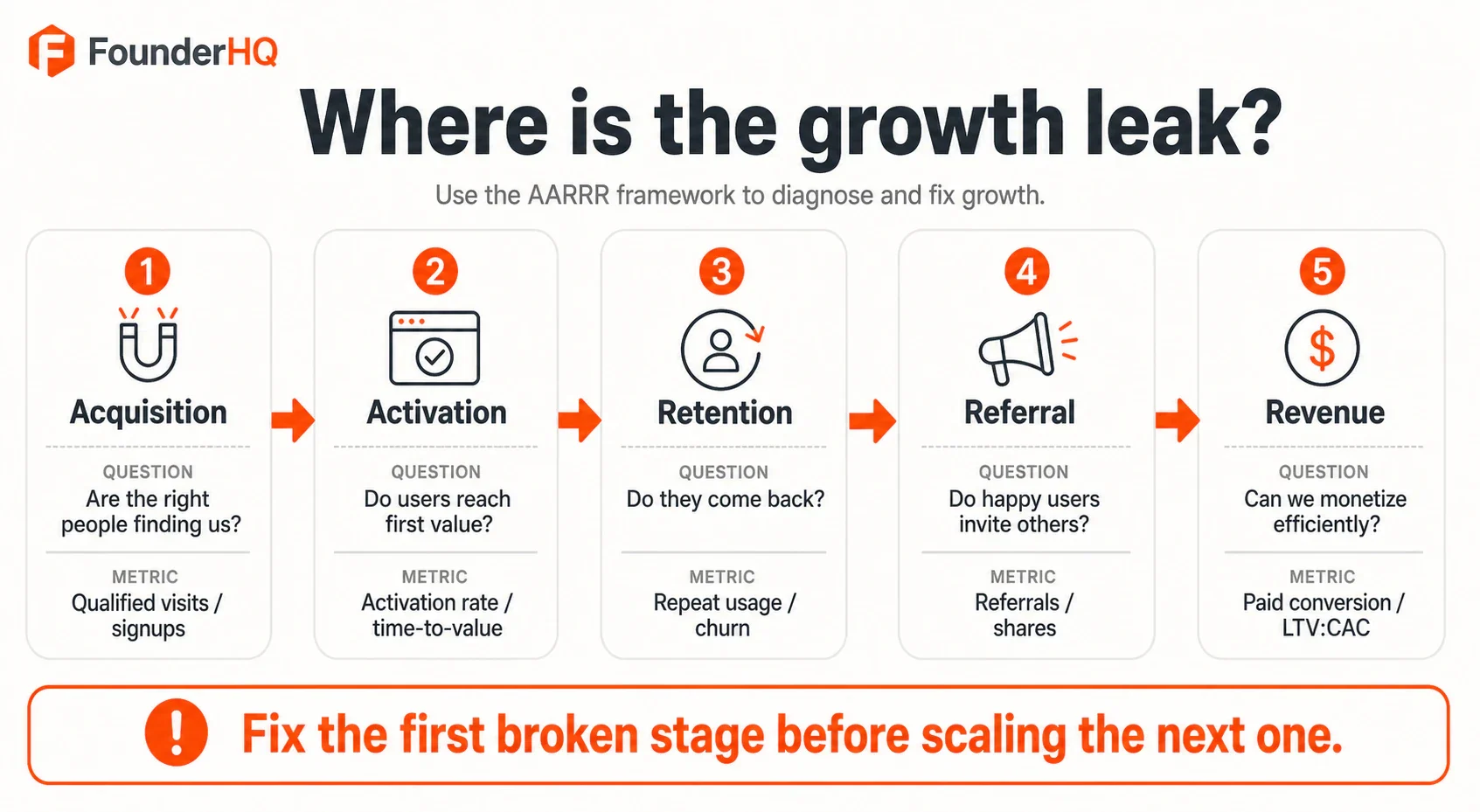
Use the AARRR map as an architecture diagnostic, not a dashboard vanity exercise. Ask one question at each stage: acquisition asks whether the right people are finding you; activation asks whether they reach first value; retention asks whether they return; referral asks whether happy users bring others; revenue asks whether value turns into efficient monetization.
The visual below is the simplest version of the diagnostic. Use it before you add a channel or a tool: if the first broken stage is activation, more acquisition will mostly pour users into a leaky bucket.
In 2026 SaaS growth writing, activation is getting more attention for a reason. Involve Digital reports that product teams own activation in 49% of companies, and frames time-to-first-value as the core activation metric for SaaS products (Involve Digital). The exact benchmark that matters will vary by product, but the principle is consistent: if users do not experience value quickly enough, acquisition spend becomes waste.
A founder-friendly way to run the diagnosis is to write down three lines every Friday: What stage leaked? What evidence proves it? Which system architecture should own next week? For example, a tiny team might notice that ten qualified signups arrived from founder posts, but only two reached the first-value action. The next week’s system choice should not be “post more.” It should be “run an activation-first journey system until first value is clearer, then restart distribution.” That cadence is more useful than a bloated report no one trusts.
Pre-PMF vs. post-traction: two different growth systems
The biggest mistake in early startup growth is treating pre-product-market-fit and post-traction like the same job. They are not.
Pre-PMF: run a manual search system
Before product-market fit, growth is a search problem. You are not trying to scale a machine; you are trying to find the small group of people with enough pain, curiosity, or urgency to try an unfinished product. Paul Graham’s classic advice to “do things that don’t scale” specifically calls out recruiting users manually as a core early startup task (Paul Graham).
That means the system architecture is intentionally manual: warm network, targeted outreach, communities, directories, customer calls, and fast product changes. FoundrList’s 2026 guide argues that the first 100 SaaS users often come from a mix of warm waitlist, directories, community engagement, cold outreach, and press, with a 60–90 day horizon as a realistic target for a focused B2B SaaS launch (FoundrList). Treat that as directional, not universal. The deeper lesson is that the first users come from conversation density, not automation.
A practical operator example: if the team has only a dozen active conversations, the “system” may be a simple CRM column, a customer-call note, and a weekly product-change decision. Buying a complex growth stack before those conversations exist creates structure around a signal you have not earned yet.
Post-traction: convert signal into a repeatable loop system
Once people are finding value and some are paying, the architecture changes. You are no longer just searching; you are trying to make the loop repeat. That usually means choosing one primary growth motion, defining the activation event, keeping a weekly experiment cadence, and resisting the urge to run every channel at once.
At this point, fragmentation becomes expensive. If customer notes, onboarding decisions, content drafts, and experiment results live in separate places, the team can spend more energy reassembling context than improving the loop. For a tiny team, you may not have a cross-functional pod. You may be the pod. The principle still holds: one owner, one operating cadence, one source of truth.
The three trade-offs that define your system
You do not need a 40-row comparison matrix. Most early-stage growth-system architecture decisions reduce to three trade-offs. Use these as architecture rules before you commit budget or founder hours.
- Manual search vs. activation-first journey: Choose manual search when you still need sharper proof of who has urgent pain. Choose activation-first when qualified users arrive but do not reach value, return, or convert. Watch-out: paid traffic will not fix a confusing first-value journey.
- Founder-led signal vs. scaled distribution: Choose founder-led when you still need customer language, trust, and positioning. Choose scaled or paid distribution when you already know who converts and what message works. Watch-out: paid amplifies a signal; it rarely creates one from nothing.
- Consolidated operating system vs. point-tool stack: Choose a consolidated system when context is scattered and the team keeps restarting work. Choose a point tool when a narrow specialist product solves a clearly isolated bottleneck. Watch-out: tool sprawl can hide as “experimentation.”
The decision rule is deliberately conservative: default to the option that preserves learning speed and reduces coordination cost. Early teams do not lose only because they choose the wrong channel. They lose because every channel, draft, onboarding change, and experiment lives in a different place.
Your stack is part of your growth system: consolidate vs. sprawl
Tooling is not neutral. Every additional tool can help, but it can also add a new place where context, decisions, and ownership fragment.
The broader software market is already feeling this. BetterCloud’s 2026 SaaS statistics list 106 as the average number of SaaS apps per company in 2024, down from 112 in 2023, with consolidation slowing to a 5% year-over-year rate (BetterCloud). SaaS Mag, citing Gartner and other market data as secondary reporting, says 68% of CIOs list vendor consolidation as a top-three priority and that many organizations are targeting fewer providers (SaaS Mag).
Those enterprise numbers are not a prescription for a two-person startup. They are a warning from the future. If large teams are paying a tax for overlapping tools, tiny teams feel the same tax sooner: context switching, duplicated drafts, conflicting metrics, and no clear memory of why a decision was made.
For early-stage teams, the lesson is not “never buy point tools.” It is: do not accumulate overlap before you have a system. If a tool solves one narrow bottleneck and plugs into your operating cadence, use it. If it creates another surface where product context, messaging, and customer learning drift apart, be careful.
Where FounderHQ fits: a consolidating operating system for the system you choose
FounderHQ is positioned as a unified growth stack for early-stage product teams: a focused operating system that helps teams build product journeys, compose founder-led content, and keep company context in one place.
That matters most when growth work crosses product and market surfaces. If your diagnosis says activation is the leak, you need clearer product journeys, onboarding, or guided first-value experiences. If your next growth bet is founder-led distribution, you need content that reflects the actual product, customer language, and market narrative—not disconnected posts generated from a blank page. If your team keeps revisiting old decisions, you need company context that survives beyond a single document or chat thread.
The honest framing is important: FounderHQ is not an autonomous system that runs the company for you. It is designed to augment the founder and product team by keeping builder, writer, and workspace closer together. That is a different buying choice from adding another isolated content tool, onboarding tool, or notes tool.
Use the capability-level test: if your chosen architecture depends on product journeys, founder-led content, and reusable company context staying connected, a consolidating operating system is worth considering. If your current bottleneck is only a narrow, isolated task, a specialist point tool may be enough.
A decision scorecard: pick the lightest system that fits your stage
Use this scorecard when the team is tempted to add “growth” in the abstract. It is not a channel-sequencing table or a one-lever checklist. It is an architecture selector: start with the system that should own the next operating cycle, then choose only the stack that supports it.
Growth-system architecture | Primary question | One metric that matters | Best-fit operating model | Minimal stack posture |
|---|---|---|---|---|
Manual search system | Can we find people with urgent pain? | Qualified conversations or paid early users | Founder-led outreach, communities, calls, fast iteration | Keep it simple: CRM/log, product notes, messaging memory |
Activation-first journey system | Can new users reach value reliably? | Activation rate or time-to-first-value | Guided journey, onboarding experiments, weekly review | Add only tools that improve first-value learning |
Repeatable loop system | Can one motion compound predictably? | Retention, CAC payback, or paid conversion depending on model | One primary channel plus lifecycle/retention cadence | Consolidate context so product, content, and experiments stay aligned |
The scorecard is intentionally light, but its labels matter. You are not just choosing “early,” “middle,” or “later.” You are choosing whether the next operating cycle should be built around search, journey design, or loop repetition. If you have not found any humans who will pay, your system should maximize learning. If signups do not activate, your system should protect first value. If one motion is working, your system should make it repeatable without burying the team in tool sprawl.
A useful final test: if you removed one tool, one meeting, or one channel this week, would the growth system become clearer or weaker? If the answer is clearer, you have found clutter. If the answer is weaker, you have found infrastructure.
Conclusion
To grow a startup in 2026, resist the tactics pile and make the architecture decision first: pre-PMF needs a manual search system, early traction needs an activation-first journey system, and repeatable growth needs one focused loop with a stack that keeps context intact. The point is not to own fewer tools for the sake of minimalism. It is to choose a system your team can run every week without losing the product context, customer language, and decisions that make growth compound.
Recommended Videos
This short Y Combinator video is a useful companion to the pre-PMF section because it explains why early users are found through targeted search, fast learning, and direct outreach—not broad scaling tactics.
Related articles

Application Onboarding Process: Definition, Steps, and When to Use It
A practical seven-step application onboarding process for moving new users from signup to first meaningful value without unnecessary setup or generic tours.

In-App Analytics for Onboarding: Definition, Metrics, and When to Use It
In-app analytics for onboarding turns events, funnels, segments, and user feedback into decisions about the path from signup to first value.

In-App Guidance for Onboarding: Definition, Examples, and When to Use It
In-app guidance helps users complete meaningful tasks inside a product. This guide explains the main patterns and how to match each one to an onboarding blocker.