FounderHQJun 27, 202612 min read
How to Grow a Startup by Building the Right Growth Asset First
To grow a startup, tiny teams should choose the durable growth asset that fixes their current constraint: activation, trust, or context.

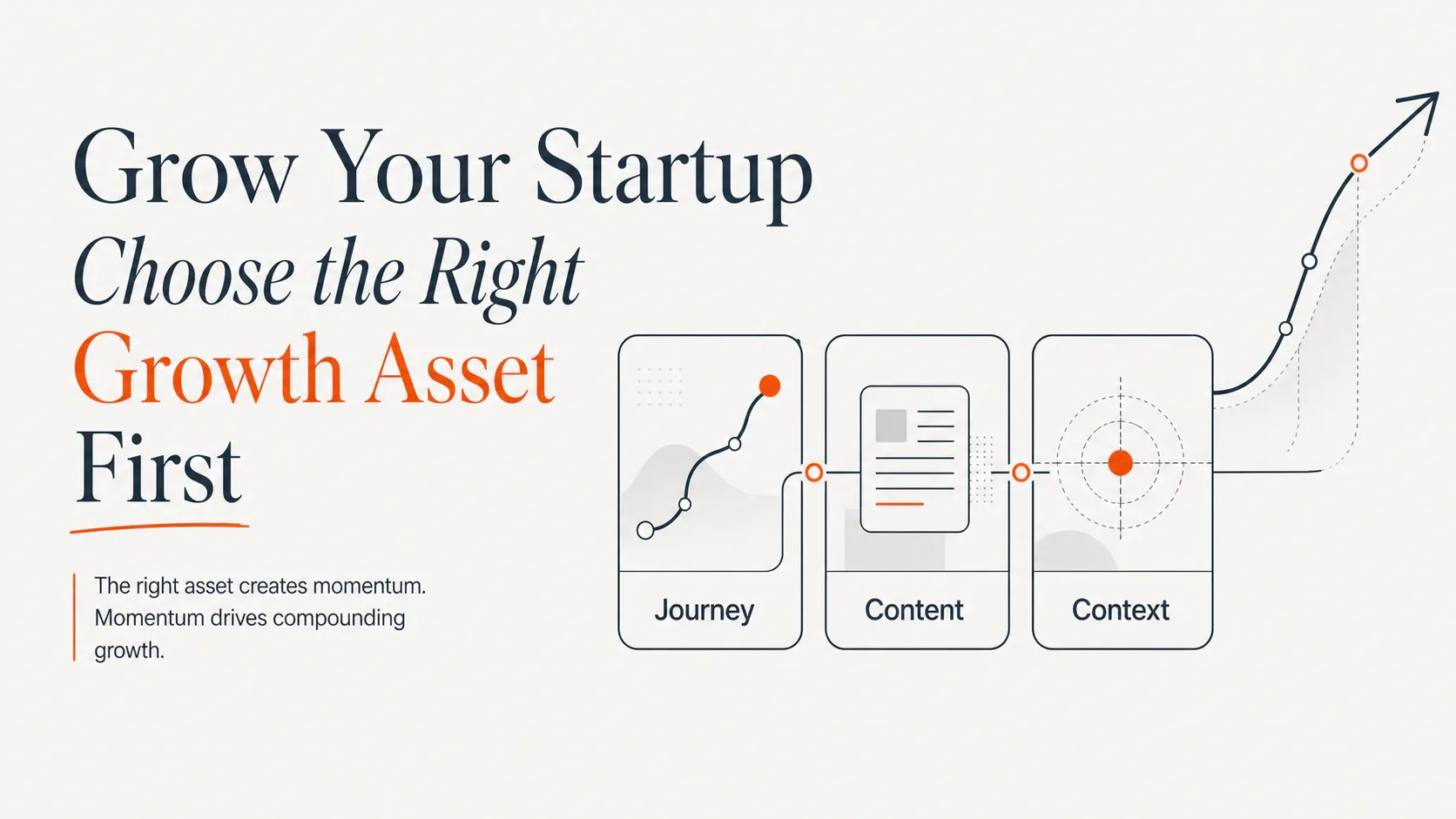
When growth stalls, the natural founder reflex is to add motion: another channel, another tool, another campaign, another experiment. Sometimes that helps. More often, it creates a louder version of the same problem. If users do not reach value, more acquisition leaks faster. If buyers do not understand the product, more content multiplies confusion. If every page, post, demo, and sales reply tells a different story, more output just spreads the drift. The better question is not “Which tactic will help us grow the startup this month?” It is “Which durable growth asset will make every future growth effort easier?” This guide is not a stage map, metric scoreboard, activation-only playbook, or message-drift fix. It is a three-way asset-selection guide: choose the first-value journey, founder-led content engine, or company-context workspace your tiny team should build first.
The mistake: treating startup growth like a tactics menu
Most startup growth advice looks useful because it lists options: founder-led sales, SEO, LinkedIn, paid ads, referrals, community, lifecycle email, product-led growth, partnerships, and more. The problem is not that those options are wrong. The problem is that a tiny team cannot run all of them with enough depth to learn.
Recent startup growth guides keep circling the same underlying point: growth is not a pile of channels; it is a system that connects acquisition, activation, retention, feedback, and learning. Startupik describes a startup growth system as a connected operating loop rather than a list of channels, and notes that these systems fail when teams scale channels before fixing activation, retention, or handoff issues (Startupik).
First Round Review’s founder-led growth playbook makes the same idea practical: map the customer journey, identify where people drop off, understand customer motivations, and test specific growth levers (First Round Review). That is very different from “try five new tactics and see what happens.”
For a solo founder or 2–3 person product team, the useful move is to choose one asset that improves the next loop. Not one campaign. Not one dashboard. One reusable growth asset that compounds.
What a growth asset is — and why tiny teams need one before more tools
A growth asset is a reusable piece of operating infrastructure that makes future growth work easier. It can be a product journey, a content system, a company-context workspace, a customer language library, a proof inventory, or a decision log. The key word is reusable.
A campaign expires. A growth asset keeps improving the next version of onboarding, the next founder post, the next sales call, the next landing page, and the next review cycle.
For this buyer’s guide, the three assets worth comparing are:
- A guided first-value journey: best when people arrive but do not experience the product’s value quickly enough.
- A founder-led content engine: best when the market does not yet understand or trust the product.
- A company-context workspace: best when the team keeps rebuilding the same positioning, messaging, and decision context from scratch.
This is also where a consolidated operating system can help. FounderHQ helps early-stage product teams build product journeys, compose founder-led content, and keep company context in one focused operating system. That matters because the three assets are connected: the product journey teaches you what customers need, content turns that learning into market trust, and shared context keeps the whole loop consistent.
Decision point 1: Is your bottleneck activation?
Choose a guided first-value journey if people show interest but do not reach the first meaningful value moment. This is the bottleneck when signups, demo requests, or early users exist, but they keep asking questions the product should answer through the experience itself.
Common signs include:
- Users create an account but do not complete the core action.
- Founder demos repeatedly explain the same “aha” moment.
- Support questions cluster around setup, next steps, or what to do first.
- The product works, but the path to value is too implicit.
The first version does not need to be a sophisticated onboarding platform. It needs five pieces:
- A value moment definition: the action that proves the user has experienced the product’s promise.
- A shortest-path map: the fewest steps from intent to that value moment.
- A friction inventory: fields, decisions, empty states, or confusing screens that slow the user down.
- A guided path: prompts, examples, templates, or sequencing that helps the user move.
- One activation signal: a simple leading indicator that tells you whether more users are reaching value.
A practical mini-scenario: a founder notices that trial users understand the promise on the landing page but stall when they open an empty workspace. Instead of buying more traffic, the team builds a three-step first-value path: pick a use case, start from an example, and complete one meaningful action. The asset is not the checklist itself; it is the reusable understanding of what the first value moment requires.
First Round’s growth lever framework supports this sequence: map the journey, find bottlenecks, understand what is happening in the customer’s head, then test specific levers. That is the right posture for activation because the issue is rarely “add more traffic.” It is usually “make the existing intent turn into experienced value.”
Choose this asset first if the product promise is clear enough to attract interest, but the experience does not yet deliver that promise quickly or consistently.
Decision point 2: Is your bottleneck demand trust?
Choose a founder-led content engine if the market does not yet understand why your product matters, what category it belongs in, or why you are the team to solve the problem. This is not the same as “post more.” It is building a repeatable system for turning founder insight into market education.
Common signs include:
- Sales calls start with the same category explanation every time.
- Prospects agree the problem exists but do not feel urgency.
- The founder has strong opinions from customer conversations, but they live in calls, notes, and Slack threads.
- Content comes out in bursts, then disappears when product work gets busy.
A useful founder-led content engine starts with raw material, not a blank page. Capture customer questions, objections, product decisions, trade-offs, founder lessons, and repeated market misconceptions. Then turn them into a few repeatable formats: a point-of-view post, an objection post, a customer-problem breakdown, a product lesson, and a practical teardown.
A practical mini-scenario: a founder hears the same objection in five demos: “We already have a doc for that.” The content asset is not one reply. It is an objection bank, a point-of-view note on why the old workflow breaks, and three reusable post formats that explain the problem from different angles. The next sales call, landing-page section, and founder post all start from the same captured insight.
First Round notes that founders are often hands-on in early sales and product, but less consistently hands-on in growth channels; the core recommendation is that founders need to help figure out how the business will grow (First Round Review). For a young company, founder-led content works because the founder has context that a generic content calendar cannot invent.
This does not mean the founder must personally write every polished draft. It means the founder should own the point of view, the customer learning, and the judgment about what the market needs to understand next. The production system can be lightweight: one weekly capture session, one idea bank, three recurring formats, one channel, and one review loop.
Choose this asset first if your biggest constraint happens before activation: buyers do not yet trust, understand, or prioritize the problem enough to take the next step.
Decision point 3: Is your bottleneck inconsistent context?
Choose a company-context workspace if the team keeps losing the thread. This is the bottleneck when the product, landing page, posts, outbound replies, investor updates, and onboarding flow all describe the company slightly differently.
Common signs include:
- The same positioning decision gets re-litigated every week.
- Customer language is scattered across call notes, docs, DMs, and memory.
- Every new page or post starts from scratch.
- The founder is the only person who can explain why a message changed.
- Product decisions and go-to-market decisions drift apart.
The first version of a context workspace should be boring and useful. It should preserve the working version of your ICP, positioning, customer language, objections, product decisions, proof points, experiment notes, and open questions. A good startup operating system does not need to be complex; Startupik describes it as a repeatable way a company makes decisions, runs work, tracks goals, and shares information (Startupik).
A practical mini-scenario: a product operator is rewriting onboarding copy while the founder is drafting a launch post and a sales reply. If each person pulls from memory, the product starts sounding like three different companies. A context workspace gives them the current ICP, positioning, customer language, and decision log so each asset can be different in format but consistent in story.
The goal is not documentation for its own sake. The goal is to reduce rework. When context is preserved, the next onboarding flow, founder post, launch message, and sales reply can start from the same source of truth.
Choose this asset first if the team is not mainly short on ideas or effort. It is short on shared memory.
Comparison table: which growth asset should you build first?
Use this comparison to make the decision concrete. The strongest choice is usually the asset that protects your current constraint, not the one that looks most impressive in a strategy doc.
Option 1: Guided first-value journey
- Best when: Users arrive but do not reach value.
- Wrong when: You do not yet know who the product is for.
- First version: Value moment, 3-step path, friction list, one activation signal.
- Owner: Product founder or product operator.
- Review cadence: Weekly.
- Leading signal: More users complete the first meaningful action.
- Tool requirement: Journey builder, prototype, or structured doc.
Option 2: Founder-led content engine
- Best when: Buyers do not trust or understand the category.
- Wrong when: You have no clear customer conversations to draw from.
- First version: Objection bank, founder POV, three recurring formats, one channel.
- Owner: Founder.
- Review cadence: Weekly.
- Leading signal: Better replies, sharper conversations, more qualified inbound questions.
- Tool requirement: Writer, notes system, or content workspace.
Option 3: Company-context workspace
- Best when: Assets, decisions, and messaging keep drifting.
- Wrong when: The team is avoiding customer work by organizing docs.
- First version: Positioning source of truth, customer language library, decision log.
- Owner: Founder or operator.
- Review cadence: Weekly.
- Leading signal: Less rewriting, fewer repeated debates, more consistent outputs.
- Tool requirement: Shared workspace or operating system.
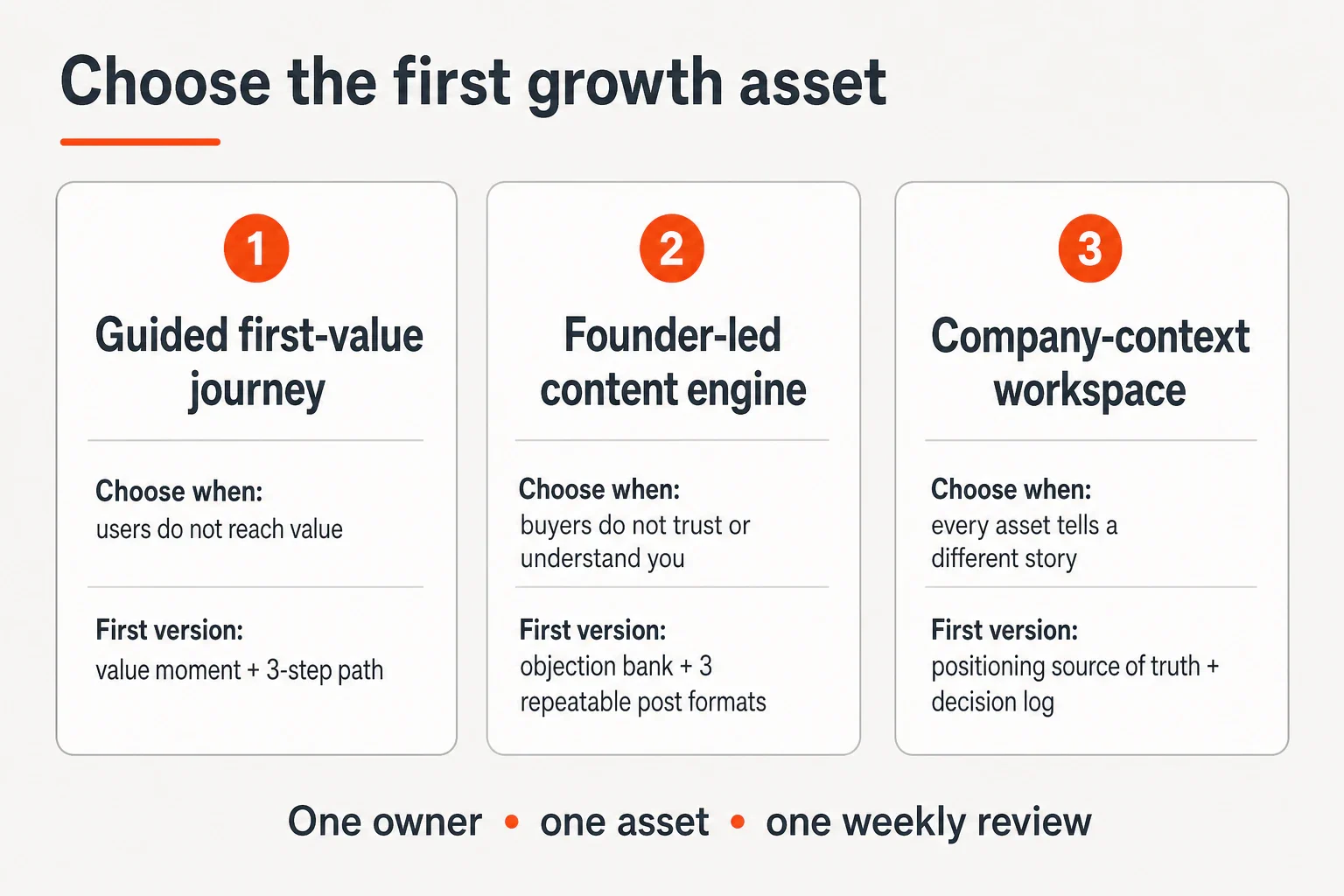
The infographic below is the simplest version of the choice: build the journey when users do not reach value, build the content engine when buyers do not yet trust or understand you, and build the context workspace when every asset tells a different story.
The 30-day implementation plan
Do not build all three assets at once. That turns a leverage decision back into a tool-sprawl problem. Use 30 days to prove that one asset can improve one live growth loop.
Week 1: Diagnose the constraint
Look at the last 10–20 meaningful signals you have: signup sessions, demos, sales calls, customer conversations, support questions, post replies, or landing-page feedback. Do not over-instrument. You are looking for the most obvious leak.
Ask three questions:
- Where does intent disappear?
- What do we explain repeatedly?
- Which decision or message do we keep rebuilding?
If intent disappears after signup, activation is likely the constraint. If intent never forms because buyers do not understand the problem, trust is likely the constraint. If every attempt sounds different, context is likely the constraint.
Week 2: Build the smallest useful asset
Keep the first version small enough to ship. A guided journey can be a three-step path with examples. A content engine can be a captured objection bank plus three post formats. A context workspace can be one positioning page plus a decision log.
The test is not whether the asset feels complete. The test is whether it makes the next growth action easier.
Week 3: Use it in a live loop
Put the asset into the real workflow. Use the journey with new users. Use the content engine for one week of founder-led posts or sales follow-ups. Use the context workspace to rewrite one page, one onboarding step, and one outbound message from the same source.
This is where many teams stall because they keep polishing the system instead of using it. The asset only becomes valuable when it touches a real customer-facing loop.
Week 4: Review one leading signal
Review one signal, not a dashboard. For a journey, ask whether more users reached the first meaningful action. For content, ask whether the conversations became sharper or more qualified. For context, ask whether the team reduced rework and produced more consistent assets.
Then decide: deepen the same asset, or move to the next bottleneck. If the constraint is still active, keep improving the same asset. If the constraint moved, build the next asset.
Where FounderHQ fits
FounderHQ fits this problem when the team wants one focused place to turn founder knowledge into growth assets. It is not positioned as an autonomous system that replaces the founder. Its value is in helping early-stage product teams keep product journeys, founder-led content, and company context connected.
That maps directly to the three assets in this guide:
- Product journeys support the activation asset: the guided path from intent to first value.
- Founder-led content supports the trust asset: the system for turning market learning into useful narrative.
- Company context supports the consistency asset: the memory layer that keeps decisions, language, and outputs aligned.
For a tiny team, the consolidation matters as much as the individual capability. The more scattered the workflow, the more often the founder has to re-explain, re-derive, and restart. A focused operating system creates leverage by keeping the work close to the context that shaped it.
Final recommendation: build the asset that protects your current constraint
If you want to grow a startup, resist the urge to choose the most fashionable tactic first. Choose the asset that protects the place where growth is currently leaking. The distinction matters: this is not a recommendation to add a growth system, scorecard, or content cadence for its own sake. It is a recommendation to pick the one reusable asset that makes the next loop easier.
Use this rule:
- If growth leaks after signup, build the guided first-value journey.
- If growth is blocked before trust, build the founder-led content engine.
- If growth work keeps getting rebuilt or contradicted, build the company-context workspace.
You can build all three over time. But the first one should make the next month easier, clearer, and more repeatable. That is the difference between chasing growth activity and building a startup growth system your small team can actually maintain.
Conclusion
Growing a startup is rarely about finding one magic channel. For early-stage teams, it is usually about choosing the right reusable asset before adding more motion. Build the journey when users need a clearer path to value. Build the content engine when the market needs a stronger founder-led explanation. Build the context workspace when your team needs one source of truth. The right asset gives every future tactic more leverage.
Related articles
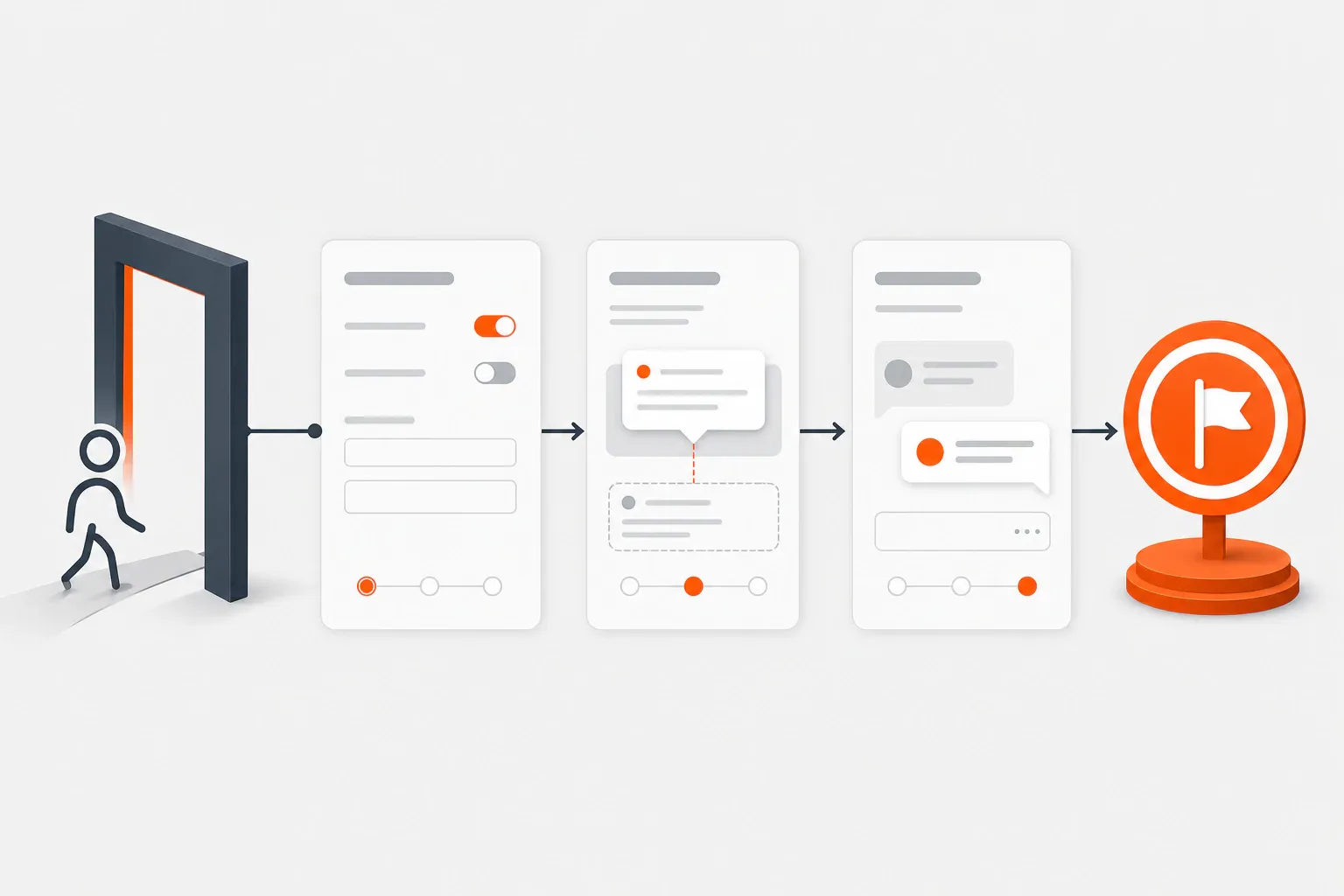
Application Onboarding Process: Definition, Steps, and When to Use It
A practical seven-step application onboarding process for moving new users from signup to first meaningful value without unnecessary setup or generic tours.

In-App Analytics for Onboarding: Definition, Metrics, and When to Use It
In-app analytics for onboarding turns events, funnels, segments, and user feedback into decisions about the path from signup to first value.

In-App Guidance for Onboarding: Definition, Examples, and When to Use It
In-app guidance helps users complete meaningful tasks inside a product. This guide explains the main patterns and how to match each one to an onboarding blocker.