FounderHQJun 27, 202611 min read
Drip Campaigns for Early-Stage Founders: Build a Follow-Up Loop That Does Not Feel Like Spam
A practical founder-focused guide to drip campaigns: what they are, when to use them, how to build a simple first sequence, what to measure, and how to avoid spammy automation.

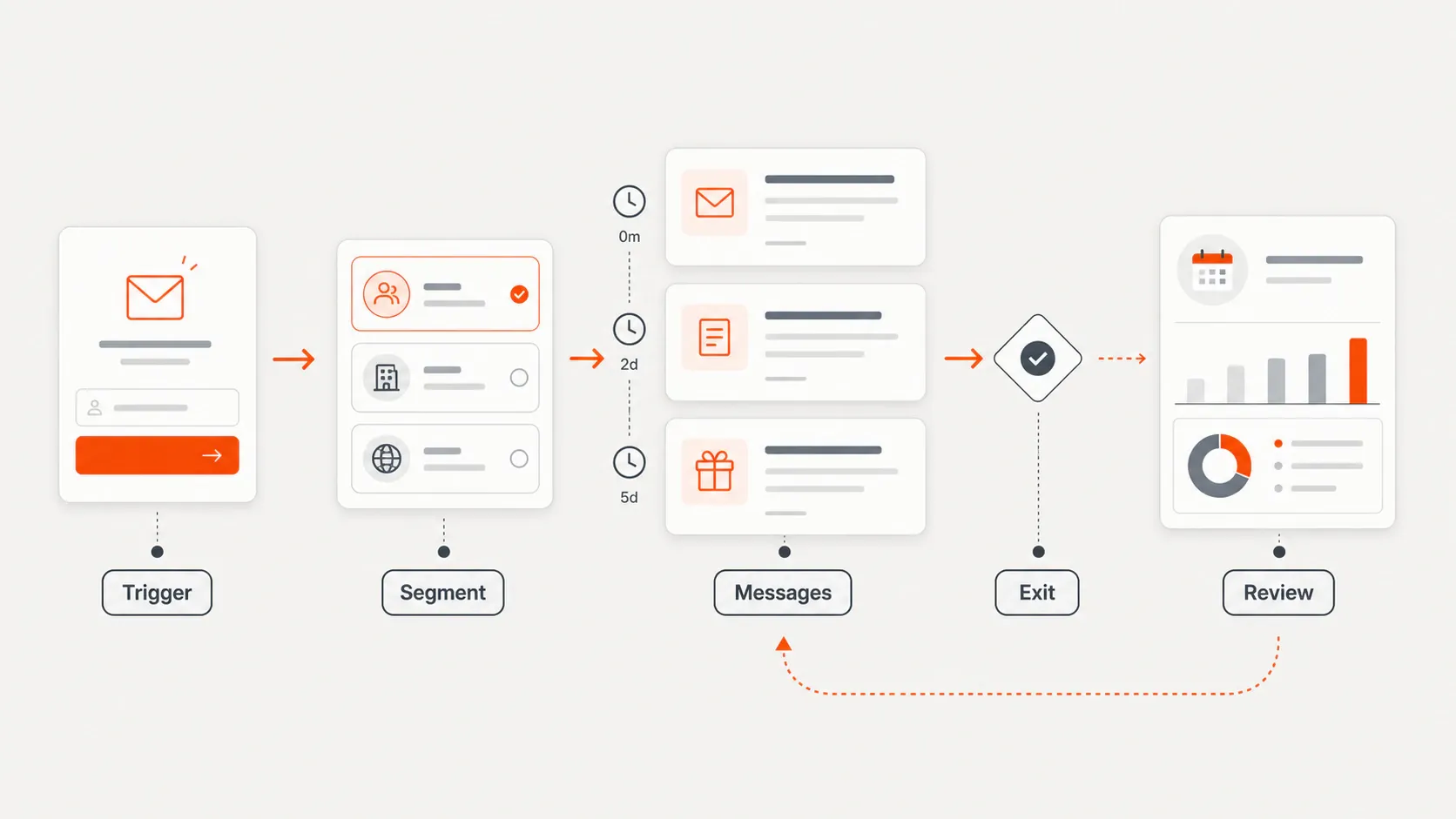
Most early-stage teams do not lose interested people because they lack another automation tool. They lose them because follow-up depends on the founder remembering who signed up, why they cared, what they should receive next, and when to send it. Drip campaigns solve that specific operating problem: they turn a clear signal — a waitlist signup, demo request, resource download, onboarding start, or inactivity event — into a useful follow-up path that helps the person take the next step.
What is a drip campaign?
A drip campaign is an automated sequence of messages sent over time based on a trigger, timeline, user behavior, status, or lifecycle stage. In email marketing, it is often called a drip marketing campaign, email drip campaign, automated email sequence, lifecycle email, or lead nurturing sequence.
HubSpot defines an email drip campaign as an automated series of emails sent to contacts based on triggers or timelines. Salesforce describes drip marketing as a series of automated, targeted emails used to nurture potential customers over time. The common pattern is simple: someone does something, qualifies for a segment, and receives a planned sequence that matches that moment.
A drip campaign is different from a one-off newsletter. A newsletter broadcasts a message to a list. A single triggered email handles one event, like a receipt or password reset. A drip campaign connects several messages into a path: first confirm the action, then educate, reduce friction, ask for a response, or move the person toward a conversion goal.
For a founder, the practical definition is even simpler: a drip campaign is a planned follow-up loop for people who have already shown intent.
Why drip campaigns matter for small teams
Small teams have a follow-up gap. A founder can personally reply to the first ten waitlist signups. But once the same follow-up repeats, the work starts to fragment: one person receives a thoughtful response, another gets a rushed reply, and another gets nothing because the week got crowded.
That inconsistency matters because early intent is perishable. Someone who downloads a guide, joins a waitlist, or starts onboarding is giving you context about what they need now. A useful drip campaign preserves that moment and turns it into a repeatable path without pretending every contact is the same.
Email remains a meaningful channel, but it should be treated carefully. Litmus reports that 35% of companies see email ROI of 36:1 or more, while also emphasizing the importance of automation, personalization, and measurement. That does not mean every startup will see those outcomes. It means email is still important enough to deserve an operating loop instead of ad hoc follow-up.
The key is not more automation. It is better context. FounderHQ is built around that idea: early-stage product teams need leverage across product journeys, founder-led content, follow-up, and company memory without positioning the founder as replaceable. A drip campaign works best when it is connected to the original signal that created the relationship.
The five parts of a useful drip campaign
Every useful drip campaign has five parts: an entry trigger, a segment, a goal, a message sequence, and exit rules. If one is missing, the sequence usually starts feeling generic or pushy.
1. Entry trigger
The trigger is the action, inaction, date, or attribute that enrolls someone. Examples include a waitlist signup, quiz completion, demo request, trial start, pricing-page visit, resource download, or seven days of inactivity. Monday.com’s guide describes this pattern as a trigger that starts a pre-built sequence, followed by timed delivery and possible behavioral branching.
2. Segment
The segment is the group receiving the campaign. Useful segments are based on what you know reliably: role, use case, product stage, signup source, selected pain point, engagement level, or lifecycle status. Klaviyo’s guide emphasizes defining customer segments and matching timing to the audience’s likely behavior.
3. Goal
The goal is the one action the sequence should move toward. For founders, that action might be: reply with a current problem, finish onboarding, book a call, join a launch list, activate a feature, or return to the product.
4. Messages and timing
A short drip campaign usually works better when each message has a distinct job: confirm, educate, reduce friction, answer an objection, invite a reply, or drive a specific next step. Repeating the same sales ask with different wording is not nurturing; it is noise.
5. Exit rules
Exit rules define when someone should stop receiving the sequence or move somewhere else. Common exit rules include conversion, unsubscribe, reply, manual conversation, inactivity after the final message, or entry into a more relevant flow. This is where many beginner drip campaigns break: the person takes action, but the automation keeps talking as if nothing changed.
When should a founder use a drip campaign?
Use a drip campaign when the next step is predictable, the trigger is clear, and manual follow-up is becoming inconsistent. If you have sent the same follow-up manually at least 5–10 times and the message depends on the same signal, it is a good candidate for a lightweight drip campaign. Treat that as a practical operating heuristic, not a universal benchmark.
Good early-stage use cases include:
- A waitlist nurture sequence for people who joined before launch
- A welcome series for a newsletter, community, or product signup
- An onboarding drip that helps new users reach first value
- A post-demo follow-up that recaps the next step without overbuilding a sales cadence
- An abandoned signup recovery sequence
- A reactivation email for users or subscribers who went quiet
- A launch drip for a specific segment of interested contacts
Do not use a drip campaign when the audience is tiny and every response should become customer discovery. Do not use one when the person has not consented to hear from you. And do not build one before you can name the next useful action.
If you are still deciding whether email follow-up is the right channel at all, use a channel-fit lens first. FounderHQ’s bootstrap marketing channel-fit scorecard is a useful companion when you need to choose between follow-up, content, outreach, product onboarding, or another growth motion.
A simple first drip campaign for founders
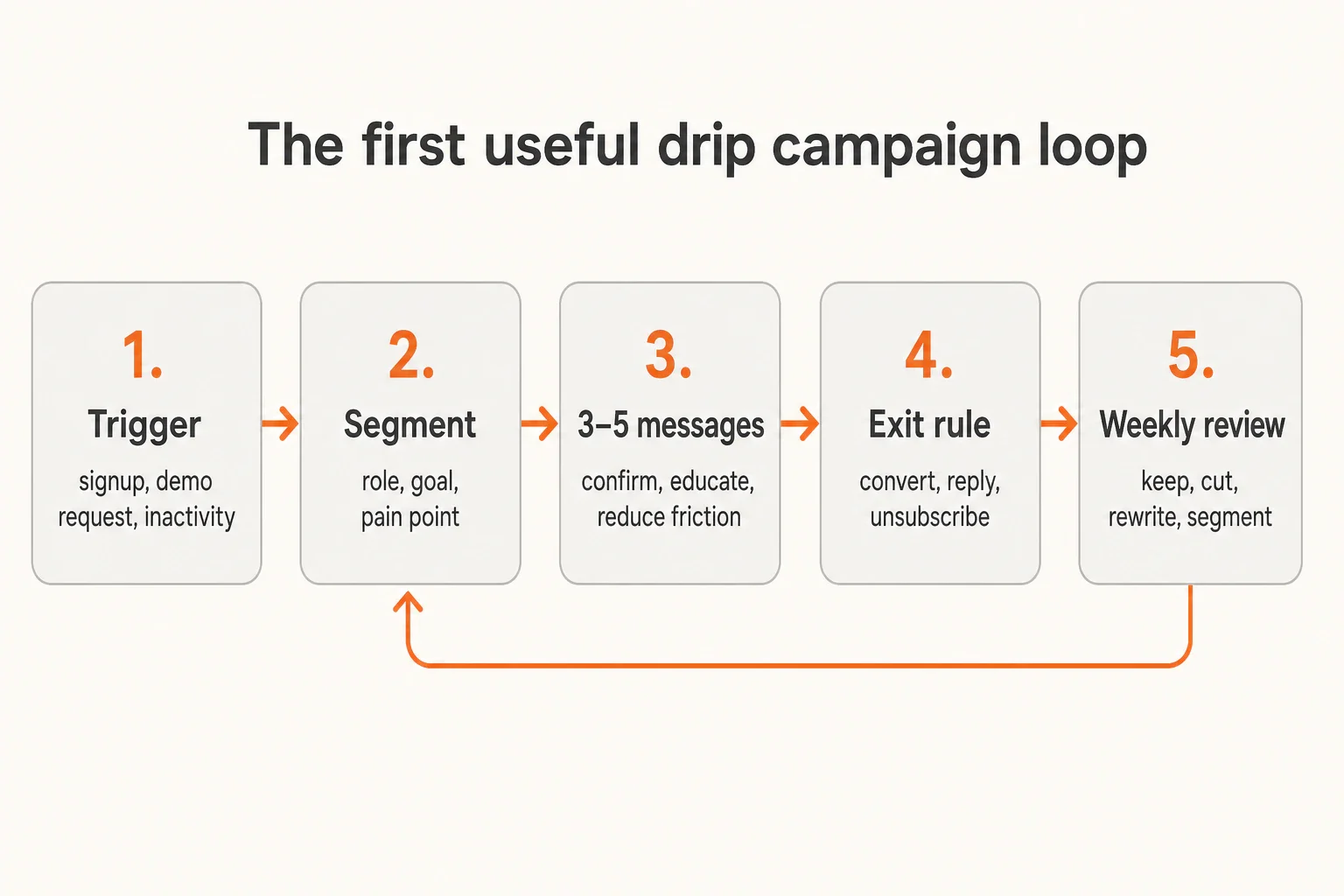
Your first drip campaign should not be a complex lifecycle machine. Start with one trigger, one segment, one goal, and three to five messages. The point is to make follow-up consistent enough to learn from, not to automate every possible path.
Here is a simple waitlist or product-journey signup sequence:
Message | Timing | Job | Example CTA |
|---|---|---|---|
Email 1 | Immediately | Confirm signup and set expectations | “Tell us what you want solved first” |
Email 2 | 1–2 days later | Educate around the problem or first use case | “Read the 3-minute setup note” |
Email 3 | 3–5 days later | Share a product decision, founder insight, or useful proof | “Reply with your current workaround” |
Email 4 | Optional | Ask a segmentation question or invite a reply | “Which path fits you best?” |
Email 5 | Before launch or milestone | Drive the next action | “Join the early-access group” |
The best input for this sequence is not a blank list. It is the contact’s original context: what they selected in a quiz, which waitlist option they chose, which onboarding path they started, or what pain point they named. That context keeps the message specific without forcing fake personalization.
FounderHQ’s product direction fits this operating pattern: product journeys can capture intent through quizzes, waitlists, onboarding flows, branching steps, and answer-based routing; contact attributes can support segmentation; founder-led content can shape the messages; and follow-up can run through connected providers. The important idea is the shared context, not the volume of automation.
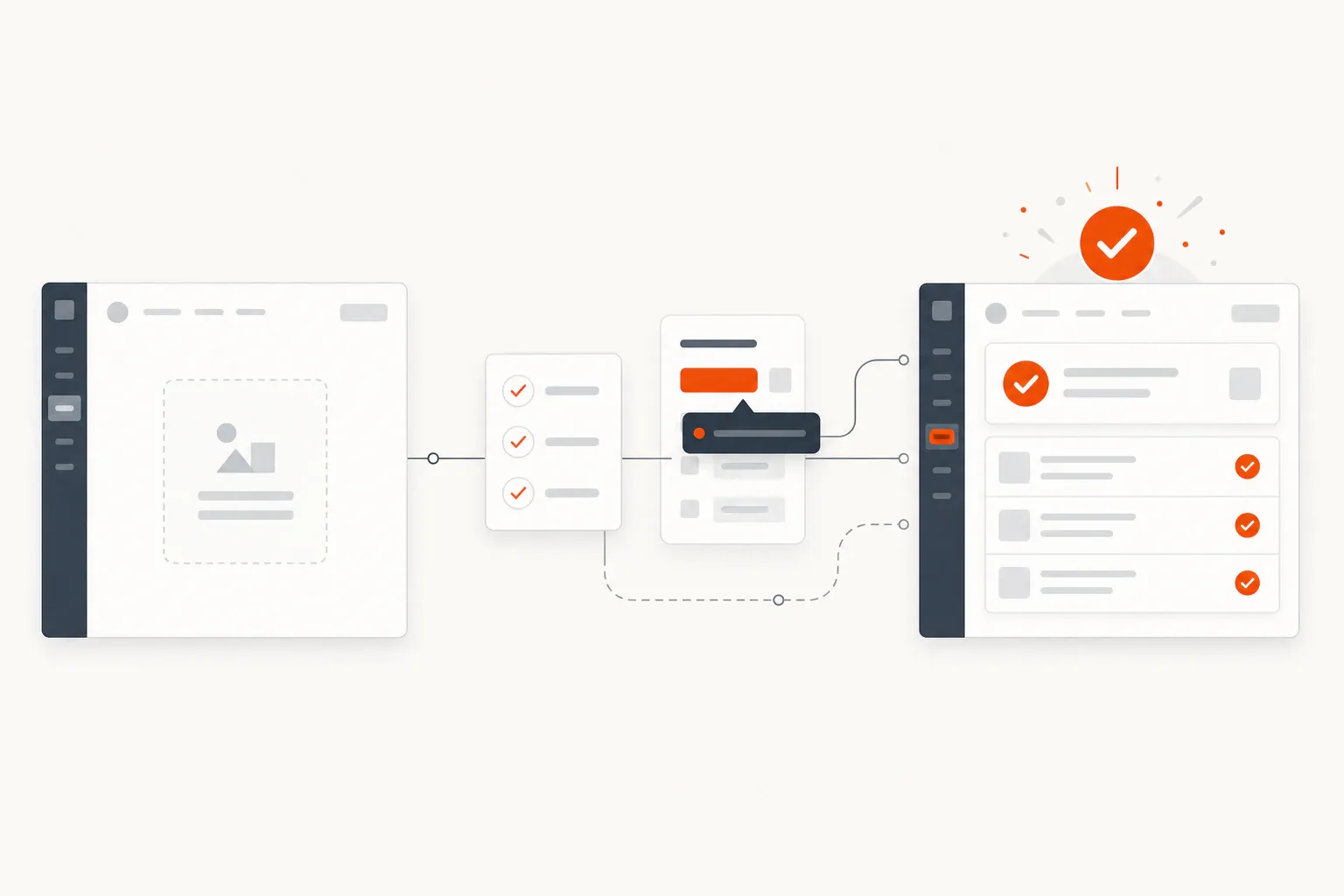
The loop below is the simplest version to build before adding branches.
How to build a drip campaign step by step
Step 1: Choose one audience and one trigger
Do not start with “all leads.” Start with a narrow group, such as people who joined a waitlist after choosing “activation” as their biggest challenge, new users who created an account but did not complete setup, or demo requests from a specific customer profile.
Step 2: Write the conversion goal in one sentence
A good goal is observable. “Nurture leads” is too vague. “Get the contact to reply with their current onboarding bottleneck” is clearer. So is “help the user complete the first setup step.”
Step 3: Map the minimum sequence before writing copy
Write the sequence as a small map: trigger, delay, message job, CTA, branch, and exit condition. This keeps the campaign from becoming five disconnected emails.
Step 4: Draft each message around one job
Each email should do one thing. Confirm the action. Explain the problem. Reduce friction. Share a useful founder note. Ask a segmentation question. Invite a reply. Recover inactivity. If a message has three CTAs, split or cut it.
Step 5: Personalize only where the data is reliable
Personalization works when it reflects real context. It backfires when it guesses. Use reliable fields such as role, selected use case, signup source, or stated pain point. Avoid pretending you know more than you do.
Step 6: Set suppression and exit rules
Before launch, define who should not receive the sequence: unsubscribed contacts, converted contacts, people in an active manual conversation, people who replied, or people already in a more relevant campaign.
Step 7: Review the campaign weekly
Small teams do not need a dashboard ceremony. They need a decision. Once a week, review replies, clicks, conversions, unsubscribes, complaints, and customer language. Then choose: keep, cut, rewrite, segment, or pause. FounderHQ’s weekly signal log is a useful model for feeding those signals back into product, messaging, and future content.
Drip campaign examples by use case
Different drip campaigns have different jobs. The mistake is using one generic sequence for every stage.
Use case | Trigger | Primary goal | What to avoid |
|---|---|---|---|
Welcome series | Newsletter, waitlist, or product signup | Set expectations and guide the first meaningful action | Turning the first email into a full pitch |
Lead nurture | Resource download or educational signup | Connect the problem, product category, and next step | Rushing to a sales ask before intent is clear |
Onboarding drip | New user or trial start | Help the user reach first value | Explaining every feature instead of the next action |
Post-demo follow-up | Completed demo or sales call | Recap value and prompt the next step | Over-automating a relationship that needs personal follow-up |
Reactivation | Inactivity or no engagement | Learn whether they still care or offer a path back | Sending more frequent messages to an uninterested contact |
Launch drip | Segmented waitlist or early-access group | Move from interest to action | Sending the same launch message to every segment |
For early-stage founders, the strongest examples are usually waitlist, onboarding, and reactivation drips. They are close to real product behavior, which means they can teach you what people understand, where they get stuck, and which messages create useful replies.
Metrics to track without over-optimizing too early
Track the metrics that tell you whether the follow-up helped someone move forward. For a founder-operated drip campaign, that usually means replies, clicks to the next action, activation events, demo bookings, conversions, unsubscribes, spam complaints, and qualitative objections.
Open rates can still provide directional information, but they should not be the scoreboard. Salesforce’s 2026 email benchmark guidance notes that Apple Mail Privacy Protection and blocked tracking pixels have reduced the precision of open rates. Salesforce also explains that bot opens and inbox filtering can distort engagement signals. Litmus similarly cautions that open rate is challenging to use on its own after Apple’s Mail Privacy Protection.
Separate sequence-level performance from message-level performance. Sequence-level review asks: did this campaign move the right people toward the goal? Message-level review asks: where did people drop, which CTA earned clicks, which email earned replies, and which segment performed differently?
A lightweight weekly cadence is enough: keep what works, cut what adds noise, rewrite unclear messages, split a segment if behavior differs, and pause the campaign if it creates complaints or low-quality engagement. If your team needs a broader operating rhythm, the bootstrap marketing weekly cadence can help keep review from becoming another forgotten task.
Common drip campaign mistakes
The fastest way to make a drip campaign feel like spam is to automate before you understand the moment. These are the mistakes to watch for:
- Starting with too many branches before you understand the audience
- Sending the same sales ask repeatedly instead of moving the conversation forward
- Using fixed schedules without considering behavior or lifecycle stage
- Ignoring exit rules, so converted or uninterested contacts keep receiving irrelevant messages
- Measuring only opens instead of replies, clicks, activation, conversions, unsubscribes, and complaints
- Over-personalizing with weak or incorrect data
- Letting automation replace customer learning instead of routing replies and objections back into the business
The last mistake is the most important for founders. A drip campaign should not distance you from customers. It should make the repetitive parts consistent so you can spend more time on the high-signal parts: replies, objections, calls, product usage, and language worth reusing. FounderHQ’s guide to a reusable asset library is useful when you want those customer signals to improve future emails, landing pages, posts, and product journeys.
A pre-launch checklist for your first drip campaign
Before you turn on the campaign, check the fundamentals. A small mistake in an automated follow-up loop repeats until you notice it.
- Consent: Should this person receive this type of message?
- Trigger: Is the entry condition specific and reliable?
- Segment: Does the message match the person’s context?
- Goal: Can you name the one action this sequence should create?
- Timing: Are the delays reasonable for the decision and relationship?
- CTA: Does each email ask for one clear next step?
- Exit rules: Does the person leave when they convert, reply, unsubscribe, or become irrelevant to the sequence?
- Suppression: Are active manual conversations, customers, and unsubscribed contacts protected?
- Mobile readability: Can the email be understood quickly on a phone?
- Tracking: Are clicks, replies, conversions, unsubscribes, and complaints visible?
- Owner: Who reviews the campaign each week?
If the checklist feels heavy, the campaign is probably too complicated. Reduce the scope until it can be reviewed by one founder in one weekly session.
Conclusion
A good drip campaign is not a way to blast more people with more messages. It is a lightweight operating loop: capture a real signal, segment by reliable context, send a small number of useful messages, exit people when the conversation changes, and review the results each week. For early-stage teams, that is enough. Start with one trigger, one segment, one goal, and three to five messages. Once that loop teaches you something, you can decide whether the next step is a better message, a sharper product journey, a cleaner segment, or a more complete lifecycle system.
Related articles
Application Onboarding Process: Definition, Steps, and When to Use It
A practical seven-step application onboarding process for moving new users from signup to first meaningful value without unnecessary setup or generic tours.
In-App Analytics for Onboarding: Definition, Metrics, and When to Use It
In-app analytics for onboarding turns events, funnels, segments, and user feedback into decisions about the path from signup to first value.
In-App Guidance for Onboarding: Definition, Examples, and When to Use It
In-app guidance helps users complete meaningful tasks inside a product. This guide explains the main patterns and how to match each one to an onboarding blocker.