FounderHQJun 27, 202611 min read
Bootstrap Marketing: A 30-Day Channel-Fit Scorecard for Startups
Bootstrap marketing works best when founders choose the no-budget channel they can actually sustain, measure, and improve for 30 days.

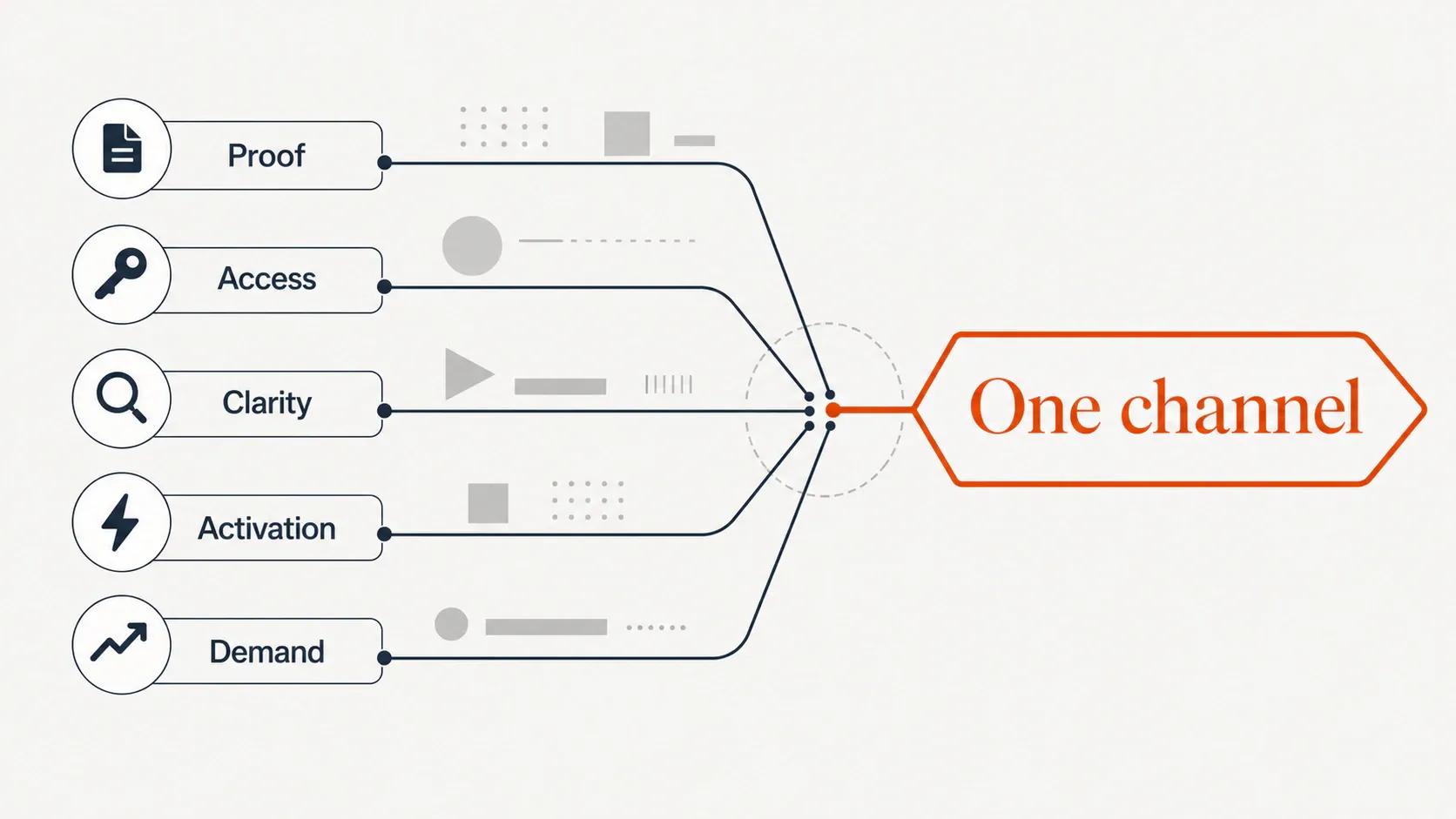
Bootstrap marketing usually gets framed as a money problem: no ad budget, no marketing hire, no agency, no elaborate stack. But for a solo founder or 2–3 person product team, the sharper question is operational: which no-budget channel can you actually run long enough to learn from it? You can try LinkedIn, SEO, communities, partnerships, outreach, launches, newsletters, and product-led loops all at once — or you can score the options, pick one, and run a clean 30-day test. This guide gives you the second path.
What bootstrap marketing really means for a tiny team
Bootstrap marketing is the discipline of substituting budget with founder insight, speed, specificity, and consistent distribution. It is not “do every free thing.” Free channels still cost something: founder attention, response time, creative energy, and the opportunity cost of not building product.
That distinction matters because early-stage marketing is rarely just promotion. It is also market learning. A good bootstrap marketing strategy should help you answer: Who cares? What words make them respond? What proof do they need? Where do they already spend attention? What happens after they sign up?
For a tiny team, the winning question is not “Which channel is best?” It is “Which channel can we run with enough consistency to create evidence?” A founder with three spare hours a week, no audience, and a tight ideal customer profile needs a different channel than a founder with steady signups and weak activation. The right choice has to fit the buyer, the product, and the founder’s actual capacity.
Why most bootstrap marketing fails before the channel has a chance
The most common failure pattern is spreading effort thin, then blaming the channel. A founder posts twice on LinkedIn, writes one blog post, sends a few cold DMs, comments in a community, launches on a directory, and starts a newsletter. Two weeks later, nothing looks conclusive because nothing was run deeply enough to produce evidence.
One focused channel test creates better learning than seven half-run channels. If you run one channel long enough to capture replies, objections, click patterns, demo questions, and activation gaps, you get market signal. If you run seven channels lightly, you mostly get noise.
This is especially important because early-stage companies are not just fighting for traffic; they are fighting for product-market learning. In a 2026 analysis of 431 VC-backed startup shutdowns, CB Insights reported that running out of capital was cited in 70% of failures, while poor product-market fit was cited in 43%. Marketing cannot solve product-market fit by itself, but a focused bootstrap marketing test can help founders test pull before they spend heavily.
Use a quick channel-fit diagnostic first
Before scoring channels, take five minutes to name the job the channel needs to do. This diagnostic pre-check is not the whole strategy; it simply keeps you from choosing a channel because it is popular instead of useful.
Use it as a shortcut, then move quickly into the channel-fit scorecard in the next section.
Evidence needed | What it sounds like | Channels likely to fit |
|---|---|---|
Proof | “Buyers do not believe we are credible yet.” | Founder-led demos, customer stories, build-in-public updates, product walkthroughs |
Access | “We know the buyer, but we are not in front of them.” | Warm outreach, niche communities, partnerships, podcasts, newsletters |
Clarity | “People see us, but they do not respond.” | Problem interviews, landing-page rewrites, hook tests, short-form posts |
Activation | “People sign up, then stall.” | Onboarding emails, product education, guided first-value journeys, demo content |
Demand | “We need discovery to compound.” | Long-tail SEO, use-case pages, comparison pages, reusable content assets |
Do not overwork this table. Its job is to narrow the field, not make the decision for you. A channel still has to pass the practical test: you need buyer proximity, fast enough feedback, founder fit, reusable output, and a clear next step.
The channel shortlist: what to consider when you have no budget
No-budget channels work when they fit both the market and the team. Here are the main options worth considering before you commit to a 30-day run.
Founder-led social
Founder-led LinkedIn or X can be useful when you need proof, clarity, or trust. It lets you test hooks quickly, show your thinking, share product decisions, and learn which problems create replies. MKT1’s 2026 analysis of 100 B2B startups found that 60% of founders at companies under $100M raised had more LinkedIn followers than their company page, which supports a practical reality for early teams: people often hear from the founder before they care about the company account.
Direct outreach
Direct outreach is best when you need learning speed. It is not just a way to “get leads.” It is a way to hear buyer language, validate pain, test positioning, and find the smallest group of people who will take a call or try the product. Keep it manual at first. Automating unclear outreach only scales unclear assumptions.
Communities and forums
Communities work when your buyers already gather somewhere: Slack groups, Discord servers, Reddit communities, niche forums, LinkedIn groups, or industry associations. The rule is simple: contribute before asking. Answer questions, clarify trade-offs, share templates, and only mention the product when it is genuinely relevant.
SEO and content
SEO is slower, but it can compound when demand already exists. HubSpot’s 2026 marketing statistics page reports that 32.9% of internet users aged 16+ discover new brands, products, and services via search engines. It also reports that blog posts were the third most popular content format used by marketers in 2025, at 38%. For a tiny team, the play is not broad thought leadership; it is specific, long-tail content that answers the exact questions your buyer already asks.
Partnerships and borrowed audiences
Partnerships help when another person, community, newsletter, tool, or expert already has trust with your market. Good partnership work starts with a clear mutual benefit: co-host a workshop, contribute an expert guide, swap useful resources, or package a practical workflow for a shared audience.
Product-led loops and activation content
If signups are arriving but not reaching first value, acquisition may not be the immediate priority. Your best bootstrap marketing channel may be activation content: onboarding emails, lifecycle messages, demo videos, first-session checklists, in-product education, or guided journeys. This is where marketing and product blur in a useful way.
How to pick one channel for the next 30 days
You do not need a complex model. Score each candidate channel from 1 to 3 across six criteria, then choose the highest-scoring option you can actually run for 30 days. The scorecard below is the core decision tool: it turns “which tactic should we try?” into “which channel fits our buyers, proof, capacity, and activation path?”
Criteria | Ask this | Score 1–3 |
|---|---|---|
Audience proximity | Are our buyers already there? | 1 = uncertain, 3 = clearly yes |
Proof quality | Can this channel show credibility or evidence? | 1 = weak proof, 3 = strong proof |
Feedback speed | Will we learn within days, not months? | 1 = slow, 3 = fast |
Founder fit | Can the founder sustain it personally? | 1 = unlikely, 3 = yes |
Asset reuse | Will outputs become reusable content, FAQs, objections, or pages? | 1 = disposable, 3 = reusable |
Activation tie-in | Can it move people toward first value, not just awareness? | 1 = vague, 3 = direct |
Here is the operator version: if two channels tie, choose the one you can run with less emotional resistance. The best theoretical channel is still a bad choice if the founder avoids it every week.
A B2B SaaS founder with no audience but a sharp ideal customer profile might score manual LinkedIn outreach plus public problem posts highest. That channel creates conversations, tests language, and generates objections the founder can reuse in product pages and onboarding.
A founder in a niche with obvious search intent might score five long-tail SEO pages highest. That route is slower, but if buyers are already searching for specific workflows, alternatives, or how-to questions, each page can become a durable asset.
The key is to choose the channel with the best execution fit, not the one that sounds most scalable. Scale is not the goal in the first 30 days. Signal is.
The minimum viable bootstrap marketing loop
Once you choose a channel, turn it into a loop. A loop is easier to improve than a vague goal like “post more” or “do outreach.”
A simple bootstrap marketing loop looks like this:
- Capture customer language from calls, support messages, community threads, sales notes, and product usage.
- Turn one repeated pain into one message, post, page, outreach angle, or onboarding improvement.
- Route interested people to one clear next step: reply, book, join, try, answer a question, or complete a first-value action.
- Record the objections and drop-offs.
- Revise the message, product journey, or proof asset.
- Repeat before adding a second channel.
Every run should create reusable context: hooks, objections, proof points, FAQs, customer phrases, onboarding gaps, and examples. This is where operating discipline compounds. FounderHQ’s focused operating system for early-stage product teams helps teams keep product journeys, founder-led content, and company context in one place so outputs stay connected instead of scattered across disconnected tools.
The important product principle is this: marketing feedback should not live separately from product work. If prospects keep asking the same question, that may be a landing-page issue, a positioning issue, an onboarding issue, or a product-journey issue. Bootstrap marketing is strongest when it improves all of those, not just the next post.
What to measure before you have a real marketing funnel
Early-stage teams often over-measure reach and under-measure learning. Impressions, likes, and follower counts can be useful later, but they are weak primary signals when you are still validating the channel.
Measure the leading indicators that match the channel’s job:
- Proof: saves, demo requests, customer-story replies, buyer comments that reference credibility.
- Access: qualified replies, warm intros, community conversations, partner interest.
- Clarity: repeated phrases, hook response, landing-page clicks, objections becoming sharper.
- Activation: first-value completion, onboarding replies, repeated drop-off points, support questions.
- Demand: search impressions, long-tail rankings, qualified organic visits, self-reported attribution.
HubSpot’s 2026 State of Marketing report found that marketers are prioritizing updates to SEO for search changes, content that reflects brand values, automation, and repurposing across channels in its survey of 1,500+ marketers. For a tiny team, the practical takeaway is not to copy large-team playbooks; it is to make each channel produce reusable learning that can be repurposed into stronger pages, posts, journeys, and conversations.
The 30-day bootstrap marketing plan
Use this plan when you need momentum without turning marketing into a second full-time job. It is intentionally narrow.
Week 1: Score and choose
List two or three possible channels. Score each one from 1 to 3 on audience proximity, proof quality, feedback speed, founder fit, asset reuse, and activation tie-in. Choose one. Define one next step you want the audience to take, such as replying to a question, booking a call, joining a waitlist, starting a trial, or completing the first product action.
Week 2: Run small batches
Publish or reach out in small batches. That might mean five founder-led posts, 30 targeted outreach messages, three community contributions, two partner pitches, one onboarding improvement, or one long-tail SEO page. Track replies, objections, and drop-offs. Do not add another channel just because the first few days feel quiet.
Week 3: Double down on the message that creates signal
Look for patterns. Which pain gets replies? Which objection repeats? Which demo moment creates interest? Which onboarding step creates confusion? Turn the strongest signal into a better message, a sharper page, a clearer demo, or a product-education asset.
Week 4: Decide: continue, adapt, or switch
At the end of 30 days, do not ask only “Did this generate customers?” Ask: Did it create qualified conversations? Did it reveal clearer language? Did it expose activation gaps? Did it produce reusable assets? Did the founder sustain the work without heroic effort? If the answer is yes, continue. If the channel produced learning but not enough access, adapt. If it produced neither, switch.
Common mistakes to avoid
The first mistake is copying a channel because another startup made it work. Their audience, founder skill, category maturity, proof level, and timing may all be different. Copy the decision logic, not the channel.
The second mistake is choosing a channel the founder cannot sustain personally. If the founder hates writing, founder-led long-form content may stall. If the founder avoids direct conversation, outreach may become mechanical. Bootstrap marketing depends on consistency, so founder fit is a real strategy input.
The third mistake is separating marketing from product learning. If marketing creates objections, questions, or usage insights, those signals should shape positioning, onboarding, and product journeys. Otherwise, the same objections keep reappearing in every channel.
The fourth mistake is adding paid spend too early. Paid acquisition can accelerate a working message, but it will not rescue unclear positioning, weak activation, or a poorly understood buyer. Use no-budget channels to find the signal before paying to amplify it.
The fifth mistake is treating automation as leverage before the message works. Automation multiplies the system underneath it. If the message is vague, automation multiplies vagueness. If the channel is unfocused, automation multiplies noise.
Conclusion
Bootstrap marketing is not a scavenger hunt for free tactics. It is a 30-day execution decision: score the channels, pick the one your team can actually run, define one next step, and use the results to improve your message, product journey, and next marketing move. That is how a tiny team turns scarce founder time into sharper learning and more disciplined growth.
Related articles
Application Onboarding Process: Definition, Steps, and When to Use It
A practical seven-step application onboarding process for moving new users from signup to first meaningful value without unnecessary setup or generic tours.
In-App Analytics for Onboarding: Definition, Metrics, and When to Use It
In-app analytics for onboarding turns events, funnels, segments, and user feedback into decisions about the path from signup to first value.
In-App Guidance for Onboarding: Definition, Examples, and When to Use It
In-app guidance helps users complete meaningful tasks inside a product. This guide explains the main patterns and how to match each one to an onboarding blocker.