FounderHQJun 22, 202614 min read
Grow a Startup by Fixing the Activation Handoff: A Buyer's Guide to Shipping a Guided First-Value Journey on a Tiny Team
Most 'grow startup' advice argues about channels and levers — all upstream of the product. For a tiny team, the quieter bottleneck is the activation handoff: the gap between sig...

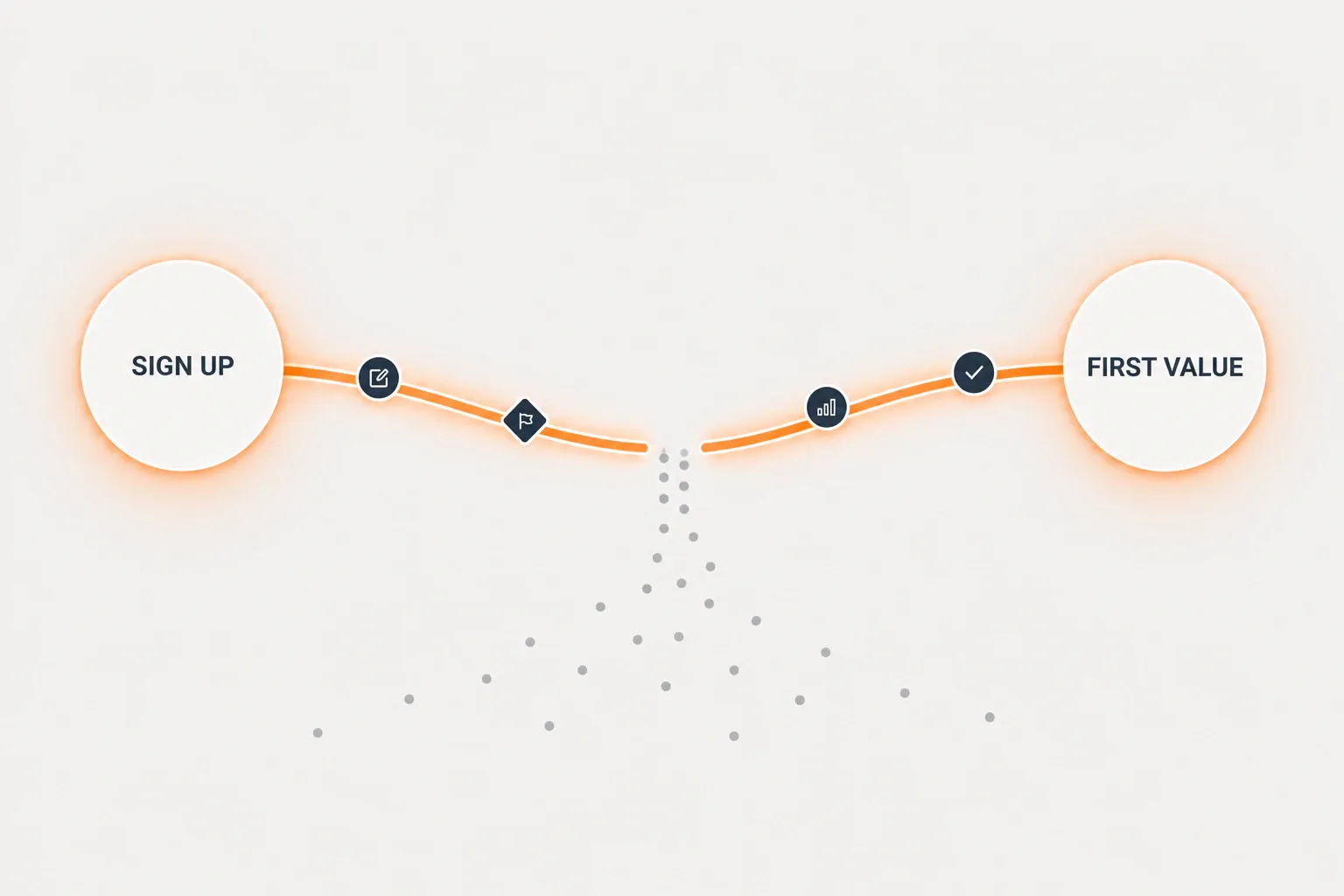
Signups are coming in. You can see them in the dashboard. But check back in a week and most of those accounts are cold — never opened again, never reached the thing your product is actually good at. The instinct is to fix it upstream: add a channel, post more, maybe finally try paid. But adding reach to a product that loses most of its new users doesn't grow the company; it just makes the same leak more expensive. For a solo founder or a 2–3 person team, the highest-leverage 'grow startup' move is usually not picking a new channel, lever, or scoreboard — it's protecting the activation handoff: the short, fragile stretch between signup and the first moment a user actually feels your product work. This is a buyer's guide, so we'll keep the lever fixed (activation) and focus on the decision that follows: how you ship that guided first-value experience, framed as a build-vs-buy choice. You'll get a working definition, the 2026 evidence on why this seam matters, a three-option comparison, and 'choose this if' rules by stage and team makeup so you fix the bucket before you pour more in.
The growth lever hiding in your product, not your channel mix
Here's the situation this guide is written for: you have some distribution working. People find you, they sign up, and then the funnel goes quiet. You don't have a traffic problem so much as a what-happens-next problem. And the standard 'grow a startup' playbook — choose a channel, sequence your tactics, build a scoreboard — all lives upstream of the moment that actually decides whether a signup turns into a user who stays.
The 2026 data is blunt about where the money leaks. Across 62 B2B SaaS companies in Userpilot's benchmark, the average user activation rate sits at roughly 37.5% (median ~37%) — meaning about two-thirds of new signups never experience the core value the product was built to deliver, according to a 2026 analysis by DigitalApplied. They don't churn loudly; they simply never come back. That gap, between 'signed up' and 'felt the value,' is the activation handoff, and on a tiny team it's almost always the biggest unowned lever in the company.
So let's set scope clearly, because if you've read other 'grow startup' guides you've heard the channel, lever, sequencing, and scoreboard arguments. We're not re-running those. We're treating activation as the chosen lever and answering one practical question: how does a team with no growth pod and little spare engineering time actually ship a guided first-value journey? That's a build-vs-buy decision, and the rest of this guide is the definition, the evidence, the three options, and the rules for choosing between them.
What 'activation' actually means (and why it decides whether growth compounds)
Activation is the moment a new user first experiences your product's core value — the 'aha' where the connection between what you promised and what they're doing clicks. It is not the same as signing up, and it is not 'opened the app once.' A user can create an account, click around three screens, and leave without ever activating. Procedural completion (finished the tour, checked the boxes) and actual value delivery are different things, and the gap between them is where retention dies.
The single most useful metric here is time-to-value (TTV): how long it takes from signup to that first 'aha.' It's predictive because it captures the friction in your critical path. 2026 benchmarks vary widely by deal size — Perspective AI's onboarding report puts median TTV at about 11 minutes for low-ARR self-serve accounts but as long as 9+ days for mid-market accounts that require data ingestion and a second stakeholder. The takeaway isn't a target number; it's that for self-serve products, value is expected to land fast, and a slow path is itself a signal your activation is below median.
The funnel logic is simple and worth stating plainly: acquisition brings people in, activation determines whether they feel value, and retention determines whether that value repeats. If activation is broken, everything downstream is starved — there's nothing to retain and nothing to monetize. As one 2026 onboarding analysis put it, when users never hit a value milestone, the overwhelming majority churn within their first couple of weeks (Amplitude benchmark data cited by DigitalApplied).
The stakes, in 2026 numbers
A few figures make the cost concrete. The industry-wide average SaaS activation rate is roughly 37.5%, with a median around 36% across 500+ products (Codivox, 2026, citing StriveCloud, Shno.co, and Lenny Rachitsky's research). On the churn side, Codivox cites that around 75% of new SaaS customers churn in the first week, and that 74% of potential customers will switch to another solution if onboarding feels complicated. The first week is the single largest churn window.
These are third-party benchmarks, not your numbers — your product may sit above or below them. But they establish the pattern: roughly a third of signups activate, the bulk of the loss happens almost immediately, and it happens quietly. You can't fix what you can't see, which is exactly why this lever stays unowned on most small teams.
Why this is the wrong thing to skip — the leaky-bucket trap
The 2026 consensus across growth writing is consistent: scaling acquisition before activation and retention are solid wastes resources. The mental model people keep reaching for is the leaky bucket — pouring water in faster doesn't help if the holes in the bottom are big enough that the bucket never fills (Startup Super School, 2026). As Venture Lab's 2026 paid-ads guide puts it, ads amplify whatever you already have: if your product retains and converts, ads accelerate that; if it leaks users after week one, ads accelerate the leak too, just more expensively.
That's not anti-marketing; it's sequencing. The same guide recommends confirming your retention is at or above category benchmark and that some customers are arriving organically before scaling spend — otherwise, paid traffic 'will just make a leaky bucket leak faster.' The familiar guardrail is a minimum LTV:CAC ratio of about 3:1, with sustainable SaaS companies landing between roughly 3:1 and 5:1 per Userpilot's 2026 benchmarks cited by Venture Lab. Below that, the unit economics are broken regardless of how clever the ads are.
There's a leverage argument too, and it's worth attributing carefully because it's a vendor estimate, not a settled fact. UserPilot's modeling (cited by Codivox, 2026) suggests that a ~25% improvement in activation can compound to a ~34% lift in MRR over 12 months. Treat that as a directional, third-party estimate rather than a guarantee — but the direction matches what practitioners report. Mavan's 2026 work on LTV:CAC argues the higher-leverage fix is usually downstream — raising lifetime value by tightening activation and surfacing the 'aha' earlier — not cutting acquisition cost.
For a tiny team, the practical conclusion is that the signup-to-value seam is the 'unowned middle.' Nobody is assigned to it, it doesn't show up as a tidy line item, and it's easy to mistake for an acquisition problem. That's precisely why it tends to be the single biggest growth lever you actually control this quarter.
Find your activation moment before you build anything
Before you choose any tooling, find the leak — because building a guided journey toward the wrong moment just wastes the build. The cheapest first step costs nothing: open an incognito window, sign up with a fresh email, and walk your own product as a brand-new user from the homepage all the way to first value. Write down every step that asks for something — a field, a decision, an invite — before the user has gotten anything back. Empty dashboards with no obvious next step and feature showcases that don't help the user do something are the usual culprits.
That audit tells you what might be wrong; cohort data tells you where it is wrong. Find your real 'aha' empirically: pull the cohort of users who converted or stuck around, look at the specific early actions they took, then do the same for users who churned. The step where the two groups diverge is your activation pattern — the behavior to design toward, and the part of the flow right before it is what you redesign first. This is more reliable than guessing at a tour script from memory.
Cut first, guide second
Once you know the target action, map the shortest possible path from signup to it and strip everything that isn't earning its place. Most signup forms ask for far more than they need. For every field, ask: can I collect this after the user has felt the value? Company size, role dropdowns, and personalization quizzes that don't actually personalize anything can almost always wait. Operations Upgrade's 2026 retention piece frames the same move as mapping your critical path to value and eliminating every unnecessary step between signup and first value.
Be honest about the exceptions, though. Some friction is intentional and good: you might be deliberately qualifying out the wrong users, or a field may be genuinely required to set up the account. The rule isn't 'remove all friction' — it's be deliberate. Know why every step exists. Only after you've cleared the path does it make sense to add a guidance layer on top, which is where the build-vs-buy decision finally enters.
The decision: three ways a tiny team ships a guided activation journey
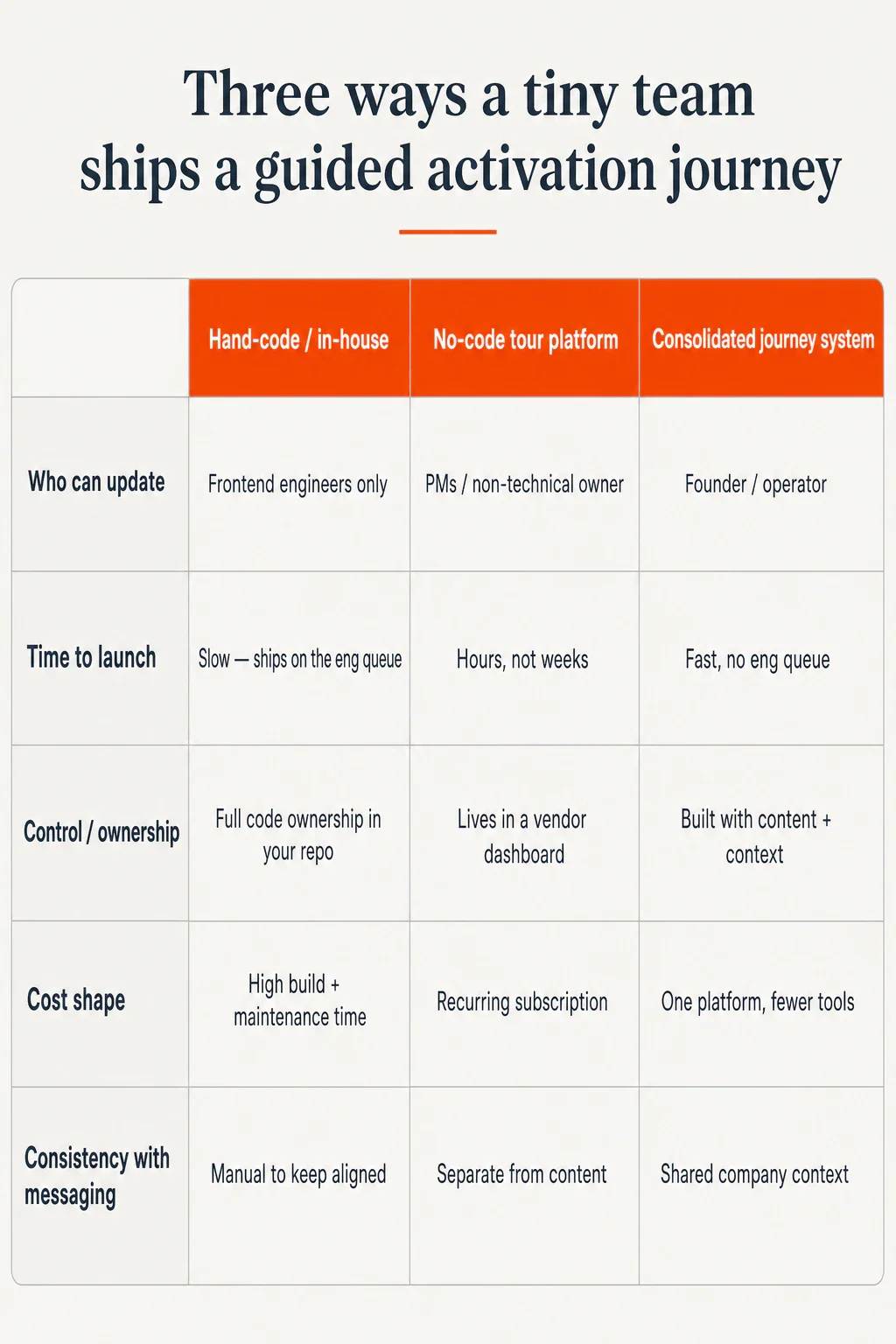
With your target 'aha' identified and the path trimmed, you need a way to guide users along it — checklists, tooltips, a short product tour, smart empty states. The classic framing is build vs. buy, but the more honest 2026 reframe is that it's rarely binary: there's also a 'stitch' middle path, and the real risk is ending up with a half-built platform glued to spreadsheets and scripts. Here are the three honest options, described at the capability level.
Option A — Hand-code / in-house (or a code library)
You build the guided flow yourself, in your own codebase. Upside: full control and code ownership — the journey lives in your repo, behaves exactly how you want, and ships with no third-party script. Downside: engineering owns every change, so you tend to iterate quarterly, not weekly. The cost estimates here are vendor figures and should be read as such: Userorbit (2026) pegs a basic in-house tour builder at 80–140+ developer hours and roughly $15,000–$30,000 before the first tour ships; Appcues (cited by Usertourkit, 2026) estimates ~$45,000 upfront and ~$70,000 year-one for a single flow, and elsewhere puts a fuller in-house build at ~$180,000+ in year one. Onramp (2026) notes even a 'modest' internal build often runs 500–1,000+ engineering hours in year one. These are directional vendor estimates, not your costs — but they capture the real trade: ownership in exchange for ongoing engineering time you may not have.
Option B — No-code product-tour platform
You subscribe to a dedicated onboarding/tour tool and a non-technical owner builds flows in a dashboard. Upside: speed. Userorbit's comparison shows a first tour shipping in under a day versus 2–3 weeks in-house, updates in ~15 minutes of PM time versus 2–4 hours of engineering, and same-day A/B tests — so you can run weekly experiments instead of quarterly ones. Built-in analytics and mobile support usually come included. Downside: a recurring subscription (often priced per monthly active user, which scales with success), a third-party script in your product, and flows that live in a vendor's dashboard rather than alongside the rest of your work. As Onboard.io's 2026 build-vs-buy piece notes, no-code is 'not always no-work' — implementation, event setup, and QA are real costs even when they don't appear on the invoice.
Option C — Consolidated journey-building operating system
You build the guided journey inside a system that also holds your founder-led content and persistent company context, so the activation flow stays consistent with the story you tell everywhere else. The argument here is consolidation: instead of a tour tool in one place, your messaging in another, and your decisions in a doc, the journey is built against the same shared context. This is the antidote to the '50/50' glue trap that several 2026 sources describe — half a platform, half a pile of stitched-together tools and spreadsheets (Quantlabusa, Deelo, and Unifygtm all flag point-tool sprawl and consolidation pressure in 2026). FounderHQ sits in this category as a focused operating system that combines a builder for product journeys, a writer for founder-led content, and a workspace for company context — described as capability, not a metrics claim.
Choose this if: rules by stage and team makeup
The variables that actually decide this aren't price-list line items — they're about your team. Synthesizing across the build-vs-buy sources (Usertourkit, Appcues, Onramp, Userorbit), four questions matter most: who owns onboarding (an engineer, or a founder/operator)? How often will you change it? Do you have frontend engineers with spare cycles? And does activation span more than the app — emails, nudges, messaging that has to stay consistent? Map your answers against the three options below.
The compact comparison:
Factor | Hand-code / in-house | No-code tour platform | Consolidated journey system |
|---|---|---|---|
Who can update | Frontend engineers only | PM / non-technical owner | Founder / operator |
Time to launch | Weeks (eng queue) | Hours, not weeks | Fast, no eng queue |
Control / ownership | Full code ownership in repo | Lives in a vendor dashboard | Built with content + context |
Cost shape | High build + maintenance time | Recurring subscription (often per MAU) | One platform, fewer tools |
Consistency with messaging | Manual to keep aligned | Separate from content | Shared company context |
Choose hand-code / a library if: your team writes frontend code, your activation flow rarely changes, and code ownership (no third-party script, full control, no per-MAU bill) matters more than iteration speed. The classic fit is a developer-heavy team with a stable flow.
Choose a no-code tour platform if: nobody on the team writes frontend, or a non-technical owner needs to ship and tweak flows weekly without waiting in an engineering queue. You're trading a recurring subscription and a vendor dashboard for speed and built-in analytics — usually worth it when iteration velocity is the constraint.
Choose a consolidated system if: you're a tool-fatigued tiny team that needs the activation journey, your founder-led content, and your company context to stay consistent — and you want to avoid point-tool sprawl and the 50/50 glue trap. The fit is the solo founder or 2–3 person team who is also the marketer and the PM, and who can't afford for the in-app experience to drift away from the story on the landing page.
A 60-second self-scorecard
Score yourself, then let the majority answer point you: (1) Does someone on the team write frontend code with spare cycles? (2) Will you change the flow more than once a month? (3) Does a non-technical person need to own it? (4) Do activation, content, and messaging need to stay in sync? If you answered 'no, no, no/n-a' — hand-code is defensible. If 'no, yes, yes' dominates — a no-code platform earns its subscription. If question 4 is a loud 'yes' and you're already drowning in tabs — the consolidated route is the one that fights sprawl instead of adding to it.
Make it real: a lightweight first activation sprint
Whatever you choose, ship it as a short, measurable sprint rather than an open-ended project. A 30–60 day activation push with tight learning loops keeps the work honest and the scope small enough for a tiny team. The point isn't to redesign onboarding end-to-end; it's to fix the single worst-leaking step first and prove the lever moves.
Instrument the one or two leading metrics that actually predict the outcome — activation rate and time-to-value — not vanity numbers like 'tour completed.' Procedural completion can climb while the cohort quietly empties, so measure whether users hit the value event you identified in your cohort analysis, within a fixed window. Then ship one guided journey toward that verified 'aha,' watch the drop-off at the step you targeted, and iterate on the next-worst leak.
This is also where consolidation pays off in practice. The same founder context that defines your activation 'aha' is the context that should shape your landing page, your onboarding emails, and your launch posts. Building the guided journey and your founder-led content against one shared, persistent company memory — which is what FounderHQ is designed to do as a unified builder, writer, and workspace — keeps the activation experience and the story around it consistent, so a user who clicked your post meets the same promise inside the product. Stated as capability: it's about reducing tool sprawl and keeping outputs aligned, not a promise of specific numbers. Fix the handoff first, keep the message consistent, and the reach you already have starts to compound instead of leak.
Conclusion
Growing a startup on a tiny team isn't usually a channel problem — it's a handoff problem. The quiet truth in the 2026 data is that roughly a third of signups activate and the bulk of the loss happens in week one, which means more traffic into a leaky product mostly buys you more expensive churn. So fix the bucket first: walk your own product as a stranger, find your real 'aha' by comparing who stayed against who left, cut everything between signup and that moment, then ship one guided journey toward it. How you ship it is the build-vs-buy decision — hand-code for control, a no-code platform for iteration speed, or a consolidated system if you need activation, content, and context to stay in sync without drowning in tools. Pick the option that fits who owns the work and how often it changes, run it as a 30–60 day sprint against one or two leading metrics, and you'll have done the one thing most 'grow startup' advice skips: protected the moment that decides whether any of your growth compounds.
Related articles
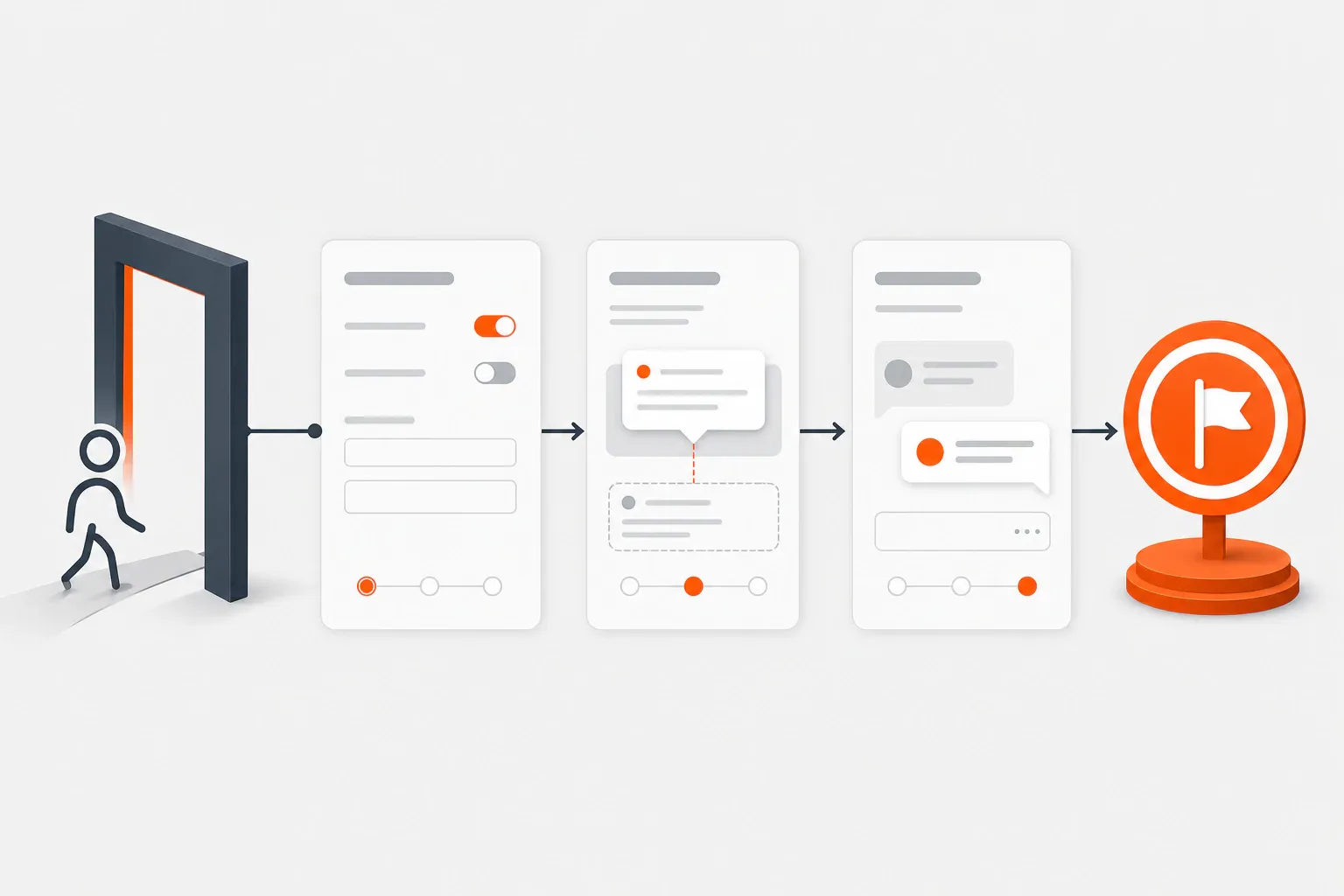
Application Onboarding Process: Definition, Steps, and When to Use It
A practical seven-step application onboarding process for moving new users from signup to first meaningful value without unnecessary setup or generic tours.
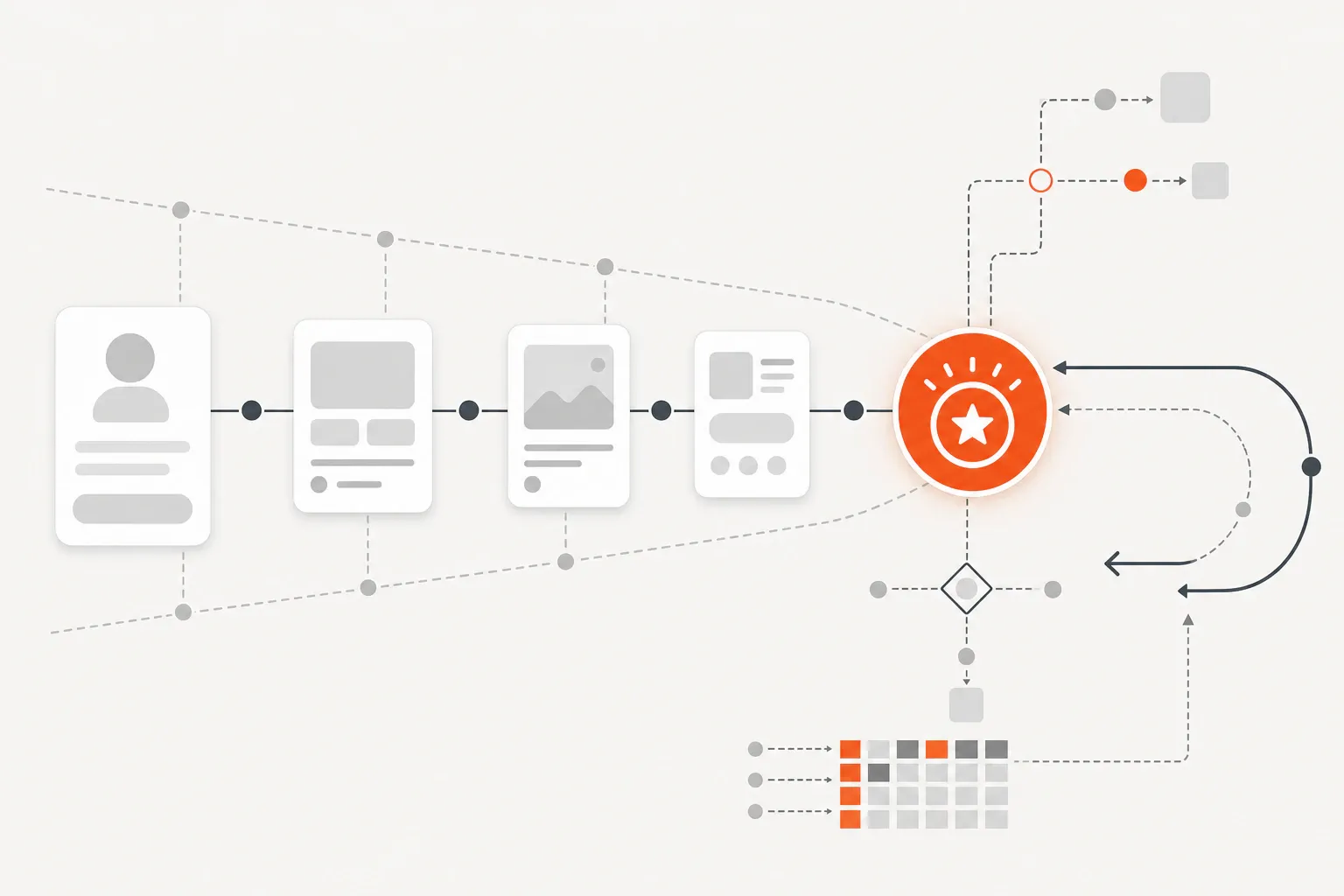
In-App Analytics for Onboarding: Definition, Metrics, and When to Use It
In-app analytics for onboarding turns events, funnels, segments, and user feedback into decisions about the path from signup to first value.

In-App Guidance for Onboarding: Definition, Examples, and When to Use It
In-app guidance helps users complete meaningful tasks inside a product. This guide explains the main patterns and how to match each one to an onboarding blocker.