When you search "grow startup," you're rarely looking for another fifty-tactic listicle. The real question underneath is harder and more honest: how do I build predictable growth without burning my runway or my own hours? In 2026, the answer isn't finding more tactics — there are more channels, AI tools, and playbooks than any lean team could ever run. The constraint is choosing a sequence and a stack: deciding what to fix first, where to spend your scarce attention, and which tools to standardize on before sprawl quietly taxes you. That reframing matters because growth most often breaks for a predictable reason — teams pour money and energy into acquisition before activation, pricing, and their ideal customer are actually working. This guide treats growth the way a buyer's guide should: as three explicit trade-offs, each with a plain "choose this if" rule, plus a decision table you can act on this week. It deliberately stays at the decision layer — the channel-by-channel distribution playbook and the build-in-public cadence are big enough topics to live in their own guides.
First, don't skip the prerequisite: a product people love, then growth
Before any growth decision, there's a gate you can't skip. Paul Graham's classic essay Do Things That Don't Scale makes the point that startups don't take off on their own — "startups take off because the founders make them take off," usually by recruiting early users manually rather than waiting for them to arrive (paulgraham.com). Y Combinator's broader canon adds the warning that founders who chase growth before they have a product people genuinely love create what's often called the leaky-bucket problem: you pour users in the top, but they drain out the bottom faster than you can replace them. Spending on acquisition then just makes you lose users more expensively.
The stakes here are well documented. CB Insights' long-running analysis of startup post-mortems found that "no market need" was the single most-cited reason startups failed, at 42% of cases — and its updated 2026 study of 431 venture-backed companies that shut down since 2023 found the headline barely moved: 43% failed due to poor product-market fit, with two-thirds of those being early-stage companies that never found a market (CB Insights; Inc.). Running out of cash topped the 2026 list at 70%, but that's almost always the symptom — the disease is building something not enough people want, then trying to grow it.
Retention is the signal worth instrumenting first
The practical move is to make retention measurable early. Track an activation rate (the share of new users who reach a first meaningful outcome) and 30-day retention before you optimize anything upstream. If returning usage is flat or climbing, you have something worth amplifying; if it decays toward zero, more traffic just accelerates the leak.
Use a fit signal as your gate
A widely used leading indicator is the Sean Ellis test: survey active users with "How would you feel if you could no longer use this product?" and measure the percentage who answer "very disappointed." After benchmarking roughly a hundred startups, Ellis found that companies clearing about 40% tended to grow relatively easily, while those well below it struggled at every level (First Round Review; Sean Ellis on Medium). Treat 40% as a directional benchmark, not a law of physics — it's pattern recognition, it needs a reasonable sample, and B2B and consumer products can differ. But the logic holds: fix the bucket before you turn up the tap.
Decision 1: Activation-first vs. acquisition-first
Your first real decision is where to point your effort: at getting more people in, or at getting the people you already have to succeed. Acquisition-first means optimizing for top-of-funnel volume — more signups, more traffic, more leads. Activation-first means optimizing the path from signup to first value and early retention before you scale volume. Both can drive growth; the failure mode is doing them in the wrong order.
The classic trap is acquisition-first while activation is still broken. Revenue and signups climb for a quarter or two, everyone celebrates, and then churn quietly catches up — because every new cohort hits the same shaky onboarding and leaves. You've spent real money to widen a leak. As the YC canon frames it, sustainable growth is pouring gasoline on proven retention, not premium spend hoping retention shows up later.
Choose activation-first if your onboarding is clunky, your 30-day retention is leaking, or you can't yet explain why the users who stick around stay. Choose acquisition-first only if retention is stable, users come back on their own, and you've identified a repeatable reason they convert. In other words, acquisition-first is a privilege you earn by fixing activation first.
Activation-first work is concrete: it lives in onboarding, activation flows, and guided product experiences — the journeys that carry a new user from "signed up" to "got the point." This is exactly the kind of work FounderHQ's builder is designed for, letting an early-stage team prototype and ship those guided product journeys and mobile-first demos rather than leaving first-run experience to chance. The benefit isn't a flashy tour for its own sake; it's closing the gap where new users currently fall out before they reach value.
Decision 2: Founder-led distribution vs. paid acquisition
Once activation is sound, the next decision is how you reach more of the right people: founder-led, organic distribution or paid acquisition. For early-stage B2B in 2026, founder-led distribution — showing up on LinkedIn, X, in niche communities, and on customer calls — remains stubbornly effective, in large part because paid channels keep getting more crowded and expensive while a founder's specific point of view is hard to replicate or auction away.
The economics have long favored owned content for lean teams. A frequently cited Demand Metric benchmark holds that content marketing generates roughly three times as many leads as outbound while costing about 62% less (Content Marketing Institute). Treat that as a directional, often-quoted figure rather than a guarantee for your specific case — but the shape of it matches what bootstrapped founders see: organic content compounds, while paid stops the moment you stop spending.
Choose founder-led if you're pre- or early-PMF, have little or no acquisition budget, and your audience is reachable where you already have a voice. Choose paid acquisition if you've already proven a repeatable loop with a healthy unit economic ratio (acquisition cost comfortably below lifetime value) and you're buying speed on something that already works. The discipline either way is focus: pick a maximum of one or two channels and commit roughly 90 days with explicit kill criteria, instead of spreading thin across six and learning nothing from any of them.
Founder-led distribution is also where FounderHQ's writer fits — turning your accumulated company context into LinkedIn posts and market narratives so the founder's perspective ships consistently instead of stalling on a blank page. We're keeping this section at the decision level on purpose: the deeper channel-sequencing and cadence work belongs in a dedicated distribution guide, not here.
Decision 3: Consolidated operating system vs. point-tool sprawl
The third decision is structural: do you assemble your growth work from many specialized point tools, or run it on a smaller, consolidated stack? The 2026 backdrop is hard to ignore. Industry trackers put the average business at well over 100 SaaS applications — Vertice estimated about 138 per business as of early 2026, and other 2026 benchmarks cite roughly 130 apps per enterprise — even as "consolidation" tops everyone's stated priorities (Vertice; SaaSStatsHub). The cost of that sprawl is real: BetterCloud's 2026 roundup notes that the majority of teams cite too many unused or underused apps as the driver for consolidation, and roughly a third of organizations consolidated redundant apps in the prior year (BetterCloud).
The lean-team nuance
Here's the catch for early-stage teams: you don't yet have a giant pile of shelfware to claw back, so the headline "de-sprawl and save millions" story isn't really yours. Your win is the opposite of those enterprises — it's starting consolidated, so you never accumulate the overlap, the context-switching tax, and the disconnected data in the first place. Cleaning up later is expensive and disruptive; not making the mess is nearly free.
That said, consolidation isn't a license to use one tool for everything. A sensible right-sizing for a small team is a handful of core tools mapped cleanly to acquisition, activation, and retention — not fifty, and not a single bloated suite that does each job poorly. Choose a consolidated operating system if you're a lean team that wants shared context across journeys, content, and decisions, and you value fewer seams over maximum depth in any one area. Choose best-in-class point tools if a specific workflow genuinely needs specialist depth that a consolidated system can't match yet — and you're willing to own the integration and context cost.
This is the trade-off FounderHQ is built around: a focused operating system that combines a builder (product journeys), a writer (founder-led content), and a workspace (company context and memory) so your outputs stay consistent because they draw on the same shared context. Worth being precise about the lane, since the market is noisy: some tools position themselves as autonomous AI that "runs your company while you sleep." FounderHQ's angle is the opposite — augmenting the founder and compounding their context, not replacing the founder or the team. And to keep it honest: this is a capability description, not a promise of specific outcome numbers, integrations, or metrics we can't yet verify.
A simple decision framework: sequence your growth in stages
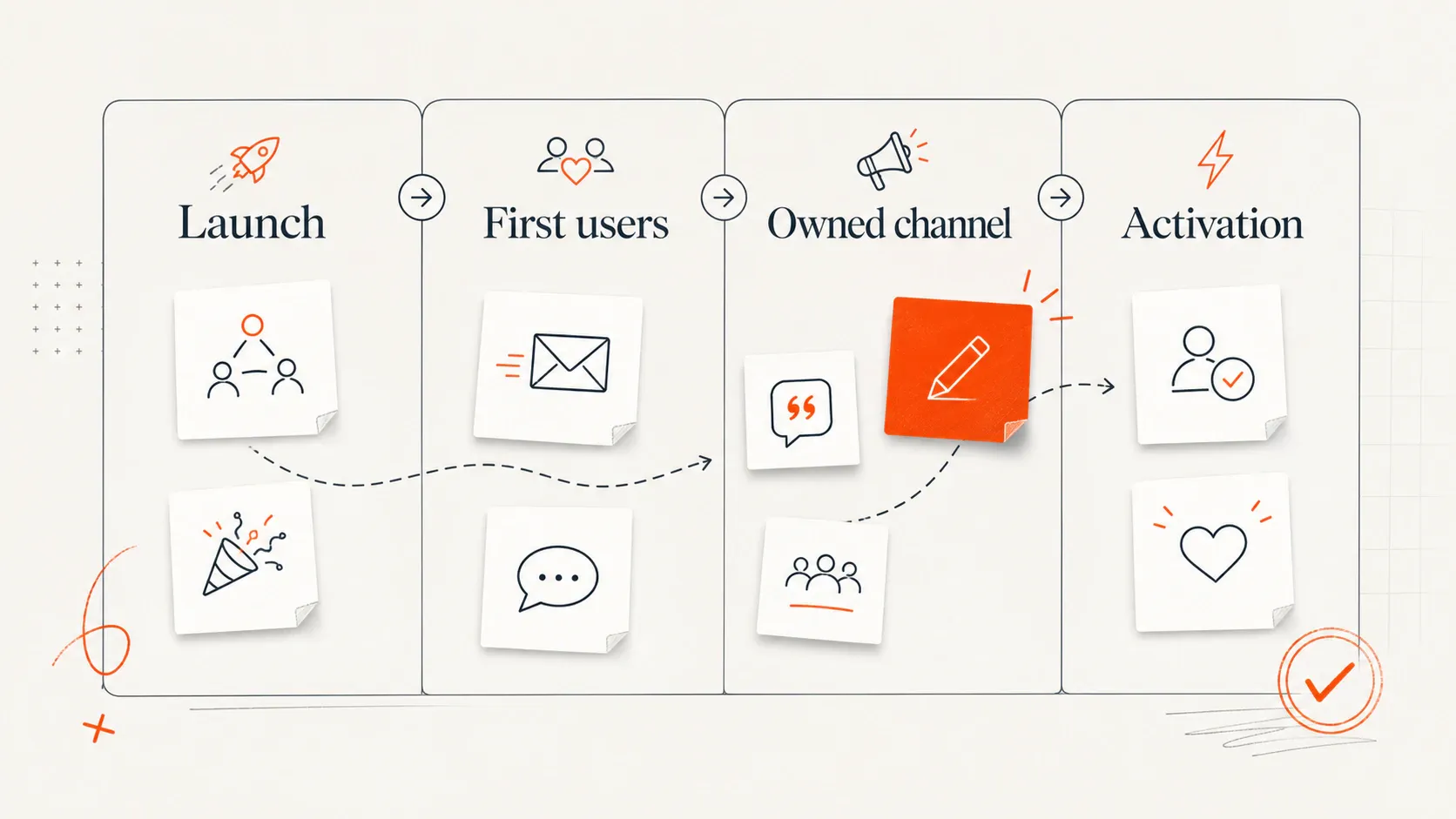
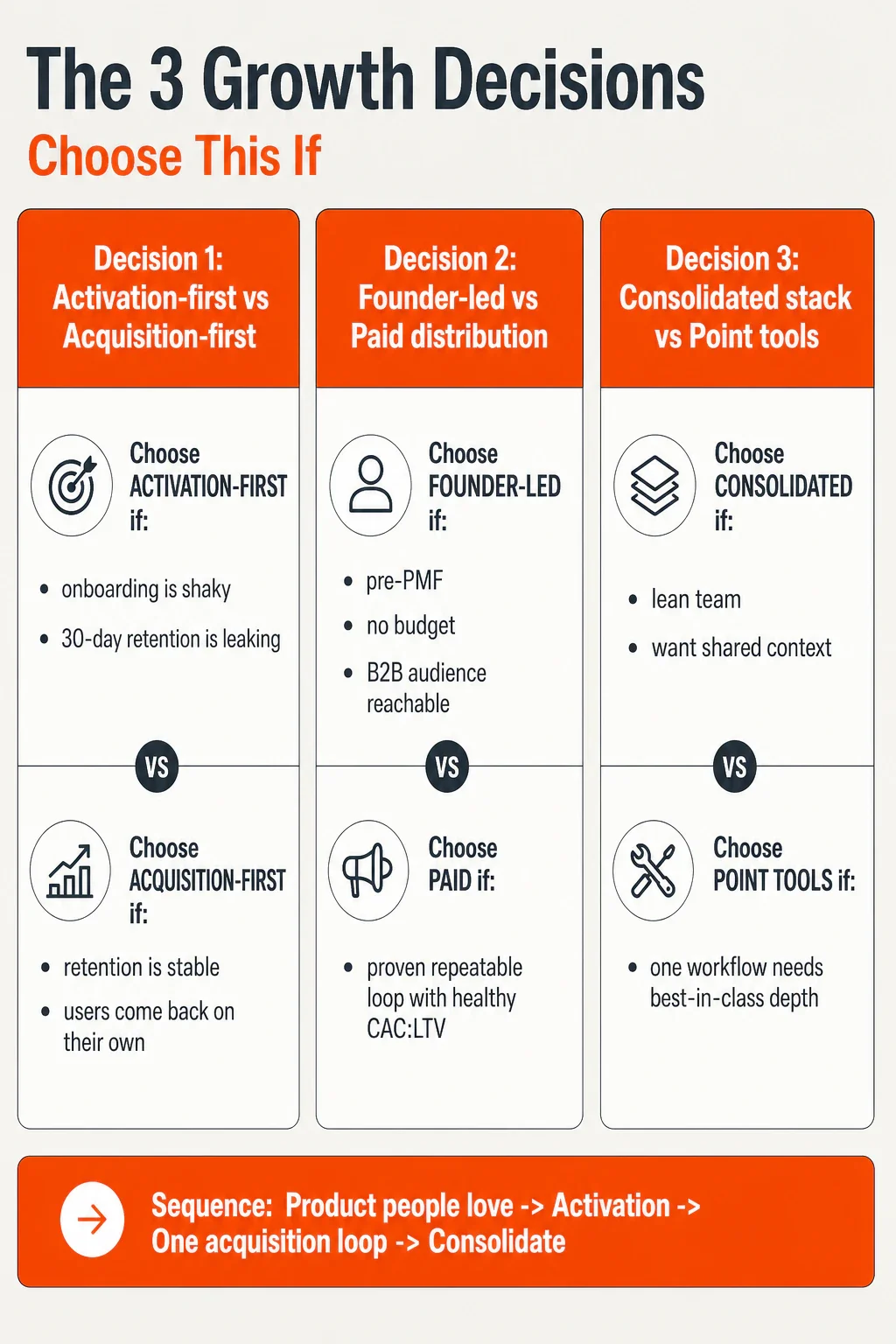
Put the three decisions in order and you get a stage-gated path rather than a tactics pile. The sequence most early-stage frameworks converge on looks like this: (1) reach problem–solution fit, then (2) confirm a fit/retention signal (your Sean Ellis-style gate and 30-day retention), then (3) fix activation so new users reliably reach value, then (4) build one repeatable acquisition loop on a single committed channel, and only then (5) consolidate and systematize what's working. The point of the sequence is that each stage earns the right to the next — you don't open the acquisition tap before the bucket holds water.
The table below maps each decision to its "choose this if" signal so you can locate yourself quickly. The accompanying infographic captures the same logic as a one-glance artifact you can keep next to your roadmap.
Decision | Choose the first option if… | Choose the second option if… |
|---|---|---|
Activation-first vs. acquisition-first | Onboarding is shaky; 30-day retention is leaking | Retention is stable; users return on their own |
Founder-led vs. paid distribution | Pre/early-PMF, little budget, audience reachable | Proven repeatable loop with healthy CAC:LTV |
Consolidated stack vs. point tools | Lean team that wants shared context, fewer seams | One workflow needs specialist depth you can't match |
Do things that don't scale first
Two more principles keep the sequence honest. First, early on, do the unscalable work yourself — recruit users manually, onboard them by hand, sit in on the support tickets — exactly as Paul Graham's essay argues; the manual version teaches you what to automate later (paulgraham.com). Systematize only after you've felt the work by hand.
Make it a weekly operating cadence
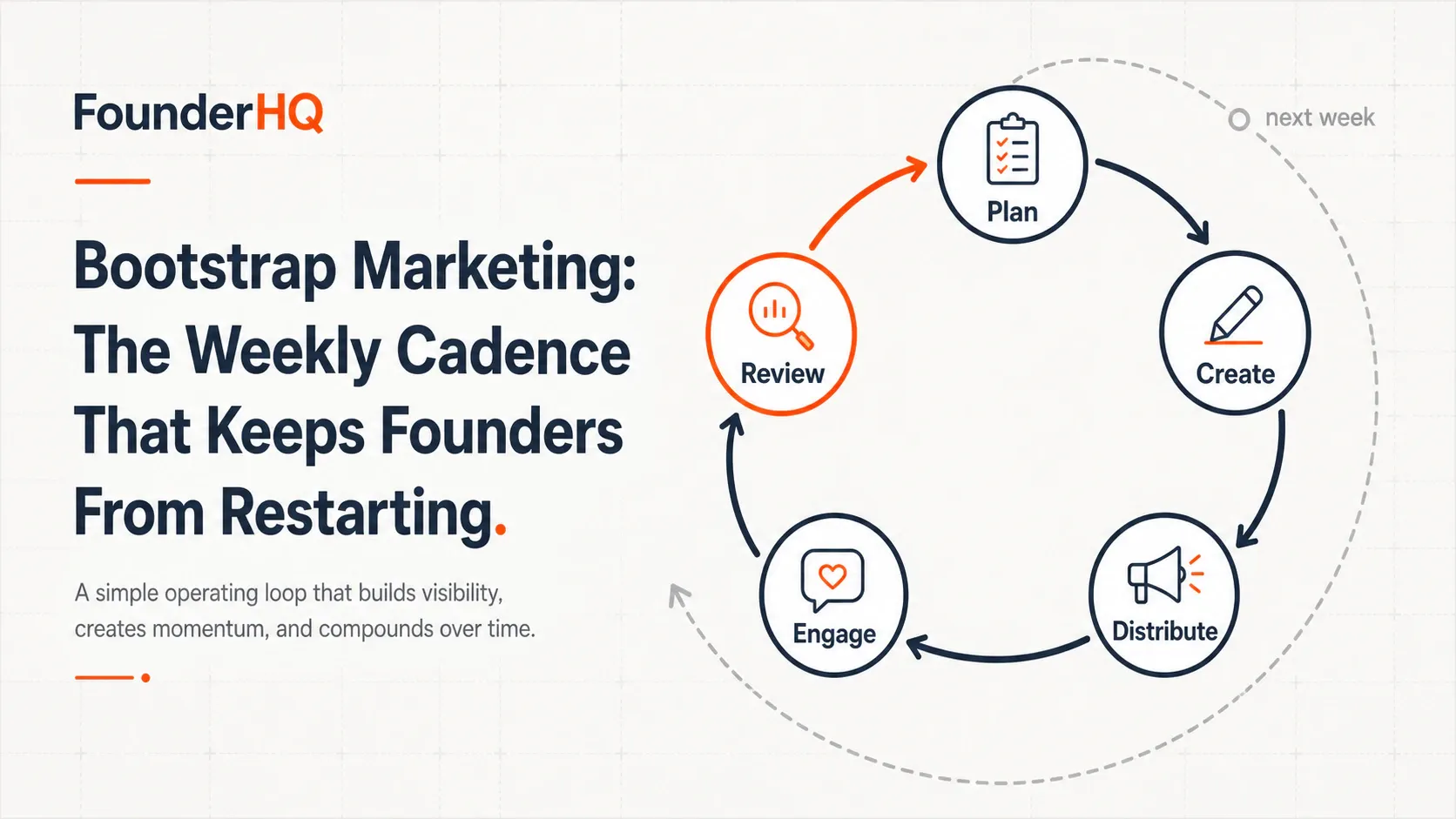
Second, growth compounds when it runs on a repeatable weekly loop rather than heroic sprints. A sustainable cadence — a fixed slot to review your activation and retention numbers, ship one journey or activation fix, and publish one piece of founder-led content — beats sporadic bursts every time. This is the "operating cadence" idea at the heart of FounderHQ: organizing growth work around a founder's real weekly loop so it accumulates instead of resetting.
How FounderHQ fits a founder-led, consolidated growth approach
Read back the three decisions and a pattern emerges: the activation-first, founder-led, consolidated path is one coherent approach, not three unrelated choices. It needs a place to build the journeys that drive activation, a place to turn founder context into the content that drives founder-led distribution, and a shared memory so both stay consistent over time. That's the gap FounderHQ is built to fill as a focused operating system for early-stage product teams — a builder for product journeys, a writer for founder-led content, and a workspace that preserves company context and decisions.
The problem it's answering is the everyday one for lean teams: scattered tools and repetitive weekly loops, where the same context gets re-explained to a new blank page every time and messaging drifts. Consolidating the builder, writer, and workspace means a journey you ship and a post you publish can draw on the same persistent context, so outputs get sharper rather than more fragmented as you grow.
To be clear about the boundary — because overclaiming is its own failure mode — FounderHQ augments the founder; it does not autonomously run your company. The defensible claims are capability claims: it helps you design onboarding and activation flows, prototype mobile-first demos, draft founder-led content like LinkedIn posts, and capture reusable company memory. It does not promise specific conversion lifts, time saved, or revenue numbers, and you shouldn't trust any tool — this one included — that does without showing its work.
Conclusion
If you take one thing from this guide, let it be the reframe: growing a startup in 2026 is less about collecting tactics and more about choosing a sequence and a stack. Fix retention and activation before you scale acquisition, or you'll pay to fill a leaky bucket. Commit to one or two founder-led channels with real kill criteria instead of spreading thin. And start consolidated, so sprawl never becomes a tax you have to pay back later. Use the decision table as your actionable artifact — locate yourself in each row, act on the "choose this if" rule, and revisit it as your signals change. The founders who compound aren't the ones running the most plays; they're the ones who picked the right order, committed, and let a steady weekly cadence do the rest.
Recommended Videos
Verified via transcript: Hormozi directly argues you care about revenue retention first and that growth ultimately reduces to CAC:LTV math — reinforcing the article's 'retention before acquisition' spine. From a recognized, high-authority independent channel (not a competitor).