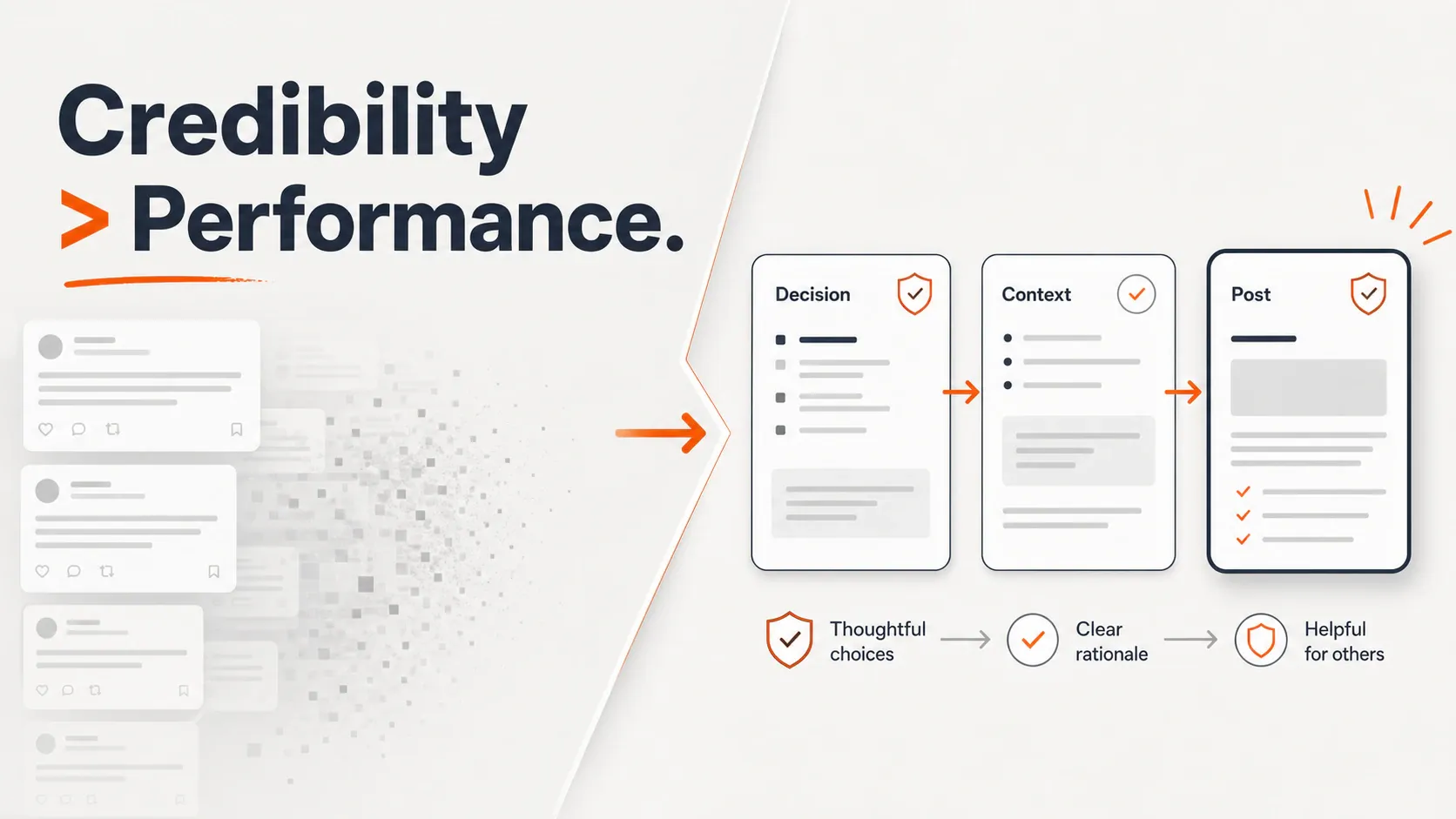
Build in public used to feel like an edge: show the work, share the messy middle, earn trust before the product is obvious. In 2026, the harder problem is that audiences have seen the playbook. They can spot the tidy failure thread, the perfectly timed “I almost quit” post, and the milestone update that says very little. This is not a beginner definition of build in public; it is a credibility filter for founders who are already posting and want the work to feel true. In founder-led content workflows, the posts that survive a skeptical read usually start from a raw decision note — what changed, why it mattered, what was still unresolved — before anyone tries to turn it into a clean public lesson. The question is no longer “Should I build in public?” It is: does this post pass a credibility test?
The credibility problem: build in public got gamed
The strongest critique of build in public is not that transparency stopped working. It is that transparency became easier to perform. Lamanda B. describes the shift as “performing transparency”: curated failures that have already turned into wins, mental-health vulnerability packaged for engagement, and pain converted into content strategy (Lamanda B.).
That critique lands because it names what many founders already feel in the feed. A post can use all the right build-in-public signals — revenue, struggle, lesson, founder voice — and still feel staged if there is no real risk, no unresolved tension, and no specific decision underneath it.
So the differentiator is not that you share. Many people share. The differentiator is whether what you share is specific, current enough to be real, useful to the reader, and consistent with what you actually did. In other words: credible beats theatrical.
Real vs. performative: a quick diagnostic
The fastest tell is timing. If every hard moment only appears after the lesson is known, the product decision worked, and the risk has disappeared, the audience reads the post as a story arc rather than a build log. That does not make it dishonest, but it does make it less believable as real-time transparency.
Use this diagnostic before you draft. If your post falls mostly on the left side, rewrite it around the real decision, trade-off, or open question instead.
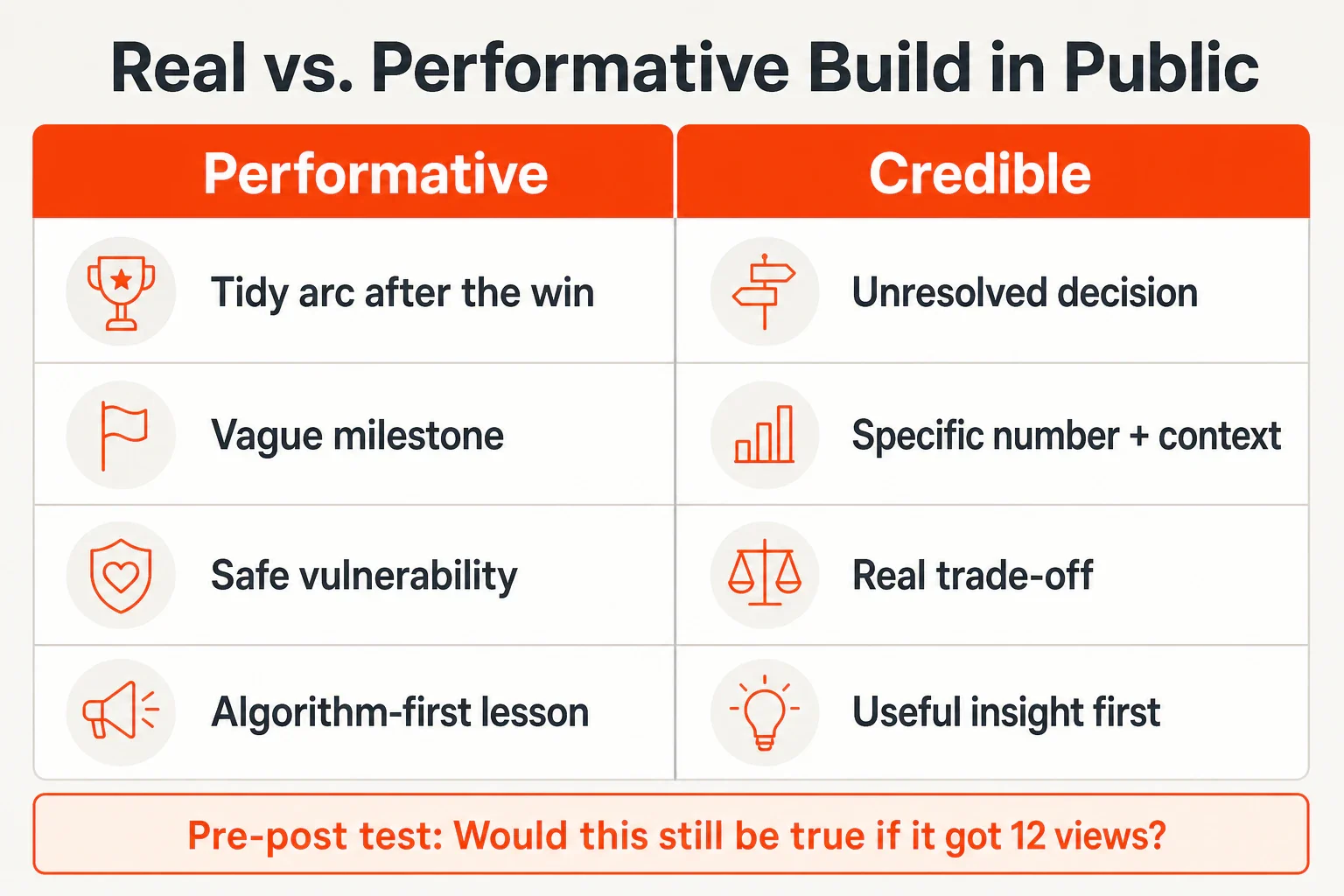
Performative build-in-public posts usually compress reality into a tidy struggle → pivot → lesson arc. Credible posts often stay closer to the actual work: “We killed this feature because onboarding data and customer calls pointed in opposite directions, and we chose the call evidence for now.” That is less polished, but it gives the reader a decision they can learn from.
Specificity is the proxy for honesty. FounderDistro’s 2026 guide argues that generic startup updates get ignored while “real numbers, real struggles, real decision-making” get shared, and recommends pairing progress with specific numbers and context (FounderDistro). You do not need to reveal every number. But you do need enough concrete detail that the post could not have been written by anyone building anything.
What credible sharing actually looks like
Credible sharing is decision-level, not vanity-level. A vanity update says, “We shipped a new onboarding flow.” A decision-level update says, “We removed two onboarding steps because new users were reaching the empty state before they understood the first action. We are trading completeness for speed-to-first-value this week.”
That second version is stronger because it reveals judgment. It shows what you noticed, what you weighed, and what you changed. It also gives another founder or operator a useful pattern to test in their own product.
A practical mix is to make most of your posts useful even to people who never buy from you. FounderDistro recommends a 70/30 split: roughly 70% insights and observations, 30% direct product progress (FounderDistro). Treat that as a bias, not a rigid quota. The point is to avoid turning your feed into a company newsletter with a founder’s face on it.
Share the reasoning, not just the result
When you share a pricing change, killed feature, homepage rewrite, or onboarding experiment, include the “why now?” behind it. What signal changed your mind? What option did you reject? What risk are you accepting? The reasoning is what makes the post useful.
Share the messy middle sometimes
Not every post needs to be unresolved. But if every post is a completed lesson, readers learn that you are narrating the journey after the fact. Occasionally share the question while it is still open: “We are choosing between two activation paths this week. Here is what makes the decision hard.” That is where real build in public earns its name.
The defensive line: transparency without overexposure or theater
Credible does not mean reckless. One reason founders drift into performance is that the real material feels too sensitive, so they replace it with safer vulnerability. The better move is to define a redaction line: what you will share, what you will anonymize, and what stays private.
Ravah’s guidance on build-in-public metrics puts customer names without permission in the “keep private” category and treats sensitive competitive or strategic information as high-risk (Ravah). Its broader build-in-public definition also separates “always share” items like shipped work and decision reasoning from selective or private items such as sensitive user data and information that could harm competitive position (Ravah).
For this article’s purpose, the guardrail is simple: share your work, your thinking, and your learning; protect other people’s information and anything that would materially weaken your position. That usually means anonymizing customer feedback, avoiding negotiation details, not telegraphing upcoming pricing moves before you are ready, and keeping detailed unit economics private unless you have a deliberate reason to publish them.
This is where “selective transparency” is healthier than radical transparency. The point is not to expose everything. The point is to keep your credibility intact by being clear and consistent about the parts of the work you are willing to make public.
Avoid the burnout trap that breeds fake vulnerability
Performance also shows up when the cadence becomes heavier than the founder’s actual operating system can support. A buildinpublic.so burnout guide calls build-in-public burnout a structural failure mode of “performance-in-public” at sustained cadence, and recommends cutting performance metrics and shifting toward workflow-in-public (buildinpublic.so).
That distinction matters. If your cadence depends on dramatic updates, public metrics, and constant emotional intensity, you will eventually run out of honest material. Then the feed starts asking for a version of you that the company does not actually need.
The counter-move is to post less, but post closer to the work. A lower-cadence update about a real trade-off can do more for trust than a daily streak of vague wins and polished lessons. You are not trying to prove that the founder is always in motion. You are trying to make the company’s learning visible.
Watch the audience-fit trap, too. If you are building a B2B product, optimizing every post for other founders can pull you away from the buyers who actually matter. A credible build-in-public strategy should still sound like it comes from the real company you are building, not from a generic founder-content template.
Make honest sharing repeatable, not a weekly performance
Most founders do not perform because they are trying to deceive people. They perform because, by post time, they have forgotten the useful specifics. The decision happened on Tuesday, the customer quote lived in a call note, the metric was checked in a dashboard, and by Friday all that remains is a vague memory: “We learned onboarding matters.”
The fix is to capture the raw material when it happens. Keep a running record of decisions, numbers, objections, user language, product changes, and the trade-offs behind them. Then drafting becomes retrieval, not reinvention.
A lightweight operator pattern: when a founder finishes a customer call, product review, or positioning debate, capture three fields before the context disappears — signal, decision, and open question. The post can come later. The credibility comes from preserving the actual operating moment instead of reconstructing it from memory.
That is also where FounderHQ fits the workflow. FounderHQ helps early-stage product teams build product journeys, compose founder-led content, and keep company context in one focused operating system. For build in public, the benefit is not “automated authenticity.” The benefit is having a persistent place for real context so your public narrative stays closer to the actual work.
Consistency compounds credibility. If your posts, product journeys, launch messages, and internal decisions all pull from the same company memory, you are less likely to drift into a different story every week. The reader may not see the workspace, but they feel the continuity.
A simple credibility checklist before you hit post
Before you publish a build-in-public post, run it through this five-question filter:
- Is it specific? Include a real decision, number, constraint, customer signal, or trade-off.
- Is it close enough to the work? If the lesson is completely resolved and polished, consider whether you are writing a case study rather than a build log.
- Would I share this if it got 12 views? If not, the post may be algorithm-first rather than truth-first.
- Is it consistent with what we actually did? Do not upgrade a messy decision into a heroic narrative.
- Am I protecting what should stay private? Redact customer identities, sensitive strategy, and anything that belongs to someone else.
Good news can still be credible. The trick is to pair the win with the cost or uncertainty behind it. “We crossed a revenue milestone” reads like a brag. “We crossed a revenue milestone, but it exposed a support bottleneck we have to fix before we push acquisition harder” reads like an operator thinking in public.
The best build-in-public posts make the reader trust your judgment, not just notice your progress. If a post does not reveal judgment, it is probably not specific enough yet.
Conclusion
Build in public did not die. The easy version got gamed. In 2026, the founders who still earn trust are not the ones with the most polished vulnerability or the loudest milestone screenshots. They are the ones whose public story keeps matching their real decisions over time. Capture the work as it happens, share the decision-level truth, protect what should stay private, and let credibility become the strategy.