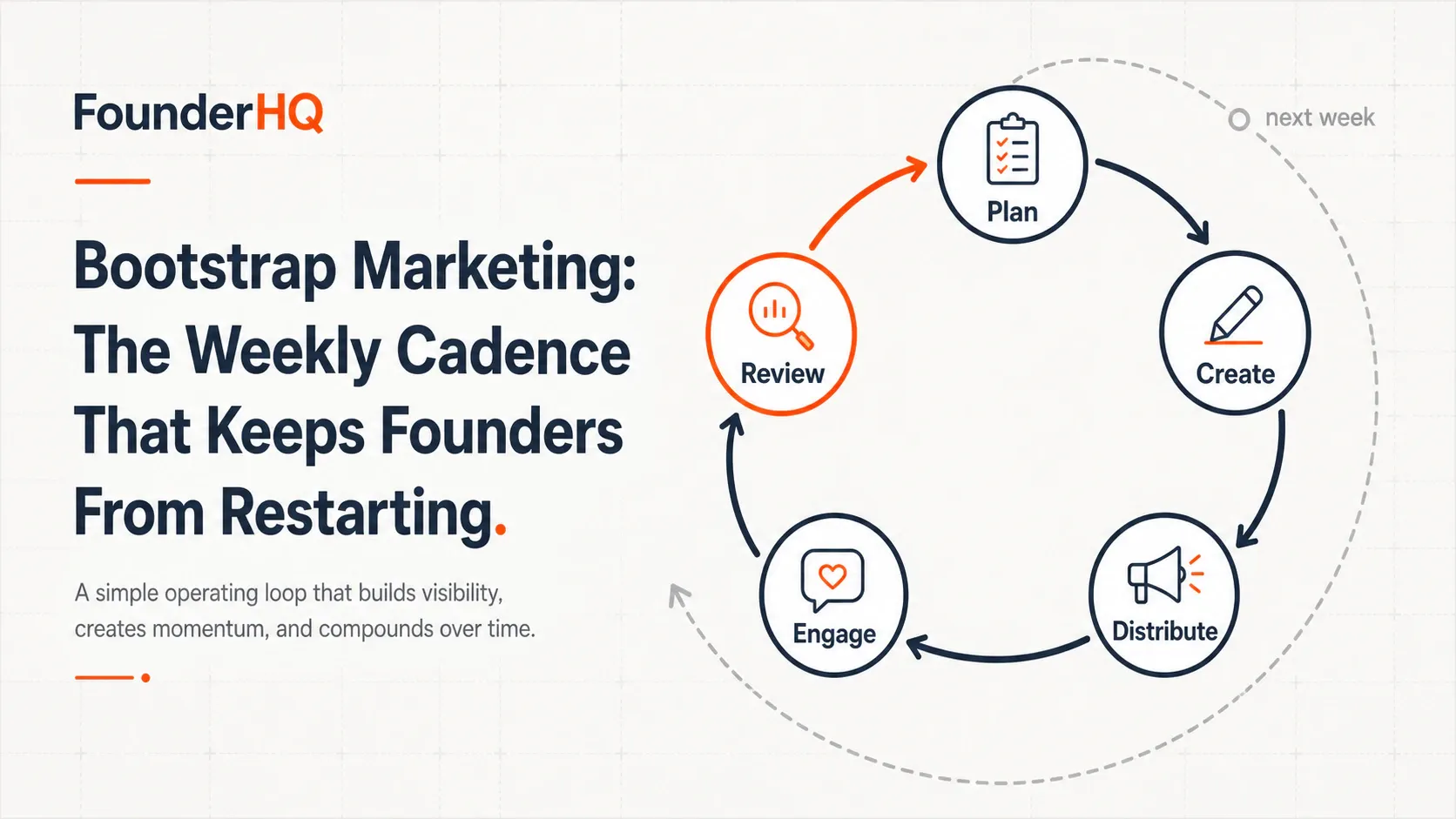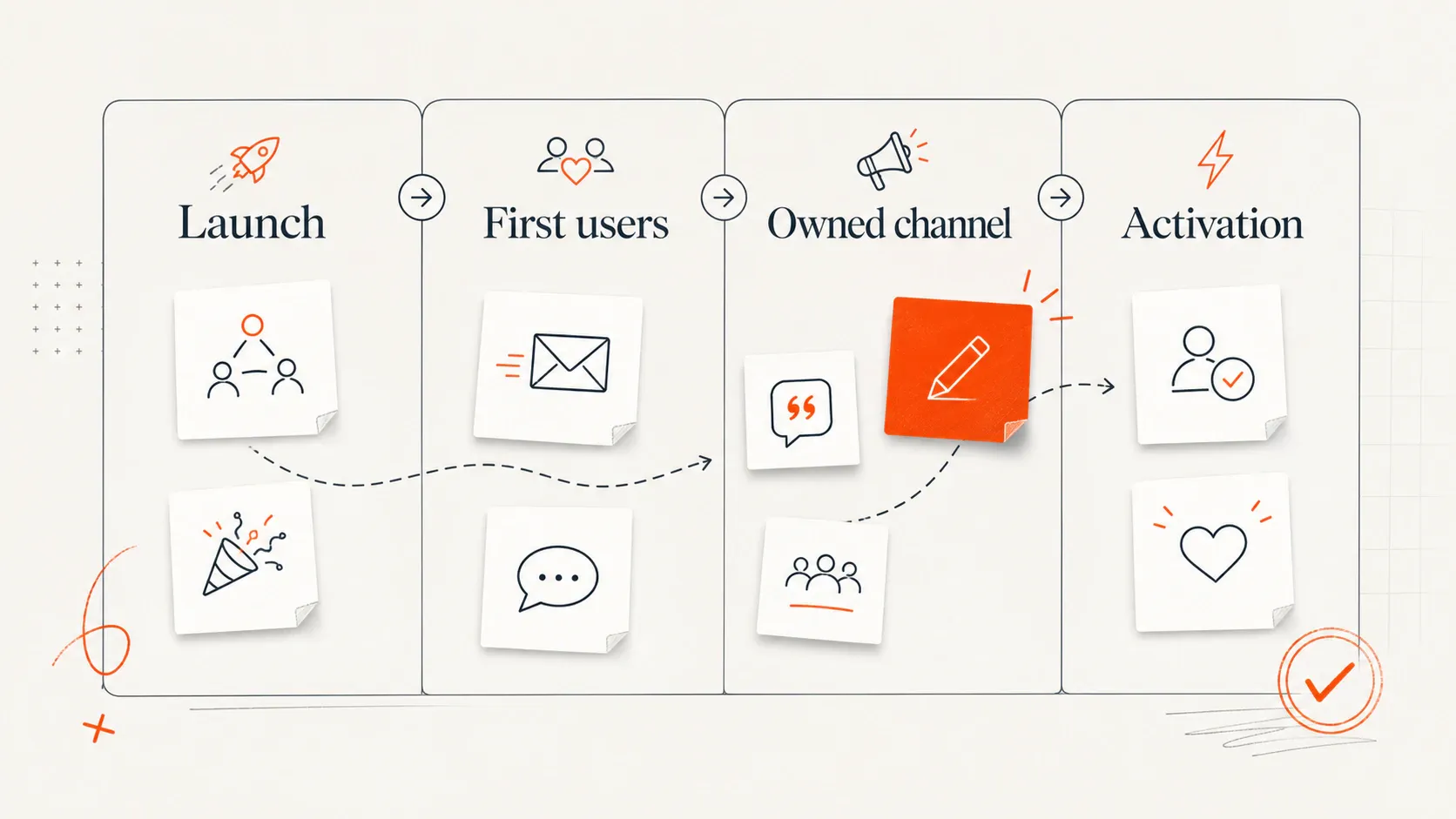
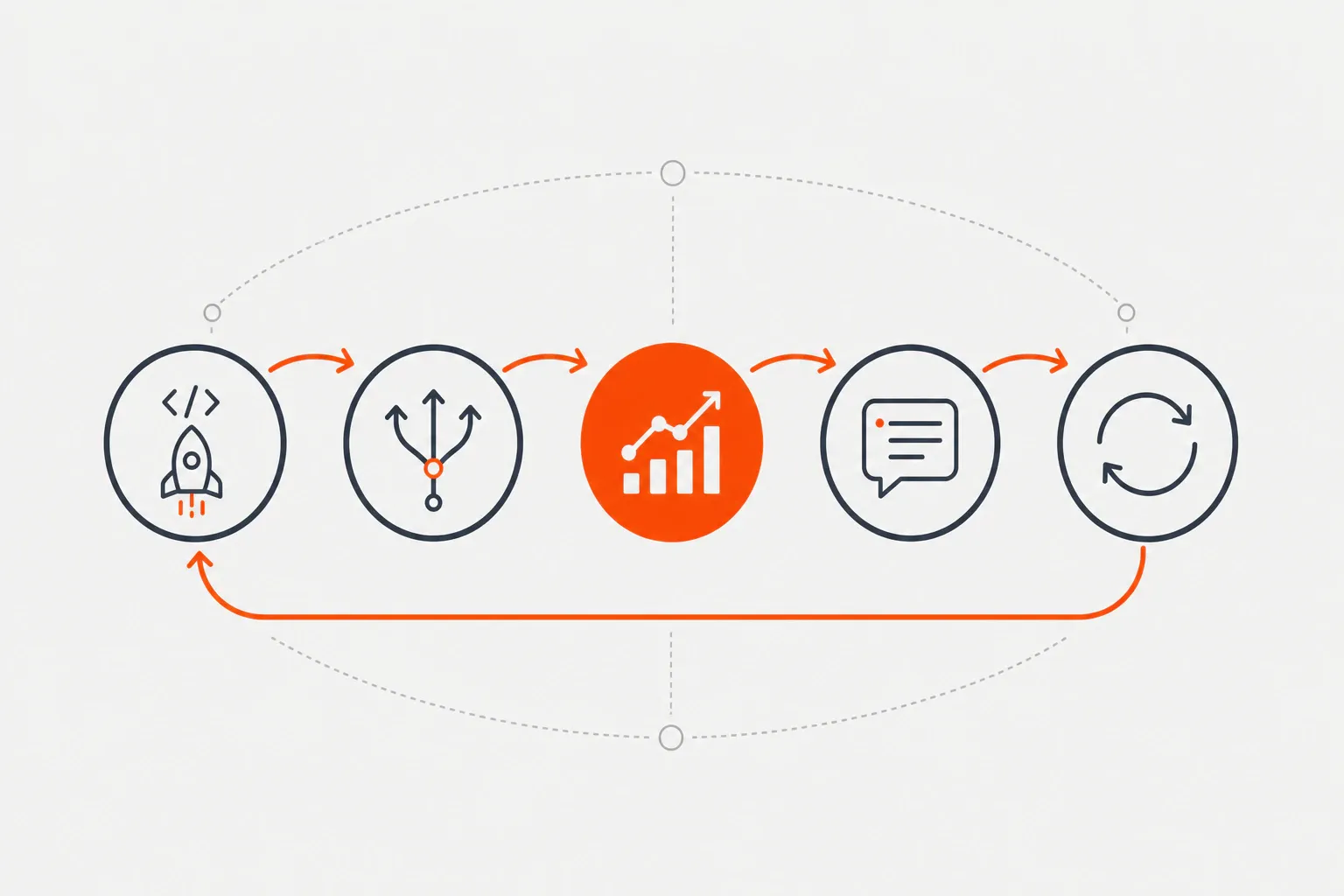
If you're reading this, you've probably already decided that building in public is worth doing. The hard part isn't the decision — it's the third month. Build in public is the practice of making the work of building visible as it happens: the ships, the decisions, the metrics, the messy middle, instead of going quiet until a polished launch. The pattern is older than the hashtag — Buffer has run a public "Open" dashboard sharing finances and salaries since 2013, and early indie hackers like Baremetrics and Groove popularized transparent revenue dashboards in 2013–2014 (buffer.com/open). What almost nobody warns you about is the failure mode: founders don't quit because the idea is wrong. They quit because of drafting fatigue, vague "excited to announce" updates that go nowhere, a cadence that collapses the first busy build week, and the low-grade stress of posting live numbers. This guide isn't another list of what to share — the parallel pieces on this blog cover that. It's the operating-system version: how to run build in public as a repeatable weekly loop that turns your actual work into specific, on-brand posts, sustained by a shared company context so you're never staring at a blank page.
Build in public in 2026: the practice, and why most founders quit it
Strip away the hashtag and build in public is simple: you share the real journey of building — wins, losses, decisions, and numbers — as they happen, instead of saving everything for launch day. The point isn't to broadcast a highlight reel; it's to attract people who recognize themselves in your problems and want to follow along. That core idea hasn't changed since Buffer's Open blog and the early transparent revenue dashboards of 2013–2014. What's changed is how saturated and algorithmically picky the channels have become.
The real problem this guide solves isn't "should you do it" or even "what should you post." It's sustaining it. In our experience watching founders try, almost everyone can fire off a strong first week. The drop-off comes from four predictable places: drafting fatigue (every post feels like it starts from zero), vague updates ("shipped some improvements") that earn nothing, an inconsistent cadence that snaps the moment a real build week hits, and the genuine discomfort of putting live metrics on the timeline.
So treat this as the operating-system guide, not a what-to-share checklist. The goal is a loop you can actually hold for months: a small, repeatable system that converts the work you're already doing into posts — rather than a separate content job competing with your build time.
What actually works now (and what stopped working)
The single biggest predictor of whether build-in-public content lands is specificity. Decision-level transparency — "we chose X over Y because Z, and here's the data" — earns follows and replies; generic announcements get scrolled past. A founder documenting six months of building in public on DEV put it bluntly: vague updates help no one, while specific, honest updates build community. The posts that converted readers into users were the ones sharing a specific technical decision and why he made it; "hot take" engagement bait worked for a day and produced zero meaningful follows (dev.to).
Failure posts tend to outperform pure wins
Multiple practitioners in 2026 report that honest failure and decision posts beat polished wins. One founder who flooded platforms with content found that revenue milestones, traffic numbers, failed experiments, and product decisions generated far more engagement than polished marketing content (dev.to). A Reddit-focused agency observed that across their r/startups data, the postmortem ("we churned 42% of our cohort in 90 days — here's what we got wrong") was the highest-survival format, precisely because admitting failure marks a post as non-promotional, while launch announcements and milestone celebrations get removed almost every time (soar.sh). Treat these as third-party observations from their own samples, not guarantees — but the direction is consistent: process and failure are hard to fake, so they compound.
What got down-weighted
The lazy version of build in public — the MRR screenshot every Friday — has lost its edge. Reporting on the 2026 X landscape notes the platform now penalizes posts with external links, demotes repetitive metric posts, and rewards reply chains over solo broadcasts (foundra.ai). A separate 2026 analysis of 50,000 LinkedIn posts similarly found that posts with links in the body received roughly 40% less reach, and personal-narrative posts outperformed generic how-to content on comments (justpollen.com). The takeaway: performance-only posting is both lower-reach and higher-stress.
It's also fair to note the contrarian case. Some founders argue for "build in private, judge in private," warning that building for an audience pushes you to make decisions that are legible rather than right — shipping the feature that makes a good tweet instead of the one that makes a good product (chiponmyshoulder.substack.com). That's a documented counter-position worth respecting, not a settled fact. The practical synthesis: share the journey for distribution, but keep your product judgment anchored to users, not the timeline.
The build-in-public loop: a repeatable weekly system
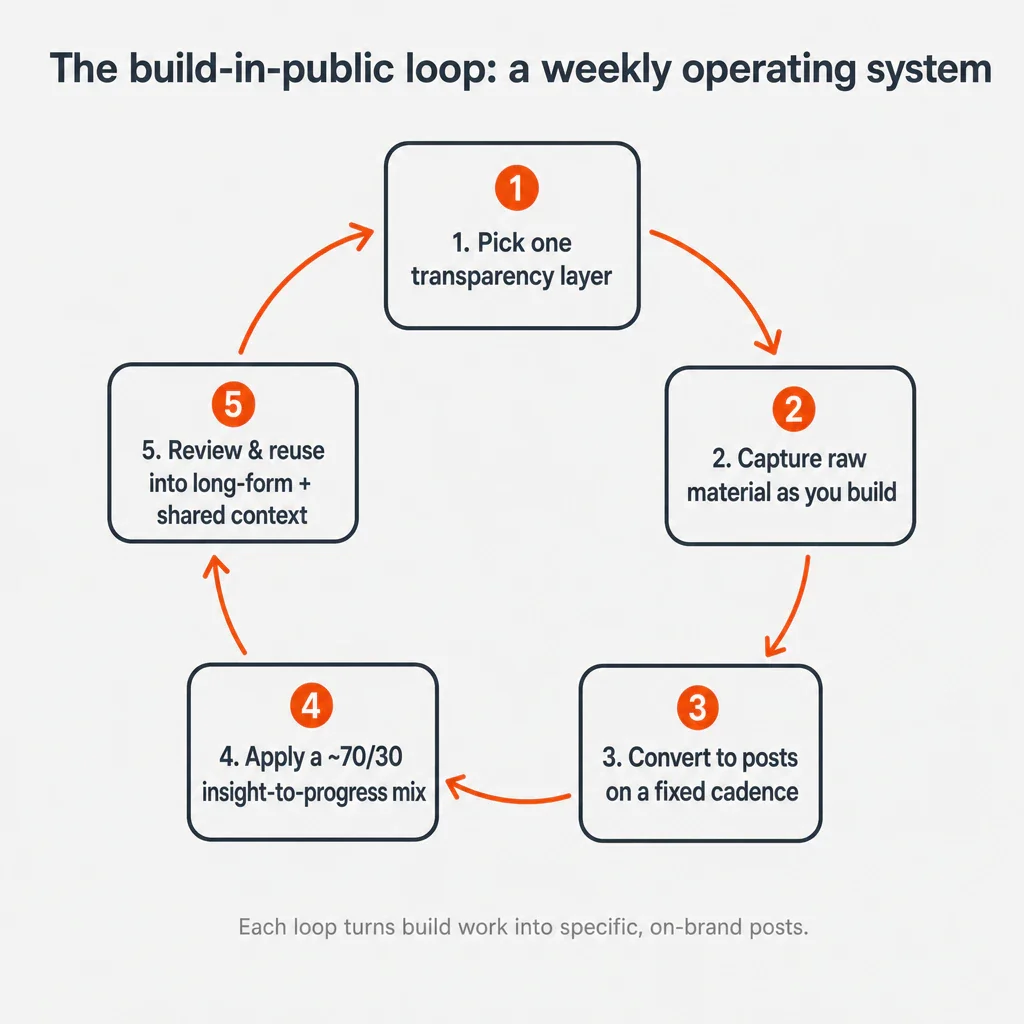
Here's the system itself — five steps that turn your build work into content on a fixed cadence. Run it weekly and the cost per post drops, because you're harvesting decisions you already made instead of inventing things to say. The diagram below maps the full loop end to end.
Step 1 — Pick one transparency layer
Don't try to be transparent about everything. Choose a single layer to narrate consistently: product decisions, pricing, growth, or team. A focused layer makes you recognizable and makes posts easier to write, because you always know roughly what you're looking for.
Step 2 — Capture raw material as you build
The reason posts feel hard is that you try to remember them later. Instead, capture inputs as they happen: the decision you made and why, what shipped, what broke, one metric that moved, a lesson. These raw captures are what make a post specific instead of generic — they're the difference between "we improved onboarding" and "we cut onboarding from 6 steps to 3 and activation moved; here's the step we were wrong about."
Step 3 — Convert captures into posts on a fixed cadence
Pick a slot and defend it. A useful side effect, noted by founders who've done it, is that committing to a Friday update changes how you scope work: instead of "I'll finish this big feature next week," it becomes "what can I ship this week that's worth talking about?" Smaller batches, faster feedback — social accountability quietly tightening your build loop (dev.to).
Step 4 — Apply a content mix
Aim for roughly a 70/30 split: about 70% insights and observations useful to anyone reading even if they never buy, and about 30% direct product-progress updates. As one 2026 X playbook frames it, flip that ratio and you're running a company newsletter, not building an audience — the insight content earns the audience, the progress updates convert it over time (founderdistro.com). The mix is a guideline, not a rule; the point is to build an audience, not just a public changelog.
Step 5 — Review and reuse
Once a week, look back at what landed and feed it forward. A strong thread becomes a blog post or a newsletter note; a recurring lesson becomes part of your shared company context so future posts stay consistent. This is where build in public stops being disposable and starts compounding into durable assets.
What to share vs. hold back: a quick, defensible framework
The fear of overexposing the business is what makes founders hesitate. A simple green/yellow/red rule lets you share confidently without thinking it through every time.
Green — low risk, high engagement (share freely): growth percentages, signups by channel, features shipped, lessons learned, content and audience metrics. These are useful to readers and rarely sensitive.
Yellow — share with framing: revenue/MRR, churn, and activation numbers. These are often the most engaging and the most personal. If you share them, pair growth with the setback or context — honest beats humble-brag, and framing protects you from looking either fragile or boastful.
Red — hold back: unannounced fundraising, acquisition, or legal/security details; customer identities without permission; and anything that creates real competitive or compliance risk. Silence here isn't a failure of transparency — it's judgment.
If you have no users or revenue yet, you are not disqualified — you just share different material. Post the problem conversations you're having, the number of customer interviews you've done, the "would you pay for this" signals, the specific objection that keeps coming up. Concrete beats impressive. A founder honestly working through a fork in real time is more compelling than a polished launch nobody asked for.
Channels and cadence: where to post without burning out
X/Twitter remains the primary founder-to-founder channel in 2026, where indie-hacker communities, product launches, and build-in-public discourse concentrate, and where the algorithm reportedly now favors individual voices over brand accounts (postory.io). Treat LinkedIn, Indie Hackers, and an owned newsletter as compounding secondaries — the newsletter especially, because it's the one audience you own outright and no algorithm can throttle.
Set realistic expectations about the curve. Practitioners describe build in public as a long game: reporting on the 2026 X landscape suggests most accounts that look like overnight wins took 18–36 months of consistent posting before momentum kicked in, and that follower growth compounds for consistent posters versus sporadic ones (foundra.ai, monolit.sh). Attribute these as others' reported ranges, not promises — your mileage will vary with niche, quality, and reply discipline.
The trick to not burning out is repurposing. One real decision or milestone should fan out into a thread, a LinkedIn post, and a newsletter note — three artifacts from one piece of thinking. That's how you keep cadence cost low while staying present on more than one channel.
Protect the build itself. Batch your captures, write in one sitting, schedule ahead, and guard focus time. Build in public should be a thin layer on top of shipping — never a second full-time job that crowds out the product the whole thing is supposed to be about.
Keeping it consistent and on-message: where FounderHQ fits
Here's the failure mode the loop is really fighting: drift. Post across weeks and channels for long enough and your voice fragments, your narrative loses its thread, and the first genuinely busy build week kills the cadence entirely. Consistency, not creativity, is what separates the founders who get distribution from build in public from the ones who quietly stop.
This is the problem FounderHQ is built around. It's a unified growth stack — a builder, a writer, and a workspace in one focused operating system — where your company context and decisions live in a shared, persistent place. The benefit is concrete for build in public: when each founder-led post (a LinkedIn draft, a thread outline) is composed against that shared context, you start from your actual decisions and product story instead of a blank page, so posts stay specific and on-message even on weeks when your head is buried in shipping.
Tie that back to the two things that make the loop hard. Persistent company context means less blank-page drafting and more on-brand specificity — the capture step from the loop has somewhere durable to live. And the structured editor for product journeys keeps your underlying product story coherent, so what you're narrating in public matches what you're actually building. To be clear about what this is and isn't: FounderHQ is about augmenting and empowering the founder — giving you leverage — not autonomously running your company or replacing your judgment. The posting cadence and the calls you narrate are still yours.
A starter 30-day build-in-public plan
If you want to start the loop this month, here's a four-week on-ramp that builds the habit before it builds the audience.
Week 1 — Set the foundation. Choose your one transparency layer (decisions, pricing, growth, or team) and stand up a lightweight capture habit. A single running note or doc where you jot the decision, the ship, the break, and the metric as they happen is enough to start.
Week 2 — Ship the first posts. Publish your first two or three decision/lesson posts and lock in a fixed posting slot you can actually defend. Don't optimize yet — just prove to yourself you can hit the slot.
Week 3 — Add structure and reuse. Layer in one weekly thread plus one repurposed long-form note (turn a thread into a newsletter or short blog post). Start tracking which post types earn follows and real conversations versus which just get likes.
Week 4 — Publish a milestone or honest setback, then review. Share a genuine milestone or an honest setback with framing, then review the month: which post types converted, what felt sustainable, and where the cadence nearly broke. Lock in the rhythm you can hold — then keep running the loop.
None of this requires going viral. It requires running the loop long enough that specificity and consistency do their compounding work. That's the whole game.
Conclusion
Build in public doesn't usually fail on concept — it fails on consistency. The founders who get distribution from it aren't more transparent or more clever; they've turned it into a repeatable weekly loop instead of a vibe. Pick one transparency layer, capture raw build material as you go, convert it on a fixed cadence with roughly a 70/30 insight-to-progress mix, keep a clear green/yellow/red rule for what you share, and reuse everything into longer-lasting assets. Anchor it all to a shared company context so your posts stay specific and on-message even on the busiest build weeks. Do that for a few months and build in public stops being a draining content treadmill and becomes what it was always supposed to be: a byproduct of shipping that quietly compounds into an audience.