Most founders do not have a build-in-public problem. They have a specificity problem. They are already shipping, deciding, debugging, changing pricing, cutting scope, and learning from users — but by the time they post, all of that detail gets flattened into “shipped a new feature” or “big week for us.” In 2026, that kind of update is easy to ignore. The version that still works is narrower: take the work you are already doing and translate it into specific, decision-level posts that teach the reader something.
The build-in-public problem in 2026: it is not whether to share, it is whether anyone cares
Build in public used to feel novel because the contrast was obvious: most companies hid the messy middle, while a few founders shared the journey. That novelty has faded. The feed is now full of launch notes, MRR screenshots, “we’re so back” updates, and AI-generated founder lessons that sound interchangeable.
That does not mean building in public is dead. It means the vague version is. Quip’s 2026 playbook argues that posts still converting now tend to share “specific decisions, specific trade-offs, and specific data,” not generic progress notes (Quip). Ravah’s build-in-public post guide reaches a similar conclusion: the best posts are tied to something the founder actually shipped, learned, changed, broke, or decided (Ravah).
The practical shift is simple: stop treating build in public as a public diary. Treat it as a translation layer. Your job is not to narrate every hour of the week. Your job is to pull one real moment out of the work, explain the decision inside it, and give the reader a takeaway they can use.
Why vague updates stopped converting: the algorithm and attention math
The attention environment is less forgiving than it was a few years ago. Metricool’s 2026 X/Twitter study analyzed 1,123,528 posts from 15,116 accounts and found weekly posting volume up 8% while impressions per post fell 5% (Metricool). In other words: more posts are competing for slightly tighter reach.
Other third-party benchmarks point in the same direction, though methodologies vary. SociaVault’s 2026 engagement benchmarks report Twitter/X at a 1.11% median engagement rate, down 9% year over year (SociaVault). The Reply Guy’s X benchmark piece reports a much lower average engagement rate of 0.029% and emphasizes that small accounts can outperform larger accounts when their audience is genuinely interested (The Reply Guy). Treat those as directional benchmarks, not universal laws.
The takeaway for founders is not “post more.” It is “earn the interaction.” Foundra’s 2026 build-in-public analysis says repetitive metric posts and external-link-heavy posts are weaker in the current X environment, while reply-driven conversation is more important (Foundra). A vague update rarely earns a thoughtful reply. A specific decision often does.
Small founders are not automatically disadvantaged in this environment. A small account can still win if its posts feel unusually concrete: the rejected option, the real number, the awkward trade-off, the bug that changed the roadmap, the customer phrase that rewrote the homepage. Specificity makes a small post feel worth stopping for.
What specific actually means: the three-layer build-in-public post
Most weak build-in-public posts sit at the outcome layer: “We shipped onboarding,” “We hit 800 users,” “We changed pricing,” “We launched on Product Hunt.” Outcomes matter, but they are usually the least useful part of the story because readers cannot learn much from the result alone.
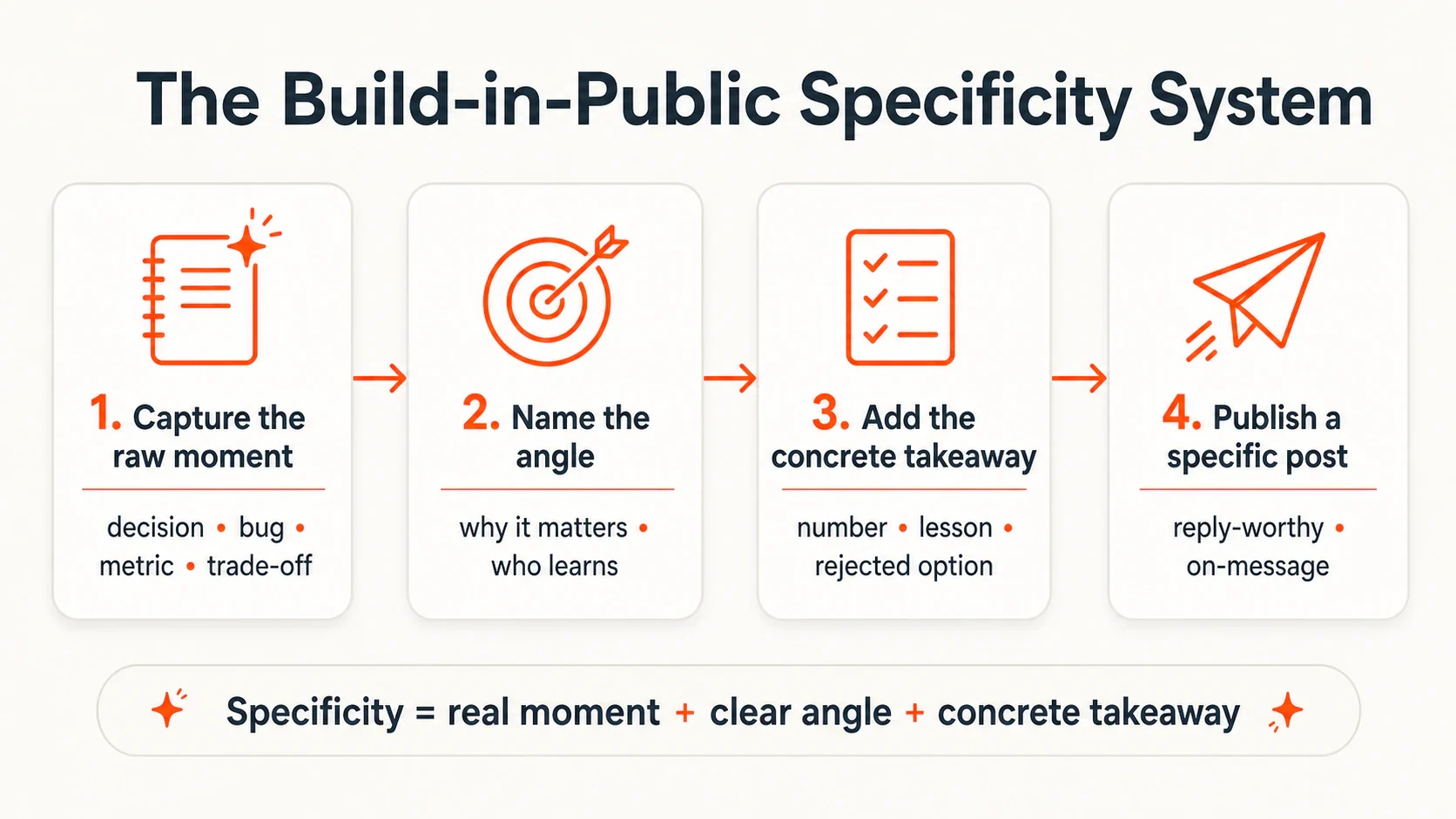
A stronger post has three layers: the real moment, the clear angle, and the concrete takeaway. Ravah describes a strong build-in-public post as a real moment plus a clear angle plus a concrete takeaway — for example, something shipped, changed, learned, broke, or decided, framed around why it matters to someone else (Ravah).
Use the visual below as the simplest version of the system: capture the raw moment, name the angle, add the takeaway, then publish the specific post.
Layer 1: The real moment
This is the raw material from the week. It might be a feature you cut, a bug that exposed a bad assumption, a user interview that changed your onboarding, a pricing debate, a metric that moved, or a launch that underperformed. If nothing real happened, do not manufacture drama. Wait for a real input.
Layer 2: The clear angle
The angle answers: why should someone else care? “We shipped onboarding” is about you. “We cut onboarding from five steps to two after watching users stall at setup” gives another founder a pattern to think with. The same event becomes more useful when it teaches a decision principle.
Layer 3: The concrete takeaway
The takeaway is the number, lesson, trade-off, or rejected alternative that makes the post credible. A DEV Community founder retrospective makes this point well: “We went from 800 to 960 users this week” reads more honestly than a percentage that hides a tiny base (DEV Community). Concrete does not mean impressive. It means inspectable.
The translation system: turn one week of build work into specific posts
The best way to build in public without creating a second job is to stop starting from a blank page. You already did the hard part during the week: you made decisions. The content session should be an extraction session, not a creative performance.
Here is the operating map:
- Shipped a feature → write a progress recap focused on what changed, what took longer than expected, and what you learned.
- Debated two paths → write a “why we chose X over Y” post.
- Hit a painful bug → write the lesson post: what broke, what assumption caused it, and what you changed.
- Changed pricing, onboarding, or positioning → write the decision post: the signal, the trade-off, and the expected effect.
- Reversed a call → write the “we were wrong” post: what changed your mind and what you will do differently.
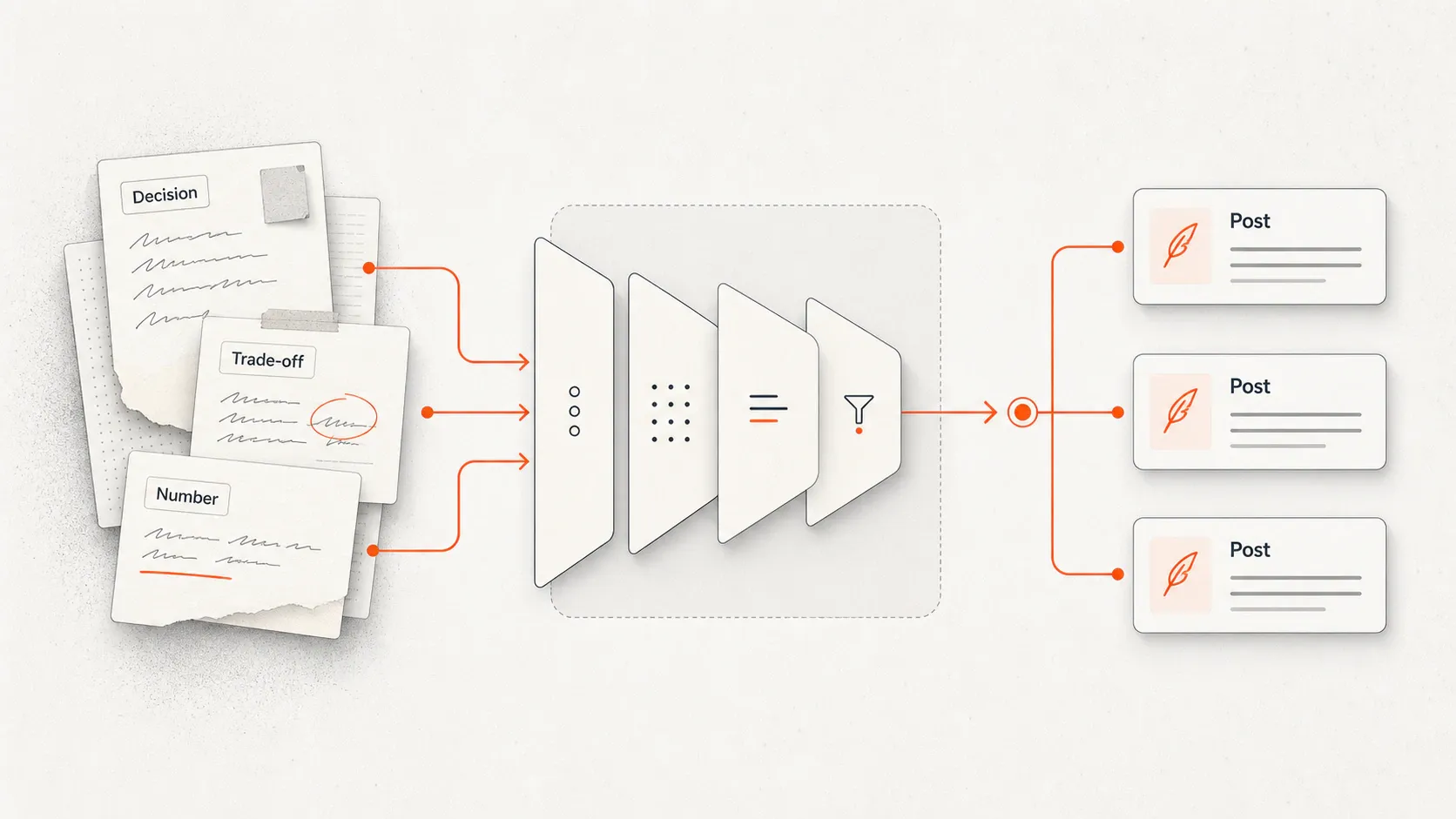
This is not a list of random build in public post ideas. It is a translation table. The input is a real operating event. The output is a useful, specific post. The more faithfully you capture the input, the less generic the output becomes.
Gallopeer’s transparency framework is a helpful guardrail here: share process, decisions, and selected metrics, while protecting customer names, detailed financials, and strategic roadmap details (Gallopeer). The point is not radical exposure. It is useful, selective transparency.
The hidden bottleneck: keeping posts specific when build weeks get busy
The system usually fails on busy weeks, not quiet ones. When you are deep in product work, the decision rationale lives in your head, the metric lives in an analytics tab, the bug lives in an issue tracker, and the customer quote lives in a call note. By Friday, you remember the conclusion but not the texture.
That is how specific work turns into vague content. “We rebuilt onboarding” loses the rejected path. “We improved activation” loses the messy reason. “We changed pricing” loses the trade-off. The post becomes generic because the context disappeared before the writing session started.
The fix is structural, not motivational: capture decisions, numbers, and rationale as you go. A useful build log can be simple. For each notable moment, write four fields:
- What happened?
- What did we choose?
- What did we reject?
- What number, quote, or lesson makes this real?
This is also where FounderHQ’s positioning matters. FounderHQ is described as a focused operating system for early-stage product teams: a builder for product journeys, a writer for founder-led content, and a workspace for company context in one place. The defensible advantage is not “AI posts for you.” It is that founder-led content can be drafted against persistent company context, so posts stay specific and on-message instead of being recreated from memory.
If you want to explore that consolidation angle, the FounderHQ overview explains the builder, writer, and workspace model for early-stage product teams.
A lightweight weekly operating loop you can actually sustain
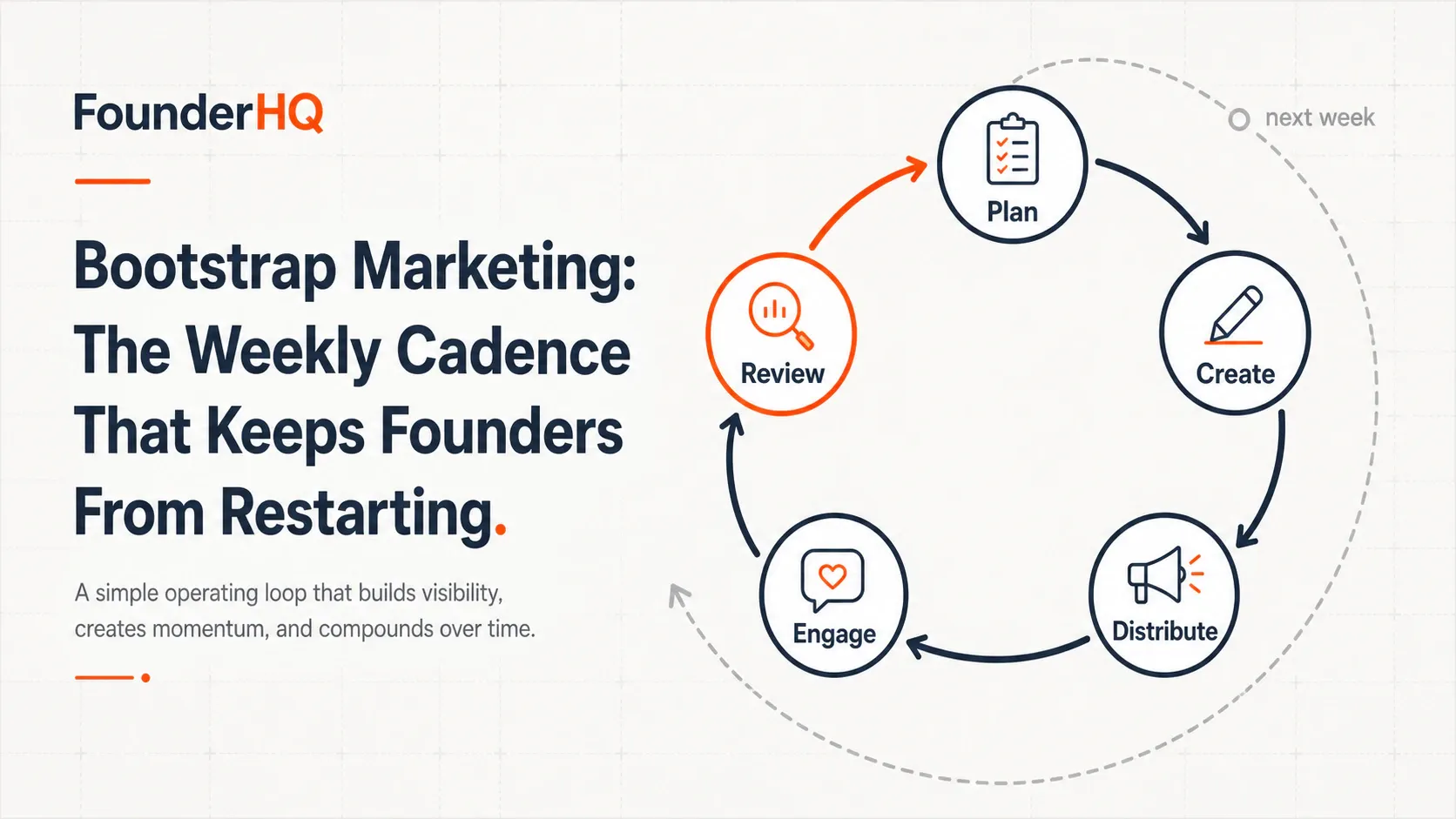
You do not need a large content calendar to build in public well. You need a small weekly loop that keeps the raw material close to the work.
Step 1: Capture as you build
During the week, log notable decisions, alternatives rejected, real numbers, bugs, customer language, and scope cuts. Do this when the context is fresh. The log is not public. It is your source material.
Step 2: Pick two or three entries
At the end of the week, choose the entries with the most useful lesson. Do not pick the most flattering moment by default. Often, the useful post is the one about the trade-off, mistake, or decision not to build something.
Step 3: Translate each entry into the three-part structure
For each entry, write one sentence for the real moment, one for the angle, and one for the takeaway. If you cannot name the takeaway, the post is not ready yet.
Step 4: Lead with the specific detail
Open with the decision, number, or rejected option. “We cut a feature we spent two weeks designing” is stronger than “Big product update.” “We chose manual onboarding for our first 20 users because the automation was hiding confusion” is stronger than “Improving onboarding this week.”
Step 5: Recut for the right channel
The same source material can become an X post, a LinkedIn post, a newsletter paragraph, or a changelog note. The context should stay consistent; the format should change by channel. That is the difference between repackaging and lazy cross-posting.
Common specificity mistakes to avoid
The first mistake is manufacturing content. The DEV retrospective cited earlier notes that daily posting eventually turned into manufactured updates, while meaningful weekly posts felt more sustainable (DEV Community). If nothing useful happened, do not force a lesson. Capture the week and wait for the next real decision.
The second mistake is chasing hot takes. Hot takes can create a one-day spike, but they rarely build trust if they are disconnected from the actual product work. A specific technical decision, customer learning, or trade-off usually earns more durable credibility than a broad opinion designed to provoke.
The third mistake is hiding tiny numbers behind inflated percentages. Percentages are useful when the base is clear. If the base is small, show the small number. Specificity builds trust because it gives the reader enough detail to understand the context.
The fourth mistake is treating transparency as confession. Building in public does not require sharing customer names, investor-sensitive details, full financials, proprietary tactics, or unshipped roadmap specifics. Share enough process to teach. Hold back details that belong to customers, partners, or future strategy.
A copy-ready decision-to-post template
Use this when you have a real moment but do not know how to shape it:
Template:
This week we [specific action or decision].
We considered [option A] vs. [option B].
We chose [option] because [reason or signal].
The trade-off: [what got worse, slower, or riskier].
The takeaway for another founder: [lesson they can apply].
Example:
This week we cut the “invite teammates” step from onboarding.
We considered keeping it early to encourage collaboration vs. moving it after first value.
We moved it because five user sessions showed people wanted to finish setup before thinking about team workflows.
The trade-off: fewer early team invites, but less friction before the first useful action.
The takeaway: if a step asks users to coordinate with someone else before they feel value, it may be too early.
Notice what this does: it turns one small product decision into a useful founder-led post without pretending the company had a massive breakthrough. That is the point. Specificity compounds because it gives people repeated evidence of how you think.
Conclusion
Build in public is not a demand to share everything. It is a discipline for turning real build work into useful public signal. In 2026, the founders who benefit from it will not be the ones posting the most generic updates. They will be the ones capturing decisions as they happen, preserving the context behind those decisions, and translating that context into specific posts that teach. Vague is easy. Specific is durable.