
If you've hesitated to build in public, it usually isn't because you're lazy or shy. It's because you've done the math. Post a clean revenue chart and you might attract a copycat. Mention a customer by name and you might breach their trust. Narrate every strategic bet and you might hand a competitor your roadmap — or spook an investor who'd rather you not litigate the messy middle in public. So a lot of careful founders default to one of two bad options: post nothing, or post only safe, generic wins that build no real trust. The good news is that the version of build-in-public that actually works in 2026 doesn't ask you to overshare. The culture has matured from the 2019-era ideal of radical transparency into something more durable: selective transparency. The honest framing that current practitioners converge on is simple — maximum transparency on your own work and learnings, and default-to-private on anything that belongs to or affects others. That single line is the highest-leverage skill in this whole game, and it's the one almost nobody teaches. This guide walks through a deliberate redaction policy: a two-bucket rule for what to share versus hold, a stage-based framework for what to wall off as you grow, the edge cases that create real liability, and — the part that actually breaks — how to keep that policy consistent across dozens of posts and busy build weeks.
The real reason cautious founders stay quiet (and why 'share everything' is the wrong default)
The instinct to hold back is rational, not timid. Multiple founders have publicly reported that posting hard numbers attracted opportunists faster than customers; as one widely-cited account put it, every time a founder posted an MRR chart, new competitors appeared copying the exact product (aitoolslister). The cost isn't only competitive. Jon Yongfook captured the personal toll in a quote that's been repeated across the community: "When your numbers are live for the world to see, the level of stress and dread is amplified 10x" (buildinpublic.so). And at scale, transparency can quietly invert from advantage to leak — CEO Weekly documented companies like Buffer and Transistor pulling back their public data once roadmap, pricing experiments, and channel economics started reading as a free strategic playbook for competitors (CEO Weekly).
So 'share everything' is the wrong default — but so is 'share nothing.' Transparency is what compounds trust, attracts early adopters, and earns you the benefit of the doubt when something breaks. The resolution isn't a volume dial; it's a policy. The 2019 culture pushed toward maximum transparency on everything. The 2026 culture has matured into selective transparency: you still share generously, but you draw a deliberate, defensible line around what you protect (buildinpublic.so).
Think of it as a redaction policy rather than a confidence problem. Once you've decided in advance what's yours to share and what isn't, the blank post box stops being a daily ethics quiz. You get to be genuinely open about the things that build trust — and genuinely quiet about the things that would actually hurt you, your customers, or your team — without re-deciding the boundary every single time you sit down to write.
Share vs. hold back: the two-bucket rule
The governing heuristic that runs through nearly every credible 2026 source is one sentence: maximum transparency on your own work and learnings; default-to-private on anything that belongs to or affects others (buildinpublic.so). Almost everything else is application. Sort each potential post into one of two buckets before you write it.
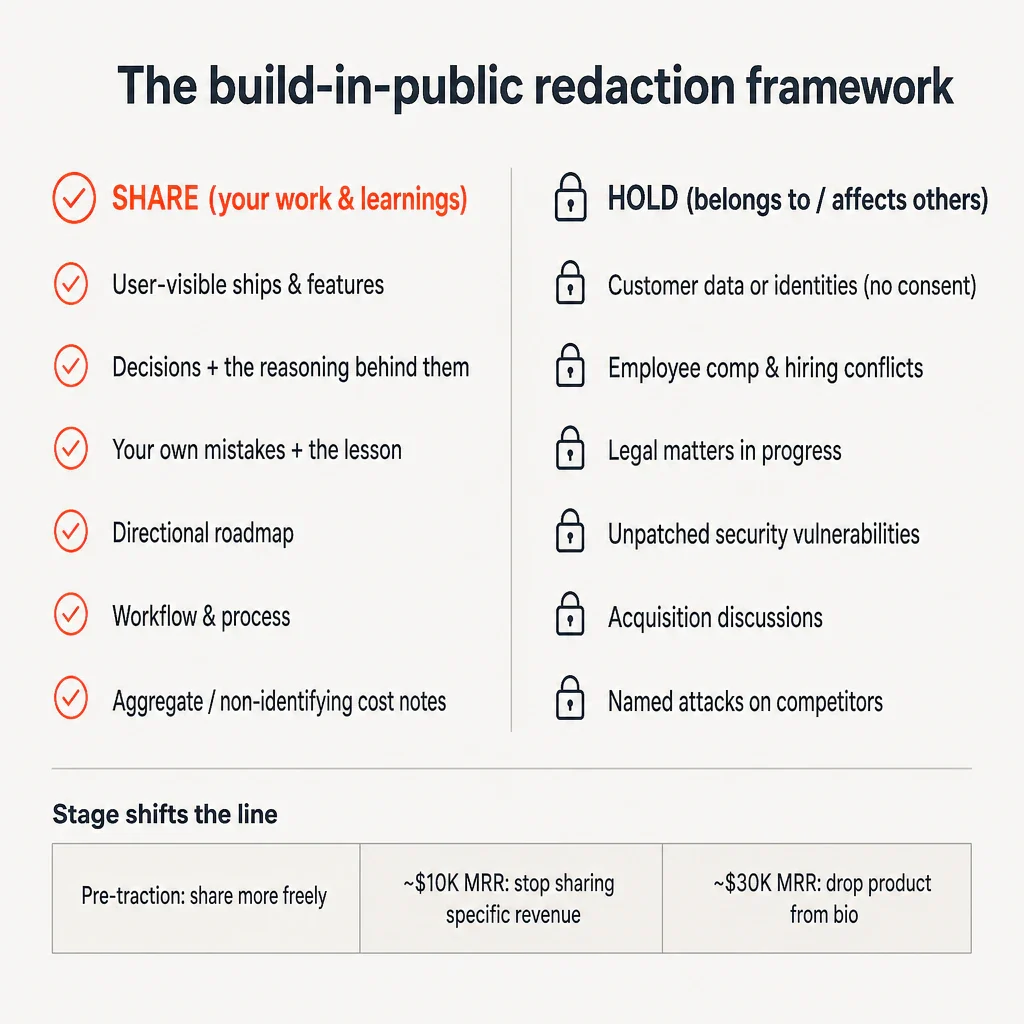
The infographic below summarizes both buckets and the stage line that moves between them; the lists that follow expand each one.
The share bucket: your work, decisions, and learnings
This is the material that builds trust precisely because it's yours to give. It safely includes: user-visible ships and features you've already released; product decisions and the reasoning behind them; your own mistakes paired with the lesson you took from them; a directional (not commitment-grade) roadmap; your workflow and process; and honest, non-identifying cost or operating observations. The 2026-native version of build-in-public leans hard into exactly this category — commit-driven content, honest cost transparency ("$14 in infrastructure spend this week" rather than MRR theater), teachable workflow notes, and weekly retros of what shipped and what you learned (buildinpublic.so). It's harder to fake and far more useful to read than a milestone screenshot.
The hold bucket: anything that belongs to or affects others
Default these to private unless you have an explicit, specific reason and the right consent: specific customer data or identities without written permission; employee compensation and hiring conflicts; legal matters in progress; security vulnerabilities until they're patched and tested; and acquisition or fundraising discussions while they're live. These aren't judgment calls you want to make at 11pm before a post — current guidance treats them as bounded, non-negotiable categories that stay private even when the rest of your practice is wide open (buildinpublic.so).
One practical guardrail sits across both buckets: avoid named attacks on competitors. Anonymized analysis — "a tool in this category does X, and here's why we chose differently" — is fair game and often genuinely useful. Naming a rival to dunk on them is a liability that invites retaliation, screenshots, and a reputation you didn't intend to build. Keep the critique about the work, not the company.
The stage-based redaction framework: what to wall off as you grow
The two-bucket rule isn't static — the line moves as you grow, because the cost-benefit of sharing a given detail changes with your stage.
Pre-traction: share more freely
Early on, copycat risk is genuinely low and the upside is high. You're not big enough to be worth cloning, and the people who notice your transparency are often exactly the early adopters and peers you want — innovators willing to try an unfinished product and give you feedback. The Bootstrapped Founder describes this directly: below a certain size, the risk was manageable and the upside of sharing outweighed the downside (The Bootstrapped Founder). At this stage, lean into the share bucket.
Growth: the documented pull-back
As founders scale, a consistent community pattern shows up: they pull back on specifics. The Bootstrapped Founder observed companies going quiet on financial metrics and product specifics somewhere around the $20,000–$30,000 MRR range. A widely-referenced framing from Alexander Belogubov's February 6, 2025 post codified two thresholds that get cited repeatedly: stop sharing specific MRR once you cross roughly $10K/month, and drop the product mention from your bio once you cross roughly $30K/month (buildinpublic.so). Several named founders — Tony Dinh, Danny Postma, Jon Yongfook, and Francesco Di Lorenzo among them — reportedly removed public revenue dashboards after crossing the $10K–$30K range, citing copycats and competitive pressure (aitoolslister). Treat these as reported founder behavior and community heuristics, not universal rules. The sources themselves are explicit that the right cutoff depends on your business — a B2C app with strong social proof might share past $10K, while a B2B SaaS with a confidential roadmap might go quiet earlier.
The decision rule you can actually apply
You don't need to memorize anyone's numbers. The portable rule is this: as the return on sharing a specific detail drops and the competitive or operational cost rises, move that detail from 'share' to 'hold.' When exact figures stop earning you customers and start earning you copycats, pivot the form of your sharing rather than going silent. The Bootstrapped Founder's own move is instructive — instead of numbers, he shares "tripwires": unexpected things that happened and what he did about them, plus industry insights general enough not to hand a competitor a playbook but specific enough to be genuinely interesting (The Bootstrapped Founder). That keeps you transparent and human without leaking the spreadsheet.
Finally, a calibration caveat: build-in-public audiences skew toward other founders and operators, not necessarily your buyers. That echo-chamber effect is widely noted as a risk (aitoolslister). Before you share something sensitive 'for reach,' ask whether it actually reaches anyone who might buy — or whether you're just feeding the competitive-intelligence feed of your peers.
Edge cases that create real liability
A few categories deserve more than a bucket label, because getting them wrong creates liability that no amount of reach makes up for.
Customer privacy. Never post usernames, emails, company logos, screenshots of someone's account, or identifiable usage details without explicit consent — and get it in writing. B2B and enterprise are stricter than B2C: a single careless post about a specific account can collapse a customer relationship and your credibility with the rest of your pipeline. 'They'll probably be flattered' is not consent.
Security. Hold vulnerabilities until they're patched and tested. Narrating a live security hole in the name of transparency isn't brave; it's an open invitation to anyone watching. Share the post-mortem after it's fixed, with enough abstraction that you're teaching a lesson rather than publishing an exploit.
Legal and people. Legal matters in progress, co-founder disputes, and anything that embarrasses an employee or contractor stay private. These aren't your story to tell alone — they involve other people who didn't sign up to be characters in your build log.
When you're unsure, run a two-part test before you hit post: Is this mine to share? And does it affect anyone who didn't consent? If the answer to the first is no, or the second is yes, hold it — or strip it down until both clear. That single question resolves the vast majority of edge cases without a lawyer.
Keeping your redaction policy consistent (the part that actually breaks)
Here's the failure mode nobody warns you about: the share/hold line isn't hard to draw once. It's hard to apply consistently across dozens of posts, three channels, and the busy build weeks when you're dashing off an update between two other fires. The boundary that felt obvious on a calm Sunday gets fuzzy when the details live only in your head and you're re-judging each post from scratch. That's how a number you'd decided to keep private slips into a Tuesday thread, or how the same customer story shows up anonymized on LinkedIn and named on X.
The fix is unglamorous and effective: write the policy down once. A short, living document — a 'share / hold / depends' list plus your current stage thresholds (your own MRR line, your bio rule, your customer-consent standard) — turns every future post from a fresh ethical decision into a quick check against a rule you already made when you were thinking clearly. The Bootstrapped Founder, CEO Weekly, and the buildinpublic.so guides all converge on the same underlying point: the founders who stay safe aren't more cautious in the moment; they decided their boundaries in advance.
This is where a persistent record of your own decisions earns its keep — and where a tool like FounderHQ fits the problem honestly. FounderHQ pairs a founder-led-content writer with a workspace that keeps your company context and decisions in one place, so you can draft posts against the policy and the decisions you've already recorded instead of reconstructing the line from memory each time. The benefit isn't 'more posts' or any promised metric — it's consistency: your public narrative stays on-message and inside your own redaction lines because it's grounded in the same persistent context every time you write. That's the difference between transparency that compounds trust and transparency that quietly leaks. A written, referenceable policy is the mechanism; a workspace that remembers it is what makes it survive a busy week.
Your build-in-public redaction checklist
To recap the whole framework: build-in-public in 2026 is selective transparency, not radical transparency. Sort every post into two buckets — share your own work and learnings; hold anything that belongs to or affects others — and run the test 'is this mine to share, and does it affect anyone who didn't consent?' before you post.
Here's a copy-ready version you can paste into your own notes and adapt:
Category | Default | Notes |
|---|---|---|
Shipped features, decisions, your own mistakes + lessons | Share | The trust-building core |
Workflow, process, directional roadmap | Share | Teachable, hard to fake |
Aggregate / non-identifying cost & operating notes | Share | Below your stage threshold |
Specific revenue / MRR / margins | Depends | Share early; pull back as cost > benefit (~$10K MRR is a commonly cited line) |
Customer data, identities, logos | Hold | Only with explicit written consent |
Employee comp, hiring conflicts | Hold | Affects others |
Legal matters in progress | Hold | Until resolved |
Security vulnerabilities | Hold | Until patched and tested |
Acquisition / fundraising talks | Hold | While live |
Named competitor call-outs | Hold | Anonymized analysis is fine |
Then fill in your own stage thresholds so the line is yours, not a stranger's: My current stage is _. Below _ MRR I'll share specific revenue; above it I'll share aggregate framing and 'tripwires' instead. My customer-consent rule is _. My bio mentions the product until _. Revisit it quarterly.
The reframe to hold onto is this: the goal was never to share less. It's to share the right things, deliberately and consistently — so that building in public compounds trust over months instead of becoming the liability that kept you quiet in the first place.
Conclusion
Most advice about building in public is about volume — post more, post more often, post more vulnerably. The harder and more valuable skill is restraint with a system behind it. A deliberate redaction policy is what lets a cautious founder participate at all: it gives you a defensible answer to 'should I share this?' before the question can paralyze you, and it keeps that answer steady across every channel and every busy week. Decide your two buckets, set your stage thresholds, wall off the non-negotiables, and write the whole thing down so you're checking each post against a rule instead of re-litigating it. Do that, and transparency stops being a risk you manage and becomes the asset it was always supposed to be — trust that compounds, without the leak.