
Almost every founder we talk to is already sold on building in public. They've seen the threads, watched someone narrate their way from zero to a real product, and nodded along: yes, I should do that. Then they open the post box, the cursor blinks, and nothing happens. They feel too small to talk, unsure what's even worth sharing on a normal Tuesday, and quietly close the tab. That gap — between believing in build in public and actually starting — is the real problem, and it's almost never solved by another motivational essay about why it works. At its core, building in public just means making the work of building visible as it happens: sharing the decisions you're weighing, the progress you're making, and the lessons you're learning, rather than waiting to unveil a polished highlight reel at launch. It's a long game and a distribution bet — a way to earn an audience and a launch list over months, not an overnight growth hack. This guide is deliberately not the definition essay or the debate about everything that changed in 2026. It's the starter system: how a time-poor, hands-on founder turns a vague intention into a repeatable first-90-days habit — one channel, a few repeatable post types, a cadence you can actually hold, and a way to keep posts specific even on weeks when building eats everything.
Why most founders never actually start building in public
The thing that stops founders is rarely disagreement with the idea. It's the friction of the blank page. You sit down to post and immediately run into three quiet objections: I don't have an audience yet, so who's even listening? We haven't shipped anything impressive enough to talk about. And I don't know what to say on a day when nothing dramatic happened. Each one feels reasonable, and together they're enough to keep you on the sidelines indefinitely.
Here's the reframe: none of those are real blockers, because build in public isn't a broadcast to a crowd you already have — it's the thing that builds the crowd. You don't need followers or revenue to start. You need a decision you made this week, a problem you're trying to validate, or a conversation you had with a potential user. The audience is the output of showing up consistently, not a prerequisite for it.
This matters most for exactly the audience that struggles to start: early-stage founders and small product teams who are time-poor and pulled in ten directions. The same forces that make build in public valuable — you're already making decisions, already learning, already shipping — are buried under repetitive weekly loops, drafting fatigue, and the nagging worry that your messaging is inconsistent. The fix isn't more willpower. It's a small, repeatable system that removes the decisions so you can just post. That's what the rest of this guide gives you.
What's different in 2026 a beginner has to know before posting
You don't need a deep dive on platform mechanics to begin, but two realities change how a beginner should post, and ignoring them is a common early trap.
Specificity is the bar now
The feed is noisy, and vague updates drown in it. "We shipped a new feature" tells a reader nothing and gives them no reason to stop scrolling. "We almost shipped onboarding behind a paywall, then realized it killed our activation in testing, so we moved it after the first win instead" is a story — a decision, a trade-off, and what you learned. The 2026 norm across founder-content guides is that decision-level and mistake-level detail consistently outperforms polished wins, because honesty about what didn't work is rarer and more trustworthy. Specific beats impressive.
X rewards conversation, not link-dumps
If you choose X, know that its 2026 ranking leans toward original, text-first posts and reply-driven conversation, and it actively surfaces content from smaller accounts rather than only established ones — good news for a beginner. The flip side is the trap: posts with an external link in the main body now get meaningfully less reach, with multiple 2026 analyses estimating roughly a 30–50% reduction in initial distribution for link-in-tweet posts (OpenTweet, Teract, adlibrary). The practical takeaway for a beginner: write the post to stand on its own, put any link in a reply, and treat replies to other people as part of the work, not an afterthought.
Put those together and the nervous-beginner reframe writes itself: you don't need scale or a finished product to earn distribution. You need to be specific, be honest, and show up in conversations. Share the conversation you had, the count of people who said they'd pay, the decision you're stuck on. That's enough.
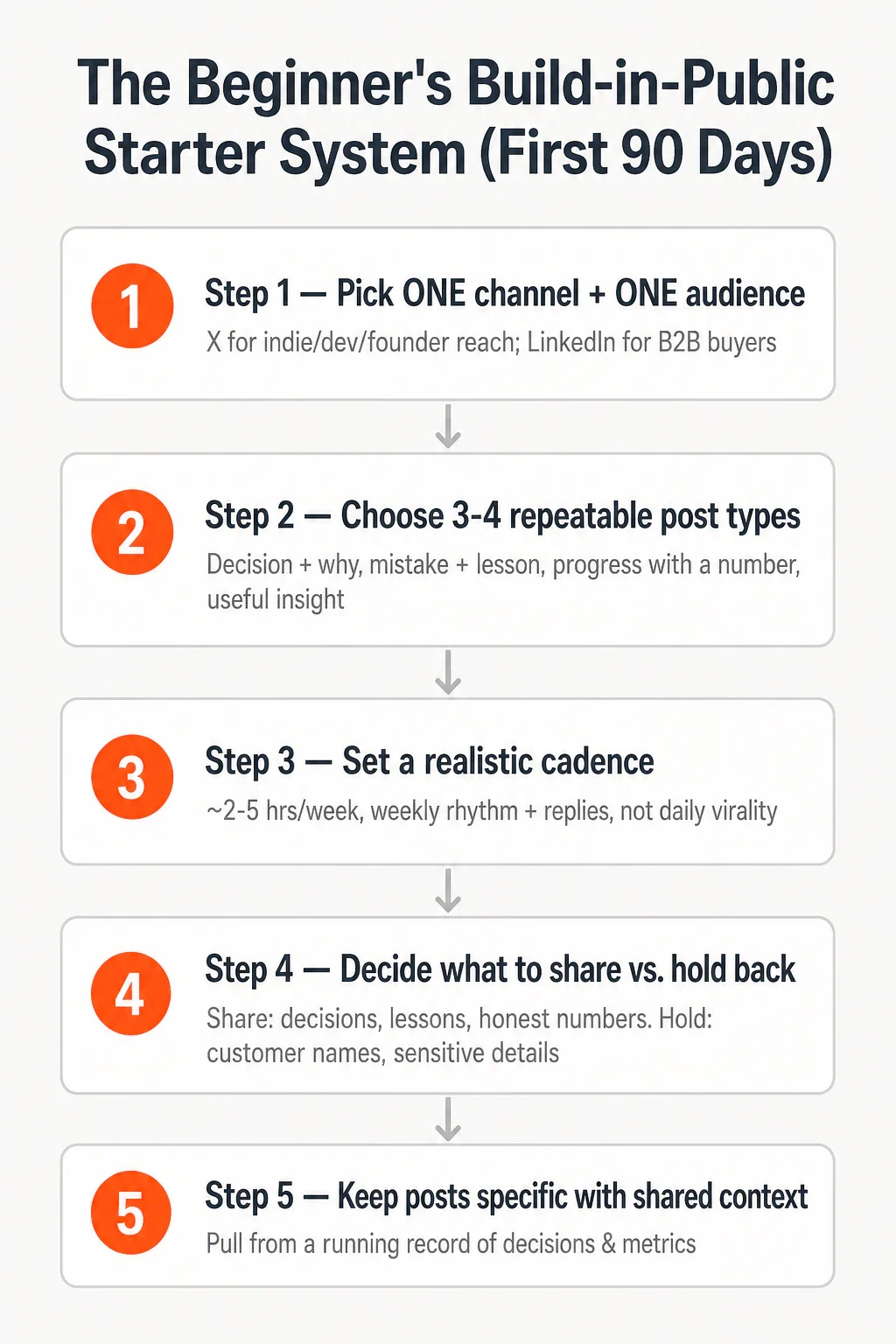
Step 1: Pick one channel and one audience
The fastest way to never build a habit is to try to be everywhere at once. On day one, pick one channel and one person you're writing for.
The channel choice usually comes down to where your ideal customer actually spends time. X tends to concentrate indie hackers, developer-tool users, technical founders, and a fair amount of investor attention — it's strong for reach and serendipity. LinkedIn skews toward B2B and enterprise buyers, operators, and a more professional register. There's no universally correct answer; there's only the one where your ideal customer hangs out and you can stand to post regularly. If you genuinely can't decide, pick the platform you already open out of habit, because the one you'll actually use beats the one that's theoretically optimal.
Why just one? Because consistency beats coverage, and consistency is a function of low friction. Cross-posting, repurposing, and a second channel are all fine — later, once the habit exists and you're not negotiating with yourself every day. Right now, one channel is one set of norms to learn and one place to show up.
Then define the single person you're writing for. Not "founders" — too broad. Something like "a solo technical founder six weeks into building their first SaaS, stuck on getting their first ten users." When you know exactly who's on the other side, your posts get specific automatically: you write to their situation, use their words, and stop hedging for an imaginary general audience.
Step 2: Choose 3-4 repeatable post types so you never face a blank page
The blank page wins when every post is a fresh creative act. The fix is to pre-decide a small menu of post types you can rotate through, so each day's question shrinks from "what could I possibly post?" to "which of my four formats fits what happened this week?"
A solid starter menu for a beginner: (1) a decision and why — what you chose, what you ruled out, and the trade-off; (2) a specific mistake and what it taught you — the most trust-building format there is; (3) a concrete progress update with a number — even a small one; and (4) a useful insight anyone in your space could learn from, whether or not it touches your product. Four formats is enough variety to stay interesting and few enough to memorize.
Weight the menu toward usefulness, not promotion. A widely cited principle in founder-content circles is a roughly 70/30 split — the majority of posts give insight or value, the minority are direct product updates (FounderDistro). You earn an audience that cares before you ask it to buy. The same source's companion principle is worth tattooing on the inside of your eyelids: share your numbers even at zero. Numbers make abstract progress concrete, and at zero revenue you still have numbers — conversations had, problems validated, demos booked, people who said they'd pay. "Five people I cold-DMed said they'd pay $20/mo for this" is a better post than most launch announcements.
If you want a fuller catalog of formats to copy, the short video below walks through ten build-in-public post types — f***-ups, wins, product updates, user stats, polls, growth experiments, and more — with real examples. Treat it as a menu to steal from, not a script to follow.
Whatever you pick, write the four formats down somewhere you'll see them. On a busy build week, the menu is what carries you.
Step 3: Set a realistic first-90-days cadence and trajectory
The two things that kill a new build-in-public habit are an unsustainable cadence and an unrealistic expectation of how fast it pays off. Get both honest up front.
A cadence a time-poor founder can hold
Aim for a small, repeatable weekly rhythm plus replies — not a sprint for daily virality you'll abandon in three weeks. A few posts a week you can sustain beats a daily streak that ends. Across founder-content reporting, the time investment for people doing this seriously tends to land in the range of a few hours per week (roughly 4–6 hours is a commonly cited median, per InnerPing's tracking of founders), much of it in writing plus replying to comments. Budget the time like any other recurring work: a fixed weekly slot to draft, and a habit of replying when notifications come in.
An honest trajectory
Early growth is slow, and that's normal — not a sign it's failing. Expect to spend the first months in the low hundreds of followers, and expect real momentum to take far longer; the broader pattern for consistent weekly creators is that breakout growth often arrives after 12–18 months of steady posting (Crescitaly). Audiences compound: each consistent month adds to a growing base, which is exactly why the slow start is the part most people quit before clearing.
Naming the failure modes up front helps you avoid them. The real risks are burnout from an over-ambitious cadence, diminishing returns when you're posting noise instead of substance, the self-imposed pressure to perform for an audience, and oversharing things competitors can use. A lighter, decision-led cadence — fewer posts, more substance, a sustainable weekly slot — sidesteps most of them. You're optimizing for still being here in month nine, not for this week's impressions.
Step 4: Decide what to share and what to hold back
The objection that keeps cautious founders out is the fear that build in public means radical transparency — broadcasting everything, including things that should stay private. It doesn't. The 2026 norm is selective transparency, and deciding your defaults once removes the anxiety from every future post.
Think of it as a transparency spectrum: at one end, surface-level metrics; at the other, full process plus numbers. Where you sit depends on your stage and your competitive risk, and you can dial it up over time as you get comfortable (Gallopeer frames transparency in levels along exactly these lines). You don't have to start at the deep end.
A workable default share list: the product decisions you make and why, the specific lessons you learn (especially from things that went wrong), real progress, and honest numbers — good or bad. A workable default hold-back list: customer identities and quotes without explicit permission, sensitive security or legal details, and unannounced moves like pricing changes, fundraising, or acquisitions until they're real and public. When something falls in a gray zone, share the lesson and abstract away the identifying specifics.
The reassurance for risk-averse founders is simple: build in public is not "share everything." It's "share the things that build trust and teach, hold the things that create real risk, and be consistent about the line." Decide your defaults now and you'll never again freeze over whether a given post is safe to publish.
Step 5: Keep posts specific and on-message with a shared company context
Here's the bottleneck almost no one warns beginners about, and it shows up around week three. The first few posts are easy — you write about the obvious recent things. Then a heavy build week hits, you're heads-down in code or customer calls, and when you finally sit down to post you're reconstructing the week from memory. The posts drift generic and slightly off-voice, because you no longer remember the specific decision or the exact number. That drift is what makes a promising habit quietly fizzle.
The practical fix is mechanical, not motivational: keep a running record of the decisions you make, the metrics you move, and the work you ship, in one place you trust. Then writing a specific post is no longer an act of recall — it's pulling a real detail off a list and shaping it. Specificity becomes the path of least resistance instead of the thing you skip when you're tired.
This is where a tool like FounderHQ is designed to earn its place: it pairs a founder-led content writer with a persistent company-context workspace, so the decisions and details you capture as you build become the raw material your posts are drafted against. The point is augmentation, not automation — it's there to make your posts sharper and more consistent on the weeks you have the least energy to write them, not to run your company or post for you. Used this way, a shared context attacks the exact pains that stop founders from sustaining the habit: less drafting fatigue, fewer repetitive weekly loops, and a narrative that stays consistent because it's grounded in the same source of truth every time.
Your first week: a starter checklist
You don't need to internalize all five steps before you begin. You need a first week. Here's the concrete on-ramp:
- Pick your one channel (where your ideal customer actually is) and the one person you're writing for.
- Write a short intro/bio post — who you are, what you're building, and that you'll be sharing the journey openly. This is post one.
- Choose your 3–4 post types from the menu in Step 2 and write them down.
- Draft the first week — three or four short posts, plus a plan to reply to a few relevant people each day.
- Set a recurring weekly slot on your calendar to draft and review. Protect it like a customer call.
If you have no audience and no revenue yet, good first posts practically write themselves: the problem you're trying to solve and why it's personal; a decision you're genuinely stuck on (and an ask for input); the count of validation conversations you've had this week; or the single most surprising thing a potential user told you. None of these require traction — they require honesty.
Finally, pick your own North Star number to narrate over time — first ten users, waitlist signups, weekly active users, MRR, conversations booked. It doesn't have to be revenue. It just has to be a real, specific number you'll track openly, because watching that number move is the throughline that turns scattered posts into a story people follow. That's the whole long game: consistency compounds, and the audience you build one specific post at a time becomes the launch list you'll be grateful for later.
Conclusion
Build in public stops being intimidating the moment it stops being a vague aspiration and becomes a small, boring system: one channel, one audience, a few repeatable post types, a cadence you can actually hold, clear rules on what to share, and a running record so your posts stay specific on the weeks you have nothing left to give. None of it requires an audience or revenue to begin — it's the thing that creates them, slowly, over months of showing up. The founders who win at this aren't the ones with the cleverest single thread; they're the ones still posting in month twelve, narrating real decisions to an audience that compounded one honest update at a time. So don't wait to look impressive. Pick your channel, write the intro post, and put the recurring slot on your calendar this week. The first post is the only hard one.
Recommended Videos
Educational, non-competitor walkthrough of ten concrete build-in-public post types (f***-ups, wins, product updates, user stats, polls, growth experiments); transcript verified to cover exactly the post-type menu in Step 2, giving beginners formats to copy.