You shipped something real this week. You wrote one update — your MRR ticked up, you killed a feature, a customer said something that stuck — and you pasted that same block of text into X, into LinkedIn, and into your newsletter. It felt efficient. It wasn't. The X version got buried, the LinkedIn version read like a tweet that wandered into a boardroom, and the newsletter version was too thin to matter. Building in public is multi-platform by nature, but the same words don't travel the same way across channels. Each platform rewards a different format and serves a different goal, so an identical cross-post leaves reach on the table in one place and conversions on the table in another. This isn't another definition of building in public, a list of what to share, or a debate about whether it works. It's the repackaging system underneath all of that: how a time-poor founder treats one week of real build work as raw material, then adapts it into native posts per platform — without rewriting everything three times and without it eating your build week.
The real problem isn't what to share — it's that you're posting the same thing everywhere
Most founders who commit to building in public don't fail because they have nothing to say. They fail at the copy-paste step. The instinct is to write once and broadcast everywhere, because that feels like leverage. In practice it's the opposite: you've taken a piece of work that could have earned reach in one place and conversions in another and flattened it into a single generic update that fits none of them well.
The fix isn't to write three completely separate things from scratch — that's how building in public quietly becomes a second job and how founders burn out by mid-year. The fix is to change one thing about your workflow: separate the source material (what actually happened this week) from the format (how you say it on each platform). Capture the build work once, then adapt it per channel. The insight stays constant; the packaging changes.
That single shift is what this guide is about. We're not relitigating whether to build in public, what to share, or how to find a cadence — those are their own conversations. We're answering the narrower, more practical question: given one week of real work, how do you produce a native post for X, a native post for LinkedIn, and a newsletter entry that each fit their home, in roughly the time you were already spending?
Why one post can't serve every platform: the 2026 outcome map
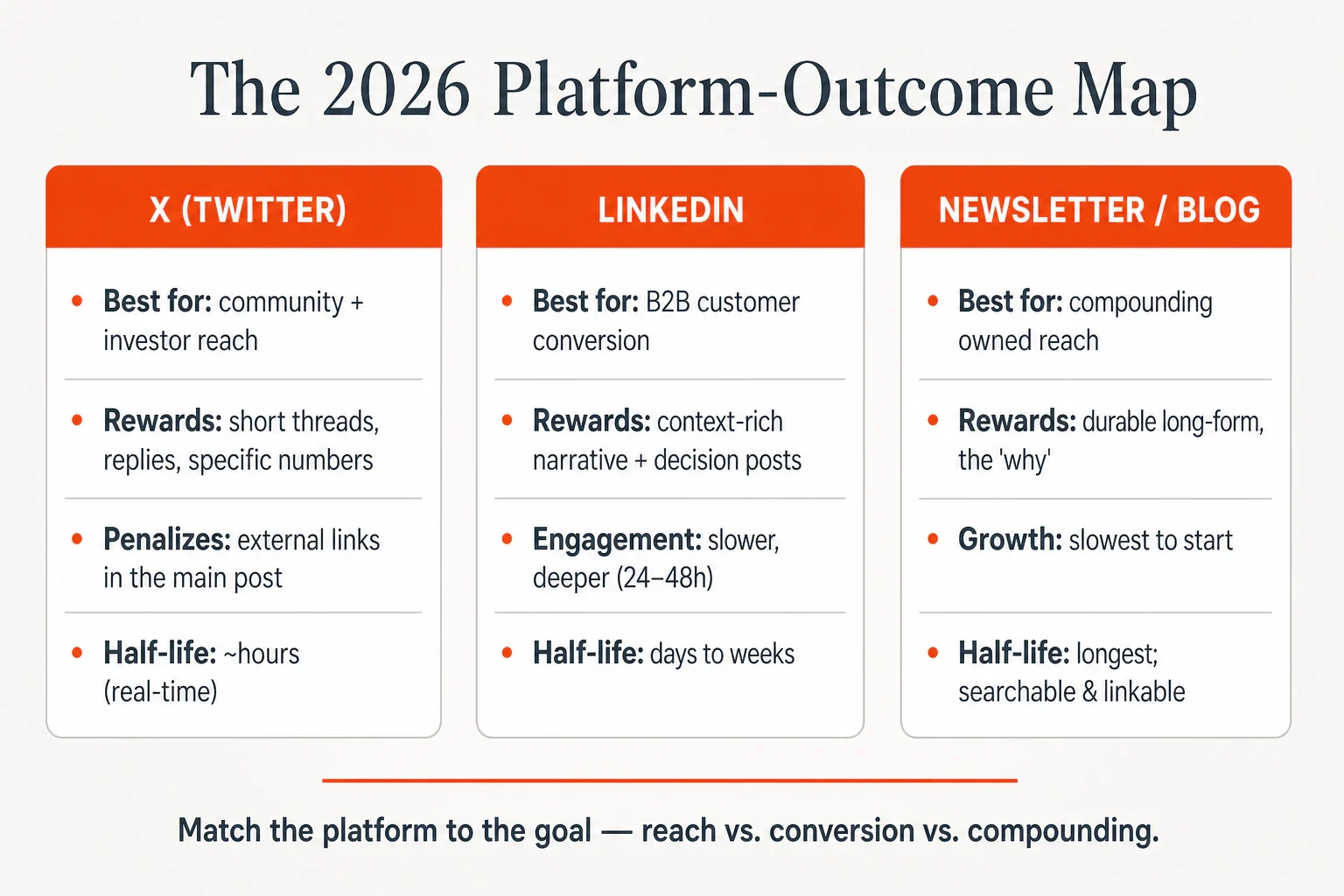
Before you adapt anything, it helps to know what each platform is actually good for in 2026, because they've drifted further apart. The chart below maps the three channels most founders use, and the rest of this section walks through each one.
X (Twitter): reach and community, not links
X is still where ideas spread fastest and where the build-in-public community is largest and most established, which makes it strong for community compounding and investor visibility. But the mechanics changed. Independent analyses of X's 2026 ranking note that the platform applies a steep time-decay — a post can lose roughly half its visibility within hours — so the first 15–30 minutes of engagement decide its fate. Reposts and replies are weighted far above likes, which is why short threads and reply chains consistently out-travel solo broadcasts (Sprout Social, ClimbX). And external links get penalized hard: Sprout Social cites a reported 50–90% reach reduction on link posts, with the widely used workaround being to keep the main post link-free and drop the URL in the first reply (Foundra, Postory). The takeaway: an X-native post is short, leads with a concrete number or decision, invites replies, and keeps links out of the main body.
LinkedIn: where B2B buyers convert
If you sell to companies, your buyers, partners, and increasingly your investors are paying attention on LinkedIn in a way they often aren't on X. Multiple 2026 comparisons report that B2B SaaS founders see higher conversion from LinkedIn content, that the audience reads before it reacts, and that founder-bylined posts outperform company-page posts (ravah, Belkin Marketing, Jean Galea). Distribution is slower (24–48 hours) but deeper, and the format rewards context: a narrative or decision post with the business reasoning spelled out beats a terse one-liner. A LinkedIn-native version of the same update expands the why for a buyer who wants to understand your thinking.
Newsletter and owned blog: the compounding layer
Your newsletter and blog are the slowest to grow an audience and the only channel you fully own. They also have the longest half-life. Where an X post is effectively gone within a day, a well-written blog post can rank in search and be cited by AI answer engines for months — and a newsletter builds the deepest, most direct relationship with readers (Belkin Marketing, Monolit). This is your durable, searchable record — the place the full why behind the decision lives and can be linked back to from everywhere else. Match the platform to the goal first (reach vs. conversion vs. compounding), then format one piece of source material to fit each.
Step 1 — Capture the raw build log once (your single source of truth)
Repackaging only works if you have something specific to repackage. So the first move isn't a post at all — it's a lightweight running log of the week's real material. Capture decisions you made (and the ones you rejected), specific metrics with the context around them, failures and postmortems, and the sharp lines from customer conversations. You're not writing for an audience yet; you're collecting raw material so that when it's time to post, you're adapting from real context instead of staring at a blank box trying to remember what happened.
Specificity is the whole game, and the data backs it. In one 2026 playbook, founders who shared mistake-level transparency — pricing experiments that lost money, hires that didn't work, features they pulled — earned trust at notably higher rates than founders who only posted wins, and "what didn't work" posts converted to follows better than "what we shipped" updates (Quip). The same source argues you should share at the decision point, not the milestone point: the interesting moment isn't hitting $10K MRR, it's the call you made between two strategies that got you there. And context turns a number into a story — "19 users" is forgettable, but "19 users, 7 of them use it daily, 3 have paid" is a narrative (ravah). Your log should capture that context while it's fresh, because you won't reconstruct it later.
This is also where a persistent company-context workspace earns its keep. FounderHQ is built around a writer plus a shared workspace, so the raw decisions, metrics, and customer notes that make up your build log live in one place and every later post is drafted against that real context rather than a blank page. The benefit is plain: consistency and speed. When your source material already lives somewhere durable, producing three native variants is an adaptation task, not three separate acts of creation. (We're describing a capability here, not promising a specific outcome — keep your own expectations grounded in your actual reps.)
Step 2 — Adapt one update into three native formats
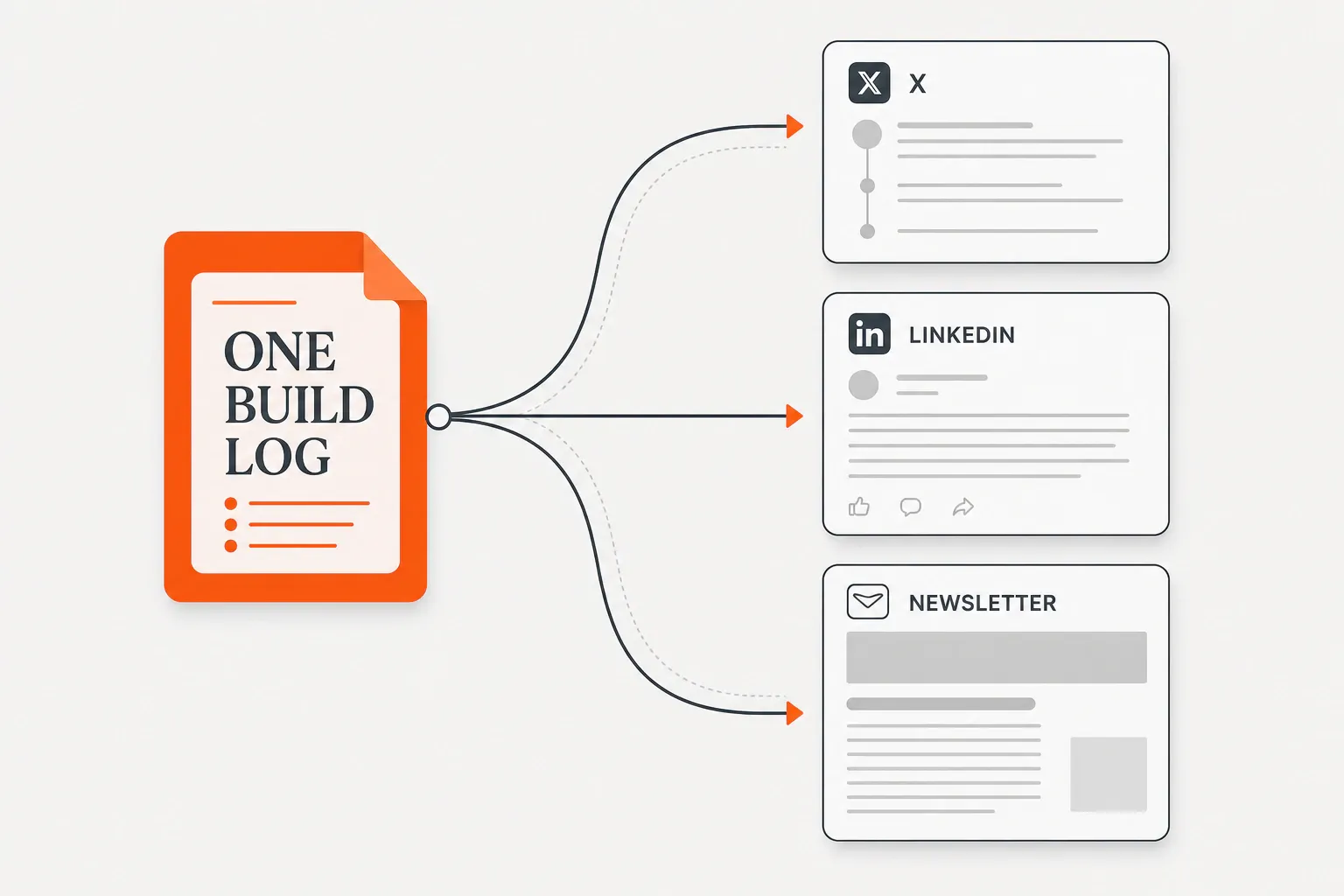
Now the actual repackaging. Take one entry from your build log and write three versions of it — same core insight, three native shapes. The diagram at the top of this article is the mental model: one log node, three branches. Let's make it concrete with a realistic build moment: you ran a pricing experiment, raised your entry tier from $19 to $29, watched signups drop sharply, and rolled it back after a week — but the customers who did convert at $29 were noticeably better fit.
The X version: short, specific, built for replies
Lead with the concrete moment and a number, keep it tight, and design it to pull replies. No external link in the main post. For example: "Raised our entry plan from $19 to $29. Signups dropped ~40% in a week, so I rolled it back. But here's the twist — the people who DID pay at $29 churned less and used the product more. Cheaper price, worse customers? Thinking through what that means. 🧵" Then a short follow-up tweet or two with the nuance, and any link to the full write-up sitting in the first reply so the main post's reach stays clean.
The LinkedIn version: the decision, explained for buyers
Same insight, expanded into a narrative a B2B reader can follow. Spell out the reasoning: why you tested the price, what you expected, what actually happened, and what it taught you about who your product is really for. This is where you sound like an operator thinking in public, not a metrics bot. The buyer reading it isn't just entertained — they're calibrating whether you understand your own customers well enough to be worth working with. End on the open question or the principle you took away, which invites the substantive comments LinkedIn rewards.
The newsletter/blog version: the durable why
This is the long-form home for the whole story: the hypothesis, the data, the rollback, the deeper lesson about price-as-a-filter, and what you'll do differently next. It's the version that can rank in search, get cited later, and be linked back to from the X reply and the LinkedIn post. Because it's owned and durable, you can be more complete here than anywhere else — and it becomes a reference you and others point to for months. One source moment, three native artifacts, each doing the job its platform is actually good at.
What to hold back — repackaging doesn't mean oversharing
Adapting an update for three platforms multiplies its exposure, so it's worth being deliberate about what enters the log as shareable in the first place. As a rule of thumb, it's safe to share with context: revenue and MRR milestones, user counts paired with usage detail, churn paired with the lesson you took from it, and failed experiments. These build trust precisely because they're specific and honest (ravah, Gallopeer).
Hold back the things that carry competitive or strategic risk and add little to the story: specific customer names or logos without permission, detailed unit economics (CAC, LTV, burn, runway), exact channel-level CAC, upcoming pricing changes, and granular cohort-retention data. The shared guidance across sources is consistent — these expose your operations to competitors and acquirers without earning proportional trust, and pricing changes in particular create anxiety among current users when telegraphed early (ravah, Gallopeer).
Most importantly, calibrate your share line to your own competitive position and stage rather than copying another founder's. The often-cited transparency of solo operators like Pieter Levels or the live dashboards of Baremetrics' Josh Pigford are real, but they came with a real personal cost — "it felt like wearing a live microphone on stage," as Pigford put it (Bullpen). Treat those as illustrative, not as a default to match. Your filter is yours.
A sustainable repackaging cadence (so it doesn't become a second job)
The entire point of sourcing once and adapting is to stay inside a realistic time budget. Founder content time tends to balloon when people try to create fresh material three times over — and overextending across platforms with no system is how you "burn 10+ hours a week and see zero pipeline growth" (Monolit). The repackaging model is the antidote: the marginal cost of a second and third variant is small when the thinking is already done.
A workable rhythm: capture continuously into your log as the week happens, then batch-adapt in one fixed slot — pick the single build moment that's most interesting, write the three variants back-to-back while the context is loaded in your head, and ship. Lead with the platform that matches your current goal. If you're raising or building community, X-native first; if you're chasing B2B customers, LinkedIn-native first; the newsletter entry is the durable anchor you write either way.
Guard against diminishing returns. The honest read across 2026 sources is that the lazy weekly-MRR-screenshot version is saturated and that selective, milestone- and decision-level sharing beats grinding out an update every Friday (Quip, Foundra). You don't owe the internet a post for every week you ship. You owe it a good one when something genuinely changed — and the repackaging system makes that good one go three places without tripling the work.
Measure whether the repackaging is working
Follower counts are the wrong scoreboard for a system whose point is conversion. Track outcomes closer to revenue instead: growth in branded search (people Googling your name or product), direct traffic, trial-to-paid conversion, and demo or sales-call close rate. These tell you whether the audience you're building is actually moving toward becoming customers, not just clapping.
Attribute by platform so you can double down where it counts. The pattern most 2026 sources describe is reach happening on X and conversion happening on LinkedIn for B2B, with the newsletter doing the compounding, relationship work in between (ravah, Belkin Marketing). When you can see which native variant is producing pipeline versus impressions, you can spend your fixed adapt-slot on the channel that's actually paying you back — and stop over-investing in the one that just feels busy.
That's the loop: capture one build log, adapt it into native posts per platform, hold back what shouldn't travel, and measure where conversion happens. A unified writer-plus-workspace setup like FounderHQ's exists to keep that loop cheap — one founder turning real build work into consistent, platform-native content without tool sprawl, with the underlying context preserved so every variant stays specific and on-message. No autopilot, no magic numbers; just less friction between the work you already did and the three places it deserves to show up.
Conclusion
Building in public was never supposed to mean broadcasting the same paragraph everywhere and hoping. X, LinkedIn, and your newsletter reward different formats and produce different outcomes, so the leverage isn't in posting more — it's in sourcing once and adapting natively. Capture the week's real decisions, metrics, and customer moments in one durable log; turn the most interesting one into a short reply-friendly post for X, a reasoned decision post for LinkedIn, and a durable write-up for your newsletter; hold back what carries more risk than trust; and watch conversion-side metrics by platform so you double down where it works. Done this way, building in public fits inside the hours you already have — and every variant stays specific because it's drawn from real context, not invented at a blank page.