If you've spent any time on X lately, you've probably had the same quiet thought I have: building in public feels tired. The feed is wall-to-wall revenue screenshots, "Day 47 of building my SaaS" countdowns, and milestone graphics that all blur together. So it's fair to ask whether the whole practice is played out. My honest read, after watching it up close as a founder, is that build in public didn't die — it forked. The lazy, metric-dump version is genuinely saturated and increasingly ignored. But a second version, the one that shares specific decisions and the messy reasoning behind them, still earns trust and attention for early-stage teams that can't buy distribution. This guide is the 2026 reset: what build in public actually means now, why it works when it works, what changed, and a repeatable system — share/hold-back rules, a cadence you can hold for a year, and a way to make the sharing part of your build instead of a second job competing with shipping.
What 'build in public' actually means in 2026
At its simplest, building in public means making the work of building a product visible to an audience as it happens — the decisions, the milestones, selected metrics, and the messy middle — rather than going dark and saving everything for a polished launch reveal. It's the opposite of the black-box launch where a product appears fully formed and nobody knows the story behind it.
The practice has a real lineage worth knowing, because it explains why it carries credibility. The label traces back to Buffer's "Open Startup" era: Buffer began publishing on its Open blog in 2013 and within months was sharing traffic and then revenue numbers publicly — at the time around $12,000 a month, according to Buffer's own account of the transparency movement (Buffer). Other teams followed with public revenue dashboards, the #buildinpublic hashtag took hold later in the decade, and communities like Indie Hackers normalized monthly revenue updates and detailed build logs (Build in Public).
Journey, not journal
The most useful distinction I can offer is this: build in public is a distribution strategy, not a personal diary or a highlight reel. There's a difference between your journey — the decisions, lessons, and trade-offs that are genuinely useful to someone else building something — and your journal — the private venting, half-formed thoughts, and 'today I felt unmotivated' notes that help you process but don't help a reader. Share the journey. Keep the journal to yourself. When founders conflate the two, the updates get either self-indulgent or noisy, and the strategy quietly stops working.
It's a long game
Set expectations before you start. Building an audience this way is measured in months and years, not weeks. The transparency stories that get cited as wins — Buffer, ConvertKit, and others — played out over many years of consistent sharing, not a viral fortnight (Buffer's own founder reflections span well over a decade; joel.is). Treat the first 12 months as building the habit and the reputation, not chasing a follower spike. Consistency, not intensity, is what compounds.
Why build in public works (the mechanism, not the hype)
Strip away the hype and there are a few concrete mechanisms that make this worth a busy founder's time. The first is trust that compounds. A public log of real decisions — including the ones that didn't work — is evidence a polished landing page simply can't fake. Anyone can claim they understand a problem; a year of visible, specific thinking about it is much harder to manufacture.
The second is free, compounding distribution. Each genuinely useful update is permanent, searchable content that keeps working for you, unlike paid ads that stop the moment you stop paying. Build in public is, in effect, content marketing where the raw material is the work you're already doing.
The third is faster feedback loops. A public commitment — say, a recurring update — pushes you toward smaller batches and surfaces edge cases, objections, and unexpected use cases earlier than you'd find them alone. And the fourth is audience-before-product: regular sharing attracts early adopters, collaborators, and advisors before you've launched, so you're not shouting into the void on day one.
A note on the impressive numbers you'll see quoted. Community stories — founders reporting that sharing grew their audience faster than staying silent, or specific MRR figures from well-known indie hackers — are real to those people, but they're individual outcomes and third-party claims, not guarantees you should expect to replicate. Treat them as illustrations of what's possible with specificity and consistency, not as a baseline you're owed.
What changed in 2026: build in public forked
Here's the part most guides skip. Two things shifted at once, and together they split build in public into a version that's dead and a version that's very much alive.
The metric dump got saturated
The lazy version — a revenue screenshot every Friday with no context — now reads as filler. There are simply too many of them, and readers have grown skeptical of numbers presented without a story. A bare "$2,300 MRR 📈" tells your audience nothing they can use and asks them to be impressed on command. That well is dry.
The platform mechanics reinforce this. Multiple 2026 analyses of X's recommendation system agree on the direction: replies — and especially conversations where the author replies back — are weighted far more heavily than passive likes, and outbound links in a post's body are aggressively deprioritized to keep users on-platform (Sprout Social; Adpicto). Some founder-focused breakdowns put the gap starkly, describing replies as worth roughly 27x a like and external links seeing severe reach reductions (gallopeer.com; teract.ai). The exact weights aren't published and do shift, so treat specific multipliers as reported estimates — but the pattern is consistent across sources: solo broadcasts that just dump a number and a link are structurally disadvantaged, while posts that start a real conversation are rewarded.
Building got cheaper, so judgment is the differentiator
The bigger shift is on the build side. AI coding tools collapsed the cost of shipping. TechCrunch reported in March 2025 that, per YC managing partner Jared Friedman, about a quarter of Y Combinator's Winter 2025 batch had codebases roughly 95% generated by AI — and these weren't non-technical founders, they were engineers who simply didn't need to write most of the code by hand anymore (TechCrunch).
When the act of building is no longer the bottleneck or the differentiator, showing that you can build something isn't impressive on its own. What still differentiates you is the workflow and the judgment behind it — the decisions about what to build, what to cut, and why. That's the new bar for building in public: specificity. Not a bare metric, but a number wrapped in a specific decision or lesson that a reader can actually learn from.
What to share — and what to hold back
The fork above leads to a practical question every founder asks: what do I actually post? You need explicit rules, because in the moment it's hard to tell a useful update from oversharing. The framework below is the one I'd give a founder starting today.
On the share side: specific product decisions and the reasoning behind them ("we cut the onboarding from five steps to two because activation was dying at step three"), lessons from failures and postmortems, real milestones tied to a story, and metrics — but only when they're attached to a decision or insight, not posted naked. On the hold-back side: acquisition channels and tactics you actively depend on, anything legal or security-sensitive, customer identities without their permission, and any "playbook" that's currently your edge and would hand a copycat a shortcut.
The infographic below sums up the framework — share the journey, protect the moat.
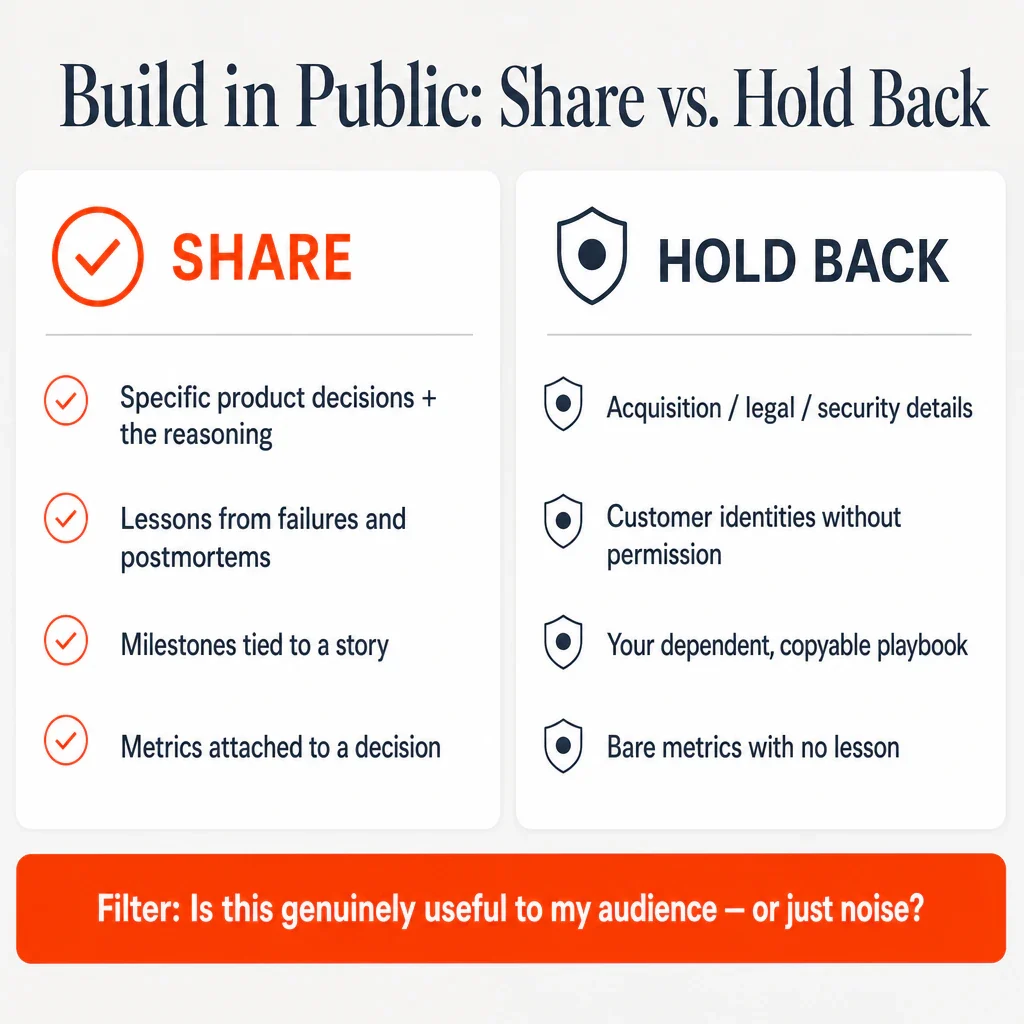
The single filter that resolves most edge cases is this: Is this genuinely useful to my audience, or is it just noise? If an update teaches, clarifies, or invites a real conversation, share it. If it only exists to perform progress, skip it. And when you do share, choose honesty over polish. A vague, sanitized "making great progress, big things coming" update helps no one and builds nothing. A specific, honest update — including the parts that went sideways — is what actually earns a following and a community.
A sustainable cadence and platform mix for time-poor founders
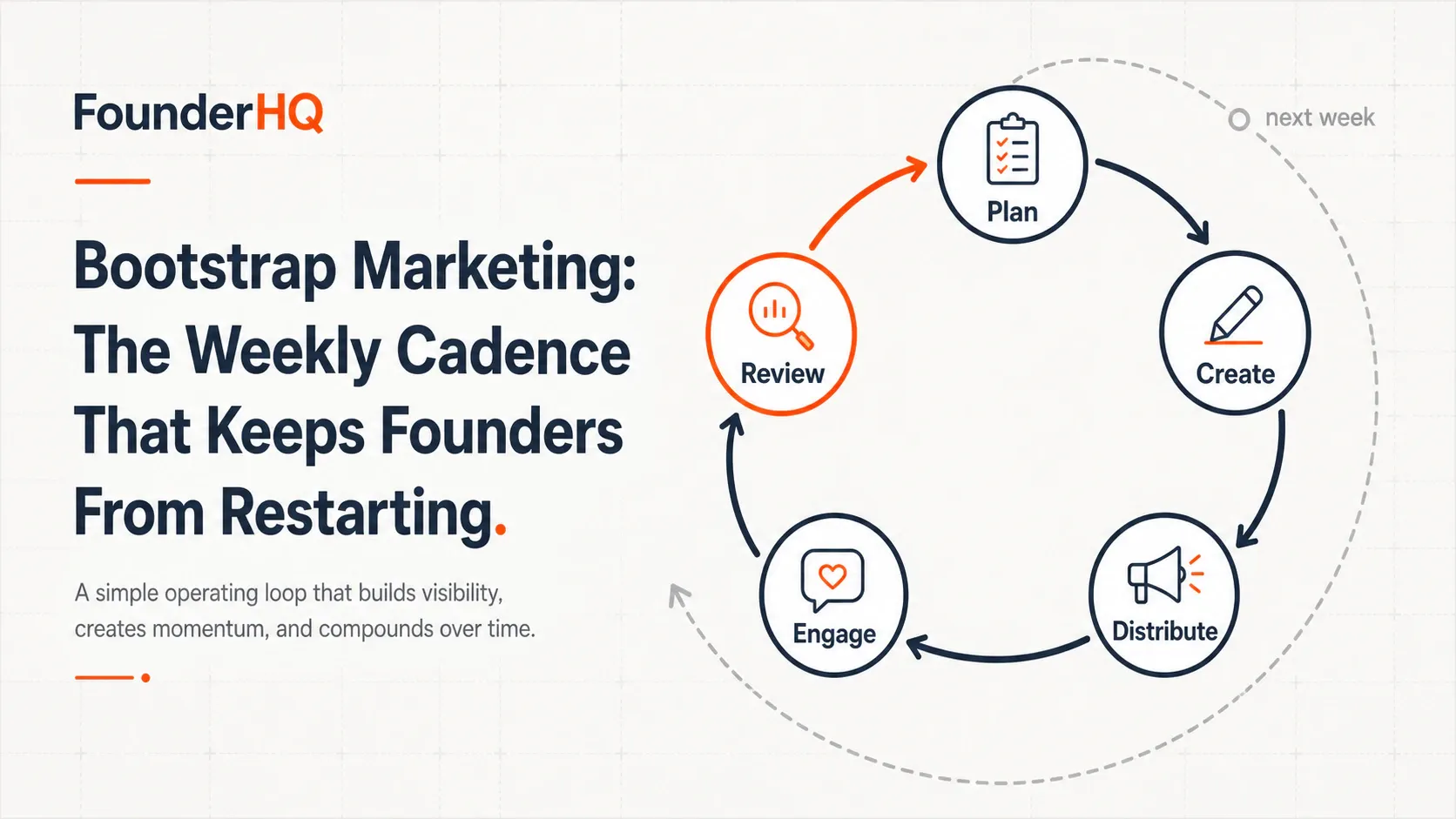
Strategy is useless if you can't sustain it on a busy build week. So design a cadence around your real operating rhythm, not an aspirational one. For most early-stage founders, a realistic and repeatable pattern is a few short posts across the week plus one slightly longer recurring update — something you can hold for a year without it cannibalizing shipping time. If a cadence only survives the weeks you have spare energy, it's the wrong cadence.
Pick a primary platform, not five
Spreading thin across every channel is the fastest way to burn out and post mediocre updates everywhere. For most founders building in public, X/Twitter is the primary channel because that's where the community and the real-time conversation live, with LinkedIn, Indie Hackers, and an owned newsletter as secondary outlets you repurpose into rather than write from scratch (Build in Public). Given the platform mechanics covered earlier, lean into text-only posts and threads that invite replies, and treat conversation in the comments as part of the job — not an afterthought.
Make sharing part of shipping
The core mindset shift is to stop treating build in public as a separate task that competes with building. The sharing is the distribution, so it should live inside your build workflow, not beside it. One concrete way to do this: take a single decision you made this week and repurpose it into multiple formats — a short thread, a LinkedIn post, a line in your newsletter — instead of starting from a blank page for each channel. One decision, captured once, becomes a week of specific content. That's how you keep the habit alive without it becoming a second job.
Common mistakes and how to avoid burning out
Most founders who quit building in public don't quit because it doesn't work — they quit because they ran the broken version of it. The most common failure is treating it as a journal or pure engagement bait instead of a strategy: posting for the dopamine of likes rather than to build something durable. That's the fast path to burnout, because the rewards are noisy and the effort is constant.
The second mistake is posting metrics with no decision or lesson attached. As covered above, these are low-information and, on a platform that rewards conversation, they tend to land flat. The third is inconsistency paired with over-scoping — going hard for two weeks, then disappearing, or trying to build in public across three products and four channels simultaneously. Pick less and hold it longer.
The fourth is oversharing sensitive details in the name of "radical transparency," and chasing hot takes that spike for a day and convert no one. A viral dunk might feel great, but if it brings the wrong audience or none of your actual prospects, it's a vanity event. Protect your time, your moat, and your customers; the goal is a compounding asset, not a daily performance.
Turning your build-in-public habit into a repeatable content system
Everything above only works if you can sustain it, and the thing that quietly kills most founders' consistency is the blank page. By Friday, after a brutal build week, you sit down to post and can't remember the interesting decision you made on Tuesday or why. So you either skip it or post something vague — and the vague version, as we've established, doesn't work.
The fix is structural: capture decisions and context as you make them, so your updates write themselves instead of starting from zero. When the reasoning behind a choice is already recorded the moment you make it, turning it into a specific, decision-level post is a few minutes of editing, not an hour of remembering. This is the bridge between doing the work and distributing it — and it's exactly the workflow FounderHQ is built around: keeping company context in one place and composing founder-led content against that persistent context, so posts stay specific and on-message even on busy weeks.
Drawing every post from one shared, persistent context also keeps your messaging consistent over time — your threads, your LinkedIn posts, and your launch narratives all reinforce the same story instead of drifting. To be clear about what this is and isn't: this is about augmenting you, not automating you. A tool can lower the friction of capturing and shaping your thinking; it can't have the founder judgment that makes build in public worth reading in the first place. The decisions are still yours.
If you want a starting point, here's a simple weekly template you can adopt this week: 1) One decision you made and the reasoning behind it; 2) One lesson from something that didn't go as planned; 3) One metric — only if you can tie it to a decision; 4) One question for your audience that invites a reply. Run that for a quarter, capture the context as you go, and you'll have a repeatable system rather than a willpower contest.
Conclusion
Build in public isn't dead — the lazy version is. The metric-dump-every-Friday playbook is saturated and increasingly invisible, but the version that shares specific decisions and the workflow behind them still does what it always did: builds trust, attracts the right people early, and turns the work you're already doing into compounding distribution. The path forward is unglamorous and reliable: have explicit share/hold-back rules, choose specificity over noise, commit to a cadence you can hold for a year, and make the sharing part of shipping by capturing context as you go so your updates write themselves. Do that, and building in public stops being a separate diary that competes with your product and becomes leverage on top of it — which, for a time-poor early-stage founder, is the only version worth running.