FounderHQJun 27, 202613 min read
Bootstrap Marketing: Build the Weekly Signal Log After Diagnosis
Bootstrap marketing compounds when founders preserve market signals, review them weekly, and feed the strongest learning back into content, messaging, and product journeys.

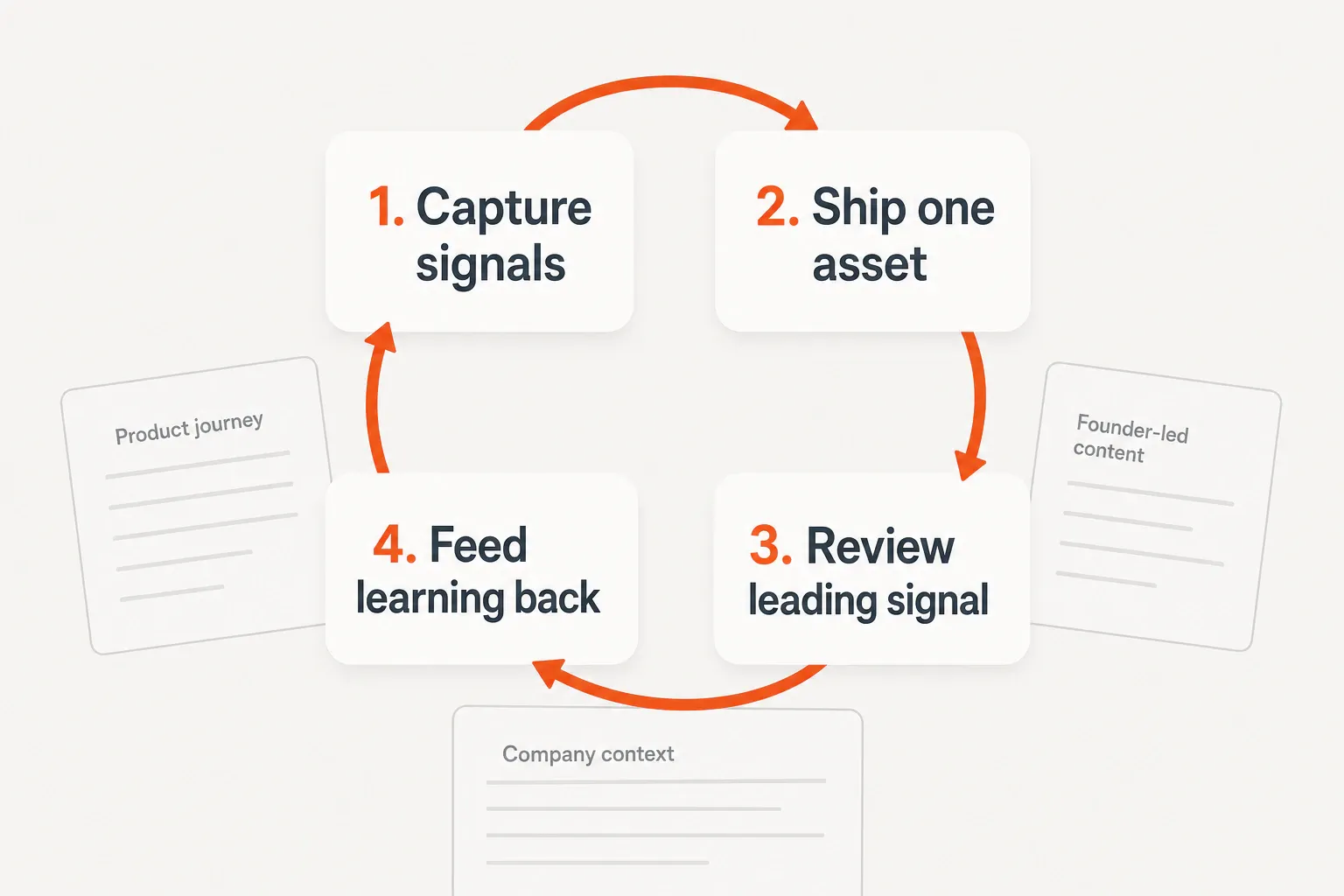
Bootstrap marketing usually breaks after the founder has already picked a tactic. A post gets likes but no buyer replies. A launch creates signups but no activation. A community thread produces a sharp objection, then the team forgets it by Monday. The fix is not another list of free channels. It is an operating artifact: a weekly signal log that captures what the market is teaching, separates useful learning from noise, and turns that learning into the next founder-led asset, message edit, or product journey improvement.
What bootstrap marketing is—and what it is not
A practical definition: bootstrap marketing means using existing and limited resources to reach, learn from, and convert the right market before relying on meaningful paid spend. Older definitions describe it as marketing through “existing, and often limited, resources” or achieving marketing outcomes with minimal financial investment (Upture, Brand Credential). That is directionally right, but for an early-stage product team, the real resource is not only cash. It is attention, founder energy, proof, customer language, and the product’s ability to deliver value once someone shows up.
Bootstrap marketing is not a permanent identity. The goal is not to avoid spending money forever. The goal is to find enough proof, language, audience access, and conversion signal that future spend has something real to amplify. If a founder has not learned who responds, why they care, what they object to, and where the product journey breaks, paid acquisition usually scales confusion.
Budget pressure is not limited to tiny teams. Gartner’s 2025 CMO Spend Survey reported that marketing budgets among surveyed CMOs remained flat at 7.7% of overall company revenue, and 59% said they had insufficient budget to execute their strategy; Gartner also notes that most respondents came from organizations with more than $1 billion in annual revenue (Gartner). Early-stage founders face a sharper version of the same problem: less cash, fewer people, less proof, and far less room to waste a quarter on scattered activity.
That is why the most useful bootstrap marketing question after diagnosis is not “What else should we try?” It is “What did this week teach us, and where does that learning go next?”
The five bootstrap marketing constraints founders confuse
Most bootstrap marketing advice jumps straight to channels. The constraint-first view starts one layer earlier. A channel is only useful if it matches the bottleneck, and the signal log is only useful if it records the right evidence for that bottleneck.
Access constraint
Access is the problem when the right buyers simply do not see you yet. You might have a clear product, a credible founder, and a useful onboarding flow—but no qualified conversations. The signals worth saving are buyer replies, community questions, partner introductions, warm-network patterns, and the exact phrasing people use when they agree to talk.
Clarity constraint
Clarity is the problem when people see you but do not understand why your product matters. Symptoms include polite replies, confused demos, weak landing-page conversion from warm traffic, or prospects describing the product in a way that does not match your intent. The signal log should preserve confusion points, repeated questions, words customers use instead of yours, and copy changes tested that week.
Trust constraint
Trust is the problem when the market understands the category but hesitates because the company is new. This is common for early-stage teams without logos, case studies, or a long track record. Founder-led marketing helps here when it shows real judgment: decisions made, trade-offs considered, mistakes learned, customer problems observed, and useful teardown-style thinking. The useful signals are saves, buyer DMs, specific objections, proof requests, and replies that show someone is evaluating rather than casually applauding.
Activation constraint
Activation is the problem when attention turns into signups, trials, or demo interest—but users do not reach first value. In that case, top-of-funnel marketing can make the leak more expensive. The signal log should connect marketing promise to product behavior: which message brought the user in, where they stalled, what help they needed, and which first-value moment should be clearer next week.
Cadence constraint
Cadence is the problem when the founder knows the right work but keeps restarting from scratch every busy week. The issue is not strategy; it is the operating rhythm. The signal log becomes the rhythm: what shipped, what came back, what changed, and what will be reused before the next week begins.
Choose the right bootstrap marketing loop
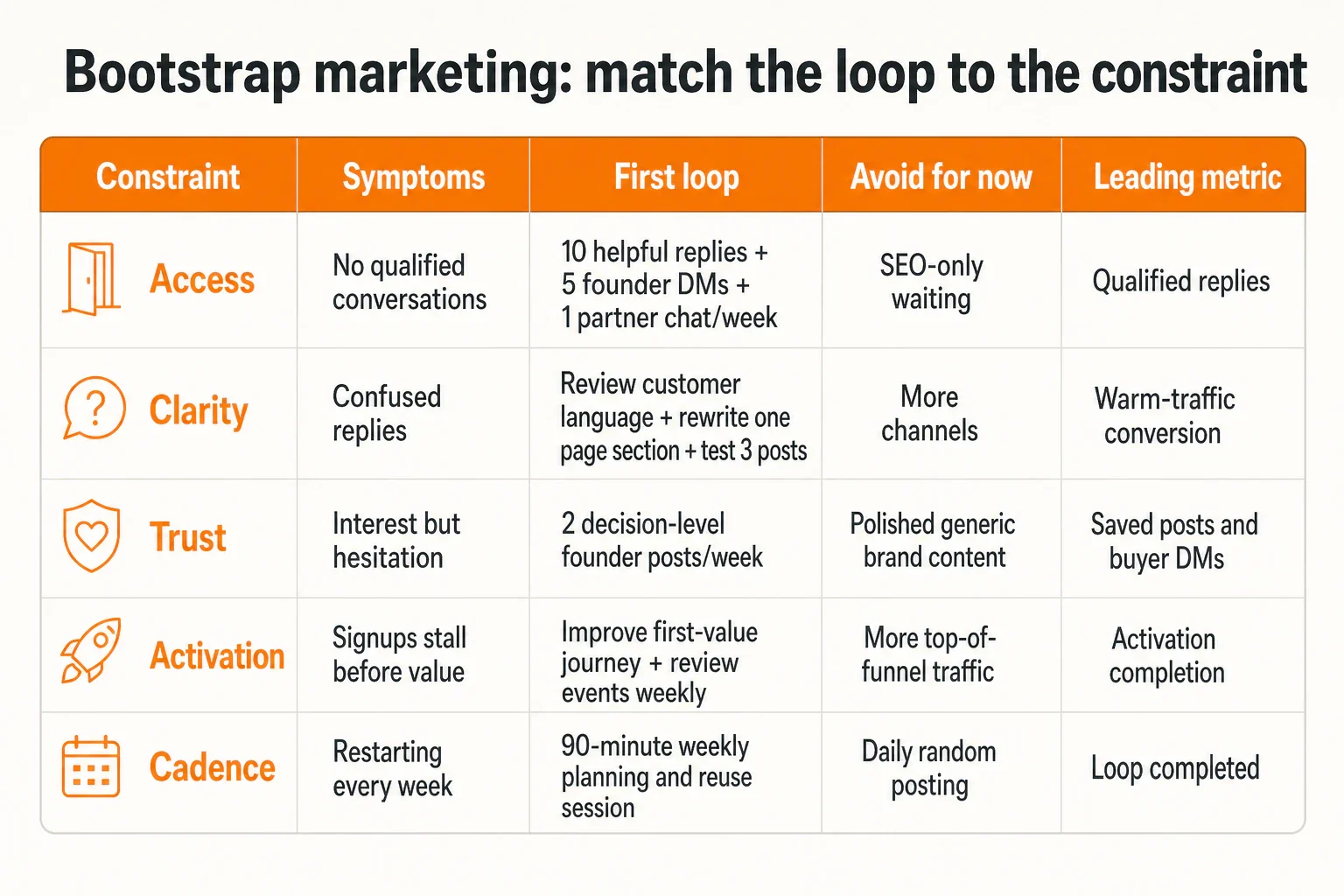
Treat loop selection as a short prerequisite, not the main strategy document. The table below helps name the current constraint so the weekly signal log knows what to capture. Once the loop is chosen, the real work is preserving what the market teaches and turning it into the next product, message, or content decision.
Constraint | Symptoms | 30-day operating loop | Channels to avoid for now | Leading metric |
|---|---|---|---|---|
Access | No qualified conversations, no relevant traffic, few replies | 10 helpful community replies, 5 direct founder messages, and 1 partner conversation per week | SEO-only waiting, broad social posting | Qualified replies and conversations |
Clarity | Confused replies, weak warm-traffic conversion, prospects use inconsistent language | Review customer language weekly, rewrite one landing-page section, test 3 founder posts | Adding new channels before fixing the message | Warm-traffic conversion and message resonance |
Trust | Engagement without buyer confidence, “interesting” replies but few next steps | 2 decision-level founder posts per week showing trade-offs, lessons, and proof snippets | Polished generic brand content | Saved posts, buyer DMs, demo requests |
Activation | Signups or trials do not reach first value | Improve one first-value journey, then review activation events weekly | More top-of-funnel traffic | Activation completion and first-value rate |
Cadence | Repeated restarts, inconsistent publishing, forgotten insights | 90-minute weekly planning and reuse session anchored in saved context | Daily random posting across platforms | Loop completed each week |
The infographic below turns the same worksheet into a visual shortcut. Use it to name the constraint quickly, then move into the weekly review ritual that decides what to preserve, what to ignore, and what to change next.
A simple loop-log template is enough:
- Loop: Which constraint and channel did this week’s work serve?
- Asset or journey shipped: What changed in the market or product?
- Strongest signal: Which reply, objection, activation event, or conversation came from the right audience?
- Weak or misleading signal: Which number looked good but did not indicate progress?
- Language captured: What exact phrase should be reused in copy, posts, onboarding, or sales notes?
- Decision made: Continue, narrow, rewrite, improve the journey, or stop.
- Next shipped change: What will be different next week because of this signal?
The review rule is deliberately strict: if a signal does not change the next asset, message, product journey, or audience focus, it is context—not a decision. Preserve it only if it may become useful later. Promote it only when it changes what the team does next.
Channel guidance: choose by audience and stage, not by what is free
Current no-budget startup marketing guides tend to repeat a familiar set of channels: founder-led LinkedIn or X content, SEO around pain-specific topics, Reddit, Slack or Discord communities, direct outreach, partnerships, Product Hunt or BetaList-style launches, referrals, and email. Those channels can work, but none is universally best.
Several recent startup marketing guides emphasize focus over coverage. One guide recommends choosing one primary acquisition channel for the first 60 to 90 days, using founder-led distribution before agencies or ads, and measuring activation instead of impressions (Startupik). Another argues that founders without a marketing team should pick one channel, go deep, and ignore the rest, with channel choice depending on the audience (pSEO Pro).
A practical matching rule:
- If your buyers are B2B founders, operators, consultants, or team leads, start with founder-led LinkedIn, targeted outbound, pain-specific SEO, and a small number of niche communities.
- If your buyers are technical, test X, Hacker News, GitHub-adjacent communities, technical blog posts, and developer forums before assuming LinkedIn is the answer.
- If your buyers are local or service-based, local search, referrals, partnerships, and direct relationships may matter more than broad content.
- If your product naturally becomes more valuable when users invite others, consider referral or product-led loops—but only after users reliably reach value.
The operating rule is stricter: pick one primary channel, one supporting channel, and one conversion surface. For example: LinkedIn as the primary channel, founder DMs as the supporting channel, and a focused demo page as the conversion surface. Everything else goes into the backlog so the signal log has clean inputs rather than five channels producing mixed noise.
How to run the weekly signal log
A channel is where the work appears. A signal log is how the work improves. Bootstrap marketing compounds when the founder captures what the market teaches and feeds it back into the next asset, message, and product journey.
The weekly ritual looks like this:
- Collect raw inputs: customer calls, support messages, community questions, sales objections, activation drop-offs.
- Create one useful asset: a post, article, reply, teardown, landing-page section, email, or product education moment.
- Distribute natively: adapt the idea to the channel instead of copying the same text everywhere.
- Start conversations: ask for replies, examples, objections, demos, trials, or feedback.
- Capture what comes back: phrases, objections, proof, use cases, and activation gaps.
- Decide what changes: product journey, headline, post angle, outreach line, onboarding moment, or audience focus.
- Repeat on a predictable cadence.
Example: founder-led content loop
Suppose the constraint is trust. Start by collecting five real observations from user calls, support notes, or product decisions. Turn two of them into decision-level founder posts: not “we are excited to launch,” but “we chose X instead of Y because early users were getting stuck at Z.” Repurpose the strongest post into a short article or email. Log replies, objections, and language. Update the message source of truth before the next week’s posts.
Example: activation-led bootstrap loop
Suppose the constraint is activation. Do not publish more top-of-funnel content first. Identify the step where new users fail to reach value. Improve one onboarding moment, help text, demo flow, or lifecycle email. Then publish content around the problem that onboarding solves. Measure whether better-fit users reach value more consistently—not whether the post got a lot of likes.
Sample weekly loop log
Here is what a lightweight operator note can look like at the end of week two:
- Loop: Trust loop on LinkedIn plus founder DMs
- Asset shipped: 2 posts about onboarding trade-offs
- Best signal: 3 replies from founders describing the same activation problem in different words
- Weak signal: High likes from non-buyers on one broad post
- Product/message change: Replace “simple onboarding” with the customer phrase “get users to the first useful action”
- Next week: Write one teardown-style post and update the demo page headline
Review agenda for a tiny team
Use a 30-minute review if you are solo and a 45-minute review if two or three people are involved:
- Five minutes: Read the raw signals without defending the week’s work.
- Ten minutes: Separate buyer-quality signals from vanity signals.
- Ten minutes: Choose one change to the next asset, message, or product journey.
- Five minutes: Archive exact language and assign the next shipped action.
If the review produces three priorities, it has failed. The point is to make next week sharper, not to open a new strategy document.
How one signal changes next week’s work
Imagine a founder publishes a post about “simple onboarding” and gets three buyer replies that all use the phrase “first useful action.” That phrase should not stay trapped in the comments. It can become next week’s post hook, the demo-page headline, the first onboarding checklist item, and the opening line in founder DMs. One signal has now improved founder-led content and the product journey at the same time.
This is where a connected operating system matters. FounderHQ is positioned for early-stage product teams that need to build product journeys, compose founder-led content, and keep company context in one focused operating system. In bootstrap marketing terms, the value is not “more tools.” It is keeping the promise you make in the market connected to the product journey that must deliver it.
What to measure when you cannot wait for revenue attribution
Early bootstrap marketing rarely gives clean revenue attribution right away. That does not mean you should default to vanity metrics. Measure the leading signal that fits the constraint, then record the decision it caused.
Good leading indicators include:
- Qualified conversations with buyers who match your target customer
- Reply quality, not just reply count
- Saved posts or thoughtful shares from the right audience
- Email signups tied to a specific pain
- Demo requests with clear intent
- Signup-to-first-value rate
- Activation completion
- Self-reported attribution from calls and forms
- Repeat visits from the same target accounts
- Message objections resolved over time
Content can absolutely play a role in demand and nurturing, but it still needs channel fit. HubSpot’s 2026 marketing statistics page cites Content Marketing Institute 2025 findings that 74% of marketers said content marketing helped generate demand or leads, and 62% said it nurtured subscribers, audiences, or leads (HubSpot). That supports content as a serious growth motion, not a shortcut. For a tiny team, content only compounds when it is specific, distributed, and connected to a learning loop.
Avoid optimizing only for impressions, likes, raw traffic, or follower count. Those numbers can be useful context, but they do not prove the constraint is moving. A post with 200 views and three high-quality buyer replies may beat a post with 20,000 views and no next step.
A 30-day bootstrap marketing signal plan
Use the first 30 days to validate the signal system, not to prove the entire growth strategy. A small team needs enough learning to decide whether to continue, narrow, or switch without losing the evidence that led to the decision.
Week 1: Set up the signal log
Review 5 to 10 real signals: user calls, lost deals, DMs, support messages, signup sessions, community questions, or landing-page feedback. Choose one constraint: access, clarity, trust, activation, or cadence. Then write one sentence: “For the next 30 days, our bootstrap marketing log exists to learn whether ___.”
Week 2: Ship the first asset or journey improvement
If the constraint is access, start conversations. If it is clarity, rewrite a high-friction message and test it in posts or outreach. If it is trust, publish decision-level content. If it is activation, improve the first-value journey. If it is cadence, create the weekly planning slot and reuse system. At the end of the week, log one strong signal and one weak signal.
Week 3: Feed the strongest signal back into the system
Do not chase the biggest number. Chase the most useful signal. Which reply sounded like a real buyer? Which objection appeared twice? Which product step blocked value? Which phrase did customers use that your copy does not use yet? Feed that back into the next asset, message, or product journey.
Week 4: Review and decide
Ask four questions:
- Did this loop create qualified conversations or activation learning?
- Did it reveal better customer language?
- Did it expose a product or journey gap?
- Can the team repeat the review ritual for another 30 days without heroics?
Keep the loop if it produces qualified conversations, clearer language, stronger activation insight, or repeatable learning. Narrow it if the channel is too broad. Stop it if it only creates vanity engagement.
When should you switch loops? Not after one quiet post or one awkward outreach batch. Switch when the loop has run for the full review window, the audience fit is still weak, and the leading metric has not improved despite a clear message and consistent execution. If the signal is real but messy, narrow the loop before abandoning it.
Common bootstrap marketing mistakes
The most common mistake is doing every free tactic at once. Free channels are not free if they consume the founder’s best thinking hours and produce no learning.
Other mistakes to avoid:
- Publishing content without a point of view or distribution path
- Treating AI-generated volume as a substitute for founder insight
- Driving traffic before the activation journey is ready
- Changing channels before the loop has run long enough to produce signal
- Calling a channel “bad” when the real problem is clarity or trust
- Forgetting to capture reusable audience language, objections, proof, and decisions
- Measuring reach when the constraint is activation
- Waiting for perfect attribution instead of reviewing leading signals
- Logging signals without deciding what they change next
Bootstrap marketing rewards focus because focus makes learning visible. If every week introduces a new channel, a new message, and a new audience, the founder cannot tell what worked. If the signal log stays narrow, the learning has a chance to become useful.
Conclusion
Bootstrap marketing compounds when market learning survives the week. The founder does not need every free channel; they need one loop, one leading signal, and a review ritual that turns replies, objections, and activation data into the next product or content decision. Start by naming the constraint, but do not stop there. Write the weekly signal log, review it honestly, and feed the strongest learning back into founder-led content, product journeys, and company context.
Related articles
Application Onboarding Process: Definition, Steps, and When to Use It
A practical seven-step application onboarding process for moving new users from signup to first meaningful value without unnecessary setup or generic tours.
In-App Analytics for Onboarding: Definition, Metrics, and When to Use It
In-app analytics for onboarding turns events, funnels, segments, and user feedback into decisions about the path from signup to first value.

In-App Guidance for Onboarding: Definition, Examples, and When to Use It
In-app guidance helps users complete meaningful tasks inside a product. This guide explains the main patterns and how to match each one to an onboarding blocker.