FounderHQJun 22, 202613 min read
Bootstrap Marketing: Build a Reusable Asset Library So You Stop Starting From Scratch
Most no-budget marketing advice tells you to find more free reach. But your real constraint is founder hours, and most of them are spent re-discovering your audience's language,...

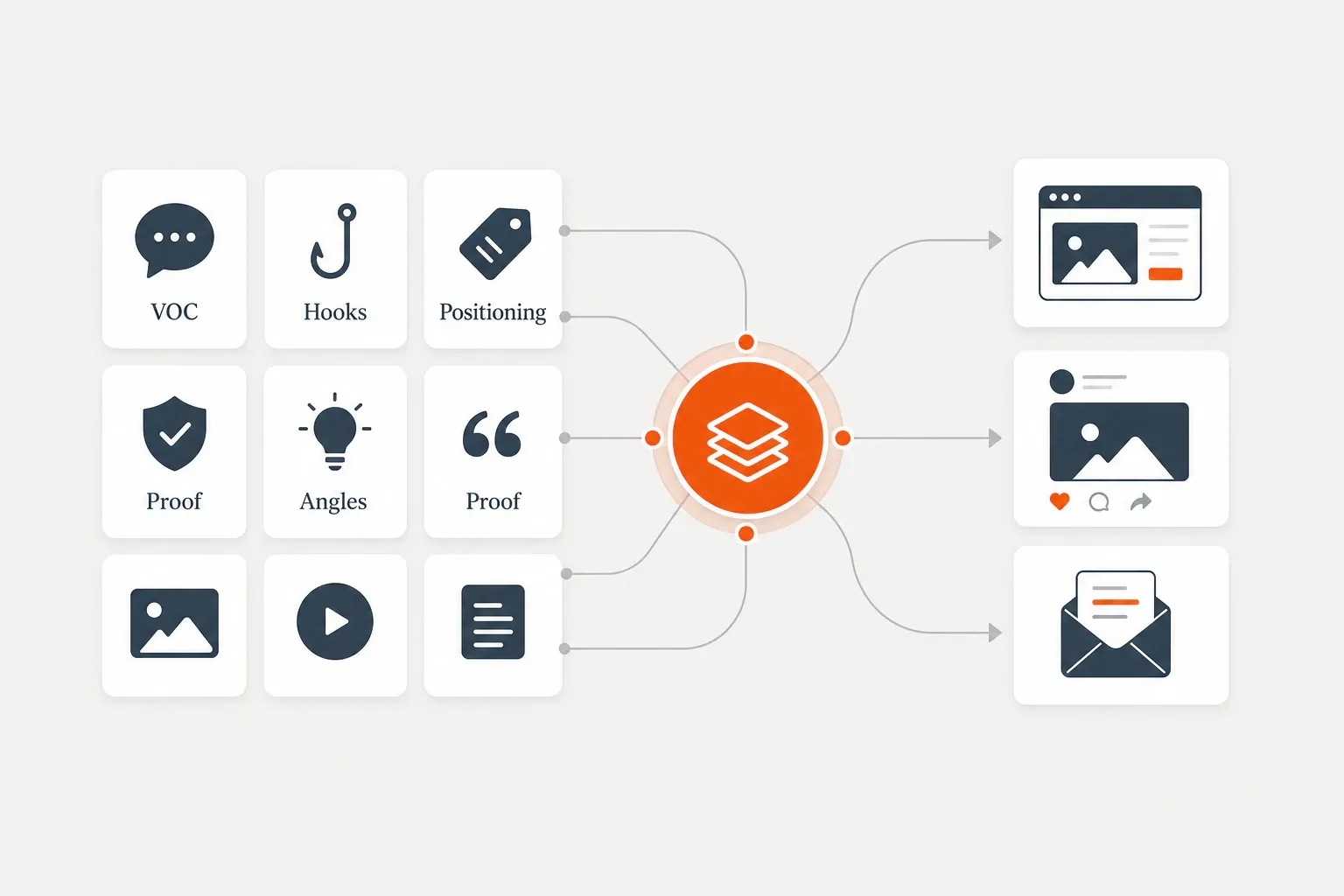
Sit down to do your marketing for the week and watch what actually happens in the first thirty minutes. You open a blank post. You go hunting for that phrasing a customer used last month that explained the problem better than you ever have. You half-remember a hook that got real replies, but you can't find the post. You rewrite your one-liner — again — because the one on your landing page, the one in your pitch, and the one in your last email no longer quite match. Only then, with your scarce focus already spent, do you start producing anything new. Most bootstrap marketing advice answers a different question: how do I get more free reach? It points you at more channels, more posts, more places to show up. But on no budget, reach is rarely the binding constraint — your own hours are. And a large share of those hours go to re-doing knowledge you already had rather than producing new output. The highest-leverage move isn't another channel. It's building a small, reusable marketing asset library — a system of record for your audience's language, your proven hooks, your working positioning, and what you've already tried — so every marketing session starts from accumulated proof instead of a blank page. This article is about that knowledge layer. It is not about picking a channel, atomizing one post into ten, borrowing someone else's audience, or holding a weekly cadence — those are real problems with their own playbooks. This is the layer underneath all of them: the proof every one of those tactics quietly draws from, and the reason your work compounds instead of resetting to zero each week.
The real bottleneck isn't reach — it's that you keep starting from scratch
Here's the uncomfortable pattern in no-budget marketing: the expensive part of each session is rarely the writing. It's the re-research. You re-discover how your buyers describe their problem. You re-derive the differentiator you've already articulated three times. You try to remember which opener earned replies and which one died in the feed. None of that produces a new asset — it just rebuilds context you already paid to learn, then lets it evaporate again the moment you close the tab.
That matters because of what your budget actually is. A funded team can paper over lost context by spending more — more ads, more contractors, more swings at the wall. You can't. Your marketing budget is denominated in founder hours, and hours don't roll over. An hour spent re-finding a quote you captured in a sales call last month is an hour you didn't spend reaching anyone new. Do that every week and the compounding works against you: you stay busy, but the work never accumulates into anything that makes next week faster.
The fix is to treat your marketing knowledge as an asset, not as something you re-generate on demand. A reusable asset library is a small, searchable system of record — your buyers' exact language, the hooks and angles that actually landed, your current positioning, the channels you've scored, and the experiments you've kept or killed. It is the place every post, page, and DM is drafted from. Reusing proven material is structurally higher-leverage than generating more random new activity, because it turns each marketing session into a deposit rather than a withdrawal. The rest of this guide is about what to put in that library, how to capture it without it becoming a second job, and how to actually draft from it.
Why this matters more for bootstrapped teams in 2026
The math behind "just run ads" has gotten worse, which makes founder hours even more precious. Multiple 2026 benchmark reports put B2B SaaS customer acquisition cost (CAC) up roughly 40–60% since 2023, driven partly by rising ad costs — FoundryCRO notes Google Ads CPCs climbed in most industries and Meta CPMs rose 40–60% over that period (FoundryCRO; ClearBrand). For a team with no ad budget, that trend isn't a line item — it's a closed door. Paid acquisition is precisely the lever you don't have.
So bootstrapped teams lean organic and lean on the founder. FoundryCRO's stage benchmarks describe an early/pre-seed organic-to-paid split around 90/10, and SaaS Capital's 2025 survey (cited across these 2026 reports) found bootstrapped SaaS companies spend far less of revenue on sales and marketing than equity-backed peers — equity-backed companies spend roughly 58% more on marketing as a share of revenue (FoundryCRO; ClearBrand). ClearBrand's own description of the bootstrapped reality is blunt: the founder carries most of the load through content, community presence, and manual outbound. In other words, your hours are the marketing department. Every hour you burn re-researching is a real cut to your only budget.
Organic compounds — but only if your work does
The case for organic is that it accrues. FoundryCRO reports SEO ROI in the neighborhood of 700%+ with a roughly seven-month breakeven for B2B SaaS, and Ink Engine models a content-vs-paid customer crossover somewhere around months 12–16 — before that point paid wins on raw volume; after it, content pulls ahead and keeps going even if you stop spending (FoundryCRO; Ink Engine). Treat every figure as the cited source's estimate, not a guarantee for your business — the ranges are wide and depend heavily on niche and execution. The directional point is what matters: organic rewards sustained, consistent work over months.
But there are two ways to compound. The good way is when each piece of work makes the next one easier — your hooks library gets richer, your positioning gets sharper, your channel bets get better-informed. The bad way is when only the output accumulates while the knowledge keeps resetting, so you're forever re-learning your own audience. A reusable asset library is what makes organic actually compound on the input side, not just the output side. It's also why founder-led channels reward this: organic LinkedIn distribution skews heavily toward personal profiles over company pages — Refine Labs' study, cited widely in 2026, found personal profiles drove about 2.75x the impressions and 5x the engagement of a comparable company page (Refine Labs). That reach runs on your voice and your stored context, which is exactly what a library protects.
The 5–6 assets actually worth keeping (and what each one saves you)
You don't need a content management system. You need five or six small, named collections — the things you re-derive most often — kept somewhere you'll actually look. The infographic below lays them out side by side; here's what each one is and the specific waste it eliminates.
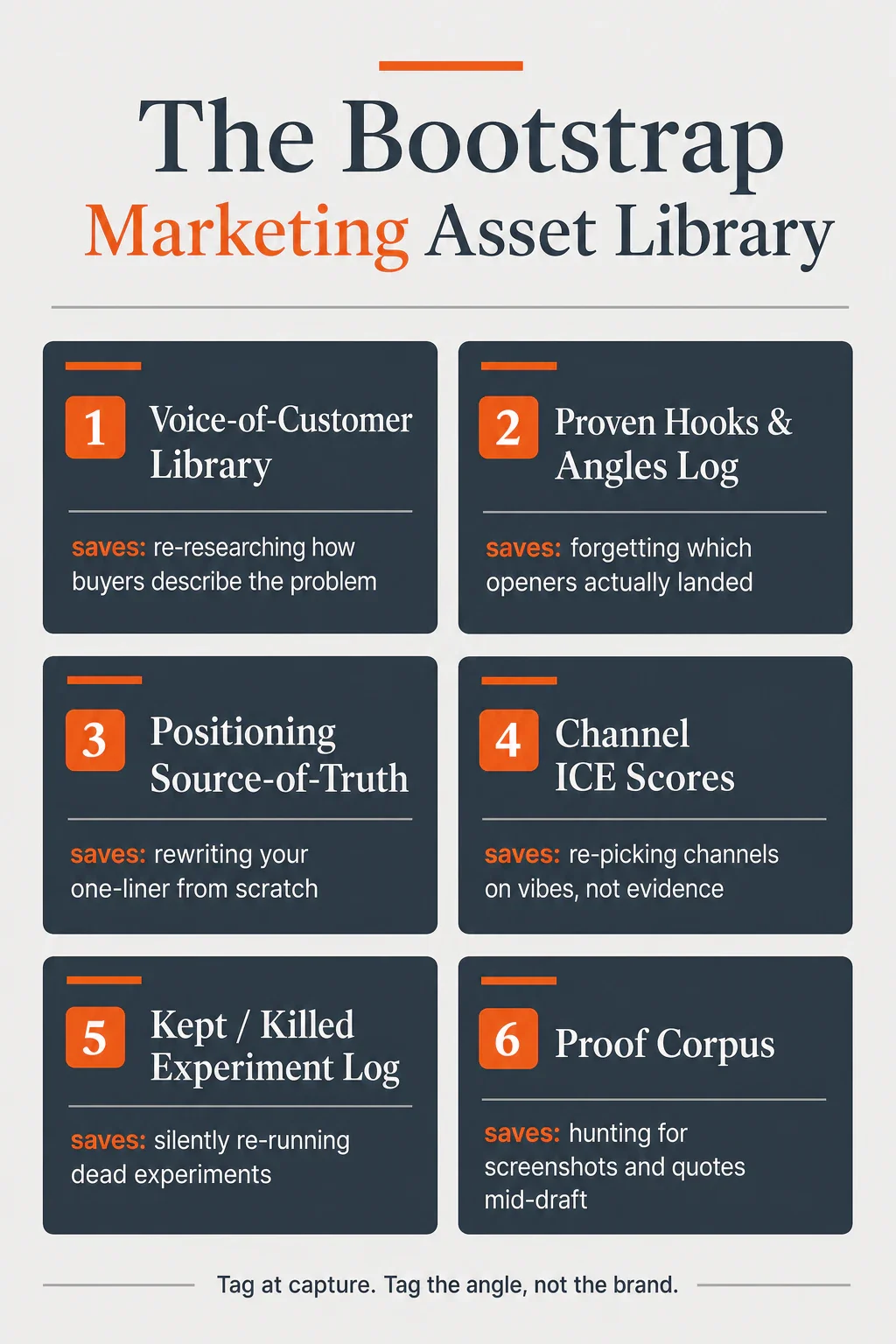
Voice-of-customer language
This is a running list of the exact phrases your buyers use — pulled from sales calls, support tickets, reviews, onboarding messages, and DMs. Not your internal product vocabulary, theirs. When your headline describes the problem in the words a customer actually said, you skip the worst tax in marketing: writing copy in jargon your reader doesn't use. Captured once, a single sentence like "I keep rewriting the same email every Monday" can headline a post, anchor a landing page, and open an outreach message. Without the library, you re-conduct that audience research every time you sit down to write.
Proven hooks and angles log
Track the openers and angles that earned real engagement — replies, saves, bookmarks, signups — not vanity likes. The crucial move is to tag by angle or mechanism, not by the one-off post. "Reframe a 'do more' problem as a 'stop wasting what you have' problem" is a reusable angle; "my June 4th LinkedIn post" is a dead artifact. Tagged by angle, a hook that worked on LinkedIn can be re-pointed at a blog intro or a cold email. This is also where you absorb a hard truth from bootstrapped operators like Rob Walling: posting to social isn't automatically marketing. Logging what genuinely moved people keeps you honest about which angles actually pull.
Positioning and message source-of-truth
One short document holding your current one-liner, your problem framing, and your two or three differentiators. This is the antidote to message drift — the slow divergence where your site, your pitch, and your latest post each describe a slightly different product. When every surface is written from the same source-of-truth, your story stays consistent without anyone policing it. Maintaining one clear message is high-leverage on its own; the library is where that message lives so it doesn't quietly fork across channels.
Channel ICE scores
Keep a running table of marketing approaches you've tried or considered, each scored on Impact, Confidence, and Ease (the ICE framing popularized by bootstrapped-SaaS operators like Rob Walling, and echoed in Gabriel Weinberg's Traction / Bullseye approach to channel selection). The point isn't precision — it's that you re-pick channels from accumulated evidence instead of vibes or whatever you read last week. A channel you scored low six months ago, with a note on why, saves you from re-testing it on a whim.
Kept/killed experiment log
A plain list of what you tried, what worked, what you stopped, and the reason. Its whole job is to stop you silently re-running dead experiments — the cold-DM script that flopped, the subreddit that went nowhere, the lead magnet nobody downloaded. On a team of one with no institutional memory, this log is your institutional memory.
Proof corpus
A small folder of real, shareable proof: screenshots, customer quotes, before/after notes, small wins you have permission to publish. When you're drafting and want evidence, you pull from here instead of hunting through your inbox mid-sentence. One discipline matters more than any other: only real, defensible proof goes in. No fabricated metrics, no invented testimonials. A proof corpus you can trust is worth more than a big one you can't.
Capture without it becoming a second job
The reason most founders don't have a library isn't that they disagree with the idea — it's that "organize all my marketing knowledge" sounds like a weekend project that never happens. The trick is to make capture nearly free and the structure nearly invisible.
Rule 1 — tag at capture, not later. A five-second tag in the moment beats a three-month retrofit you'll never start. The swipe-file discipline that ad librarians swear by is exactly this: log the thing when you notice it, because the version of you that planned to "sort it later" is not coming (adlibrary.com). When a customer says something sharp on a call, drop the quote into your VOC list before you hang up. When a post pops, log the angle that day.
Rule 2 — tag the angle, not the brand or platform. Tag by the underlying mechanism so the entry survives changes to your product, your channels, and the tools you use. "Loss-aversion hook" stays useful for years; "the tweet about our v2 launch" is obsolete the moment v3 ships.
Keep the taxonomy tiny. For a team of one, a handful of fields is plenty: asset type, angle, source, and status. Resist the urge to build an elaborate schema — over-structuring is just procrastination wearing a productivity costume. A reference library that's too heavy to maintain rots into a screenshot graveyard, which is exactly the failure you're trying to avoid; the goal is a living asset library, not a one-time archive (mean.ceo).
Make capture a side effect of work you already do. You're already on customer calls, already posting, already shipping. Capture should ride along on those activities, not become a separate ritual you have to remember. The only standing appointment you need is a short weekly review — fifteen minutes to file the week's new language and hooks and update the kept/killed log. One small loop, not a heavy process.
Turning the library into sharper marketing output
A library only earns its keep if you draft from it. Make this the rule: before you write any post, page, or outreach message, pull three to five relevant entries first — a proven hook, a voice-of-customer phrase, the current positioning line — and write from those. You are no longer staring at a blank page; you are assembling from proof. That single habit is what converts the library from a storage cost into a speed advantage.
Drafting from a shared source-of-truth is also what quietly kills message drift. When your landing page, your LinkedIn post, and your cold email all pull the same differentiator and the same problem framing, they reinforce each other instead of confusing your reader with three slightly different stories. Consistency stops being a thing you enforce and becomes a thing that falls out of the workflow.
It speeds repurposing, too. Because your captured insight is stored as an angle rather than a finished post, translating it into each channel's native format is a small adaptation rather than a fresh act of invention. One voice-of-customer insight becomes a LinkedIn hook, a blog section, and an outreach opener — same core, three native shapes — without you generating three unrelated ideas from scratch.
This is also where a tool can genuinely help, as long as it stays in its lane. The hard part of a library isn't storage; it's keeping persistent context in one place and actually drafting against it. FounderHQ is built around exactly that pairing — a workspace that holds persistent company context and memory, plus a founder-led writer that drafts content from it — so posts start from your accumulated proof rather than a blank page. The honest framing matters here: a system like this augments the founder, it doesn't run your marketing for you. It's a sharper place to keep and reuse your own context, not an autopilot that replaces your judgment. Whatever you use — a doc, a spreadsheet, or a workspace built for it — the principle is the same: write from accumulated context, not from memory.
A starter setup you can stand up this week
You can build the minimum viable version in a single sitting. Make one doc or one table with six sections — voice-of-customer, hooks/angles, positioning source-of-truth, channel ICE scores, kept/killed log, and proof corpus — plus the tiny four-field taxonomy (type, angle, source, status). That's the whole system. Don't add a seventh thing until the first six are earning their keep.
Then seed it from what already exists, because you've been generating this material all along — you just haven't been keeping it. Spend thirty minutes pulling exact phrases from your three most recent customer calls or reviews into the VOC list, and reverse-engineer the angles from your three best-performing posts into the hooks log. Drop your current one-liner into the positioning doc even if you're not thrilled with it; you can sharpen a real line far faster than you can conjure one from nothing.
Finally, install the two habits that keep it alive: a recurring fifteen-minute weekly slot to capture and review, and one standing rule — never write from a blank page again. Every post, page, and message starts by pulling from the library first.
What does "good" look like? Described qualitatively — not as a promised number — over the first 30, 60, and 90 days you should notice drafts coming together faster, your messaging sounding consistent across surfaces without effort, and fewer moments of re-running an experiment you already knew didn't work. That's the compounding mindset in practice. Bootstrap marketing isn't won by generating more random activity on no budget; it's won by reusing what already proved useful, so that every scarce founder hour builds on the last one instead of starting over.
Conclusion
Bootstrap marketing gets framed as a creativity problem — find a clever way to get free reach. For a time-poor founder, it's closer to a memory problem. The reason marketing feels so heavy on no budget is that you keep paying, in your scarcest currency, to re-learn things you already knew: how your buyers talk, which angles land, what your message actually is, and what you've already tried. A small reusable asset library fixes that by turning your marketing knowledge into something you deposit into rather than rebuild. Capture at the moment, tag the angle not the brand, keep the structure tiny, and make it an ironclad rule to draft from the library instead of a blank page. Do that for a few weeks and the loop flips: instead of every session resetting to zero, each one leaves you a little further ahead. On no budget, that compounding — not more activity — is the whole game.
Recommended Videos
Rob Walling — a recognized bootstrapped-SaaS operator and investor, not a competitor — walks through choosing low-cost channels with an ICE (impact/confidence/ease) analysis and argues posting to social isn't automatically marketing; the transcript confirms it directly supports the channel-ICE-scores and proven-hooks sections.
Related articles
Application Onboarding Process: Definition, Steps, and When to Use It
A practical seven-step application onboarding process for moving new users from signup to first meaningful value without unnecessary setup or generic tours.
In-App Analytics for Onboarding: Definition, Metrics, and When to Use It
In-app analytics for onboarding turns events, funnels, segments, and user feedback into decisions about the path from signup to first value.
In-App Guidance for Onboarding: Definition, Examples, and When to Use It
In-app guidance helps users complete meaningful tasks inside a product. This guide explains the main patterns and how to match each one to an onboarding blocker.