
When marketing isn't working on no budget, the instinct is to do more: post more often, book more demos, send more cold emails, rewrite the landing page one more time. It feels like a reach problem — if more people just saw it, surely more would convert. But after watching enough founders run that loop, a different pattern shows up. The volume goes up and conversion stays flat, because the thing being amplified isn't clear in the first place. On no budget, your binding constraint is rarely reach. It's an unclear, inconsistent message that makes the same content, the same outreach, and the same landing page underperform everywhere at once. This guide makes the case that message clarity is the real multiplier in bootstrap marketing — backed by 2026 research on what actually separates pages and pitches that convert from ones that don't — and then walks through how to define one message 'source of truth' and keep it consistent across every free channel you already run. It's the clarity layer that sits beneath channel choice, cadence, and production, not another list of hacks.
The bootstrap marketing trap: you think it's a reach problem, it's a clarity problem
Bootstrap marketing is usually framed as a money problem — no ad budget, so you have to be clever about getting free attention. But the harder constraints for an early-stage founder are focus, speed, and clarity. You only have so many hours, and when results lag, the muddy thing is almost never how many people you reached. It's what they understood when they got there.
Here's the symptom most founders misread. Conversion is flat, so you compensate with volume: more posts, more demos, more outreach, more re-explaining on every call. Each of those is an attempt to brute-force around a message that isn't doing its job. If a prospect can't tell who your product is for, what problem it solves, and why it's different, then every extra impression you earn for free inherits that same confusion. You're not scaling clarity — you're scaling a question mark.
That's the trap, and it's why the fix isn't another channel. On no budget, message clarity is the multiplier. A sharp message makes every free channel you already run convert better; an unclear one taxes all of them equally. Add a channel on top of a fuzzy message and you've just bought yourself more places to be misunderstood. Fix the message and the channels you already have start working harder for the same effort.
So this article deliberately stays in one lane. It's not a channel list, a cadence plan, or a production system — those are real problems worth their own treatment. This is the layer underneath all of them: getting your message right, then keeping it identical everywhere it shows up. Get that wrong and, as positioning expert April Dunford puts it, "you're optimizing the wrong machine."
What the 2026 data says: clarity beats budget and design
The encouraging part for a bootstrapped team is that the evidence is on your side — clarity, not spend, is what separates winners from losers, and clarity is free to fix. Treat the numbers below as what they are: third-party studies, each attributed to its source and year, not FounderHQ's own data.
Budget barely predicts quality
In its State of Landing Pages 2026, roast.page scored more than 1,000 landing pages across eight conversion dimensions and found a median overall score of just 44 out of 100. Copy and messaging was the weakest dimension across nearly every industry, and — critically for a no-budget team — company size had near-zero correlation with quality (an r-squared of about 0.04, which roast.page calls "statistical noise"). In their words, a bootstrapped founder selling a $29/month tool scored 78 while a Series B startup with $14M in funding scored 31. What did correlate with a higher score was specificity of copy. You don't need a bigger budget; you need clearer thinking about who you're for.
PitchKitchen's 2026 State of B2B Homepage Messaging found the same direction from a different angle. Scoring 200 B2B homepages on 18 messaging criteria, it reported that smaller T3 scale-ups ($5–$50M) outscore T1 enterprises ($500M+) on messaging clarity by about 27% — "every sector, no exceptions." Their explanation is blunt: smaller companies have to tell the truth clearly because they can't afford to be vague. Bigger isn't sharper; bigger is often broken. For a bootstrapped founder, that's permission to win on the one dimension money doesn't buy.
Clarity shows up downstream as money
Clarity isn't a branding nicety — it moves the numbers that matter. The Starr Conspiracy's B2B Positioning & Messaging Benchmarks (2024), citing 2023 Forrester-style buyer research across 1,165 global B2B buyers, reports that sellers who clearly articulate differentiated value are about 35% more likely to close than peers who can't. Use it as a lift figure attributed to that 2023 study, not an absolute promise — but the direction is unambiguous: a clear, differentiated message is worth real revenue.
And when the message is muddy, the cost doesn't disappear — it just moves downstream where it's harder to see. GTMVP's analysis of patterns from roughly 1,000 B2B SaaS sales calls makes the point sharply: when a prospect asks "how is this different from [competitor]?" twelve minutes into a demo, that isn't a sales problem, it's a positioning failure that started with your ads, homepage, or ICP definition. As they put it, that messaging gap "shows up in your CPA, your close rate, and your sales cycle length." The takeaway for a founder is to treat messaging as an operating lever, not a one-time copywriting task — because every channel you run is quietly paying the bill for an unclear message.
Define your message 'source of truth' (the one-page spine)
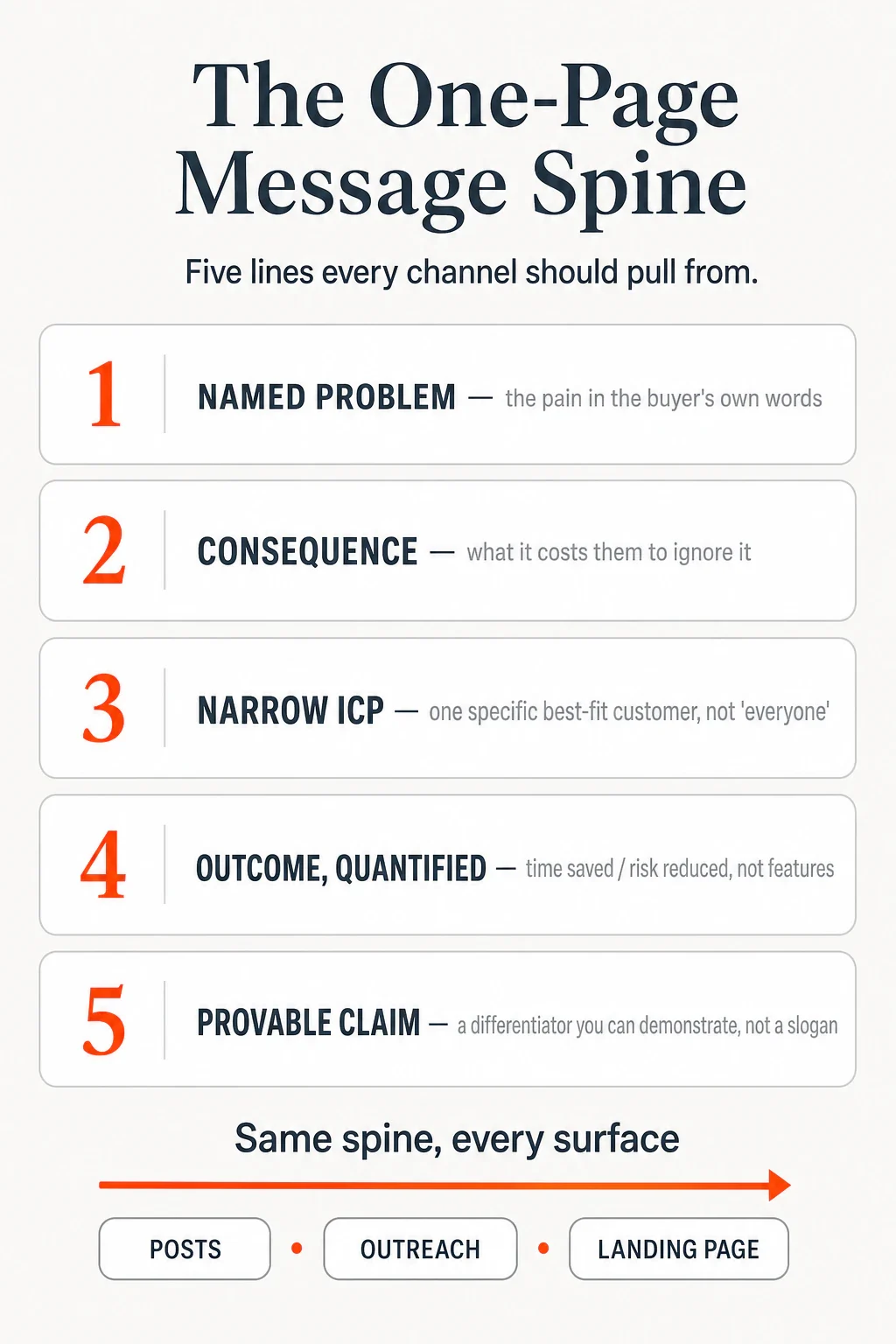
If clarity is the multiplier, the work is to define your message once, deliberately, and write it down — a short 'source of truth' your every post, email, and page can pull from. The infographic below shows the five lines worth nailing; the rest of this section explains each one. The goal is a one-page spine you can reuse, not a 30-page brand book nobody opens.
Name the problem in the buyer's own words
Start with the specific problem your best customer actually feels, written the way they would say it — not the way your category says it. Then state the consequence of leaving it unsolved (the cost, the risk, the time bleed) and the transformation on the other side. This is the order a problem-aware reader needs: here's your pain, here's what it costs you, here's what changes. PitchKitchen's audits found that most B2B homepages get this backwards, talking about the company far more than the customer; the healthy ratio leans heavily toward the buyer's reality, not yours.
Translate capability into outcomes, and narrow the ICP
The most common failure in the landing-page data is a feature dump — explaining what it is instead of why it wins. Translate each capability into an economic outcome: time saved, risk reduced, revenue protected, effort avoided. roast.page found outcome-driven headlines materially outscore feature-driven ones, yet most pages still lead with features. Pair that with a narrow ideal customer profile. "Our market is huge" isn't a strategy; one core story aimed at one specific best-fit customer (with small persona-specific twists) beats a broad message built for everyone. Narrow is fast; broad is slow.
Find a claim you can prove
Finally, anchor on defensible white space — a claim you can actually demonstrate, not a clever tagline. The cheap version is a slogan that any competitor could also write; survey data has long shown that the majority of B2B pages sound interchangeable to their target buyers. The durable version is something specific and provable that your competitors can't honestly say. Pull these five lines together and you have your spine: named problem, consequence, narrow ICP, quantified outcome, and a provable claim. That's the one page every other piece of marketing should be drafted against.
Make it consistent everywhere: one story, many angles, zero contradictions
Writing the message once is the easy part. The hard part of bootstrap marketing is keeping it identical across LinkedIn posts, cold outreach, your homepage, your onboarding, and your pitch — for months, on busy build weeks, when you're tired. That consistency is where compounding trust actually comes from.
A useful way to think about it comes from GTM strategist Jonathan Buckley of The Artesian Network, who frames messaging not as a copywriting task but as a companywide operating system: "one story, many angles, zero contradictions." His distribution model is owned media (your site, emails, content), shared media (LinkedIn, communities, partners), and earned media (podcasts, PR, guest articles) — with the same core story showing up at a steady cadence so trust compounds. The goal isn't more posts; it's the same message landing in the right places, repeatedly, until the market can repeat it back to you.
So why does the message drift for solo founders? Because the context lives in one place — your head — and gets re-derived from scratch every time you write something. This week's cold email phrases the problem one way; next month's landing-page rewrite phrases it another; a LinkedIn post hedges the differentiator because you weren't sure of the exact wording. None of it is wrong on its own, but together it slowly contradicts itself. That's the consistency tax, and on no budget it's expensive: every contradiction makes a free impression a little less convincing.
The fix is structural: keep a single, persistent source of truth your content is drafted against, instead of re-deriving the message each time. This is exactly the problem FounderHQ is built to consolidate — a writer for founder-led content plus a workspace that holds your company context and decisions, so the posts, narratives, and outreach you draft stay on-message over time. The framing matters: this is augmentation, not automation. It's not about an AI running your company while you sleep — it's about your hard-won message staying consistent across everything you ship, so you stop re-explaining and start compounding.
How to tell if your message is working (a no-budget check)
Without an analytics budget or a big sample, you can still tell whether your message is landing — by judging the quality of response, not just the quantity. Do prospects understand faster? Do higher-fit users engage, while poor-fit ones self-select out? Do sales conversations start from a better baseline, with less time spent explaining what you even do? Those are clearer signals than raw impressions.
Watch for the 'translation tell.' When people read your post or page and then ask "but what does that actually mean for us?", that's a clarity failure upstream of the click. The same goes for the demo pattern GTMVP flagged: if you're re-pitching what your product does at minute eight of every call, your message isn't carrying its weight before the conversation — and no amount of extra reach fixes that. Brian Carroll's line captures it well: most companies don't have a sales problem, they have a clarity problem.
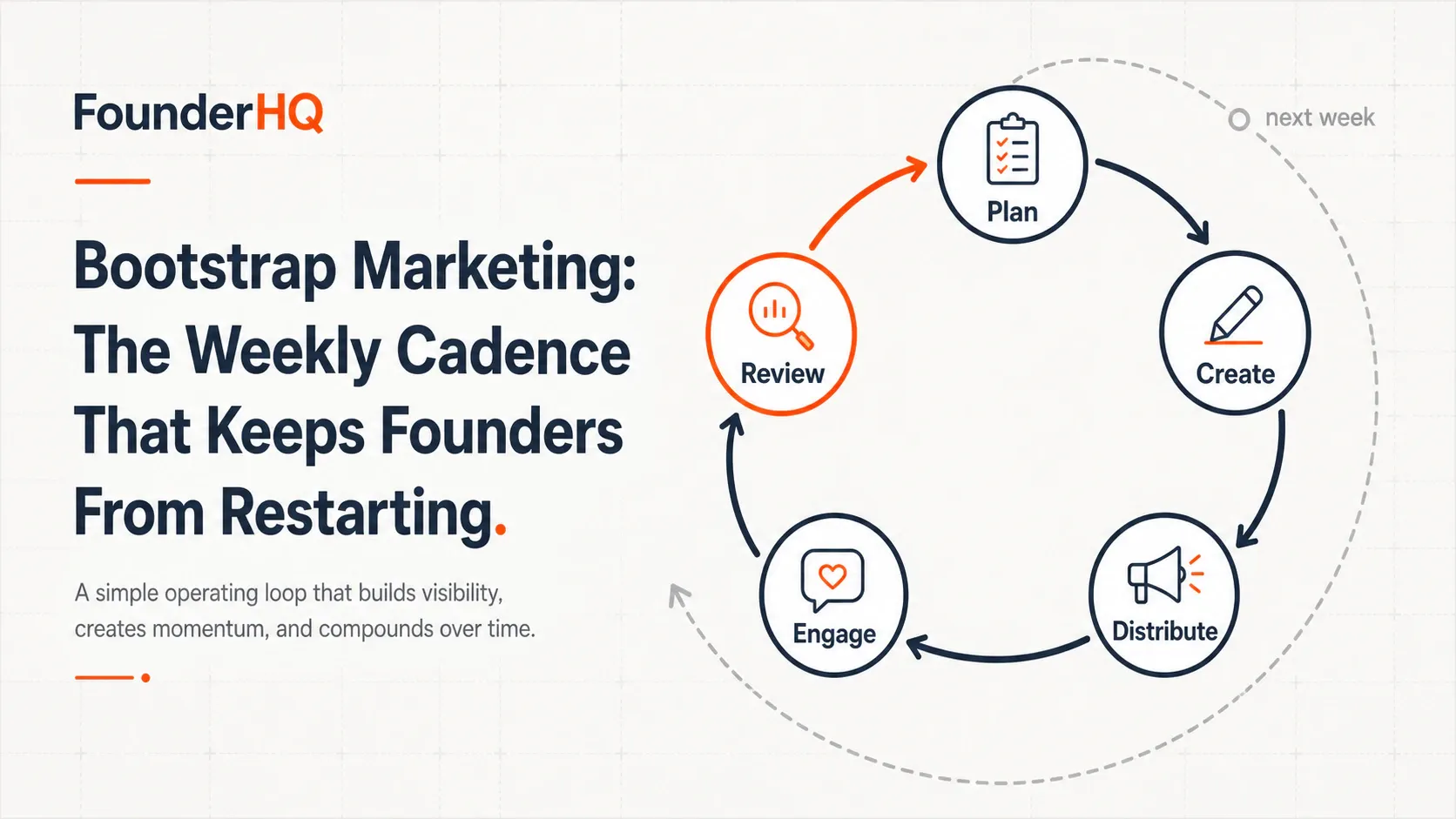
Hold a simple weekly review you can actually keep. Take the things you published or sent that week, lay them next to your one-page spine, and check for drift: Is the problem stated the same way? Is the ICP still narrow? Is the differentiator still the provable one? Fix the contradictions before you scale spend or effort on top of them. It's a ten-minute habit that protects the multiplier.
AI can help here, but only as a refiner — sharpen and pressure-test the message, generate persona-specific variations of the same core story, and surface contradictions across your channels. Used that way it multiplies your thinking. Used to crank out more generic content, it just produces more noise to be inconsistent in; roast.page even found pages leaning on generic AI copy score lower on differentiation. The discipline is the same as the rest of this guide: clarity first, volume second.
A lightweight bootstrap-marketing operating loop built on a clear message
Put it together as a sequence, not a pile of tactics. First, lock the message spine — named problem, consequence, narrow ICP, quantified outcome, provable claim. Then let your channel choice, cadence, and content production run on top of it. The order matters: a clear message makes a modest channel mix work; the best channel mix in the world can't rescue a muddy one. If you want to go deeper on the channel and distribution side this article deliberately skips, the companion guides on building a no-budget distribution system and growing a startup pick up where this one leaves off.
For a credible outside take on treating messaging as a system rather than a copywriting chore, the short explainer embedded below is worth ten minutes — it walks through the same idea of a single source of truth feeding owned, shared, and earned channels.
The honest, slightly unglamorous conclusion is that the highest-ROI move in bootstrap marketing usually isn't a new hack — it's a clear, consistent message you protect over time. That's where the leverage is: one message, defined once, kept identical everywhere, doing more work for the same effort across every free channel you already run. Fix the multiplier first, and everything you build on top of it converts better.
Conclusion
Bootstrap marketing rewards focus, and the most underrated place to focus is the message itself. The 2026 evidence is consistent: budget and design barely predict whether marketing converts, while clarity and specificity do — which means a bootstrapped team can genuinely out-message a funded one. So before you add another channel, post more, or rewrite the page again, define one message source of truth, then keep it identical across every surface. Consistency is ultimately a context problem: when your message lives only in your head, it drifts; when it lives in a persistent, shared place your content is drafted against, every output stays on-message. That's the quiet multiplier behind all the hacks — and it's the one that's free.
Recommended Videos
Transcript verified on-topic: a GTM consultant (The Artesian Network, non-competitor) explains messaging as a companywide operating system with a single source of truth feeding owned/shared/earned channels — directly reinforcing this article's consistency thesis. Reach stats were unavailable from inspection, so it's included as an optional supporting explainer rather than a primary claim.