Most advice about marketing on no budget treats it like a scavenger hunt for free tactics. Do this growth hack, post in that subreddit, run this viral loop. Then you try ten of them at once, none of them gets enough reps to work, and three months later you conclude that you're just bad at marketing. You're not. The problem is that bootstrap marketing was framed as a money problem when, for an early-stage founder, it's a focus problem. Your binding constraint isn't a missing ad budget — it's the five to fifteen hours a week you can actually defend for distribution while you're still shipping the product. This guide reframes bootstrap marketing as a distribution system: a small set of owned, compounding channels you commit to long enough for them to pay off. We'll use current 2026 data on what each channel actually costs, give you a way to pick one primary channel and sequence the rest, and lay out a weekly cadence and 90-day plan that a one-person team can keep. No autonomy claims, no fabricated outcomes — just a playbook you can run on Monday.
What bootstrap marketing actually is (and isn't)
Bootstrap marketing is acquiring customers with your time, insight, and content instead of paid ad spend. That's the whole definition, and the word that matters most is system. It is not a brand exercise — you are not buying awareness or polishing a logo. You are building a repeatable path from "a stranger has a problem" to "that stranger uses and pays for your product," and you are building it out of assets you own rather than attention you rent.
The trap almost every founder falls into is mistaking activity for distribution. You start a newsletter, a LinkedIn habit, an SEO blog, a Reddit presence, and a Product Hunt plan in the same month — and split your handful of weekly hours so thin that nothing compounds. This is the real failure mode of no-budget marketing, and it's worth naming the constraint precisely: not money, but focus, speed, and message clarity. A founder with one sharp channel and a clear message beats a founder with six half-tended ones almost every time.
There's market signal behind the "go deep on fewer channels" instinct, too. HubSpot's 2026 State of Marketing report (a survey of 1,500+ marketers) found that most brands now run five to eight channels at once, with only about 6% running just one or two — but that's resourced teams with headcount, not a solo founder. The same report stresses that what separates high performers isn't channel count; it's consistent, on-message execution and reusing content across surfaces rather than spreading thin. For a one-person team, the honest read is: copy the discipline, not the channel count.
One scoping note so this guide stays useful and doesn't blur into adjacent topics: this is the strategy and operating-system view of bootstrap marketing — how to choose channels and sustain them. It is deliberately distinct from the narrower "build in public" tactic (one possible channel within this system) and from broader "how to grow a startup" comparisons. Here, we care about one question: given almost no budget and very little time, where do you place your bets and how do you keep them going?
Why cheap channels win in 2026: the economics
The case for organic-first isn't ideology; it's unit economics. Paid channels rent attention: spend turns traffic on, and the moment you stop paying, it turns off. Owned channels — content and SEO, community participation, referrals, product-led loops — are a fixed investment that keeps working after you've stopped touching it. As one budget-allocation breakdown puts it, paid is variable (spend equals traffic) while organic is a fixed investment with compounding returns and a CAC that tends to fall with scale rather than rise (Stackmatix, 2026).
The cost gap is large and well-documented across 2026 channel-CAC datasets. Compiled benchmarks put referrals and word of mouth in roughly the $50–$300 range, organic search and content anywhere from about $100 to the $900s depending on maturity, and product-led/freemium motions around $150–$600 — while paid search commonly runs $400–$3,000, paid social on LinkedIn/Meta $400–$2,500, and SDR-led outbound $2,000–$8,000 per customer (ranges synthesized from culta.ai, attrifast.com, foundrycro.com, and prospeo.io). Treat these as ranges, not promises — your numbers will depend on your niche and price point — but the shape is consistent: owned channels are materially cheaper per customer, paid is faster but expensive.
The infographic below lays out those 2026 ranges side by side so you can see why a no-budget founder almost always starts at the top of the list.
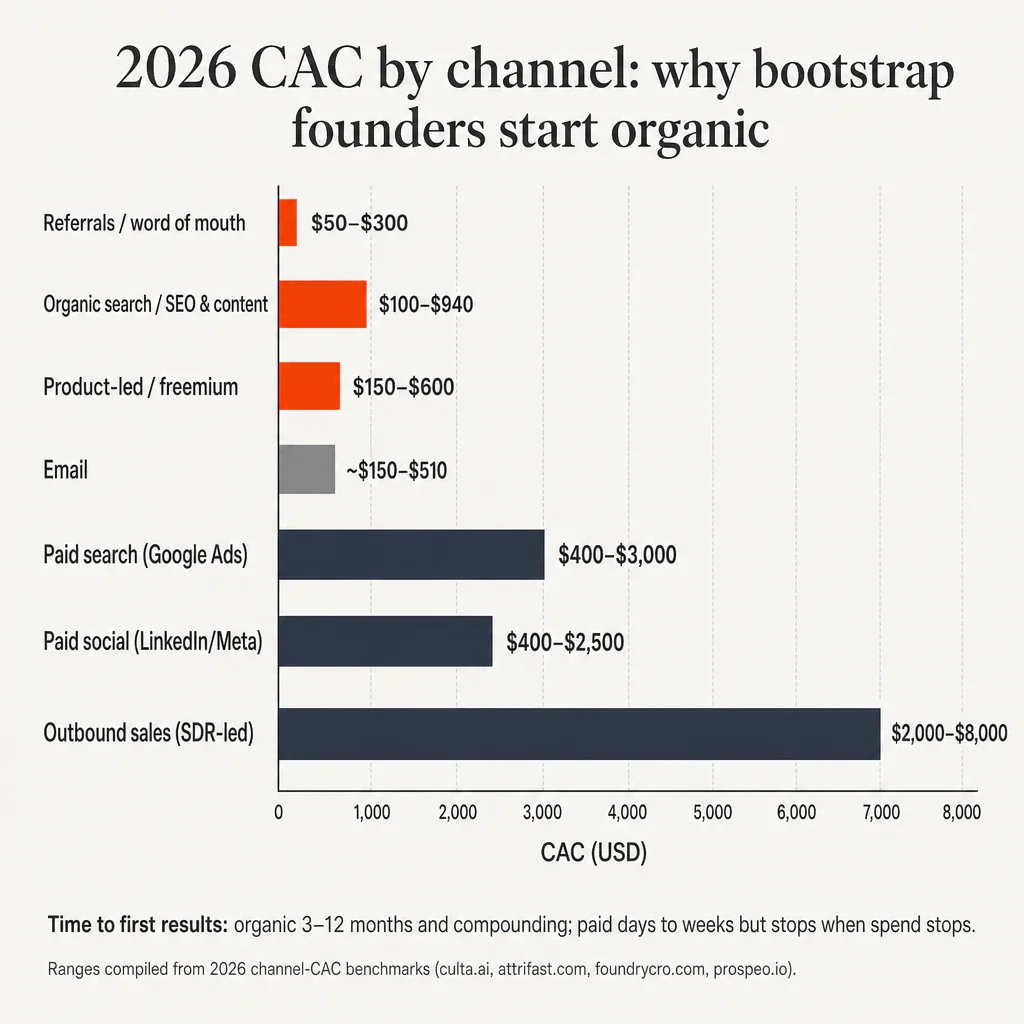
This is also why early-stage budget guidance skews so heavily organic. One 2026 stage-by-stage benchmark set shows the organic-vs-paid split sitting around 90/10 at pre-seed and roughly 60/40 at seed, with pre-seed ad spend often $0–$500/month and "founder time carrying most of the load" (FoundryCRO, 2026). Multiple guides echo that at pre-revenue you should run one or two channels, not a full mix (EverestX; Monolit, 2026). The bootstrap version of that math is simple: your paid budget is roughly zero, so your channels are roughly all organic — which makes channel choice and consistency the entire game.
The honest catch: "free" isn't free
Owned channels carry a loaded cost that blended CAC math hides: your hours. As Attrifast's 2026 channel-CAC guide points out, organic search that looks free can quietly cost hundreds of dollars per customer once you price in the ~20 hours a month you spend writing — and most founders undercount their own time while overcounting conversions (counting trials as customers). There's also a timing cost. Content and SEO typically take 3 to 12 months to show meaningful results and 6 to 18 months to compound (Stackmatix; EverestX, 2026), whereas community participation and referrals can produce signal in weeks. Plan your sequence around that curve rather than fighting it.
The 2026 shift: "organic" now includes answer engines
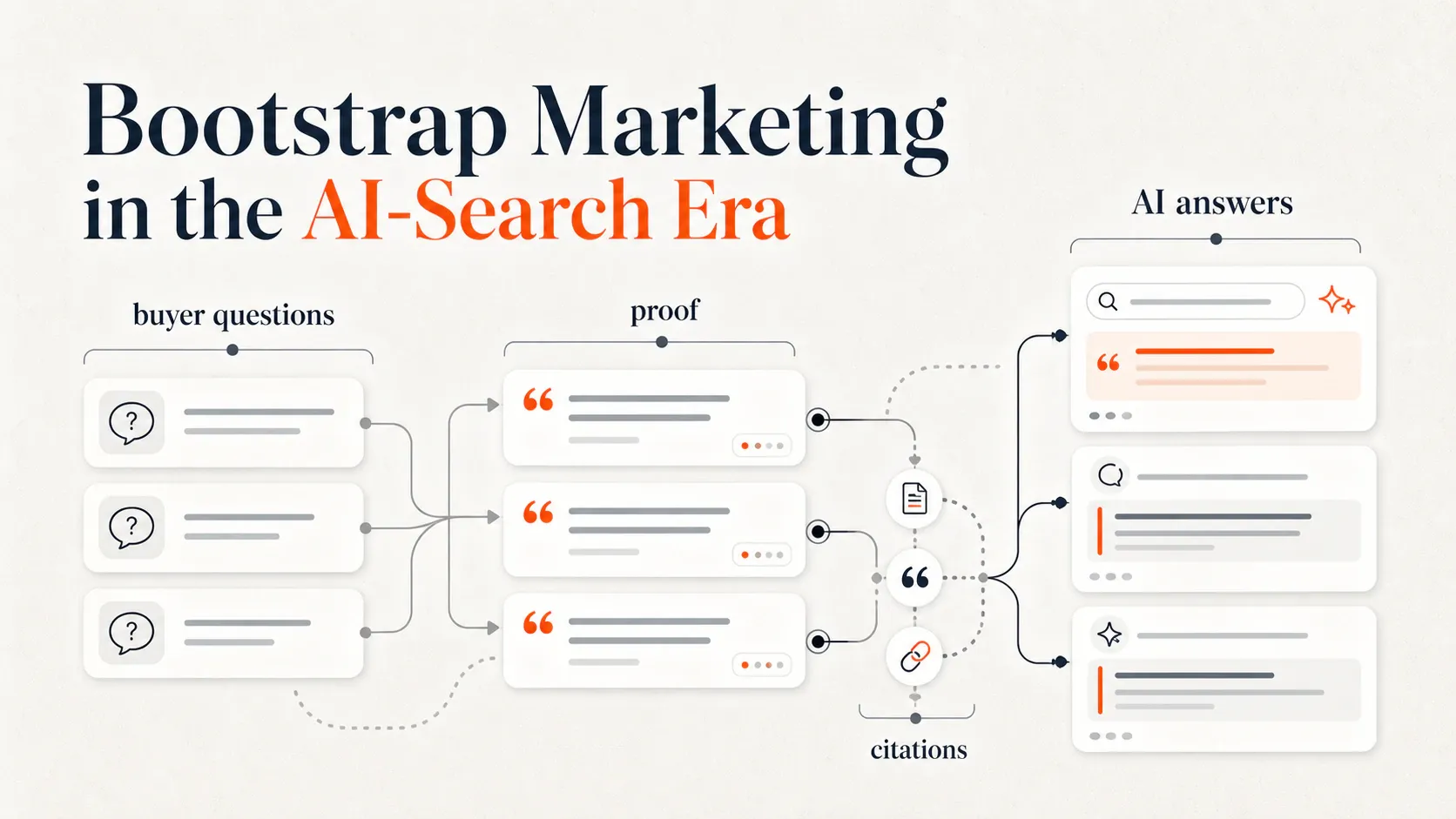
What "organic" means changed in 2026, and it changed in a way that favors specific, credible founders. AI answer engines now intercept a meaningful share of searches before users ever see blue links — one analysis estimates AI surfaces touch up to ~30% of Google searches, and Ahrefs found AI Overviews correlated with a 58% lower click-through rate on the top result when an Overview is present. The flip side is opportunity: Ahrefs also found that 28.3% of ChatGPT's most-cited pages had zero traditional organic keyword visibility, meaning being citeable is now a separate lane from ranking. The way to win it is unglamorous — be crawlable, answer the question directly and early, and back claims with real expertise and evidence (triaza.com; Google's 2026 generative-search guidance). For a founder, that's an advantage: generic, AI-flooded content is cheap and everywhere, but first-hand operator insight and specificity are exactly what models and humans now reward.
The no-budget channel stack (and how to sequence it)
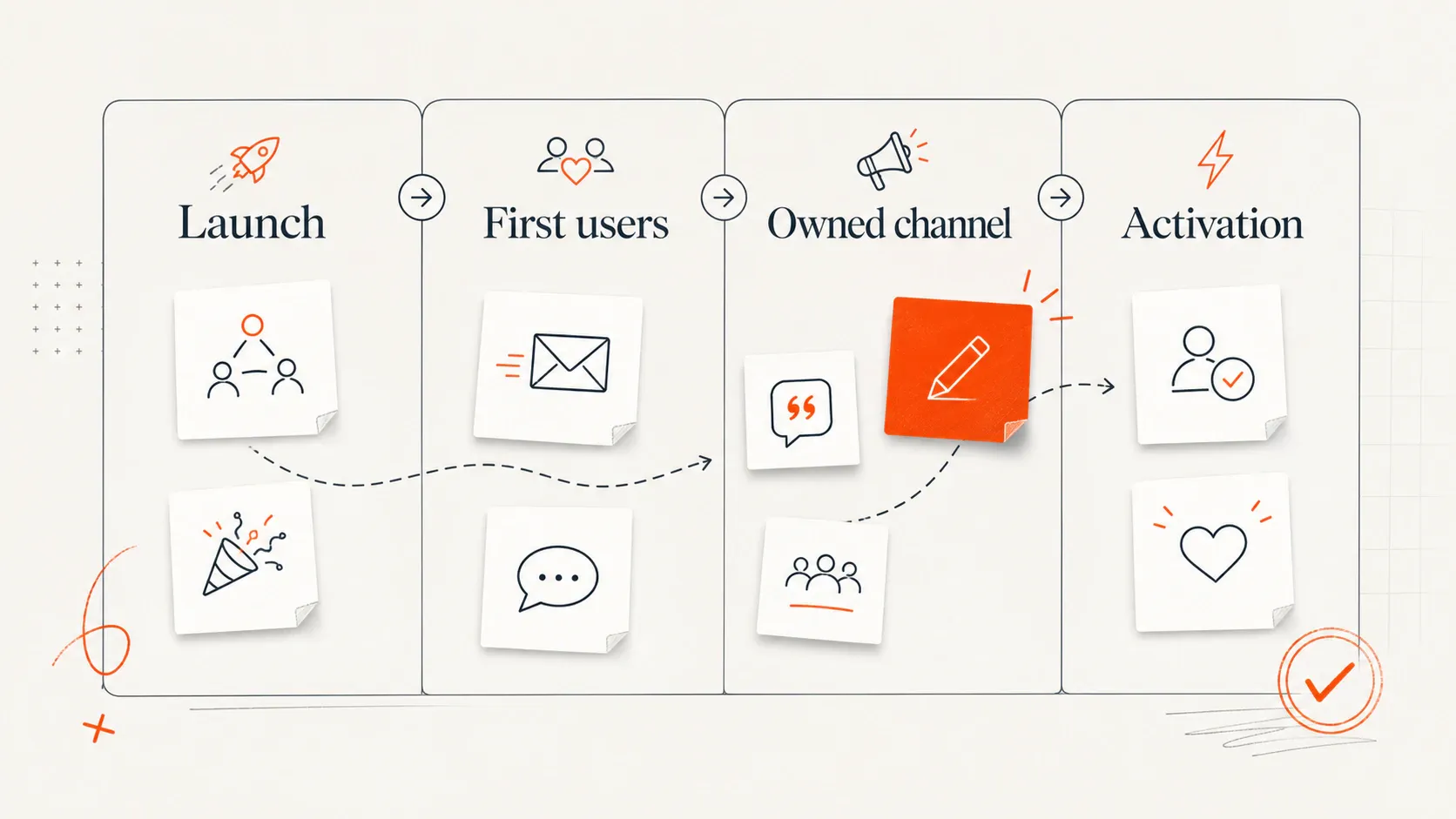
There are only a handful of channels worth a bootstrapper's time, and they cluster into three tiers. Manual channels show signal fast and teach you your message: direct outreach to your warm network, and active participation in communities where your buyers already are (relevant subreddits, Discord and Slack groups, Hacker News, niche forums). Compounding channels are slow to start and then keep paying: founder-led content on LinkedIn or X, pain-point SEO and comparison pages, and product-led or referral loops built into the product itself. Launch surfaces — Product Hunt, BetaList, a waitlist — are spike events, not a steady channel; useful for a burst, not a plan.
The sequencing logic is what most no-budget founders miss. Don't run all three tiers at once. Pick one primary channel and commit to it for the first 60 to 90 days, run cheap and manual experiments first to learn what converts, then layer in a compounding channel once you have a message that lands. Treat paid as the last move, not the first — something you reach for only after you have real conversion data and know your numbers, exactly the order early-stage budget guides recommend (FoundryCRO; Monolit, 2026). Building in public, if it fits you, is simply one way to run that founder-led-content channel — a tactic inside the system, not the system itself.
How to choose your one channel
Pick the channel that sits at the intersection of two things: where your buyers already gather, and your own unfair advantage. If your users live in two specific subreddits and a Slack community, community participation is your channel — being genuinely helpful there will beat a blog nobody's found yet. If you have a sharp point of view and write well, founder-led content compounds your credibility. If you have a network from a previous role, manual outreach gets you to your first ten conversations fastest. There's no universally best channel; there's the one you can run consistently and that reaches people who can actually buy.
Measure activation, not impressions
The metric you choose quietly decides whether your marketing works. Impressions, followers, and traffic feel like progress but can be pure noise — a viral post that brings 5,000 visitors and zero signups taught you nothing about distribution. Measure the things downstream of attention: signups, activation rate (the share of new users who reach first value), and paying customers per channel. Calculate CAC per channel including your time, the way Attrifast prescribes, so you can tell which channel is actually carrying you. Traffic without usage is a vanity metric; activation and revenue are the only signals worth steering by.
A weekly operating cadence a solo founder can actually keep
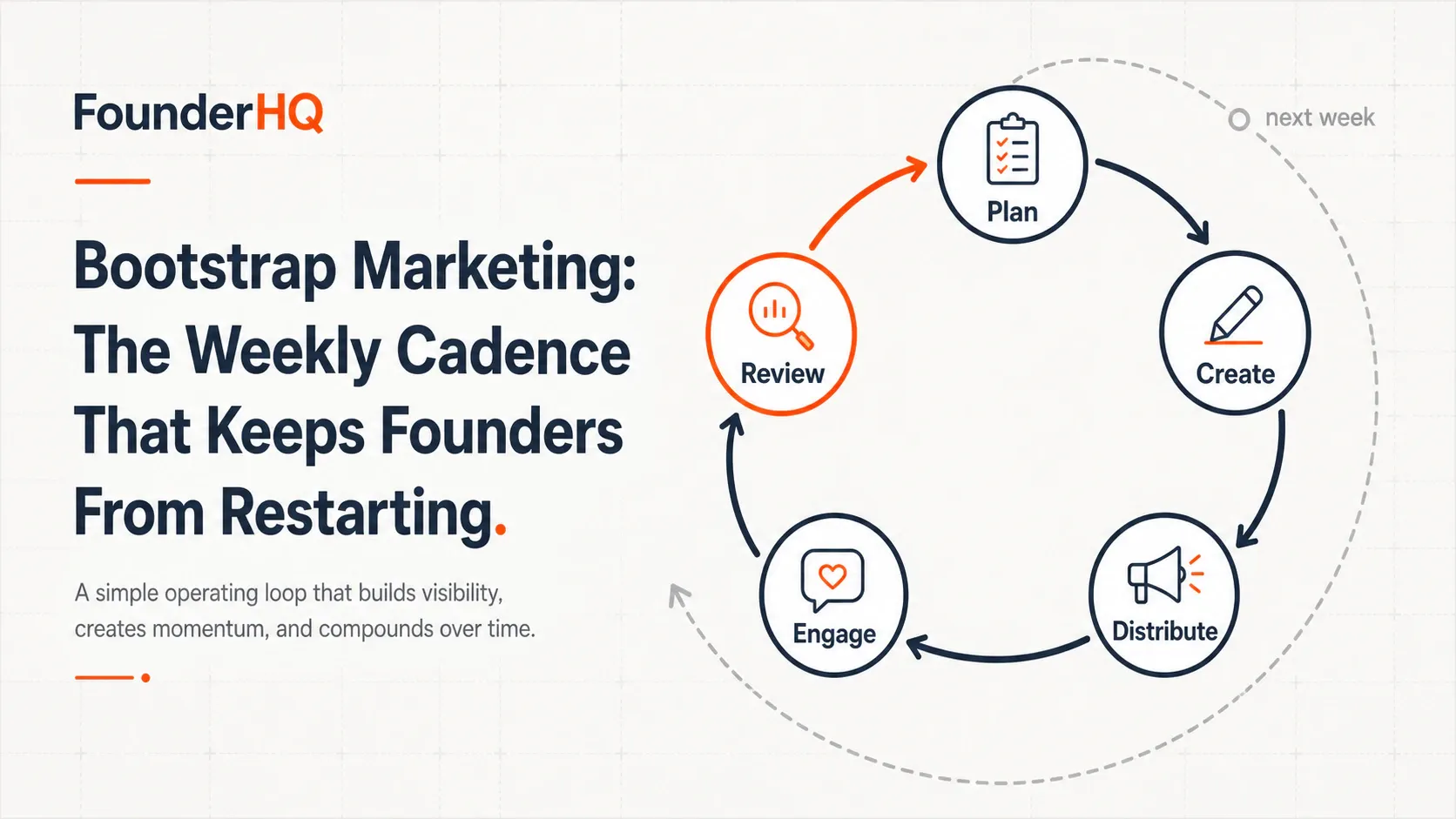
Here's the uncomfortable truth: bootstrap marketing almost never dies in planning. It dies in execution, usually the first week product work intensifies. You skip a post because a bug is on fire, then skip the next because you're catching up, and a month later the channel is cold. Consistency is the entire ballgame, and consistency is a scheduling and systems problem, not a willpower problem. The goal of a cadence is to make the minimum viable amount of marketing survive a bad week.
A realistic loop for five to fifteen hours a week looks like this: one anchor piece roughly every week or two (a substantive article, teardown, or thread built from real work you're doing), three to five repurposed founder posts pulled from that anchor and from what you're learning, a fixed recurring slot — same days, on the calendar — for community participation and direct outreach, and a short monthly review of what actually converted so you double down on signal and cut dead weight. Notice the leverage: one anchor feeds the week. You're not generating from scratch every day; you're remixing, which is precisely the repurposing discipline HubSpot's 2026 data ties to higher-performing teams.
Reuse over re-create
The hidden tax on a solo founder's marketing is re-derivation. Every week you re-decide your positioning, re-explain your product, re-find the phrasing that resonated last month — and the message drifts a little each time. The fix is a shared, persistent company context: your positioning, your ICP, the exact language customers used, the decisions you've already made, all captured once so you write from it instead of rebuilding it. When context is durable, a busy build week doesn't reset your messaging to zero. This is a core reason FounderHQ exists — it's a unified growth stack for early-stage product teams that keeps founder-led content and company context in one focused operating system, so the work you do to get sharp this month still pays off next month.
Framed plainly: the value isn't automation, and it isn't a tool that markets for you. It's consolidation. Instead of your positioning living in your head, your drafts in a notes app, and your customer language scattered across DMs, the writing surface and the context behind it sit together — so each post stays specific and on-message without you re-thinking the fundamentals every time. The aim is to augment a founder who's already stretched, not to replace the judgment that makes the content worth reading in the first place.
Common bootstrap marketing mistakes to avoid
Being everywhere at once. The single most common bootstrap mistake is breadth over depth — five channels at 20% effort instead of one at 100%. None gets enough reps to reach its compounding window, and you mistake the resulting silence for failure. Going deep on one repeatable path is what actually produces a working channel.
Copying funded competitors' tactics. When you study a competitor's playbook, you're usually looking at a budget you don't have. Retargeting funnels, a paid agency, sponsored events, and brand campaigns assume spend and headcount that don't exist at pre-seed. Borrow ideas from companies at your stage and constraint, not from the ones three rounds ahead of you.
Treating content as one-off campaigns. A campaign mindset produces a burst of posts that decay to nothing. The bootstrap mindset treats content as durable, compounding assets — a strong pain-point article or comparison page that you refresh and keep ranking, not a launch you do once and abandon. The cut-organic-to-fund-paid reflex many teams reach for under pressure just trades a compounding asset for a dependency on ongoing spend (EverestX, 2026).
Quitting before the compounding window. Because owned channels take months to pay off, the lethal mistake is abandoning one right before it would have worked — usually because you measured impressions, saw a flat line, and bailed. Decide your channel and your test window up front, measure activation and conversions rather than vanity numbers, and give the channel the 60–90 days it needs before you judge it.
A 90-day starter plan
You don't need a strategy deck; you need a sequence you can start this week. Here's a 90-day version that respects both the compounding curve and a founder's limited hours.
Days 1–30: clarity and your first channel
Spend the first month getting your message right and committing to one channel. Nail your positioning in plain language — who it's for, the specific pain, why you. Pick your single primary channel using the intersection test (where buyers gather × your unfair advantage). Ship your first anchor assets and start the manual work — direct outreach to your warm network and genuinely useful participation where your buyers already are. The goal isn't volume; it's learning the words that make people lean in.
Days 31–60: build the cadence
Now make it a habit. Lock the weekly loop — anchor piece, repurposed posts, a fixed outreach/community slot — onto your calendar so it survives busy build days. Keep capturing the exact language that resonates (objections, phrasings, the "oh, that's the thing I need" moments) into your shared company context so every future post starts from real customer words instead of guesses. You're not scaling yet; you're proving you can sustain the channel.
Days 61–90: double down and measure
Look at what's actually converting — not what got the most likes — and pour more into it. Begin layering a second, compounding channel (for example, turning your best-performing posts into pain-point SEO pages) only once the first is steady. Stand up basic measurement: signups, activation rate, and paying customers per channel, with CAC that includes your time. Then set a clear decision gate: only consider paid acquisition once you have repeatable organic acquisition and a real activation signal. Paid should amplify a funnel that already works, never paper over one that doesn't.
Conclusion
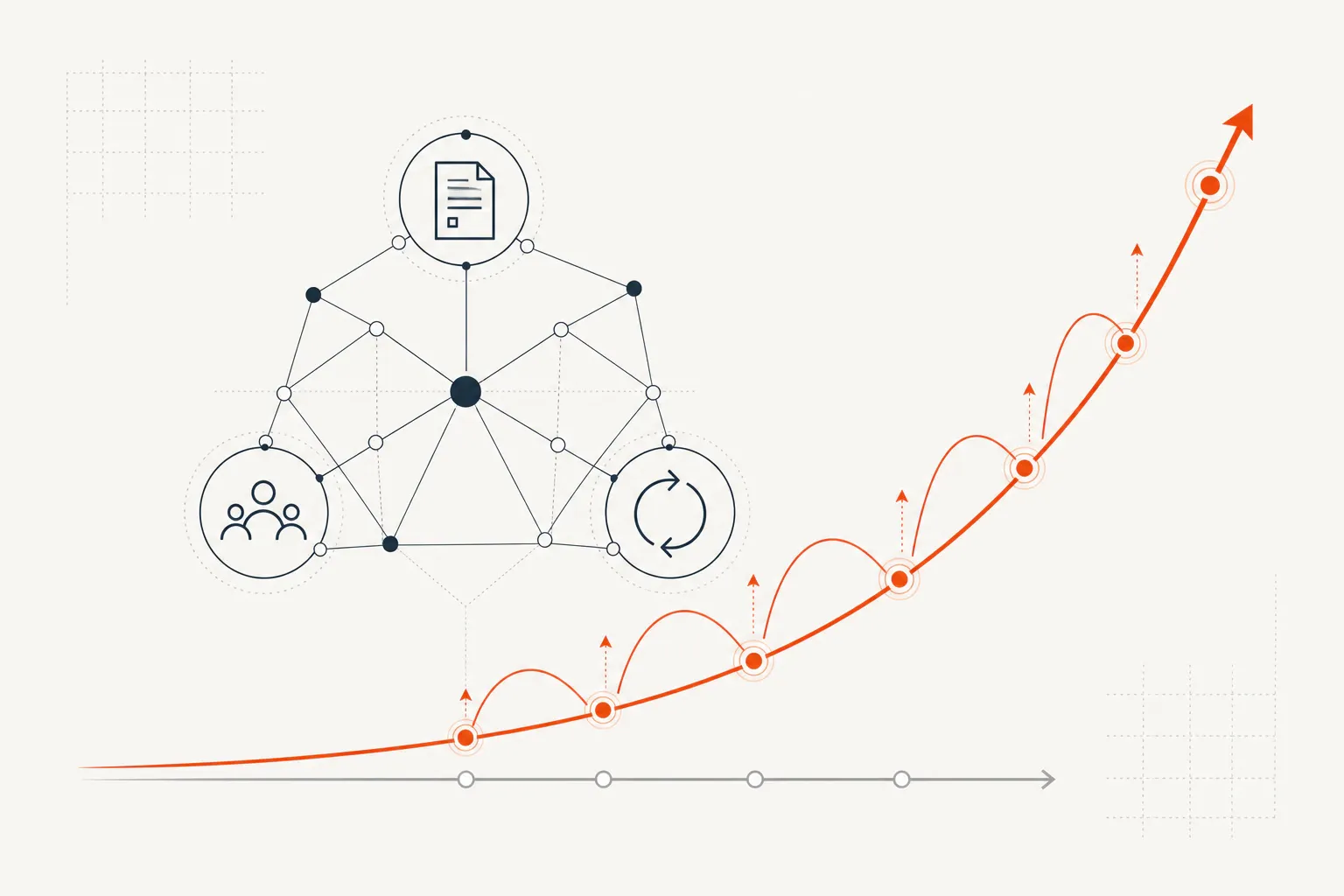
Bootstrap marketing rewards founders who treat distribution like a product: pick a focused bet, ship consistently, measure what matters, and let owned channels compound. The 2026 data backs the instinct — organic and referral channels cost a fraction of paid per customer and keep working after you stop, while paid rents attention you can't afford to keep renting. But the data also exposes the real risk, which was never the budget. It's whether a time-poor founder can stay consistent on one channel long enough for it to pay off, with a message that stays sharp through busy weeks. That's a systems problem, and it's solvable: one primary channel for 60–90 days, a weekly cadence you can defend, a durable company context so you reuse instead of re-derive, and a hard rule that paid comes last. Do that, and "marketing with no budget" stops being a handicap and starts being a compounding advantage — one you, not an ad account, actually own.