If you're marketing an early-stage product with little or no ad budget, the advice you usually get is a list — 30 growth hacks, 12 channels, a dozen tools to wire together. It feels productive and it almost always fails, because spreading thin is the opposite of what no-budget marketing requires. When you can't buy distribution, the scarce resource was never money. It's your focus, your speed to learning, and the clarity of your message. Bootstrap marketing, done well, is not a branding exercise and it's not a hacks checklist — it's a distribution system: a small number of owned, compounding channels you commit to long enough for them to pay off. This guide makes the organic-first case with current 2026 data, gives you a framework to pick one channel and sequence the rest, and lays out a weekly cadence you can hold while you're still building the product.
Bootstrap marketing, defined: a distribution system, not a brand exercise
Bootstrap marketing is the practice of acquiring users with little-to-no paid spend by building repeatable distribution rather than "doing marketing" in the abstract. It's not logo polish, a tagline workshop, or a one-off launch. It's the set of channels and habits that reliably put your product in front of people who already have the problem you solve — and do it again next week without you buying attention.
The trap most founders fall into is treating channels like a to-do list: post on LinkedIn, start a newsletter, do SEO, hit Reddit, launch on Product Hunt, run a webinar — all at once. With a full team and a budget, you can afford that breadth. As a time-poor founder, breadth is how you end up with five channels that are all slightly alive and none that compound. The constraint that actually binds you is focus.
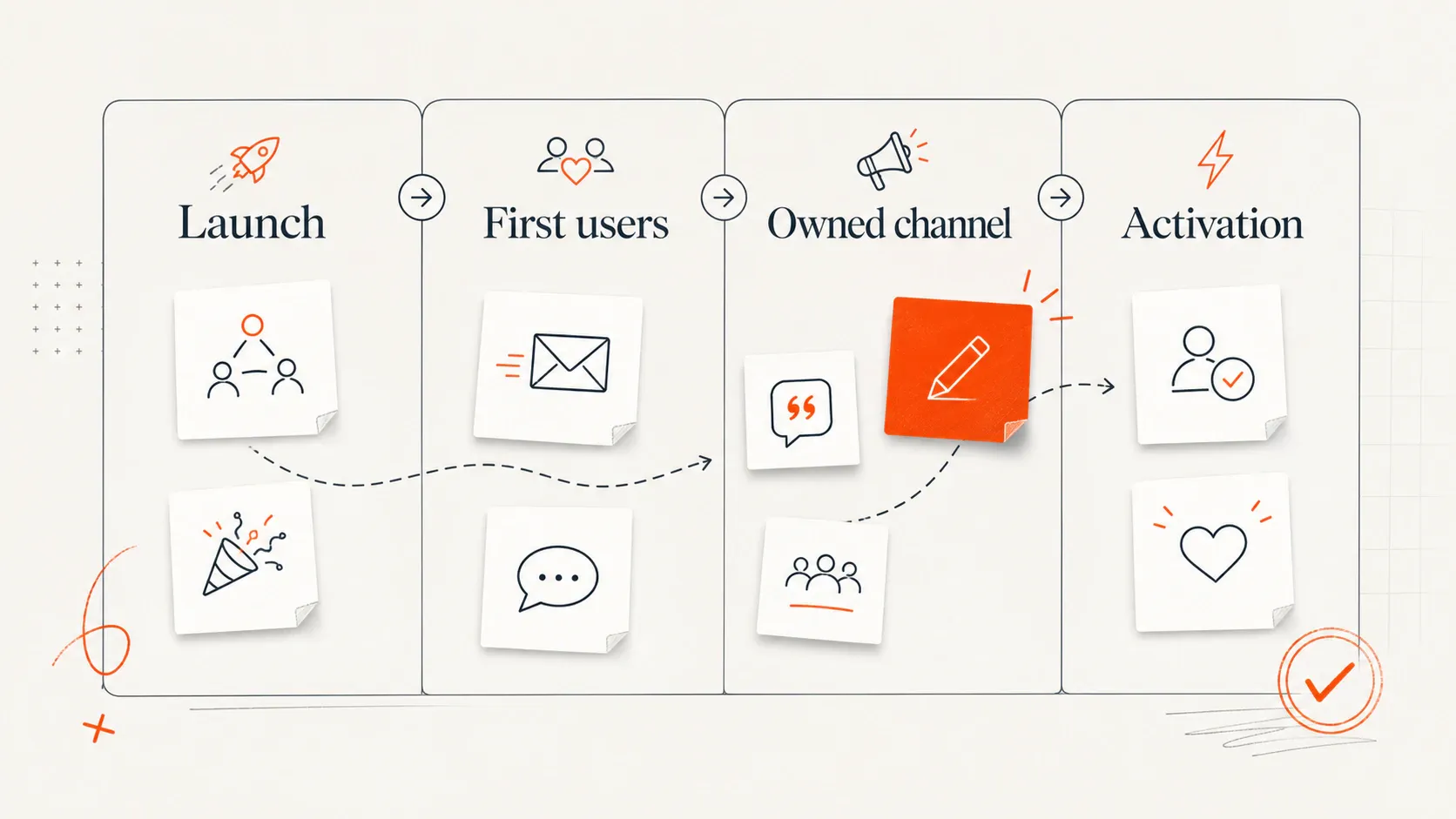
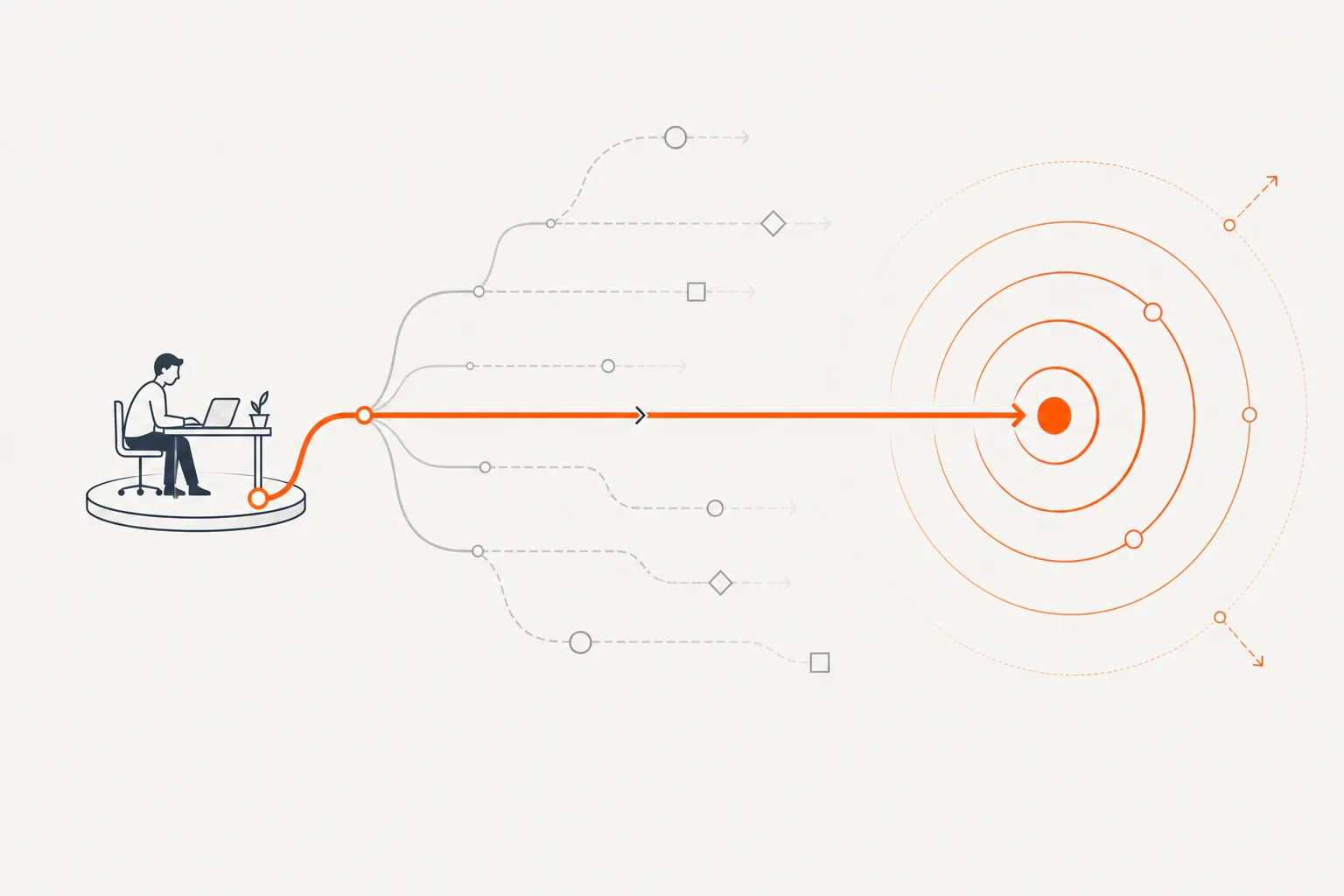
So reframe the job. You're not trying to "be everywhere." You're trying to find one repeatable path from a stranger to an activated user, prove it works, and only then add a second. That makes bootstrap marketing a sequencing and cadence problem, not a volume problem.
This article is about building that system — choosing, sequencing, and sustaining channels. It deliberately doesn't re-teach adjacent disciplines like building in public (a tactic that lives inside the founder-content channel) or the broader build-vs-buy decision of how to grow a startup. Think of those as neighbors to this system, not substitutes for it.
Why organic-first wins on a tight budget (the 2026 math)
The case for owned, organic channels over paid isn't ideology — it's the current unit economics. Paid acquisition has gotten meaningfully more expensive, and it stops the moment you stop paying. Owned channels are slower to start but they compound.
Paid keeps getting more expensive — and it's rented
According to Benchmarkit's 2025 SaaS benchmarks, the median company now spends about $2.00 in sales and marketing to acquire $1.00 of new customer ARR — a ratio that rose roughly 14% year over year — and fourth-quartile spenders are at about $2.82. On the ad side, multiple 2026 reports peg SaaS cost-per-click inflation at roughly 15–18% year over year (TripleDart, VonClaro), with B2B search CPCs running well into the mid-single digits and higher. The deeper problem with paid isn't just the price; it's that it's rented attention. Turn off the budget and the pipeline goes dark the same day.
Organic and content compound — but they're back-loaded
Owned channels behave the opposite way. First Page Sage's SEO ROI analysis (campaigns run Q1 2021–Q3 2025) reports a roughly 702% three-year ROI for B2B SaaS with a ~7-month break-even, and a roundup by olivermunro.com citing the same figure also notes organic search accounting for a large share of B2B revenue. Averi's content-ROI benchmarks describe a similar curve: content tends to break even around month seven and climb toward 300%+ by month twelve, with returns peaking 24–36 months in. Treat these as reported ranges from third-party research, not guarantees — your numbers depend on your niche, your content quality, and your patience.
Intent beats demographics when money is tight
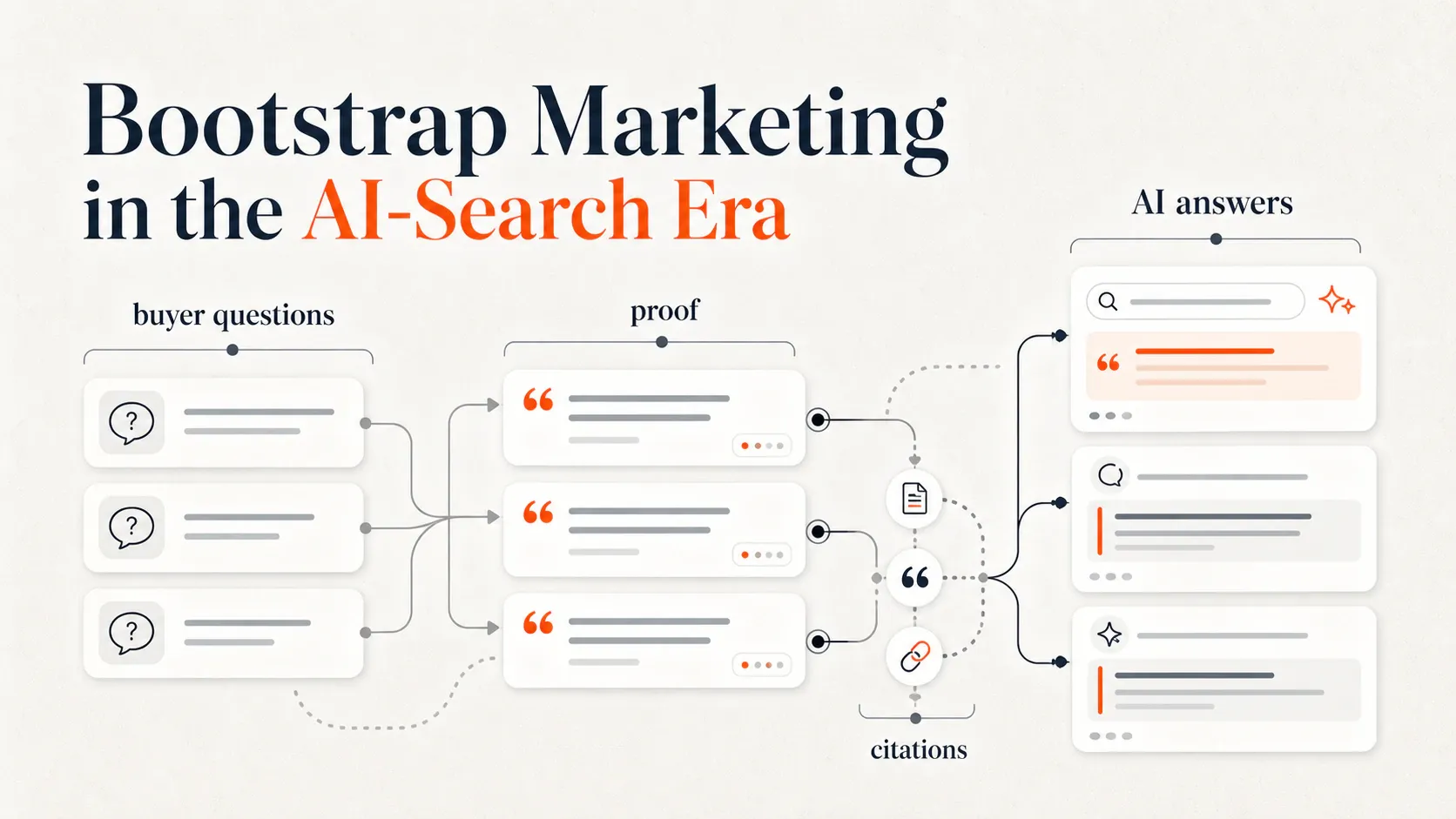
There's also a targeting reason to go organic-first. Paid targeting mostly buys demographics and lookalikes; organic channels let you meet intent — the person already searching "how do I do X" or asking the exact question in a community. High-intent traffic converts better and teaches you more, which matters enormously when each conversation is also market research. The honest caveat that follows from the compounding curve: because content ROI is back-loaded, you cannot judge it on a 90-day revenue window. In months 0–6, measure activation and leading indicators — signups, replies, qualified conversations — not revenue, or you'll kill a channel right before it starts working.
The bootstrap channel menu (and how to think about each)
Here's the menu of low-cost channels worth considering. Read it as options to choose from, not a list to run all at once. Each one has a different intent profile and a different founder-fit, which is exactly what you'll score in the next section.
- Founder-led content (LinkedIn / X): You, sharing specific lessons, decisions, and points of view. Best for B2B visibility and credibility, and the cheapest way to turn the context already in your head into distribution. This is where practices like building in public live.
- Intent-driven SEO and pain-point pages: Comparison pages, "how to" guides, and bottom-of-funnel content that captures people already searching for a solution. Slow to start, but it compounds and works while you sleep — and it pairs naturally with founder content (one insight can become a post and a page).
- Community participation (Reddit, niche Slack/Discord, forums): A free, ongoing focus group where your buyers already talk. You answer real questions, learn the exact language they use, and earn pull rather than push.
- Direct outreach and warm network: The fastest path to your first handful of users and the richest source of messaging data. It doesn't scale, but early on it isn't supposed to — it's how you learn what to say.
- Product-led loops, launches, and partnerships: Product Hunt, waitlists, referral loops, and co-marketing. Treat these as amplifiers of a channel that already works, not as a starting point. A launch to an empty audience is a firework, not a system.
The mistake is reading this menu as a checklist. The skill is reading it as a set of bets and picking the one with the best odds for you right now.
The pick-one-channel framework: choose, sequence, double down
Focus is easy to agree with and hard to execute. This is the framework I'd use to actually commit, structured as four moves: choose, commit, measure, double down.
The flow below summarizes how to move through it without getting stuck on any one step.
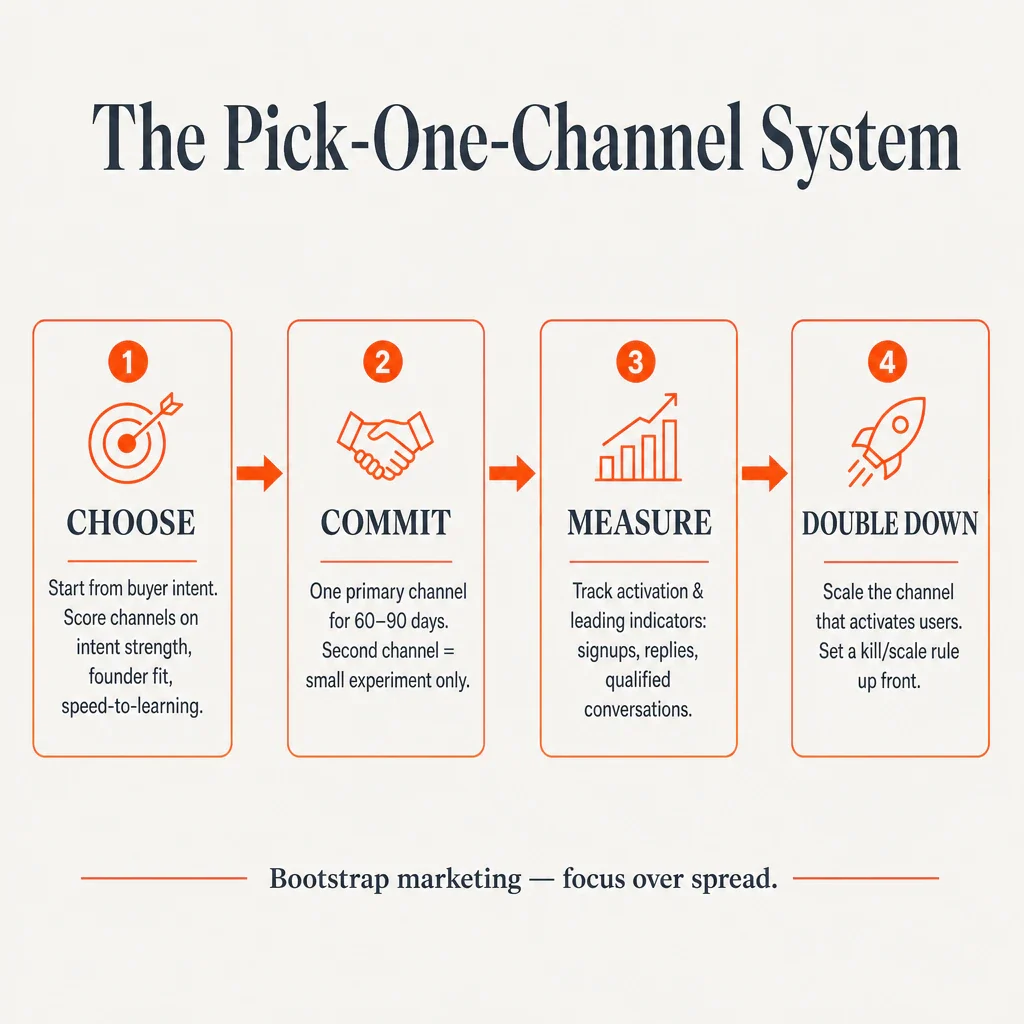
Step 1 — Start from intent, not from "where should we post?"
Begin with the question, "What are my buyers already trying to do today, and where do they do it?" rather than "Which platform should I be on?" If your users are searching Google for a fix, that points to SEO. If they're venting in a subreddit, that points to community. Intent comes first because it's where conversion and learning are highest.
Step 2 — Score candidate channels on three axes
Rate each candidate channel on intent strength (how ready-to-act is the audience there?), founder fit (can you personally sustain it — are you a writer, a talker, a builder?), and speed-to-learning (how fast will it tell you whether it's working?). A channel that scores high on all three beats a "bigger" channel you'll quietly abandon in three weeks. Founder fit is the tiebreaker people underrate: the best channel is the one you'll still be running in month three.
Step 3 — Commit to one primary channel for 60–90 days
Pick one channel as your primary and give it a real runway — 60 to 90 days — because most owned channels need that long to show their first signal. Allow yourself at most one small secondary experiment, capped so it can't steal focus. Running two "primary" channels at once is how both stay mediocre.
Step 4 — Define a kill/scale rule before you start
Decide up front what "working" looks like in leading indicators (e.g., a steady rise in qualified replies or signups by week 8), and what failure looks like. Writing the rule down beforehand protects you from two opposite mistakes: quitting a channel the week before it compounds, and clinging to a dead one because you're emotionally invested.
Step 5 — Double down on activation, not impressions
When a channel hits its scale threshold, pour your hours into it — but judge it on activated users, not reach. Ten thousand impressions that produce zero signups lose to fifty community replies that produce three activated users. Scale what activates, not what merely gets seen.
A sustainable weekly operating cadence (~5 hours/week)
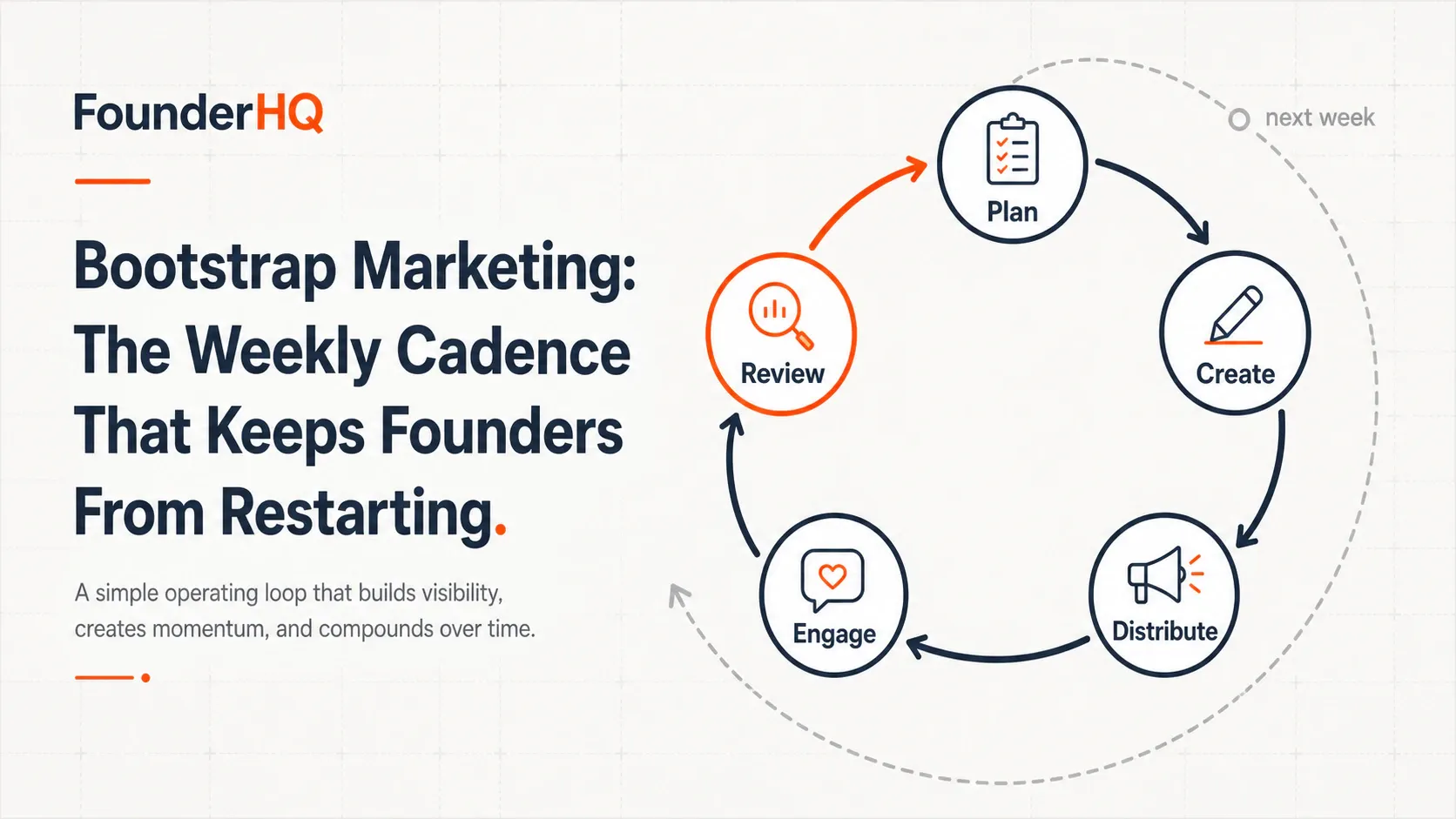
A system you can't sustain on a busy build week isn't a system. The goal here is a cadence a solo founder can hold in roughly five hours a week — small enough to survive crunch, consistent enough to compound.
Split the time into research, create, engage
Divide your weekly block into three jobs. Research (~1 hour): mine real problems and questions — search queries, community threads, support messages, sales calls. Create (~2 hours): turn what you found into posts or pages. Engage (~2 hours): reply, answer, DM, and follow up, because distribution on owned channels is a conversation, not a broadcast. The exact split flexes by channel, but all three jobs should happen every week.
Reuse one insight across formats
The cheat code for staying consistent is to stop generating net-new ideas every time. A single insight — say, a sharp answer you gave in a community thread — becomes a LinkedIn post, then the seed of an SEO page, then a talking point in outreach. One unit of thinking, three or four assets. That's how five hours produces more than five hours of output.
Measure leading indicators, not vanity reach
Track the metrics that move first and predict revenue: signups, replies, demo requests, qualified conversations. Impressions and follower counts feel good and tell you almost nothing about whether your system is working. Pair this with the back-loaded reality from the data: in the first few months, leading indicators are your scoreboard.
Keep messaging consistent with a shared context
The hidden tax on a five-hour cadence is re-deciding your positioning every time you open a blank page — what you do, who it's for, the words you use. If each post is rewritten from scratch, your message drifts and your effort balloons. Drafting against a shared, persistent record of your company's decisions and language keeps every post specific and on-message, even on weeks when the product is on fire. This is exactly the founder-content-plus-context workflow FounderHQ is built around — composing founder-led content against company context you've already captured, rather than starting cold each time.
Common bootstrap-marketing mistakes to avoid
Most no-budget marketing fails for a handful of predictable reasons. If you recognize yourself in any of these, the fix is usually "narrow and commit," not "add more."
- Spraying effort across too many channels. Five half-run channels lose to one channel run properly. Find one repeatable path before you add a second.
- Buying ads before you've earned organic conversion. Paid amplifies what already works. If you don't yet have a page or a message that converts organic interest, ads just buy you expensive proof that your funnel is broken — at a CAC that's still climbing.
- Judging content on a 90-day revenue window. Given a ~7-month typical break-even for SEO and a back-loaded content curve, a three-month revenue verdict will tell you to quit right before it works. Measure activation early; measure revenue later.
- Chasing impressions over activation. Reach is a vanity metric until it converts. Optimize for activated users, qualified replies, and signups.
- Rewriting your message from scratch every time. Inconsistent positioning confuses buyers and burns your hours. Work from a captured context so your story stays the same across every post and page.
Where FounderHQ fits (problem → leverage, not autonomy)
If you've read this far, the pain is probably familiar: drafting fatigue, scattered tools, and a message that drifts because every post starts from a blank page. That pain is exactly the gap FounderHQ is designed to close. It pairs a writer for founder-led content with a workspace that holds your company context and memory, so the words you ship stay consistent without you re-deciding your positioning every week.
The framing matters. FounderHQ's role is to augment a founder's cadence — to turn the context already in your head into sharper, more consistent content — not to run your marketing on autopilot or replace your judgment. The system in this article only works because a real founder is choosing the channel, having the conversations, and learning from them; the tooling just removes the blank-page friction so you can keep the cadence.
Kept honest, the defensible claims are simple: FounderHQ helps you compose founder-led content, capture reusable company context, and keep your outputs consistent over time, all in one focused operating system rather than a sprawl of point tools. No magic numbers, no autonomous results — just less friction between your context and your published work.
So here's the founder takeaway. With no budget, you win on focus, not spend: pick one intent-driven channel, commit to it for 60–90 days against a written kill/scale rule, measure activation before revenue, and reuse every insight across formats. Do that consistently — five hours a week, against a context that keeps your message sharp — and bootstrap marketing stops being a scramble and starts being a system that compounds.
Conclusion
Bootstrap marketing isn't about being clever with no money; it's about being disciplined with no money. The 2026 math is clear enough: paid CAC keeps climbing and disappears the moment you stop paying, while owned, organic channels compound — slowly at first, then meaningfully — if you give them room. Your edge as a founder isn't budget; it's focus, the speed at which you learn, and a message that stays clear. Choose one channel by intent, commit for 60–90 days with a kill/scale rule, measure activation before revenue, and hold a cadence light enough to survive a busy build week. Do that, and distribution stops being a thing you scramble for and becomes a system that quietly works in your favor.
Recommended Videos
Independent, non-competitor educational walkthrough of free, founder-led acquisition tactics (warm network, direct DMs, lead magnets) that reinforces the article's organic-first, intent-driven channel argument; transcript confirms the topic and the channel has substantial reach (~14K+ views, 600+ likes per search metadata).