Bootstrap marketing breaks when founders treat “free” as the strategy. Free channels still cost the scarcest resource an early-stage team has: founder attention. The better question is not “Which tactics cost zero dollars?” It is “Which small marketing system can teach us quickly and keep working after this week?” For most early-stage product teams, that system is simple: one fast-learning channel for near-term conversations, paired with one compounding asset for durable demand.
What bootstrap marketing really means
Bootstrap marketing is the practice of earning learning, trust, and early demand with limited cash. Instead of buying reach with a large ad budget, you trade founder insight, consistency, and focused execution for distribution.
That does not make it “free marketing.” It means the budget moves from cash to time. Warm outreach, founder-led posts, community participation, SEO pages, templates, newsletters, and product education assets can all work, but none of them work because they are free. They work when they match where your ideal customer already looks for help and when the team can sustain them long enough to learn.
This matters even outside startups. Gartner’s 2025 CMO Spend Survey reported that marketing budgets among surveyed CMOs remained flat at 7.7% of overall company revenue, with the survey skewing toward larger organizations rather than early-stage startups. The useful takeaway for founders is not the benchmark itself; it is the broader reality that marketing teams are being asked to make sharper allocation choices, not simply spend more. Gartner
Why most bootstrap marketing breaks
Most bootstrap marketing fails in one of two ways. The founder chooses only slow channels, publishes a few thoughtful pieces, sees little immediate response, and loses patience. Or the founder chooses only fast channels, gets a few replies or demos, but never builds anything that compounds beyond active effort.
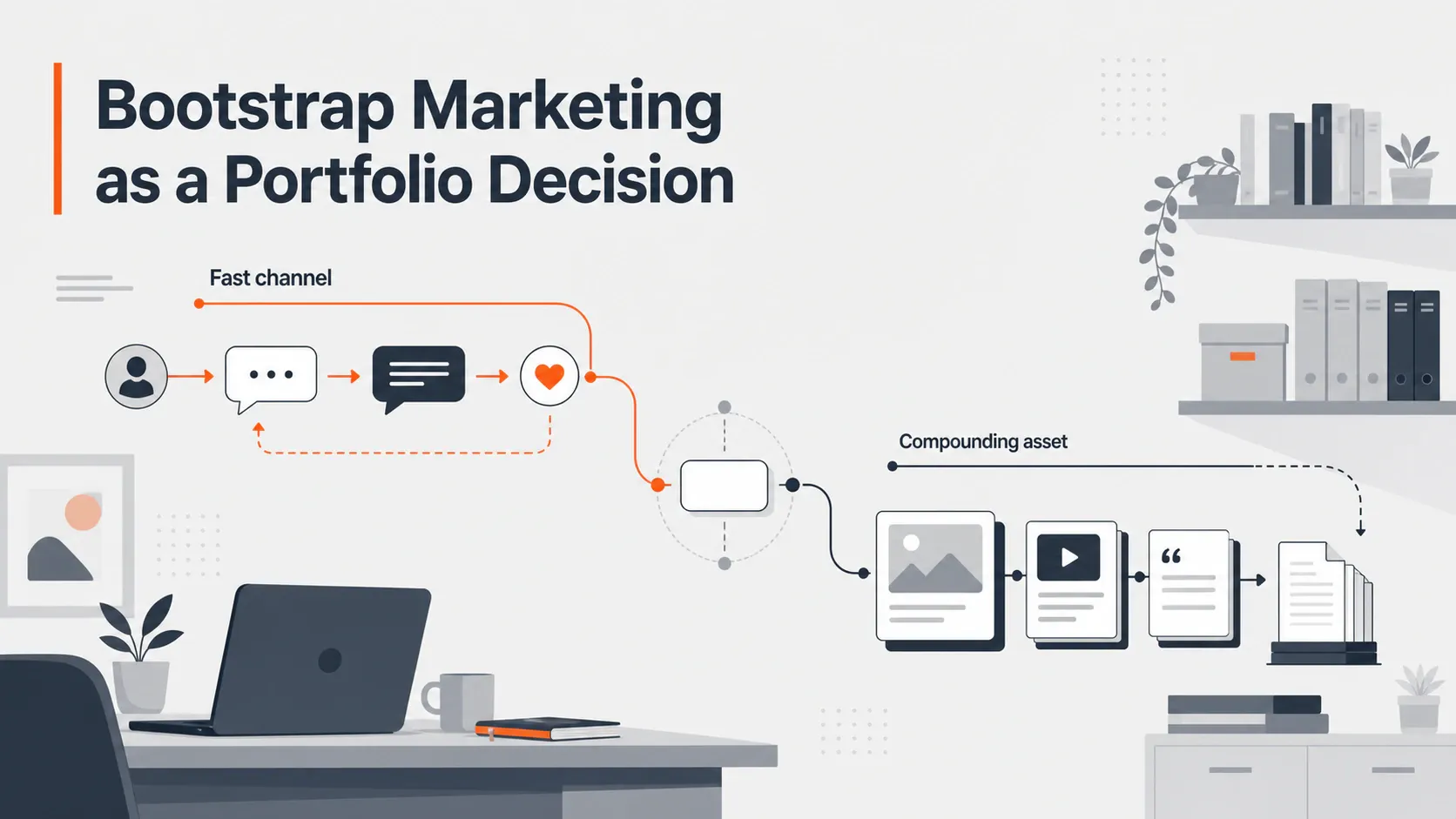
The fix is a two-speed portfolio. You need one fast channel that can create a reply, customer conversation, demo request, objection, or message signal within days. You also need one compounding asset that can keep educating, ranking, converting, or answering buyer questions after you stop actively pushing it.
Think of the fast channel as your learning engine and the compounding asset as your memory engine. The fast channel tells you what buyers actually care about. The asset turns those signals into something reusable: a page, article, checklist, comparison, product journey, template, or narrative that can be distributed again.
Step 1: Pick the constraint you are solving this month
Before choosing channels, name the bottleneck. A tiny team cannot solve every marketing problem at once, and bootstrap marketing gets messy when every tactic feels urgent.
Use this four-part diagnostic:
- Not enough customer conversations: You need a fast channel such as warm outreach, community participation, founder-led social, partner conversations, or customer interviews.
- Unclear message: You need a channel that exposes your positioning to real objections quickly, then a place to preserve the language that resonates.
- No repeatable distribution: You need a compounding asset such as a focused SEO cluster, newsletter archive, template, guide, or comparison page.
- Weak activation after interest: You need a better product education path, onboarding flow, or demo journey so interested people reach first value faster.
Choose one primary constraint for the next 30 days. If the real issue is message clarity, do not hide inside SEO for three months. If the issue is durable discoverability, do not confuse daily posting with a long-term asset. The constraint decides the channel mix.
Step 2: Choose one fast-learning channel
A fast-learning channel is any channel that can create market signal quickly. The signal can be a reply, objection, sales call, demo, comment thread, signup, trial behavior, or repeated question. The goal is not reach for its own sake; it is faster learning.
Good fast-channel candidates include:
- Warm outreach: Ask existing contacts, former colleagues, early users, or adjacent operators for feedback or introductions.
- Founder-led LinkedIn posts: Share a specific product decision, customer problem, or point of view, then treat replies and DMs as research.
- Niche communities: Participate where your ideal customers already ask questions, but contribute before pitching.
- Partner conversations: Talk to founders, consultants, agencies, or tool builders who already serve your audience.
- Customer interviews: Use direct conversations to test problem language, urgency, and willingness to switch.
The selection test is practical: where does your ICP already spend time, where do you have credibility, how quickly does feedback appear, and can you sustain the motion for four weeks without resenting it?
One warning: posting is not automatically marketing. A founder-led post becomes marketing when it leads to replies, DMs, calls, signups, saved language, or distribution for an asset. If it only creates impressions you do not learn from, it is a content habit, not a growth channel.
Step 3: Choose one compounding asset
A compounding asset is a durable piece of marketing infrastructure. It can be a long-tail SEO article, comparison page, product education guide, template, checklist, newsletter archive, demo journey, or reusable narrative. The test is simple: can this asset keep helping buyers understand the problem after the founder stops manually promoting it?
SEO is often a good bootstrap fit because buyers still use search to discover products and answers. HubSpot’s 2026 marketing statistics page reports that 32.9% of internet users aged 16+ discover new brands, products, and services via search engines, and that 41% of marketers say a top trend they are exploring is updating SEO strategy for changes in search. HubSpot
But SEO is not the only compounding asset. If your category is too new for search demand, a stronger asset might be a founder’s teardown series, a buyer checklist, a small free tool, a repeatable demo journey, or a practical template that partners can share.
The best asset usually comes from the fast channel. If five prospects ask the same onboarding question, write the guide. If three demos stall at the same objection, build the comparison page. If community replies keep using the same phrase, turn that language into the headline of your next asset.
Step 4: Score channels with a founder-fit matrix
Do not pretend channel selection can be perfectly modeled. A 1–5 founder-fit matrix is enough to make the trade-offs visible. Score each candidate by ICP presence, speed to signal, compounding potential, founder advantage, execution cost, and confidence.
Use the matrix below as a working tool, not a spreadsheet theater exercise. The point is to expose whether a channel is fast, durable, realistic for the founder, and tied to the constraint you chose.
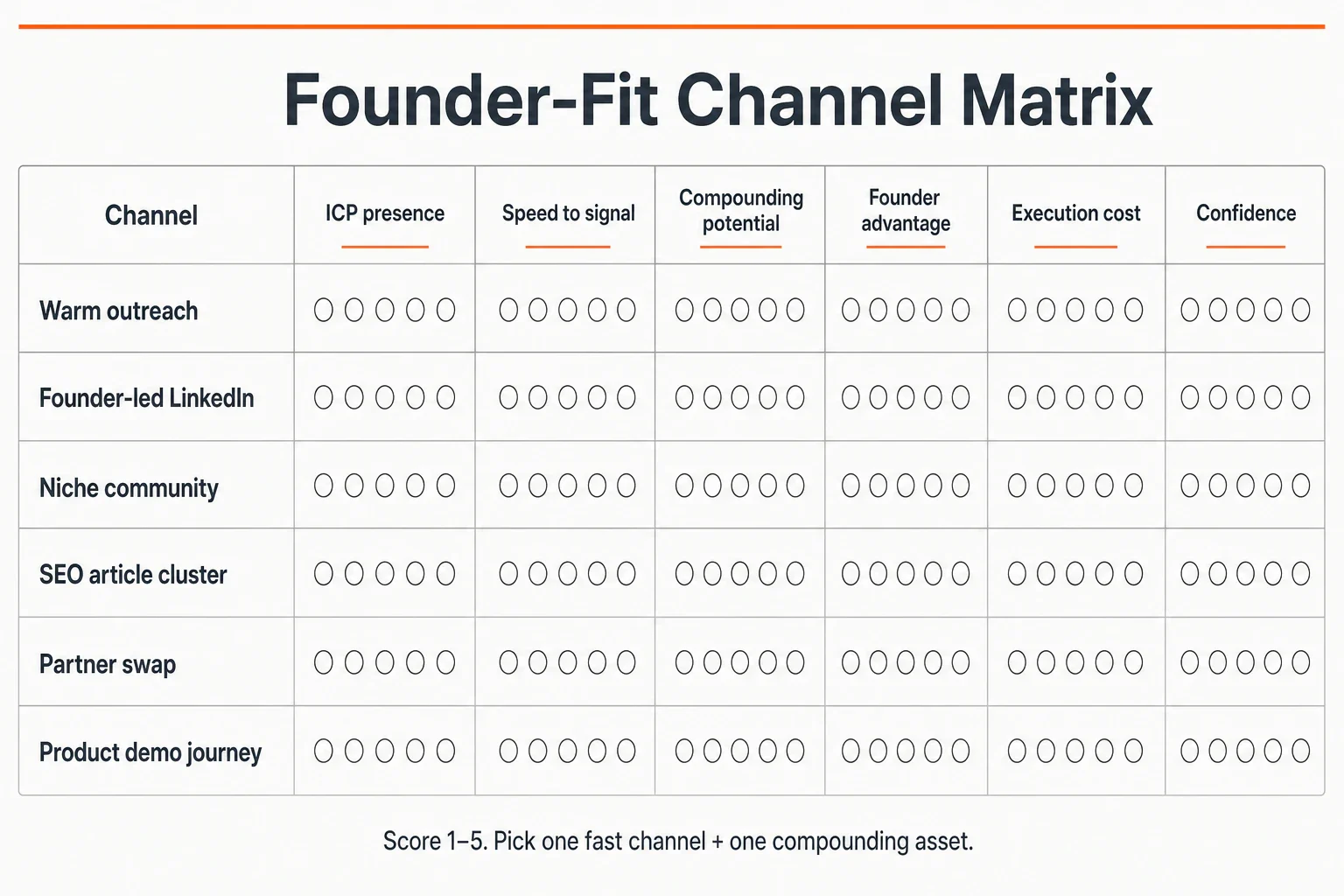
Channel option | Best role | Choose it if |
|---|---|---|
Warm outreach | Fast channel | You need customer conversations and already have access to credible contacts |
Founder-led LinkedIn | Fast channel or distribution layer | Your buyers or adjacent operators are active there and you can write from real decisions |
Niche community | Fast channel | Your ICP asks public questions and you can participate without forcing a pitch |
SEO article cluster | Compounding asset | Buyers search for the problem, category, alternatives, or job-to-be-done |
Partner swap | Fast channel plus borrowed trust | Another credible operator reaches the same audience with a complementary offer |
Product demo journey | Compounding asset | Interest exists, but people need a clearer path to understand first value |
After scoring, pick one fast channel and one compounding asset for the next 30 days. Everything else goes into a parking lot. Bootstrap marketing improves when you reduce the number of half-started motions.
Step 5: Turn every signal into reusable company context
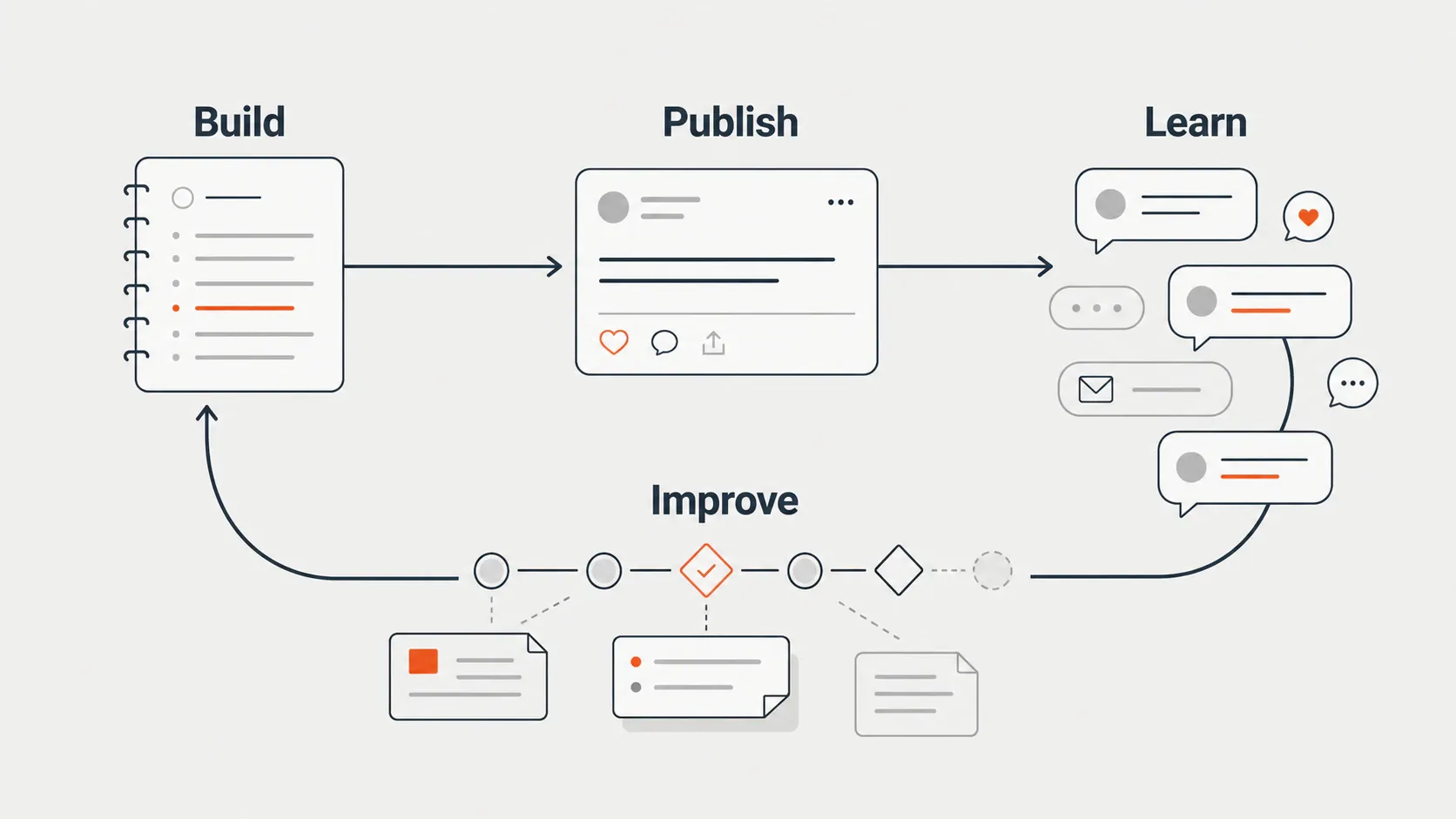
The highest-leverage part of bootstrap marketing is not the first reply or the first article. It is the memory you build from the work. Every objection, phrase, demo question, search query, comment, and onboarding stumble should make the next asset sharper.
A tiny team can start with three simple logs:
- Audience language: exact phrases customers use to describe the problem, trigger, workaround, and desired outcome.
- Message tests: hooks, claims, examples, and angles that created meaningful replies or clearer conversations.
- Product-journey friction: where interested people hesitate, misunderstand, or fail to reach first value.
This is where a focused operating system helps. FounderHQ helps early-stage product teams build product journeys, compose founder-led content, and keep company context in one focused operating system. For bootstrap marketing, the benefit is not replacing the founder. It is preserving the founder’s market learning so posts, pages, journeys, and narratives do not restart from a blank page every week.
A 30-day bootstrap marketing plan
Week 1: Define the portfolio
Pick one constraint, one fast channel, and one compounding asset. Write down the signal that counts. For a fast channel, that might be qualified replies, demo conversations, objections, or signups. For a compounding asset, it might be published asset quality, distribution touchpoints, qualified visits, or assisted conversations.
Do not pick more than two motions. The portfolio is the strategy: one channel that teaches quickly, one asset that can keep working.
Week 2: Run the fast channel and collect language
Spend the week creating conversations. Send the outreach. Participate in the community. Publish the founder-led post. Ask specific questions. Capture exact language, not vague impressions.
At the same time, outline the compounding asset using the words your market gives you. If prospects keep saying “we are duct-taping onboarding,” that phrase is more useful than a polished internal positioning line.
Week 3: Ship the asset and distribute it through the fast channel
Publish the guide, page, checklist, demo journey, or template. Then distribute it through the fast channel instead of waiting for discovery. Send it to people who asked the question. Use it as the follow-up after a call. Break it into founder-led posts. Ask partners whether it would help their audience.
Week 4: Review, decide, and preserve the learning
Review what produced signal. Keep the fast channel if it created useful conversations. Keep or improve the asset if it clarified the buyer’s problem or helped move people forward. Replace only one side of the portfolio at a time; changing both the channel and the asset makes it hard to learn what worked.
Common bootstrap marketing mistakes
The most common mistake is trying to be everywhere because every channel is technically free. That creates motion without learning. A founder with five inconsistent channels usually learns less than a founder with one well-run channel and a clear signal log.
Other mistakes to avoid:
- Copying funded-company playbooks too early: Paid acquisition, large launches, and broad brand campaigns usually need clearer positioning and more budget than a bootstrap-stage team has.
- Measuring vanity metrics: Likes, impressions, and traffic can be useful context, but conversations, qualified visits, activation, and message clarity matter more.
- Publishing without distribution: A useful asset still needs a path into the market.
- Doing outreach without preserving learning: If every reply disappears into an inbox, the next post and page do not improve.
- Adding tools before defining the loop: Tooling should support the operating loop, not substitute for one.
The practical takeaway
Bootstrap marketing works when it creates learning now and assets for later. The founder’s job is not to run every low-budget channel. It is to choose the smallest system that can produce signal, preserve that signal, and compound it into sharper distribution over time.
Start with one fast-learning channel and one compounding asset. Run them together for 30 days. Capture the language, objections, and product questions that appear. Then let those signals decide the next asset, not another generic list of free tactics.
Conclusion
The best bootstrap marketing system is intentionally narrow. It gives the founder conversations now, discoverability later, and a reusable memory of what the market is teaching the team. That is how a tiny product team turns limited time into leverage instead of another scattered set of drafts, notes, and half-finished channels.