FounderHQJun 22, 202611 min read
Bootstrap Marketing: Turn One Pillar Piece Into a Week of Distribution (The Atomization System)
Most bootstrap marketing advice tells you to find more free reach. But on no budget, your scarcest resource is your own creative time. This guide reframes the highest-leverage n...


You know the pattern. You spend the better part of a day on one good post, hit publish, and watch it get a handful of likes before it sinks out of the feed. Then tomorrow arrives and you're staring at a blank box again, trying to manufacture the next idea from nothing. That's the content treadmill, and for a bootstrapped founder with no ad budget it's the quiet reason marketing feels like a second full-time job that never compounds. The instinct is to ask, "How do I find more reach?" But that's the wrong question. With no money to spend, your scarcest resource isn't impressions — it's your own creative hours. The leverage question is: how much distribution can one piece of real work generate? This guide answers that with a single, repeatable move called content atomization: refine one argument once, then echo it across every channel in formats each platform actually rewards. Not lazy cross-posting — a designed system. Here's how it works, why it beats reactive repurposing, and how to keep every derivative on-message without burning out.
The real bottleneck on no budget isn't reach — it's creative hours
Start by being honest about the constraint. A bootstrapped founder doesn't have a media budget to buy attention, so every bit of distribution has to be earned with time and craft. That makes your week — not the algorithm — the limiting factor. The math of paid acquisition only reinforces it: in 2026, paid channels keep getting more expensive while organic and referral stay the cheapest, compounding ways to grow.
The benchmarks line up across multiple independent sources. FirstPageSage-derived data reported via several 2026 roundups puts median SaaS organic CAC around $205 versus roughly $341 for paid — organic landing about 40% cheaper — and notes CAC rising on the order of 20% year over year (noizz.io). One 2026 benchmark set found paid search CAC up about 19% year over year and paid social (LinkedIn) up about 24%, while organic/SEO CAC actually fell (Digital Applied). Referral and partner channels are consistently flagged as the lowest-CAC option, often cited around $150 per customer (Optifai).
Treat those as directional ranges, not guarantees — attribution windows and company stage move them a lot. But the shape of the picture is reliable: the cheapest channels for a no-budget team are the ones powered by content and word of mouth, and they reward consistency over time rather than spend. (If you want the broader case for picking and sequencing those channels, that's its own topic — this article assumes you've decided to lean organic and focuses on getting more out of every piece you make.)
So here's the thesis for the rest of this guide. Bootstrap marketing doesn't win by manufacturing more reach from a blank page each day. It wins by refining one strong argument once and echoing it everywhere — turning a single pillar piece into a week or two of platform-native distribution. The system that makes that possible is content atomization.
Atomization vs. lazy repurposing: why most founders only get 5 posts out of a pillar
Most people use "atomization" and "repurposing" interchangeably. They're not the same, and the difference is exactly why so many founders run out of steam after a few posts.
Atomization is a pre-production decision, not an afterthought
Content atomization is a pre-production strategy: you map the derivative outputs before you write the pillar, so every section, statistic, and framework is deliberately designed to be extractable. As LexiConn puts it, "the micro-format map is built before the hero asset is written, so every section, data point, and framework is designed from the start to be extractable" (LexiConn). You're building the molecule already knowing how you'll split it into atoms.
Reactive repurposing is the opposite: you finish a piece, publish it, and then ask, "Can I get something else out of this?" The problem is timing. According to the same analysis, teams that attempt atomization after publication "routinely produce five to eight derivative pieces and stop, because the momentum and context for the hero asset have faded" (LexiConn). That's the five-posts-and-done trap. By the time you go looking for atoms, you've lost the energy and the structure to find them.
Native formats beat copy-paste
The second failure mode is cross-posting the identical update to every channel. Each platform rewards a different native shape — depth and narrative on LinkedIn, brevity and punch on X, visual sequencing in a carousel, a personal lead-in for a newsletter. The same idea has to be re-cut for each, not copy-pasted. As one repurposing framework frames it, the alternative to a real system is "the same post copy-pasted across channels until your audience tunes out" (Postory).
Done right, the upside is meaningful: practitioners describe a well-structured pillar reliably yielding 10–30 derivative pieces, sequenced over weeks, that compound reach and reinforce the same expertise (Aprimo; Postory). We won't promise a specific reach multiplier — that depends entirely on your audience and craft — but the mechanism is sound: refine the argument once, adapt it many times, and you get far more distribution per creative hour.
Pick a pillar worth atomizing
Thin pillars produce thin atoms. If the source piece is a 400-word reaction post with no real spine, you'll struggle to pull three decent derivatives out of it. The whole system depends on starting from something substantive.
A good pillar is roughly 1,500+ words and carries at least one of three things: a clear framework or step-by-step process, real data or a concrete decision you made, or a genuinely contrarian take. The practical test from atomization practitioners is simple — before you write, list every self-contained unit the piece will contain (every stat, every framework component, every example). If that list is shorter than 15, the pillar isn't substantive enough yet; widen the scope or combine topics (LexiConn).
For founders, the best pillar sources are usually things you already have lying around: a deep how-to blog post, a build decision or product teardown, an insight from a customer conversation, or a founder-led narrative about why you're building what you're building. These are dense with extractable units because they came from real work, not from a topic generator.
There's a compounding bonus when the pillar also targets a real search query. A search-optimized pillar earns organic traffic on its own — the cheapest, most durable channel in the 2026 data above — so the same asset does double duty: an SEO entry point and the source material for weeks of social atoms. You're not choosing between SEO and social; one pillar feeds both.
This is also where starting from accumulated context beats starting from a blank page. A pillar drafted against your own captured decisions, customer notes, and positioning is sharper and faster to write than one you invent from scratch. FounderHQ's unified growth stack is built around exactly that idea — composing founder-led content against persistent company context so the pillar starts from what you already know, not an empty editor. It augments your judgment; it doesn't replace it.
The extraction map: turn one pillar into 8–15 atomic units
The extraction map is the heart of the system. It's a simple table you fill in before or during writing that lists each atom, the format it becomes, and where it goes. Build it first and the pillar gets structured for extraction; bolt it on after and you're back to the five-posts trap.
Start by harvesting atom types. Across the repurposing literature, the reliable categories are: a sharp one-liner or quotable thesis, a specific stat or data point, a contrarian take, a step-by-step process, a before/after example, a mistake you made, a framework or mental model, and a recurring question you keep getting asked (Postory). Each of those is one atom — and a meaty pillar usually contains 8–15 of them without straining.
Then map each atom to a native format and platform. A one-liner becomes a standalone hook post on X or LinkedIn. A stat becomes a quote-card graphic. A framework becomes a carousel with one step per slide. A contrarian take becomes a short thread. A mistake becomes a story-style LinkedIn post. A recurring question becomes a newsletter Q&A snippet that links back to the full pillar. The infographic below shows this mapping as a fill-in template you can copy.
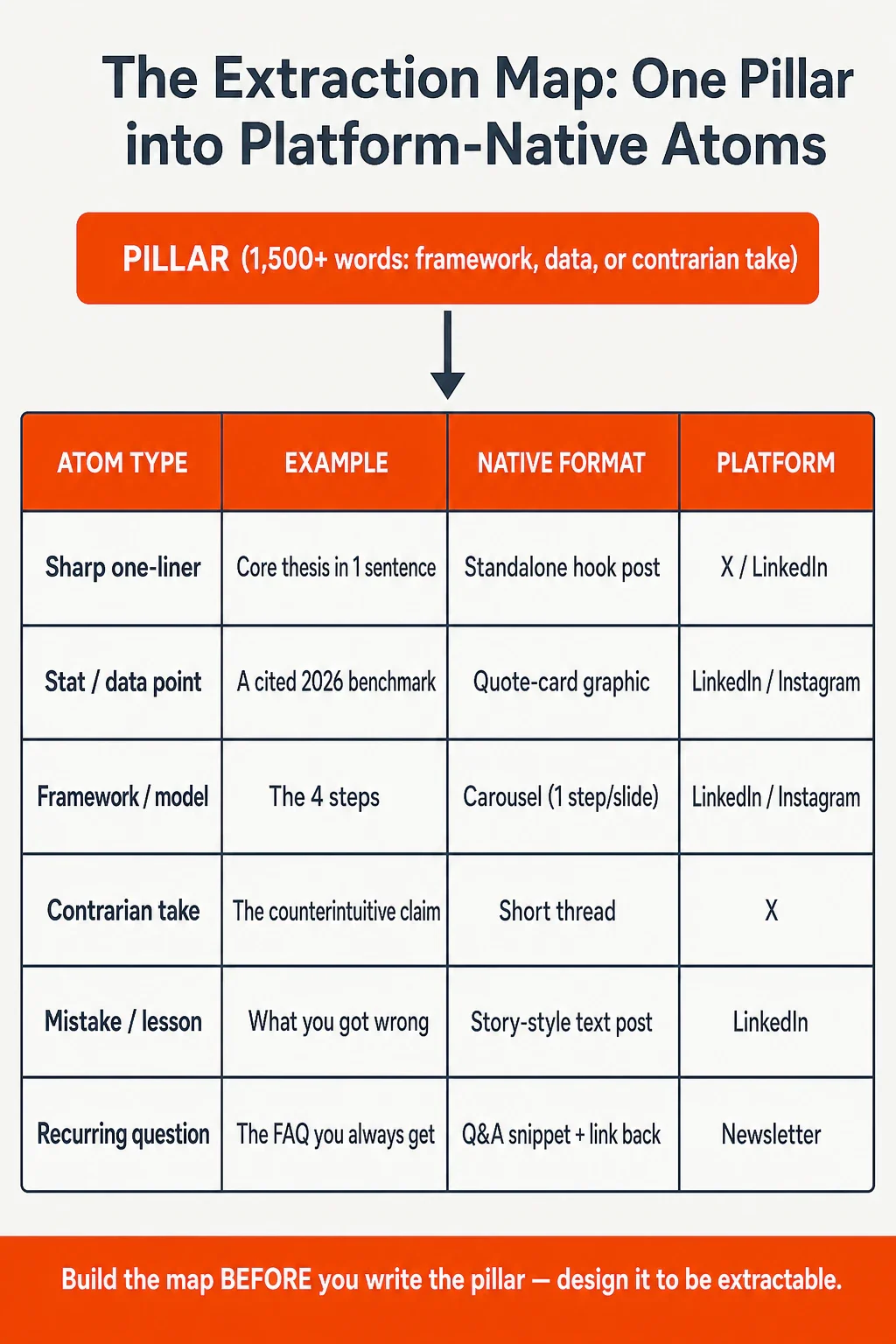
Here's the same template in plain text so you can paste it into a doc and reuse it for every pillar:
Atom type | Native format | Target platform | Publish slot |
|---|---|---|---|
Sharp one-liner / thesis | Standalone hook post | X / LinkedIn | Day 1 |
Stat / data point | Quote-card graphic | LinkedIn / Instagram | Day 3 |
Framework / model | Carousel (1 step per slide) | LinkedIn / Instagram | Day 5 |
Contrarian take | Short thread | X | Day 7 |
Mistake / lesson | Story-style text post | Day 9 | |
Recurring question | Q&A snippet + link back | Newsletter | Day 11 |
The discipline that makes this work: fill the first three columns of the map while you outline the pillar, not after you publish. When you know in advance that section two has to become a carousel and section four has to stand alone as a thread, you write those sections to be self-contained — and the atoms practically fall out.
Distribute without it becoming a second job
Having a stack of atoms is not the same as having a sane publishing rhythm. Two rules keep distribution from eating your week.
Sequence, don't dump
Don't fire all your atoms out on the same day. Spread them over roughly one to two weeks, posting no more than one piece per platform per day, and mix atom types so nothing feels repetitive. Atomization practitioners specifically recommend a sequenced release rather than a single simultaneous drop, because spacing extracts more value from each unit and keeps the underlying argument in front of people who missed the first pass (LexiConn). The publish-slot column in your extraction map is what turns a pile of drafts into a calendar.
On time: a realistic solo-founder rhythm is one deep pillar plus a handful of atomic posts derived from it, produced in a contained weekly block. Treat that as a range, not a quota — some weeks you'll get six atoms out of a pillar, some weeks three. The point is that the heavy creative lift happens once (the pillar), and the rest of the week is adaptation, which is far cheaper than ideation from scratch.
Keep every atom on-message
When one pillar fragments into a dozen posts across four platforms, the risk is drift — each atom slowly describing a slightly different product in slightly different words. The fix is a single source of truth for your positioning that every atom inherits, so the carousel, the thread, and the newsletter all describe the same product the same way. (Message consistency is a deep topic in its own right; if your posts keep saying subtly different things, that's worth fixing at the source rather than reach by reach.)
Finally, a caution on automation. AI drafting tools are genuine leverage for re-cutting one pillar into platform-native variants — but treat their output as a first draft you review and sharpen, not autopilot that ships in your name. The whole value of founder-led content is that it sounds like a founder who actually made the decisions. Don't outsource that judgment, and don't name your product the same way a generic caption machine would.
Make atomization a repeatable system (and where FounderHQ fits)
Pulled together, the loop is small and repeatable: pick a pillar worth atomizing → build the extraction map before you write → adapt each atom into its native format → sequence the atoms over one to two weeks → reuse the evergreen ones again later. Run it a few times and something quietly powerful happens — you accumulate a back catalog of pillars and proven atoms you can re-run, so your consistency stops depending on daily inspiration and starts depending on a system you already trust.
That's the real bootstrap payoff. Instead of grinding out a fresh idea every morning, you do the deep thinking once, then spend the week distributing it across the cheapest, most compounding channels you have. More distribution from the same hours, without the burnout of the blank page.
This is also the seam where a focused operating system earns its place. FounderHQ's writer helps compose founder-led content, and its workspace preserves company context and memory — so the pillars you write and the atoms you extract stay consistent over time and live in one place instead of scattered across a dozen tools. The framing matters: it's there to augment the founder's leverage and keep everything on-message, not to run your marketing for you. You still make the calls; the system just makes sure every output reflects them.
Start with one pillar this week. Build the extraction map first, harvest eight to fifteen atoms, and sequence them over the next two weeks. That single discipline — refine once, echo everywhere, on-message — is the closest thing bootstrap marketing has to a cheat code that doesn't cost a dollar.
Conclusion
Bootstrap marketing has never really been about cleverness with no money — it's about leverage with no money. And the highest-leverage move available to a time-poor founder isn't chasing more reach; it's getting far more distribution out of every hour of real creative work. Content atomization is how you do it: start from a substantive pillar, map its atoms before you write, re-cut each one into the format its platform rewards, and sequence them so one good argument echoes for two weeks instead of vanishing after one upload. Keep it all anchored to a single source of truth so every derivative stays on-message, lean on tools to draft and not to decide, and let the back catalog compound. Do that a few cycles in a row and the content treadmill turns into a flywheel — the same hours, far more reach, on the channels that actually compound.
Related articles

Application Onboarding Process: Definition, Steps, and When to Use It
A practical seven-step application onboarding process for moving new users from signup to first meaningful value without unnecessary setup or generic tours.
In-App Analytics for Onboarding: Definition, Metrics, and When to Use It
In-app analytics for onboarding turns events, funnels, segments, and user feedback into decisions about the path from signup to first value.

In-App Guidance for Onboarding: Definition, Examples, and When to Use It
In-app guidance helps users complete meaningful tasks inside a product. This guide explains the main patterns and how to match each one to an onboarding blocker.