
Most bootstrap marketing advice gives founders a longer list: post on LinkedIn, write SEO content, launch on communities, ask for referrals, try partnerships, record short videos, send cold emails, build in public. The problem is not that these tactics are wrong. The problem is that a tiny team cannot run all of them well at the same time. Bootstrap marketing works when you stop asking, “Which free channel should we try?” and start asking, “What constraint is blocking the next customer?”
What bootstrap marketing actually means
Bootstrap marketing is growth work that trades money for founder time, specificity, and consistency. Instead of buying reach through paid media, you earn attention through useful assets, direct conversations, clear positioning, proof, and repeated distribution.
That does not mean every free tactic deserves your time. A “free” channel still costs attention, context switching, follow-up, learning time, and emotional energy. For a solo founder or a 2–3 person product team, those costs are often more dangerous than a small software bill.
A better definition: bootstrap marketing is a resource-allocation system for constrained teams. It helps you decide which marketing work to do now, which work to delay, and which work to ignore until the business has earned the right to take it on.
SEO is a good example. Ahrefs explains that startup SEO can bring organic traffic without paying for every visit, but it still requires keyword research, useful content, optimization, promotion, and time to be crawled and indexed. In other words, SEO may be budget-light, but it is not effort-free. The same is true for founder-led content, partnerships, communities, and outbound.
The useful question is not “Is this tactic free?” It is “Does this tactic solve our current constraint better than everything else we could do this month?”
Why tactic lists fail bootstrapped founders
Tactic lists feel productive because they create motion. A founder can publish a few posts, send a few DMs, write half an SEO article, apply to a launch site, and join three communities in the same week. From the outside, that looks like marketing. From the inside, it often becomes scattered effort with no compounding asset behind it.
Marketing benchmarks can make this worse. Gartner’s 2025 CMO Spend Survey reported that marketing budgets remained at 7.7% of overall company revenue among surveyed CMOs and marketing leaders, with most respondents coming from companies above $1 billion in annual revenue. That is useful context for mature organizations, but it is not a practical operating model for a founder trying to preserve runway.
Mercury’s small-business marketing budget guidance makes the more important point for early teams: there is no universal marketing spend number. The right level depends on stage, goals, business model, and how clearly you understand what drives return.
For a bootstrapped team, the first budget is not dollars. It is founder focus. If you spend that focus on five channels before you understand the bottleneck, you do not get five experiments. You get five weak signals that are hard to interpret.
The fix is to separate channels from constraints. A channel is where the work happens: search, LinkedIn, email, communities, partnerships, product onboarding. A constraint is what is actually blocking growth: unclear message, missing proof, no audience access, weak activation, inconsistent execution, or poor measurement. Channels change by company. Constraints repeat.
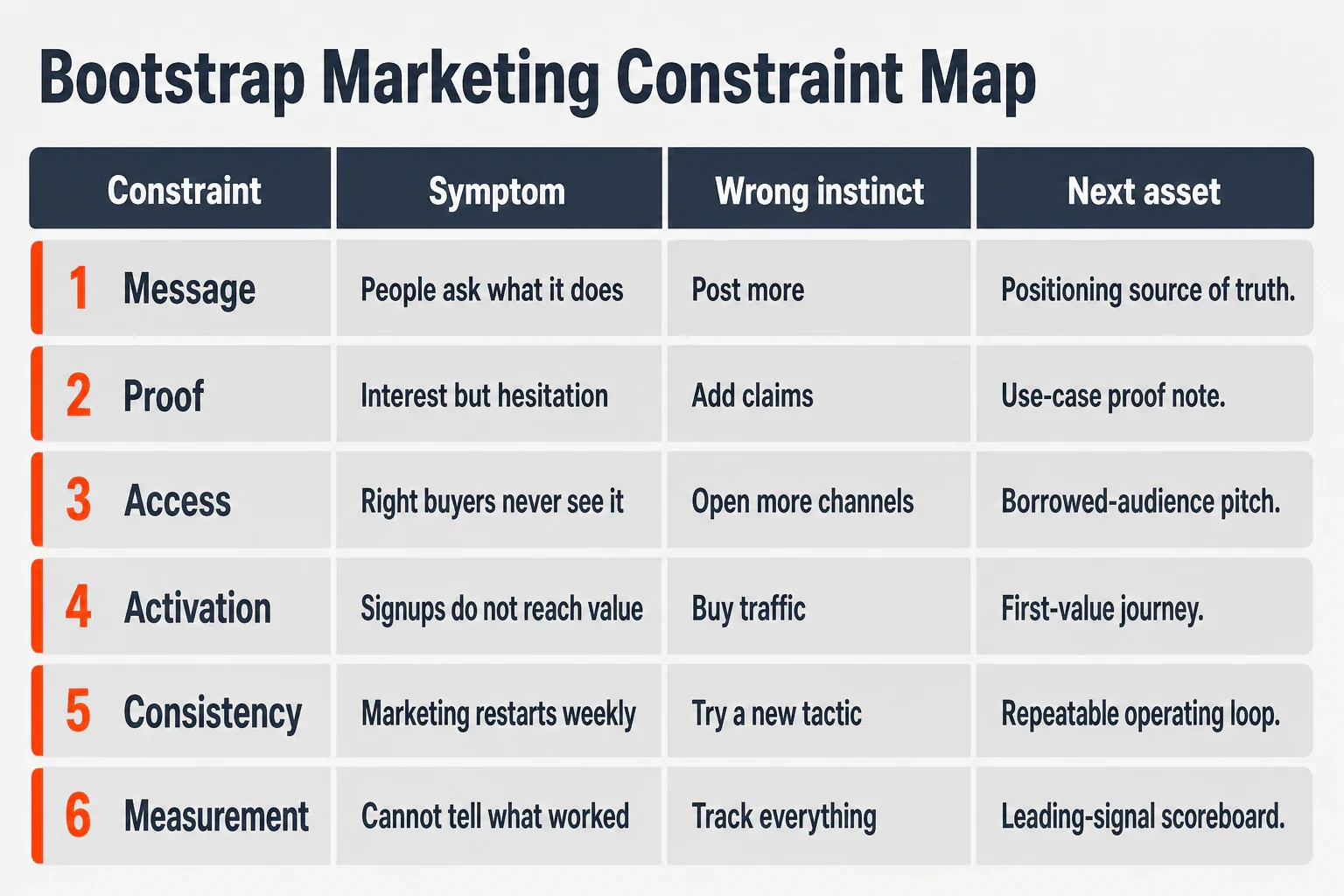
The bootstrap marketing constraint map
Use the constraint map below before choosing your next channel. The goal is not to diagnose everything perfectly. The goal is to prevent the common founder mistake: adding more distribution when the real bottleneck is somewhere else.
Constraint | Symptom | Wrong instinct | Right next move | Asset to create |
|---|---|---|---|---|
Message | People ask, “What does it do?” or misdescribe the product | Post more often | Sharpen the promise, audience, use case, and language | Positioning source of truth |
Proof | Prospects are interested but hesitant | Add bigger claims | Document real use cases, examples, conversations, and before/after context | Proof note or use-case page |
Access | The right buyers rarely see the product | Open more channels | Borrow trust through warm intros, communities, partners, or audience holders | Partner pitch or community post |
Activation | People arrive but do not reach first value | Pour in more traffic | Improve onboarding, product journeys, and handoffs to the first useful moment | First-value journey |
Consistency | Marketing restarts from scratch every week | Try a new tactic | Build a repeatable operating loop that is small enough to maintain | Weekly operating loop |
Measurement | You cannot tell what worked | Track everything | Pick one or two leading signals tied to the constraint | Leading-signal scoreboard |
The visual version of this map is worth keeping nearby while you plan a month of bootstrap marketing. It keeps the team focused on the bottleneck rather than the loudest tactic.
Message constraint
If prospects cannot explain why your product matters, more reach usually spreads confusion faster. This shows up in vague replies, low-quality inbound, sales calls that start from zero, or prospects comparing you to the wrong category.
The next move is to create one positioning source of truth: who it is for, what painful job it helps with, what changes after using it, and what words customers already use to describe the problem. This does not need to be a brand manifesto. It can be a one-page working document that tightens the next landing page, post, outreach message, and demo intro.
Proof constraint
If people understand the product but hesitate, proof may be the constraint. Early teams often respond by making stronger claims. That is risky and usually less persuasive than showing clearer evidence.
Instead, collect proof at the level you can honestly support: screenshots, anonymized customer language, founder decisions, workflow examples, before-and-after narratives, objections answered, or a concrete use case. Avoid invented metrics. A specific story beats an unsupported percentage.
Access constraint
If conversations convert when they happen but not enough of the right people see you, access is the constraint. The answer is not always “post more.” It may be to get closer to audiences that already gather around the problem.
That can mean a partner newsletter, a community thread, a small webinar, a founder introduction chain, a guest post, or a practical resource shared where the audience already pays attention. The asset is not a generic announcement. It is a useful pitch or contribution designed for that audience.
Activation constraint
If signups, trials, demo requests, or visits happen but users do not reach first value, acquisition is not the immediate fix. More traffic will only make the leak easier to see.
This is where product journeys matter. A guided first-value path, better onboarding sequence, clearer activation checklist, or tighter handoff from marketing promise to product experience can be more valuable than another campaign.
Consistency constraint
If marketing disappears every time product work gets intense, consistency is the constraint. This does not require a complex content calendar. It requires a small loop the founder can actually repeat.
The asset might be a weekly planning note, a capture doc for customer language, or a short distribution checklist. The key is to reduce the number of decisions required to show up again next week.
Measurement constraint
If every channel feels equally “maybe useful,” measurement is the constraint. This does not mean building a full analytics stack. At the bootstrap stage, over-instrumentation can become another form of avoidance.
Pick one or two leading signals tied to the constraint: qualified replies for message, objections resolved for proof, warm introductions for access, first-value completion for activation, shipped assets for consistency, or source-tagged conversations for measurement. The signal should help you decide what to do next.
How to choose the one constraint to solve this month
Once you have the map, score each constraint from 1 to 3 across three questions:
- Severity: How much is this blocking the next customer?
- Confidence: How sure are we that this is the real bottleneck?
- Ease of action: Can we make meaningful progress in 30 days with the team we have?
Add the scores. The highest total is your working constraint for the month. Do not overcomplicate this. You are not making a permanent strategic bet; you are choosing the next bottleneck to reduce.
A few examples make the choice clearer:
- If discovery calls go well and prospects understand the value, but you are not having enough of those calls, choose access.
- If posts get engagement but few qualified people ask about the product, choose message or proof.
- If signups happen but users disappear before the first meaningful action, choose activation.
- If every Monday starts with “What should we post this week?” choose consistency.
- If the team debates channels but cannot point to any signal from the last month, choose measurement.
For a tiny team, the operating rule should be simple: one owner, one constraint, one month, one primary asset. If the constraint is access, do not simultaneously rebuild the website, start a newsletter, launch SEO, and redesign onboarding. Build the access asset, distribute it, and learn from the response.
A practical 30-day bootstrap marketing plan
This plan is intentionally narrow. It is not a standing weekly cadence or a first-100-users sprint. It is a 30-day constraint cycle for deciding what deserves focus and what should be ignored for now.
Week 1: Diagnose and collect context
Pick the constraint using the 1–3 scoring method. Then collect the raw material that will make the month useful: customer phrases, sales-call notes, product usage observations, support questions, objections, community threads, search queries, or founder decisions.
End the week by choosing one asset. Examples include a problem explainer, use-case page, proof-backed post series, partner pitch, onboarding journey, comparison page, or leading-signal scoreboard. If you cannot name the asset, the constraint is still too vague.
Week 2: Build the asset
Create the asset in its most useful form, not its most polished form. A positioning source of truth can be a structured document. A proof asset can start as a concise use-case page. An activation asset can be a guided first-value journey. A measurement asset can be a simple scoreboard.
The point is to build something reusable. Bootstrap marketing compounds when the work improves future work. A one-off post can help, but a post derived from a clearer message, proof note, or onboarding journey helps more than once.
Week 3: Distribute without channel sprawl
Choose one primary channel and one reuse path. That might mean publishing a founder-led post and sending it to five warm prospects. Or sharing a use-case page in a relevant community and turning the replies into follow-up outreach. Or launching an onboarding improvement and emailing recent signups with a clear first-value prompt.
Ahrefs’ startup content guidance notes that content does not simply go viral on its own; it needs a way to kickstart promotion. For founders, that usually means direct distribution: replies, DMs, warm intros, communities, newsletters, or partner channels where the context is already warm.
Week 4: Review, adapt, or kill
At the end of the month, do not ask, “Did marketing work?” Ask, “Did this constraint become less severe?”
Use one of three decisions:
- Continue: The signal improved and the constraint still matters.
- Adapt: The constraint is right, but the asset or channel needs adjustment.
- Switch: The month revealed a different bottleneck.
A useful kill criterion protects founder time. If a channel produces activity but no better signal tied to the constraint, pause it. That does not mean the channel is bad forever. It means it is not the highest-leverage work right now.
What to ignore when you are bootstrapping marketing
Bootstrap marketing becomes easier when “not yet” becomes an acceptable answer. Many tactics are useful later but expensive too early.
Ignore broad top-of-funnel content if your message is unclear. It is hard to educate a market when you are still changing the basic explanation every week.
Ignore paid ads if activation is weak. Paid traffic can speed up learning, but if users do not reach first value, the first job is to fix the handoff.
Ignore generic social posting if you do not know which audience you are trying to reach. Consistency without audience fit creates motion, not momentum.
Ignore competitor channel copying unless you understand their stage, brand awareness, budget, and proof base. A channel that works for a mature company may fail for an early team because the underlying constraint is different.
Ignore complex dashboards if the team has not agreed on the decision the data should support. At the bootstrap stage, a small scoreboard that changes behavior is better than a large dashboard everyone forgets to open.
Most importantly, ignore the pressure to look like a “real marketing function” before you have a real marketing constraint. A founder-led system can be small and still be serious.
Where FounderHQ fits into the workflow
For early-stage product teams, the hardest part of bootstrap marketing is not always creating the next asset. It is preserving the context that makes the next asset sharper.
FounderHQ helps early-stage product teams build product journeys, compose founder-led content, and keep company context in one focused operating system. That matters because the constraints in this guide are connected. Message work shapes founder-led content. Proof work improves product narratives. Activation work often becomes a product journey. Measurement work feeds back into what the team should build or say next.
The practical value is consolidation. Instead of keeping positioning notes in one doc, onboarding ideas in another tool, founder posts in a separate draft folder, and decisions scattered across chat, a focused operating system can help the team work from shared context.
That does not replace founder judgment. Bootstrap marketing still requires choosing the constraint, talking to customers, making trade-offs, and deciding what not to do. The leverage comes from turning those decisions into reusable memory so the team is not starting from a blank page every week.
Bootstrap marketing checklist
Use this checklist before starting the next month of marketing work:
- Define the current constraint: message, proof, access, activation, consistency, or measurement.
- Pick one audience segment for the month.
- Choose one reusable asset that directly reduces the constraint.
- Choose one primary distribution channel and one secondary reuse path.
- Set one or two leading signals before publishing.
- Review after 30 days and decide: continue, adapt, or switch.
- Preserve the learning so the next asset starts from stronger context.
Bootstrap marketing compounds when the founder preserves the learning. If every week restarts from scratch, even good tactics lose their leverage. If each cycle leaves behind a sharper message, clearer proof, better journey, warmer access path, or cleaner signal, the system gets stronger without needing a large budget.
Conclusion
The best bootstrap marketing strategy is rarely the longest tactic list. It is the clearest constraint choice. Diagnose what is blocking the next customer, build one asset that reduces that bottleneck, distribute it through a channel you can actually maintain, and review the signal before adding more. When money is limited, focus is the budget. Spend it like it matters.