Most early-stage products don't fail because the product is weak. They fail because almost nobody warm ever hears about it. When you have no ad budget, the instinct is to produce more — more posts, more blog articles, more cold outreach — and grind a tiny owned audience up from zero. That's necessary, but slow. The faster, higher-leverage move is usually different: borrow audiences other people have already spent years earning the trust of. This guide is about that access layer of bootstrap marketing — reaching warm, trusting audiences you don't own yet through co-marketing partnerships, newsletter swaps, lightweight integrations, genuine community participation, and referrals. We'll lead with the real bottleneck, walk through the four plays a solo founder can run, show how to pick partners and craft an exchange they can't easily refuse, and end with a 30-day starter loop — all grounded in current 2026 benchmarks, with the honest caveats those numbers deserve.
The real bottleneck isn't budget — it's access
Talk to enough early-stage founders and a pattern emerges: the product is fine, even good, but distribution is thin. The constraint isn't a missing feature or a missing dollar — it's that the people who'd happily pay have no warm reason to discover you. That's an access problem, and it's the one no-budget marketing advice tends to skip past, because it usually defaults to "make more of your own content."
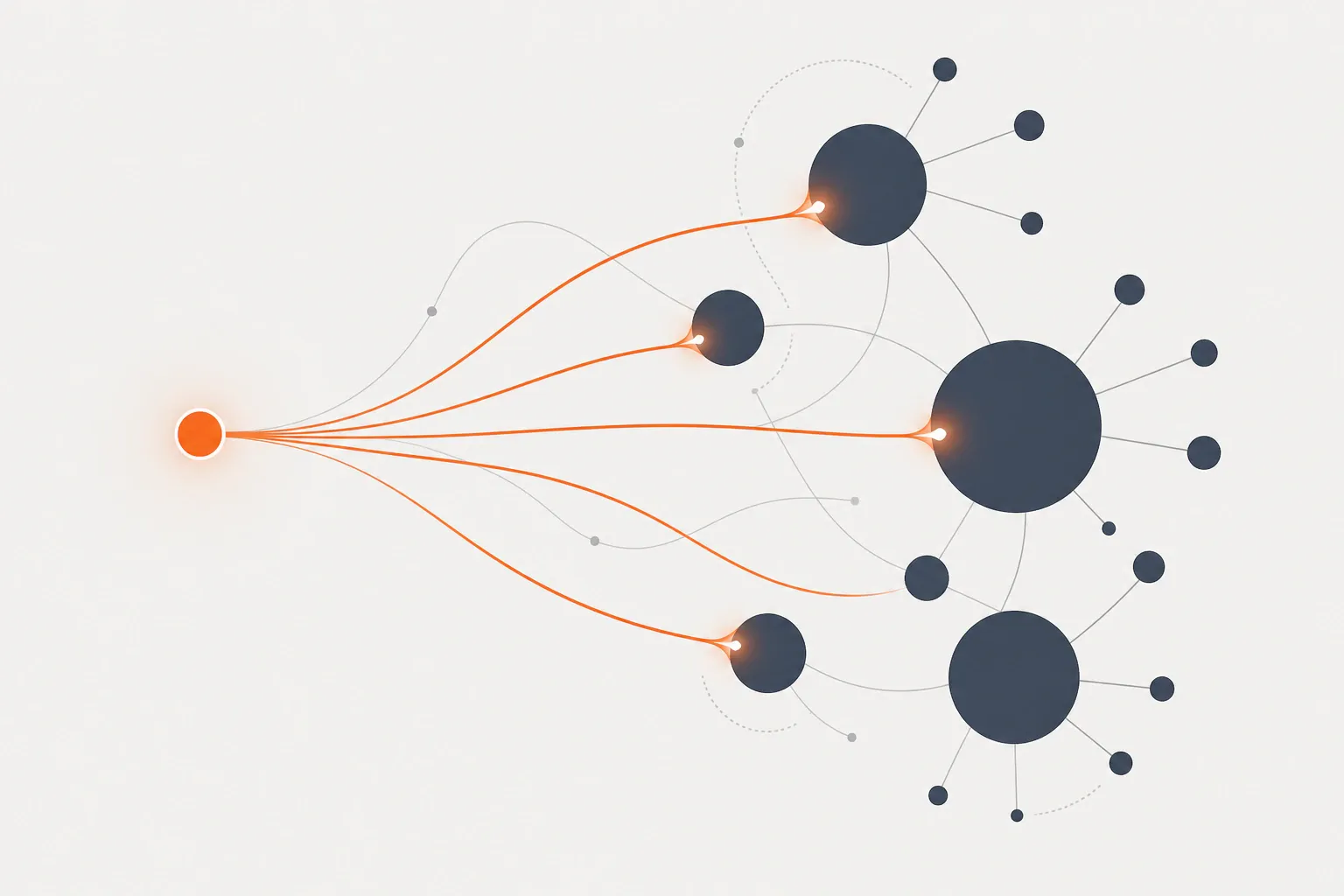
Borrowed-audience marketing is the alternative. Instead of paying for cold reach or only building your own audience from scratch, you get in front of warm audiences someone else already owns and trusts — a complementary product's email list, a creator's newsletter, a niche community, or a happy customer's network. You're not buying attention; you're borrowing earned trust and routing some of it toward your product.
The reason this slice matters more in 2026 is simple math: paid acquisition keeps getting more expensive. Across 2026 SaaS benchmark roundups, blended B2B SaaS customer acquisition cost (CAC) is frequently cited around the $1,200 mark, with paid search and paid social commonly landing in the high hundreds to over a thousand dollars per customer (see, for example, Attrifast's 2026 CAC-by-channel guide, knowledgelib.io's 2026 marketing-metrics benchmarks, and growth-onomics' 2026 multi-channel CAC roundup). Treat these as directional vendor-reported ranges, not guarantees — but the direction is consistent: cold, paid reach is a bad fit for an empty bank account.
One scope note before we go further. This article is deliberately about the access layer — borrowing warm reach. It is not the place where we re-argue organic-vs-paid economics, channel sequencing, your owned-content flywheel, or your weekly operating cadence. Those are their own conversations. Here, the single question is: how do you reach audiences you don't own, without paying for ads?
Why borrowed warm reach beats more of your own cold reach (the 2026 math)
The case for borrowing is partly about cost and partly about speed. On cost, the channel that consistently shows the lowest reported CAC in 2026 benchmarks is referral and word-of-mouth. Multiple roundups put B2B SaaS referral CAC in roughly the $50–$300 range — Attrifast lists referral/word-of-mouth at about $50–$200 with a 1–3 month payback, while knowledgelib.io and growth-onomics both peg referral CAC around $150, the most efficient channel in their tables. Warm introductions convert because the trust is already there; you're inheriting it rather than manufacturing it.
On speed, contrast the timelines honestly. Organic search and content are durable and high-ROI over the long run, but slow: 2026 benchmark sets describe organic SEO CAC roughly in the $200–$940 range with payback measured in many months, and reach that compounds over 6–12+ months. Borrowed audiences are the opposite shape — a newsletter swap or a joint webinar can put you in front of hundreds or thousands of warm readers in weeks, while your owned channels quietly build underneath. You're not choosing one or the other; you're using borrowed reach to buy time while your slow assets compound.
Run it founder-to-founder
There's a structural reason these plays work best when a human runs them rather than a brand account. In 2026, personal profiles dramatically out-distribute company pages: a widely cited Refine Labs study found personal LinkedIn profiles drove about 2.75x more impressions and 5x more engagement than the company page posting identical content — despite the individuals having 46% fewer followers. Newer 2026 analyses describe an even wider gap as company-page organic reach has fallen further. People engage with people, not logos.
That asymmetry is exactly why partnership outreach should be founder-to-founder and creator-to-creator. A real person reaching out, with a real face and a real track record, transfers trust in a way a generic "partnerships@" inbox never will — and it's also more likely to actually get a reply.
'Free' isn't free
The honest caveat: borrowed reach is low-cash, not zero-cost. Every credible 2026 source on channel CAC makes the same point — you have to count your own time as a real input. Attrifast is explicit that the correct CAC formula includes your time, and that founders who ignore it badly understate what a channel really costs. Pitching partners, co-creating an asset, and showing up in a community all consume hours you can't get back.
So the right way to frame the win is time-ROI, not literal zero spend. Borrowed-audience plays win because a few hours of focused outreach can reach a warm audience that would cost hundreds or thousands of dollars to reach cold — not because they're free. Budget your hours as deliberately as you'd budget cash.
The four borrowed-audience plays for a team of one
You don't need a partnerships team to do this — you need a short menu of plays and the discipline to run one at a time. The four below are the ones a solo founder or 2–3 person team can realistically execute on no budget. The infographic below summarizes them and roughly how much effort each takes.
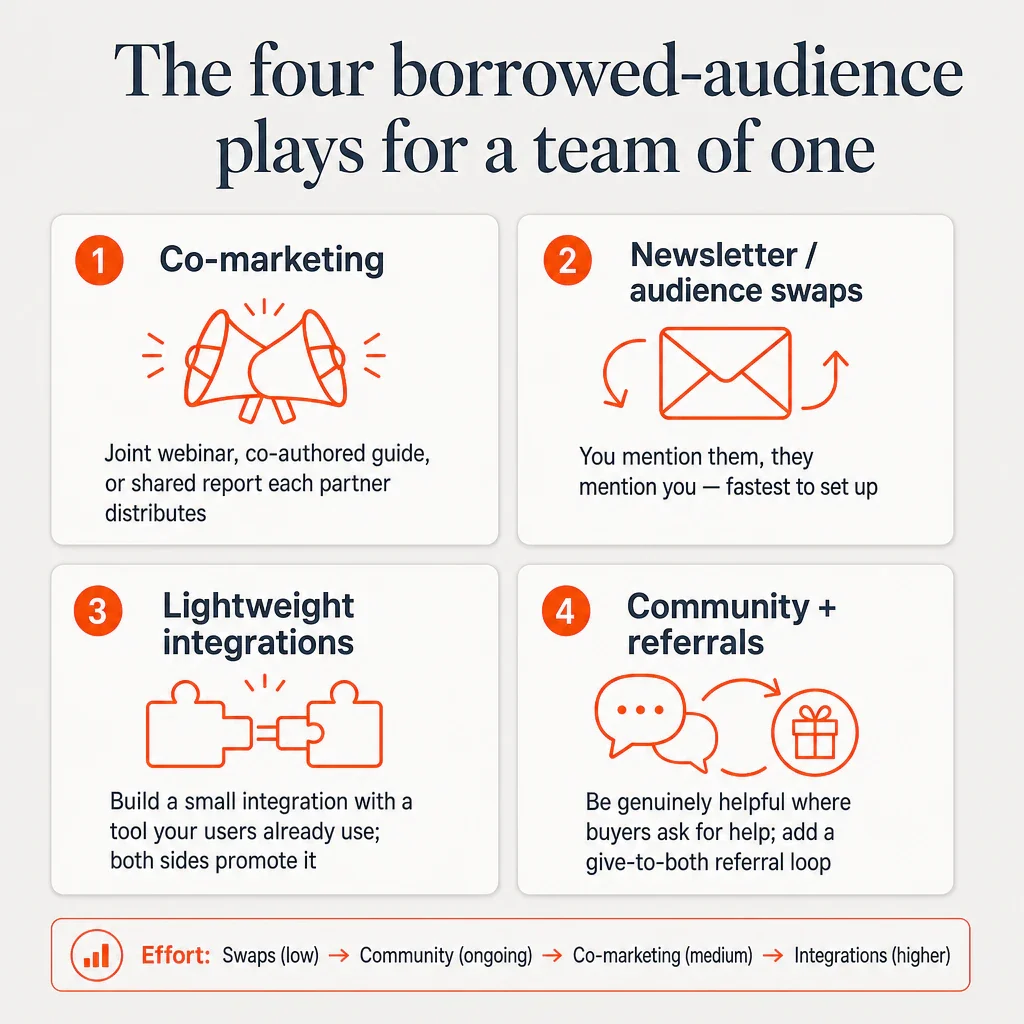
1. Co-marketing with non-competing, same-audience products. Find a product that serves your buyer but doesn't compete with you, then make one thing together that each partner distributes to their own list: a joint webinar, a co-authored guide, or a small shared report. 2026 co-marketing playbooks from knowledgelib.io and blog.mean.ceo describe this as the core move — the value exchange is straightforward: both sides borrow each other's audience for the price of co-creating one asset.
2. Newsletter / audience swaps. The lowest-effort entry point. You mention them to your audience, they mention you to theirs — a guest section, a recommended-tool blurb, or a simple cross-feature. It's fast to set up, easy to test, and reversible if it flops. The trade-off is honest: if your list is tiny, you have less to offer, which is why swaps are where many teams start and graduate from.
3. Lightweight integration partnerships. Build a small, genuinely useful integration with a tool your users already rely on, and you create a natural reason for both sides to promote it — a launch post, a workflow template, a help-doc mention. 2026 co-marketing writing repeatedly notes that integration ecosystems create some of the most durable co-marketing opportunities precisely because the products share customers without competing. The cost here is engineering time, so reserve it for an integration your users are actually asking for.
4. Community participation + referral mechanics. Show up where your buyer already asks for help — niche subreddits, Indie Hackers, topical Slack and Discord groups — and be genuinely useful. The critical rule: self-promotion is aggressively policed in these spaces, so this is helpfulness-first, not link-dropping. Earn the right to be discovered by answering real questions; let people click your profile, not your pitch. Pair that with a simple two-sided referral ask to existing users (a small give-to-both reward), and you turn your happiest customers into the warmest channel you have — the same word-of-mouth engine the 2026 CAC data rates most efficient.
Choosing partners and crafting an exchange they can't easily refuse
Most failed partnership outreach fails at selection, not execution. A useful partner-fit test from 2026 co-marketing playbooks comes down to four checks: same (or adjacent) audience, non-competing offer, comparable or slightly larger reach, and a complementary problem solved. blog.mean.ceo frames a longer scorecard around audience match, trust transfer, real distribution strength (not vanity numbers), and execution reliability — but for a team of one, those four checks will screen out most mismatches fast.
Accept that you may have nothing to trade yet
Several 2026 sources are blunt about a hard truth: don't pitch formal co-marketing before you can actually offer value. knowledgelib.io's playbook states it almost as a rule — don't propose partnerships before you have a small active audience, because no audience means no value to offer. If you're pre-traction, that's fine; it just means you start informal. Guest posts, content swaps, a genuine mention, helping in a community — these build the credibility and the small audience that later make structured plays worth a partner's time.
A simple stage path falls out of this. Below roughly 1,000 users, lean on informal plays: content swaps, guest contributions, newsletter mentions. As you grow into the low thousands and beyond, you've got enough to bring to structured co-marketing — joint webinars, co-authored content, shared reports. The numbers in any playbook are directional; adapt the path to your own reach rather than copying a partner's audience size.
Make the offer specific and mutual
The single biggest upgrade to your outreach is specificity. A vague "let's collaborate sometime" gives a busy founder nothing to say yes to. knowledgelib.io's rule is that proposals must include specific, measurable value for both parties — so propose the actual shape: "I'll feature your tool to my ~X subscribers in next month's issue if you include ours in yours," or "Let's co-author one guide, each promote it once, and split the signups we can attribute."
De-risk it for them, too. A pattern that recurs across 2026 partnership writing is the small, time-boxed pilot: propose one campaign, track attribution, and agree up front that if it doesn't work, you both walk away as friends. That lowers the perceived commitment, bypasses the urge to over-formalize, and makes "yes" the easy answer.
Running it without it becoming a second job — and keeping it on-message
The fastest way to burn out on partnerships is to spin up a "program" before you've proven a single play. Keep it lightweight: run one or two partnership experiments at a time, and track partner-sourced signups separately from everything else so you actually know what worked. knowledgelib.io's guidance lines up here — start with 1–2 experiments before any formal program, and track partner-sourced leads separately from day one. Without that separate tracking, you'll keep doing partnerships on vibes.
There's a subtler tax, too: message drift. Every co-created asset, swap blurb, and outreach note is a chance for your story to come out slightly different — a different one-liner here, a different positioning there — until your product means something a little different on every partner's surface. Spread across enough collaborations, that inconsistency quietly erodes the trust the whole strategy depends on. Keeping one consistent story is its own discipline, and it gets harder, not easier, the more partners you add.
This is where a shared company context earns its place. FounderHQ is built around exactly this kind of work: its writer (founder-led content) drafting against a workspace that holds your persistent company context, so your partnership pitches, swap copy, and co-created posts all come from one source of truth and stay on-message. The point isn't to automate outreach for you — borrowed-audience marketing only works founder-to-founder — it's to make every human pitch you send consistent, reusable, and faster to produce. Think augmentation, not autopilot.
Finally, the short list of what to avoid: spray-and-pray DMs that ignore partner fit; pitching before you can offer real value; and over-formalizing too early with contracts and programs you don't yet need. Do the opposite — targeted, specific, small — and partnerships stay a high-leverage channel instead of a second full-time job.
A 30-day borrowed-audience starter loop
If you want to actually start this week, here's a four-week loop that fits around building. It's deliberately small — one or two experiments, not a program.
Week 1 — Map. List 10 non-competing, same-audience products, creators, and communities your buyer already trusts. From that list, pick 3 partner targets to approach and 1 community to genuinely show up in. Run each candidate through the four-check fit test before it makes your shortlist.
Week 2 — Pitch and show up. Send one swap or co-marketing pitch with a specific, mutual offer (name the asset, the audiences, and how you'll both promote it). In parallel, start participating in your chosen community — answer questions, be useful, and don't pitch. You're building the right to be discovered.
Week 3 — Ship and ask. Run your first swap or joint asset, even a small one. At the same time, set up a simple two-sided referral ask for your existing users — a give-to-both incentive that makes sharing easy and worth it.
Week 4 — Review and bank it. Compare partner-sourced signups against the hours you actually spent. Keep what worked, drop what didn't, and document every partner contact, the offer you used, and the messaging that landed in your context store so the next round starts from your own playbook instead of a blank page. That documentation is what turns a one-off month into a repeatable channel.
Conclusion
Bootstrap marketing isn't really a money problem — it's an access problem. When you can't pay for cold reach, the highest-leverage move is to borrow the warm, trusting audiences other people have already built: through co-marketing, newsletter swaps, lightweight integrations, helpful community participation, and referrals. The 2026 data backs the instinct — referral and word-of-mouth show the lowest reported CAC and fastest convert times, and founder-to-founder reach beats brand pages by a wide margin — as long as you stay honest that your time is the real cost. Start informal and specific, run one or two experiments, track what's partner-sourced, and keep your story consistent across every collaboration so all that borrowed trust compounds instead of fracturing. Do that, and a team of one can reach audiences that would cost a funded competitor a fortune.